Harper Lewis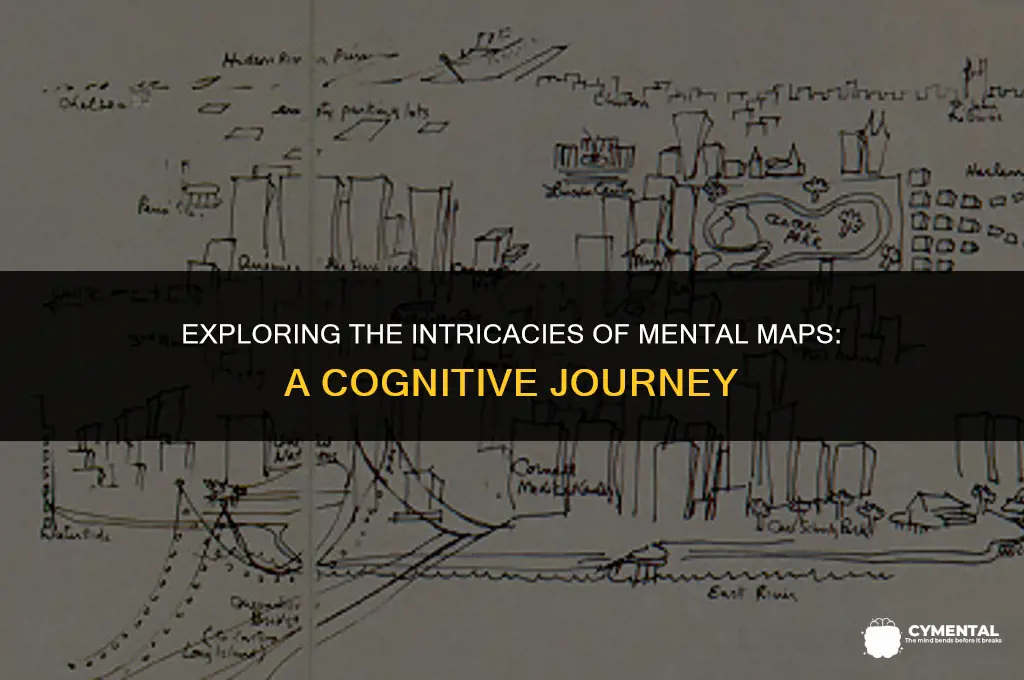
Mental maps are cognitive representations of an individual's knowledge about the spatial layout of their environment. They are internal, subjective depictions that help people navigate and understand the world around them. These maps are not just simple sketches but complex networks of interconnected nodes and pathways that represent various locations, landmarks, and routes. Mental maps are dynamic and constantly evolving as people gain new experiences and information about their surroundings. They play a crucial role in spatial reasoning, problem-solving, and decision-making, allowing individuals to mentally simulate routes, estimate distances, and recall memories associated with specific places.
Explore related products





What You'll Learn
- Definition and Concept: Mental maps are cognitive representations of spatial relationships and environments
- History and Development: The concept was popularized by psychologist Edward Tolman in the 1940s
- Components and Structure: Mental maps include spatial layouts, landmarks, routes, and semantic information
- Functions and Uses: They aid in navigation, spatial reasoning, and memory recall
- Applications and Research: Mental maps are studied in cognitive psychology, neuroscience, and used in fields like urban planning and education

Definition and Concept: Mental maps are cognitive representations of spatial relationships and environments
Mental maps are intricate cognitive frameworks that individuals construct to navigate and understand their spatial surroundings. These maps are not mere visual representations but encompass a wide array of sensory information, including auditory, tactile, and even olfactory cues. They are dynamic and constantly evolving, adapting to new experiences and information.
The concept of mental maps is deeply rooted in the field of cognitive psychology and has been extensively studied by researchers such as Edward Tolman and Lynn Nadel. Tolman's work in the 1940s laid the foundation for understanding mental maps as cognitive representations of space, while Nadel's later research expanded on this idea, exploring the neural mechanisms underlying these maps.
Mental maps serve multiple functions beyond simple navigation. They play a crucial role in spatial reasoning, allowing individuals to make sense of their environment and predict potential outcomes. For example, when planning a route, a person's mental map helps them anticipate turns, obstacles, and landmarks, enabling them to choose the most efficient path.
Moreover, mental maps are not limited to physical spaces; they can also represent abstract concepts and relationships. This is evident in fields such as mathematics and physics, where mental maps help scientists visualize complex equations and theoretical constructs. In everyday life, mental maps aid in organizing thoughts, planning tasks, and even in social interactions, as individuals mentally map out social hierarchies and relationships.
The construction of mental maps is a highly individualized process, influenced by factors such as personal experiences, cultural background, and cognitive abilities. For instance, a person who has lived in a particular city for many years will likely have a more detailed and nuanced mental map of that city compared to a newcomer. Similarly, individuals with exceptional spatial abilities, such as those with savant syndrome, may possess more elaborate and accurate mental maps.
In conclusion, mental maps are sophisticated cognitive tools that enable individuals to navigate, understand, and interact with their environment. They are multifaceted, incorporating various sensory inputs and serving a wide range of functions beyond mere spatial orientation. By studying mental maps, researchers gain insights into the complex processes of human cognition and the ways in which individuals make sense of their world.
Exploring the Origins of Mental Age: A Historical Perspective
You may want to see also
Explore related products
![MindManager Professional | 1 Year Subscription | Powerful Visualization Tools and Mind Mapping Software [PC/Mac Download]](https://m.media-amazon.com/images/I/61mMvv8hYVL._AC_UY218_.jpg)


History and Development: The concept was popularized by psychologist Edward Tolman in the 1940s
Edward Tolman, a pioneering psychologist, introduced the concept of mental maps in the 1940s, revolutionizing our understanding of spatial cognition and navigation. Tolman's work built upon earlier theories of spatial awareness but was the first to comprehensively articulate the idea that humans and animals create cognitive representations of their environment to navigate and remember locations.
Tolman's initial studies involved observing the behavior of rats in mazes, where he noted that the animals seemed to possess an internal map of their surroundings. This led him to propose that mental maps are a fundamental aspect of spatial learning and memory. Over time, his research expanded to include human subjects, using innovative techniques such as verbal reports and reaction time measurements to probe the mental mapping process.
The development of Tolman's theory was not without its challenges. Early critics argued that mental maps were too abstract and lacked empirical evidence. However, Tolman's persistence and continued research eventually led to widespread acceptance of his ideas. His work laid the foundation for future studies in cognitive psychology, neuroscience, and even artificial intelligence, influencing how we understand and replicate spatial intelligence in machines.
Today, Tolman's concept of mental maps is a cornerstone in the field of spatial cognition. It has been expanded and refined through decades of research, incorporating new technologies such as brain imaging and virtual reality. These advancements have provided deeper insights into how mental maps are formed, stored, and utilized in the brain, further solidifying Tolman's legacy in the history of psychology.
Understanding Mental Status Exams for Disability Benefits
You may want to see also
Explore related products


![MindManager Essentials | 1 Year Personal Subscription | Visualization Tools and Mind Mapping Software [Web Access]](https://m.media-amazon.com/images/I/611IimKI4XL._AC_UY218_.jpg)

Components and Structure: Mental maps include spatial layouts, landmarks, routes, and semantic information
Mental maps are complex cognitive representations that encompass various components and structures to facilitate spatial understanding and navigation. At their core, mental maps include spatial layouts, which are the fundamental frameworks that organize our perception of physical spaces. These layouts are not merely static representations but are dynamic and can be updated as we receive new information about our environment.
Landmarks play a crucial role in mental maps, serving as reference points that help us orient ourselves within a space. They can be physical structures, such as buildings or trees, or even abstract concepts, like the position of the sun or the sound of a particular bird. By identifying and remembering landmarks, we can more easily navigate through unfamiliar territories and recall specific locations.
Routes are another essential component of mental maps, representing the paths we take as we move through space. These routes are not just physical trajectories but also include the actions and decisions we make along the way. For example, when giving directions, we often describe the route in terms of the turns we need to take, the distance we need to travel, and the landmarks we will pass. By encoding these routes in our mental maps, we can efficiently plan our movements and adapt to changes in our environment.
Semantic information is also integrated into mental maps, providing meaning and context to the spatial layouts, landmarks, and routes. This information includes the names of places, the functions of buildings, and the cultural or historical significance of particular locations. By incorporating semantic information, mental maps become more than just spatial representations; they become rich, multifaceted models that help us make sense of our surroundings.
In conclusion, mental maps are intricate constructs that combine spatial layouts, landmarks, routes, and semantic information to support our ability to navigate and understand the world around us. By examining these components and structures, we can gain a deeper appreciation for the complexity and utility of mental maps in our daily lives.
Unveiling Mental Abuse: A Guide for Divorce Proceedings
You may want to see also
Explore related products


Functions and Uses: They aid in navigation, spatial reasoning, and memory recall
Mental maps serve as cognitive tools that enhance our ability to navigate through physical spaces. They are internal representations of external environments, allowing us to orient ourselves and find our way without relying solely on visual cues. For instance, when you walk through a familiar neighborhood, your mental map helps you recognize landmarks, anticipate turns, and estimate distances, making navigation more efficient and intuitive.
Beyond navigation, mental maps play a crucial role in spatial reasoning. They enable us to understand and manipulate spatial information mentally. For example, when you're planning a new route or trying to fit furniture into a room, your mental map helps you visualize the space and make informed decisions. This spatial reasoning is essential in various fields, from architecture and urban planning to video game design and robotics.
Mental maps also aid in memory recall, particularly for episodic memories that are tied to specific locations. When you revisit a place where a significant event occurred, your mental map can trigger memories associated with that location. This phenomenon is known as the "place effect" and is a key aspect of how our brains organize and retrieve memories. By leveraging mental maps, we can improve our ability to remember past experiences and use them to inform future decisions.
In summary, mental maps are versatile cognitive tools that enhance navigation, spatial reasoning, and memory recall. By understanding and utilizing these mental representations, we can improve our ability to interact with and remember the world around us.
Exploring the Cognitive Demands of Complex Mental Processing
You may want to see also
Explore related products




Applications and Research: Mental maps are studied in cognitive psychology, neuroscience, and used in fields like urban planning and education
Cognitive psychology and neuroscience have extensively studied mental maps to understand how individuals navigate and represent spatial information in their minds. Researchers have identified specific brain regions, such as the hippocampus and entorhinal cortex, that play crucial roles in the formation and retrieval of mental maps. These studies have not only advanced our understanding of spatial cognition but have also led to the development of new diagnostic tools and therapies for individuals with spatial memory impairments.
In urban planning, mental maps are used to design more intuitive and user-friendly cities. Planners consider how residents and visitors mentally represent the urban environment, taking into account factors such as landmark visibility, street layout, and signage. By incorporating these insights, urban planners can create spaces that are easier to navigate, reducing confusion and improving overall quality of life.
Educators have also recognized the importance of mental maps in learning and teaching. Mental maps can be used to help students understand complex concepts, such as historical events or scientific processes, by visually organizing information in a spatial format. This approach can enhance memory retention and facilitate deeper understanding of the material.
Moreover, mental maps have practical applications in everyday life. For example, they can be used to improve personal organization, such as planning routes for errands or vacations. Mental maps can also be employed in professional settings, such as in architecture, interior design, and video game development, where spatial reasoning and visualization are essential skills.
In conclusion, the study and application of mental maps have far-reaching implications across various fields. By understanding how individuals create and use mental maps, researchers and practitioners can develop innovative solutions to improve navigation, learning, and overall well-being.
Unveiling the Mystery: What Does 5 of 50 Million Mean?
You may want to see also
Frequently asked questions
Mental maps are cognitive representations of an individual's knowledge about the spatial layout of their environment. They help people navigate and understand the relationships between different locations and landmarks.
Mental maps are created and stored in the mind, based on personal experiences and memories. They are subjective and can vary greatly from person to person. Physical maps, on the other hand, are tangible representations of geographical areas, typically created using standardized symbols and measurements.
Mental maps are used for navigation, planning routes, and understanding the spatial relationships between different locations. They can also be used to recall memories associated with specific places and to make decisions about where to go or what to do in a given situation.
Yes, mental maps can be inaccurate or misleading due to factors such as memory distortions, incomplete information, or personal biases. They are also subject to change over time as new experiences and information are acquired.
Mental maps can be improved or updated by actively exploring and experiencing new environments, seeking out additional information about unfamiliar areas, and practicing navigation skills. Additionally, using physical maps or GPS devices can help to correct inaccuracies and fill in gaps in one's mental map.