Ava Ramirez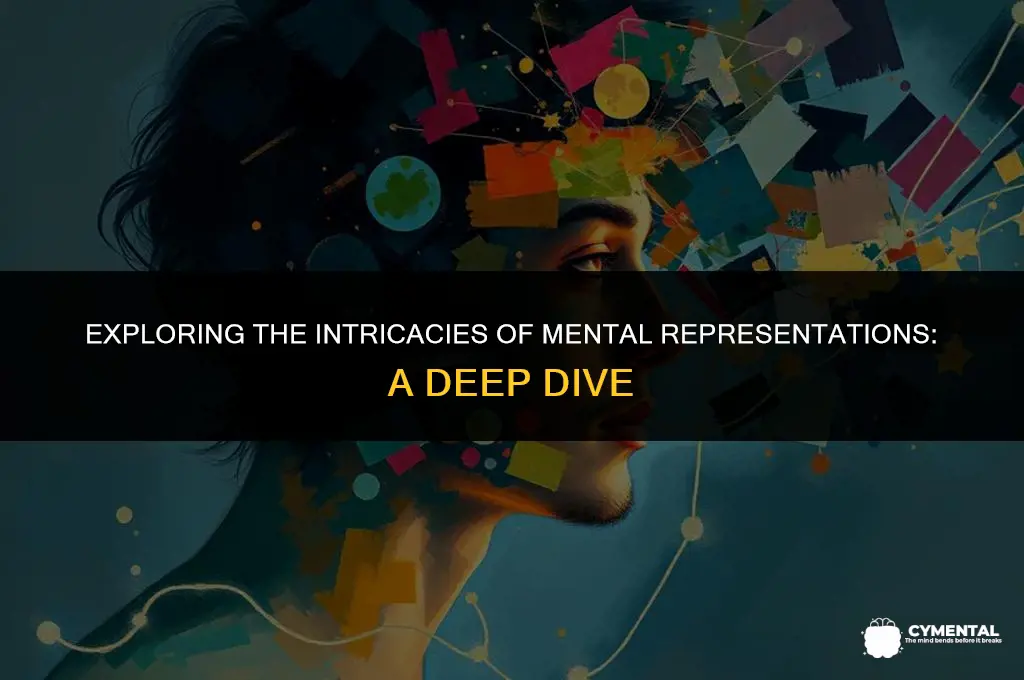
Mental representations are the internal representations of the world that we use to think, reason, and make decisions. They are the building blocks of our cognitive processes, allowing us to perceive, understand, and interact with our environment. These representations can take many forms, including images, concepts, rules, and narratives, and they are often stored in our long-term memory. Mental representations are crucial for problem-solving, creativity, and learning, as they enable us to manipulate and transform information in our minds. By understanding how mental representations work, we can gain insights into how people think and behave, and develop strategies to improve cognitive functioning and mental well-being.
Explore related products


What You'll Learn
- Schemas: Mental frameworks that organize knowledge about concepts, events, or people
- Prototypes: Typical examples or images that represent a category or concept
- Scripts: Mental sequences of events that guide behavior in specific situations
- Stereotypes: Generalized beliefs or images about groups of people
- Models: Simplified representations of complex systems or processes

Schemas: Mental frameworks that organize knowledge about concepts, events, or people
Schemas are mental frameworks that organize knowledge about concepts, events, or people. They are like blueprints or templates in our minds that help us make sense of the world around us. For example, when we meet someone new, we might use a schema to understand their personality, interests, and motivations. This schema could include categories like "friendly," "outgoing," or "creative," and we might use these categories to predict how the person will behave in different situations.
Schemas can be very useful, but they can also lead to problems if they are too rigid or inaccurate. For instance, if we have a schema that assumes all politicians are corrupt, we might be more likely to dismiss evidence that contradicts this belief. This can lead to confirmation bias, where we only pay attention to information that supports our existing beliefs.
One way to avoid these problems is to be aware of our own schemas and to actively challenge them. This can involve seeking out new information that contradicts our beliefs, or by considering alternative perspectives. For example, if we have a schema that assumes all people from a certain culture are lazy, we might challenge this by reading about the history and achievements of people from that culture.
Schemas can also be used to improve our memory and learning. By organizing information into meaningful categories, we can make it easier to remember and recall. For instance, if we are trying to learn a new language, we might use a schema to organize vocabulary words into categories like "food," "animals," or "places." This can help us to remember the words more easily and to use them in context.
In conclusion, schemas are powerful mental tools that can help us to organize and make sense of the world around us. However, it is important to be aware of their potential pitfalls and to actively challenge them in order to avoid bias and to improve our learning and memory.
Age Gap Dilemmas: Navigating Relationships Between 18 and 15
You may want to see also
Explore related products


Prototypes: Typical examples or images that represent a category or concept
Prototypes serve as the quintessential examples that encapsulate the essence of a category or concept within our mental representations. These typical instances are not merely random samples but are imbued with the core characteristics that define their respective categories. For instance, when we think of a 'tree,' our mind conjures an image of a tall, green, leafy plant with a sturdy trunk—this is our prototype of a tree. It's the standard against which we compare other entities to determine if they fit within the 'tree' category.
The concept of prototypes is deeply rooted in cognitive psychology, where it is believed that these mental images play a crucial role in categorization and recognition processes. When we encounter a new object or idea, our brain quickly compares it to our stored prototypes to identify its category. This process is so instantaneous that we often don't realize we're doing it. For example, when you see a bird, your mind immediately matches its features with your prototype of a bird, allowing you to recognize it effortlessly.
Prototypes are not static; they can evolve over time as we gain more experience and knowledge. Our initial prototype of a 'car' might be a simple four-wheeled vehicle, but as we learn about different types of cars, our prototype becomes more detailed and nuanced, incorporating features like shape, size, and functionality. This adaptability ensures that our mental representations remain relevant and useful in our ever-changing environment.
Moreover, prototypes can vary across cultures and individuals, reflecting the diversity of human experience. What might be the prototypical image of a 'home' for someone in a rural area could be vastly different from that of someone living in a bustling city. These variations highlight the subjective nature of mental representations and the influence of personal and cultural contexts on our cognitive processes.
In practical terms, understanding prototypes can be beneficial in various fields, such as education, marketing, and design. For instance, educators can use prototypes to help students grasp complex concepts by providing concrete examples that embody the essential features of the concept. Marketers can leverage prototypes to create more effective advertising campaigns by tapping into consumers' pre-existing mental images. Designers can use prototypes to develop products that align with users' expectations and needs, ensuring a better user experience.
In conclusion, prototypes are fundamental to our mental representations, serving as the building blocks for categorization, recognition, and understanding. They are dynamic, evolving entities that reflect our experiences and contexts, and they play a crucial role in shaping our perceptions and interactions with the world around us.
Overcoming Mental Barriers: Strategies to Break Through Creative Blocks
You may want to see also
Explore related products


Scripts: Mental sequences of events that guide behavior in specific situations
Scripts are a type of mental representation that play a crucial role in guiding our behavior in various situations. They are like mental blueprints that outline the sequence of actions we should take in response to specific stimuli or events. For example, when we encounter a dangerous situation, our brain may activate a script that prompts us to take immediate action to ensure our safety.
These scripts are often developed through experience and learning, as our brain processes and stores information about how we and others have responded to similar situations in the past. They can be triggered by sensory cues, emotions, or even thoughts, and once activated, they can influence our behavior in a way that feels automatic or habitual.
One of the key features of scripts is that they are context-dependent, meaning that they are only activated when the situation matches the conditions specified in the script. For instance, a script for responding to a fire would only be triggered if we perceive a threat of fire, not if we simply see smoke or hear a fire alarm.
Scripts can also be hierarchical, with more complex scripts incorporating simpler ones. For example, a script for responding to a medical emergency might include a sub-script for calling 911, which in turn includes a script for dialing the phone number.
Understanding how scripts work can be helpful in various ways. For instance, it can help us to identify and change maladaptive scripts that may be contributing to problematic behaviors or mental health issues. It can also help us to develop new scripts that can improve our ability to cope with challenging situations or achieve our goals.
In conclusion, scripts are a powerful tool that our brain uses to guide our behavior in specific situations. By understanding how they work, we can gain greater insight into our own mental processes and develop strategies for improving our well-being and performance.
Effortless Calculations: Exploring the World of Mentally Easy Numbers
You may want to see also
Explore related products


Stereotypes: Generalized beliefs or images about groups of people
Stereotypes are a pervasive aspect of human cognition, representing generalized beliefs or images about groups of people based on limited or inaccurate information. These mental representations can be deeply ingrained and influence our perceptions, attitudes, and behaviors towards others. Stereotypes often arise from a need to simplify complex social information, leading individuals to categorize and make assumptions about groups based on superficial characteristics such as race, gender, or nationality.
The formation of stereotypes involves a combination of cognitive processes, including categorization, attribution, and confirmation bias. Categorization is the act of grouping individuals into broad categories, which can lead to the loss of unique personal characteristics and the adoption of generalized traits. Attribution involves assigning characteristics or behaviors to a group based on limited observations or anecdotes, often without considering alternative explanations. Confirmation bias further reinforces stereotypes by causing individuals to selectively seek out and interpret information that confirms their existing beliefs, while ignoring or dismissing contradictory evidence.
Stereotypes can have significant negative consequences, both for individuals and society as a whole. They can lead to prejudice, discrimination, and social exclusion, as well as perpetuate harmful power dynamics and inequalities. Stereotypes can also limit personal growth and self-expression by constraining individuals to conform to societal expectations based on their group membership. Furthermore, stereotypes can hinder effective communication and collaboration by creating barriers to understanding and empathy between different groups.
Challenging and overcoming stereotypes requires a multifaceted approach that involves education, self-reflection, and exposure to diverse perspectives. Education can help to raise awareness about the harmful effects of stereotypes and provide individuals with the critical thinking skills needed to analyze and question them. Self-reflection involves examining one's own beliefs and biases, and actively working to recognize and challenge them. Exposure to diverse perspectives, through personal interactions or media representation, can help to break down stereotypes by providing a more nuanced and accurate understanding of different groups.
In conclusion, stereotypes are a complex and pervasive aspect of human cognition that can have significant negative consequences. By understanding the cognitive processes involved in their formation and the strategies for challenging them, individuals can work towards creating a more inclusive and equitable society.
Understanding Islamic Perspectives on Mental Disability and the Afterlife
You may want to see also
Explore related products


Models: Simplified representations of complex systems or processes
Models serve as simplified representations of complex systems or processes, allowing us to understand and interact with the world around us more effectively. These mental constructs can take various forms, such as conceptual models, mathematical models, or visual models, each tailored to capture specific aspects of reality. By distilling intricate details into more manageable forms, models enable us to make predictions, identify patterns, and solve problems that would otherwise be intractable.
One example of a powerful model is the double helix structure of DNA, which revolutionized our understanding of genetics. This visual model, developed by James Watson and Francis Crick, provided a clear and concise representation of how genetic information is stored and transmitted, paving the way for significant advancements in molecular biology and biotechnology. Similarly, mathematical models, such as Newton's laws of motion, have allowed scientists to predict and explain the behavior of physical systems with remarkable accuracy.
In the realm of psychology, cognitive models help us understand how people process information, make decisions, and learn. For instance, the cognitive load theory, developed by John Sweller, posits that working memory has limited capacity and that excessive cognitive load can impede learning. This model has informed the design of educational materials and teaching strategies, helping to optimize learning outcomes.
Models can also be used to facilitate communication and collaboration among diverse stakeholders. For example, in the field of urban planning, participatory modeling involves engaging community members, policymakers, and experts in the development of models that represent the complex interactions within a city. These models can help identify potential solutions to urban challenges, such as traffic congestion or environmental degradation, and foster a shared understanding of the issues at hand.
In conclusion, models play a crucial role in our mental representations of the world, enabling us to simplify complexity, make predictions, and solve problems. By leveraging the power of models, we can gain deeper insights into the systems and processes that govern our lives and develop more effective strategies for addressing the challenges we face.
Exploring Mental Focus: A Journey to Clarity and Concentration
You may want to see also
Frequently asked questions
Mental representations are the internal representations of the world that we use to think, reason, and make decisions. They can take many forms, such as images, concepts, or rules.
Physical representations are tangible objects that represent something in the world, such as a map or a model. Mental representations, on the other hand, are intangible and exist only in our minds.
Mental representations are essential for problem-solving because they allow us to manipulate and transform information in our minds. This can help us to find new solutions to problems and to make better decisions.