Caleb Wright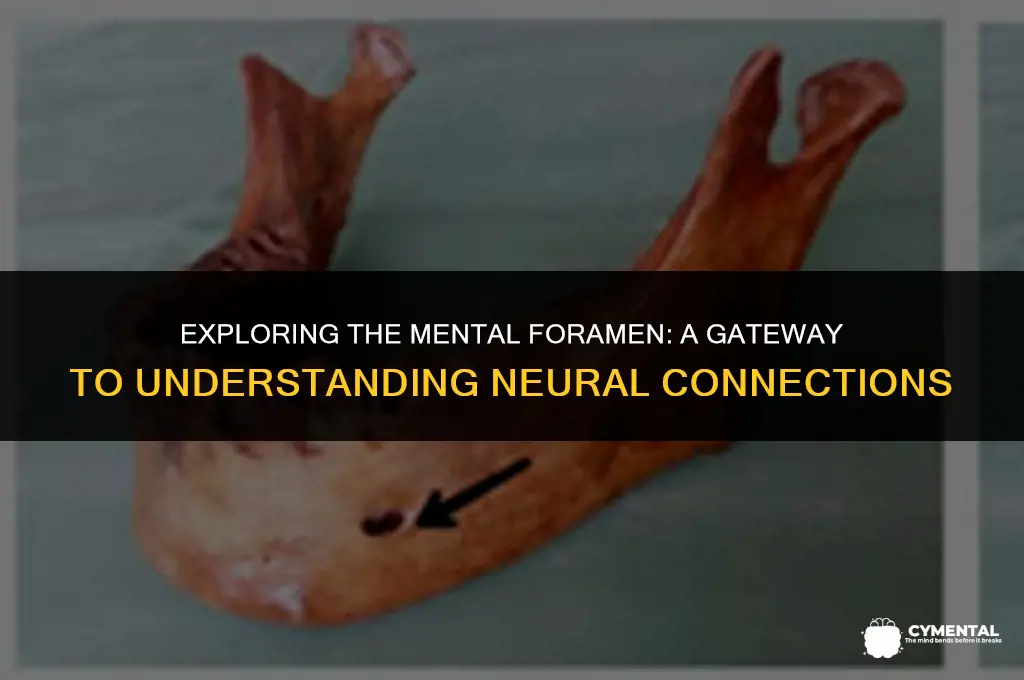
The mental foramen is a small, oval-shaped opening located on the mandible, or lower jawbone, in humans and other primates. It serves as a passageway for the mental nerve, a branch of the trigeminal nerve, which provides sensory innervation to the lower lip and chin. This anatomical feature is crucial for transmitting sensory information from the lower face to the brain. The mental foramen is typically situated near the midpoint of the mandible's inferior border, although its exact location can vary slightly among individuals. Understanding the mental foramen is essential in fields such as dentistry, oral surgery, and neuroanatomy, as it plays a key role in various procedures and diagnostic processes related to the lower jaw and facial nerves.
| Characteristics | Values |
|---|---|
| Location | Mental foramen is located in the mandible, near the lower incisor teeth. |
| Structure | It is an opening in the bone that allows the passage of the mental nerve and vessels. |
| Function | The mental foramen provides a pathway for the mental nerve, which supplies sensation to the lower lip and chin. |
| Shape | Typically oval or round in shape. |
| Size | The size can vary, but it is generally small enough to allow only the mental nerve and vessels to pass through. |
| Variation | There can be variations in its location and size among individuals. |
| Clinical Relevance | Knowledge of the mental foramen is important in dental and surgical procedures to avoid damaging the mental nerve. |
| Imaging | It can be visualized on radiographic images such as panoramic X-rays or CT scans. |
| Embryology | The mental foramen develops during the fetal stage as the mental nerve and vessels form and require an opening in the mandible. |
| Pathology | Conditions such as mental foramen cysts or infections can occur, which may require medical attention. |
| Surgical Considerations | Surgeons must be cautious when operating near the mental foramen to prevent nerve damage and ensure proper healing. |
| Anesthesia | Local anesthesia can be administered near the mental foramen to numb the lower lip and chin area. |
| Dental Procedures | Dentists need to be aware of the mental foramen when performing procedures on the lower incisor teeth to avoid nerve injury. |
| Patient Education | Educating patients about the mental foramen can help them understand the importance of proper oral hygiene and the potential risks of certain dental procedures. |
| Research | Ongoing research is important to better understand the variations and clinical implications of the mental foramen. |
Explore related products


What You'll Learn
- Definition: The mental foramen is an opening in the mandible for the mental nerve and vessels
- Location: It's situated on the lateral aspect of the mandible, near the lower border
- Contents: The mental nerve, a branch of the mandibular nerve, and the mental artery and vein pass through it
- Clinical Significance: It's important in dental and maxillofacial surgery to avoid damaging the structures passing through it
- Anatomical Variations: The position and size of the mental foramen can vary among individuals, which is crucial for surgical planning

Definition: The mental foramen is an opening in the mandible for the mental nerve and vessels
The mental foramen is a critical anatomical structure located in the mandible, serving as a conduit for the mental nerve and blood vessels. This opening is essential for providing sensory innervation to the lower lip and chin, as well as supplying blood to these areas. Understanding the mental foramen's location and function is crucial for various medical and dental procedures, as it helps practitioners avoid damaging the nerve and vessels during interventions.
In terms of its anatomical position, the mental foramen is typically situated near the apex of the mandibular first molar, although its exact location can vary among individuals. It is formed by the confluence of the mandibular canal and the mental canal, which branch off from the inferior alveolar canal. The mental nerve, a branch of the trigeminal nerve, passes through this foramen to provide sensory input to the skin and mucous membranes of the lower lip and chin. Additionally, the mental foramen allows for the passage of the mental artery and vein, which supply blood to the same regions.
Clinically, knowledge of the mental foramen is vital for procedures such as dental extractions, particularly when removing lower molars. Dentists and oral surgeons must be cautious to avoid damaging the mental nerve, as this can lead to numbness or altered sensation in the lower lip and chin. Furthermore, understanding the mental foramen's anatomy is important for administering local anesthesia in the mandibular region, as it helps ensure that the anesthetic is delivered effectively without causing harm to the surrounding structures.
In the context of medical imaging, the mental foramen can be visualized using radiographic techniques such as panoramic radiographs or computed tomography (CT) scans. These imaging modalities allow healthcare professionals to assess the foramen's size, shape, and location, which can be particularly useful when planning surgical procedures or diagnosing conditions that may affect the mental nerve and vessels.
Overall, the mental foramen plays a significant role in the sensory and vascular supply of the lower lip and chin. Its anatomical importance underscores the need for healthcare professionals to have a thorough understanding of its structure and function, particularly when performing procedures in the mandibular region. By avoiding damage to the mental nerve and vessels, practitioners can help ensure optimal patient outcomes and minimize the risk of complications.
Exploring the Depths of Cognitive and Behavioral Endeavors
You may want to see also
Explore related products



Location: It's situated on the lateral aspect of the mandible, near the lower border
The mental foramen is a crucial anatomical structure located on the lateral aspect of the mandible, near the lower border. This small opening serves as a conduit for the mental nerve and vessels, which are essential for providing sensation and blood supply to the lower lip and chin. Understanding the precise location of the mental foramen is vital for various medical and dental procedures, as it helps clinicians avoid damaging these important structures during interventions.
In terms of its anatomical position, the mental foramen is typically situated approximately 1-2 cm anterior to the mandibular ramus and 4-6 cm below the inferior alveolar nerve. This location places it in a relatively superficial position, making it accessible for procedures such as local anesthesia administration or surgical interventions. However, its proximity to other critical structures, such as the inferior alveolar nerve and the mandibular canal, necessitates careful planning and execution to prevent complications.
The mental foramen can be identified through various imaging modalities, including panoramic radiographs, computed tomography (CT) scans, and magnetic resonance imaging (MRI). These imaging techniques allow for detailed visualization of the foramen's location and size, which is crucial for preoperative planning. Additionally, the mental foramen can be located intraoperatively using anatomical landmarks, such as the mandibular ramus and the lower border of the mandible, as guides.
In clinical practice, knowledge of the mental foramen's location is particularly important for procedures involving the lower lip and chin. For example, when administering local anesthesia for dental extractions or other oral surgeries, it is essential to avoid injecting the anesthetic directly into the mental foramen, as this can lead to nerve damage or other complications. Similarly, when performing surgical procedures in this region, such as biopsies or tumor resections, careful dissection and avoidance of the mental foramen are necessary to preserve sensation and vascular supply to the area.
In conclusion, the mental foramen's location on the lateral aspect of the mandible, near the lower border, is a critical piece of anatomical knowledge for various medical and dental professionals. Understanding this location helps clinicians perform procedures safely and effectively, minimizing the risk of complications and ensuring optimal patient outcomes.
Mindset Matters: Strategies to Mentally Gear Up for Work
You may want to see also
Explore related products


Contents: The mental nerve, a branch of the mandibular nerve, and the mental artery and vein pass through it
The mental foramen is a critical anatomical structure located in the mandible, or lower jawbone. It serves as a passageway for several important neurovascular structures, including the mental nerve, a branch of the mandibular nerve, and the mental artery and vein. These structures play a vital role in providing sensation and blood supply to the lower lip, chin, and surrounding areas.
The mental nerve, which emerges from the mental foramen, is responsible for providing sensory innervation to the skin of the lower lip, chin, and the anterior part of the tongue. It is a mixed nerve, containing both sensory and motor fibers. The sensory fibers carry information about touch, pain, and temperature from the skin to the brain, while the motor fibers control the muscles of facial expression in the lower face.
The mental artery and vein, which also pass through the mental foramen, supply blood to the lower lip, chin, and surrounding tissues. The mental artery is a branch of the external carotid artery and provides oxygenated blood to the area, while the mental vein drains deoxygenated blood back to the heart. These blood vessels are essential for maintaining the health and vitality of the tissues they supply.
In clinical practice, knowledge of the mental foramen and its contents is crucial for various procedures, such as dental extractions, surgical interventions, and local anesthesia. Damage to the mental nerve or blood vessels can result in serious complications, including loss of sensation, bleeding, or infection. Therefore, careful consideration of the mental foramen's location and contents is necessary when planning and performing any procedures in the lower jaw area.
In summary, the mental foramen is a small but significant opening in the mandible that houses the mental nerve, artery, and vein. These structures are essential for providing sensation and blood supply to the lower lip, chin, and surrounding areas. Understanding the anatomy and function of the mental foramen is crucial for healthcare professionals, particularly those involved in dental and maxillofacial procedures.
Understanding Masculine Development: At What Age Do Men Reach Mental Maturity?
You may want to see also
Explore related products


Clinical Significance: It's important in dental and maxillofacial surgery to avoid damaging the structures passing through it
In the realm of dental and maxillofacial surgery, the mental foramen is a critical anatomical landmark. This small opening in the mandible serves as a conduit for essential neurovascular structures, including the inferior alveolar nerve, artery, and vein. Damage to these structures during surgical procedures can lead to severe complications, such as prolonged bleeding, infection, or even permanent nerve damage, resulting in altered sensation or motor function in the lower lip and chin.
The clinical significance of the mental foramen lies in its role as a gateway to the mandibular canal, which houses the inferior alveolar nerve. This nerve is responsible for providing sensory innervation to the lower teeth, gums, and skin of the lower lip and chin. During dental extractions, particularly of the lower molars and premolars, there is a risk of damaging the mental foramen and the nerve it contains. Such damage can result in a condition known as inferior alveolar nerve injury, which may manifest as numbness, tingling, or burning sensations in the affected area.
To avoid these complications, dental surgeons must exercise extreme caution when approaching the mental foramen. Preoperative planning, including radiographic imaging, is essential to accurately locate the foramen and plan the surgical approach accordingly. Intraoperative techniques, such as the use of surgical loupes and meticulous dissection, can help minimize the risk of damage. Additionally, the use of specialized instruments, like the mental foramen locator, can aid in identifying the foramen's location during surgery.
In cases where damage to the mental foramen does occur, prompt and appropriate management is crucial. This may involve suturing the nerve, applying a nerve graft, or in some cases, performing a surgical repair. Postoperative care, including the administration of antibiotics and pain management, is also important to prevent infection and ensure patient comfort.
In conclusion, the mental foramen is a vital anatomical structure that plays a significant role in dental and maxillofacial surgery. Its clinical importance cannot be overstated, as damage to the structures passing through it can lead to serious complications. By understanding the anatomy and function of the mental foramen, and by employing careful surgical techniques and postoperative management, dental surgeons can minimize the risk of complications and ensure optimal patient outcomes.
Boost Your Mental Stamina: Strategies for Enhancing Endurance
You may want to see also
Explore related products


Anatomical Variations: The position and size of the mental foramen can vary among individuals, which is crucial for surgical planning
The mental foramen, a small opening in the mandible, exhibits significant anatomical variations among individuals. These variations are not merely academic curiosities but have profound implications for surgical planning and execution. Surgeons must be acutely aware of these differences to avoid complications and ensure successful outcomes.
One of the key variations is the position of the mental foramen. It can be located anywhere from the midpoint of the mandible to the region near the third molar. This positional variability can affect the approach and technique used in surgical procedures involving the mental nerve, such as mental nerve block or neurolysis. For instance, if the mental foramen is located closer to the third molar, the surgical approach may need to be modified to avoid damaging the tooth or the surrounding bone.
The size of the mental foramen also varies considerably, ranging from a few millimeters to over a centimeter in diameter. This size variation can influence the choice of instruments and the technique used during surgery. A larger foramen may allow for easier access and manipulation of the mental nerve, while a smaller foramen may require more delicate instruments and a more precise technique to avoid nerve damage.
Furthermore, the shape of the mental foramen can also differ, with some individuals having a round opening, while others may have an oval or even a slit-like opening. This shape variation can impact the way the mental nerve is visualized and accessed during surgery. For example, a slit-like foramen may require a different approach to ensure that the nerve is not damaged when passing instruments through the opening.
In addition to these variations, the mental foramen can also be affected by pathological conditions such as cysts, tumors, or infections. These conditions can alter the size, shape, and position of the foramen, further complicating surgical planning. Surgeons must be prepared to adapt their techniques based on the specific anatomical and pathological findings of each patient.
In conclusion, the anatomical variations of the mental foramen are a critical consideration in surgical planning. Surgeons must be knowledgeable about these variations and be prepared to modify their techniques accordingly to ensure safe and effective outcomes. By understanding the unique characteristics of each patient's mental foramen, surgeons can better plan and execute procedures involving the mental nerve, ultimately improving patient care and satisfaction.
Mastering Mental Multiplication: Strategies for Quick Calculations
You may want to see also
Frequently asked questions
The mental foramen is an opening in the mandible (lower jawbone) through which the mental nerve and blood vessels pass. It is located near the premolar teeth and is an important anatomical landmark in dentistry and oral surgery.
The mental foramen is typically located in the mandible, near the premolar teeth, and slightly above the level of the occlusal surface (the biting surface of the teeth). Its exact position can vary slightly from person to person.
The mental nerve, which is a branch of the mandibular nerve, and blood vessels, including the mental artery and vein, pass through the mental foramen. These structures provide sensation and blood supply to the lower lip, chin, and surrounding areas.
The mental foramen is crucial in dental procedures because it houses the mental nerve and blood vessels. Dentists and oral surgeons must be aware of its location to avoid damaging these structures during procedures such as extractions, implant placements, or other surgical interventions in the lower jaw.