Harper Lewis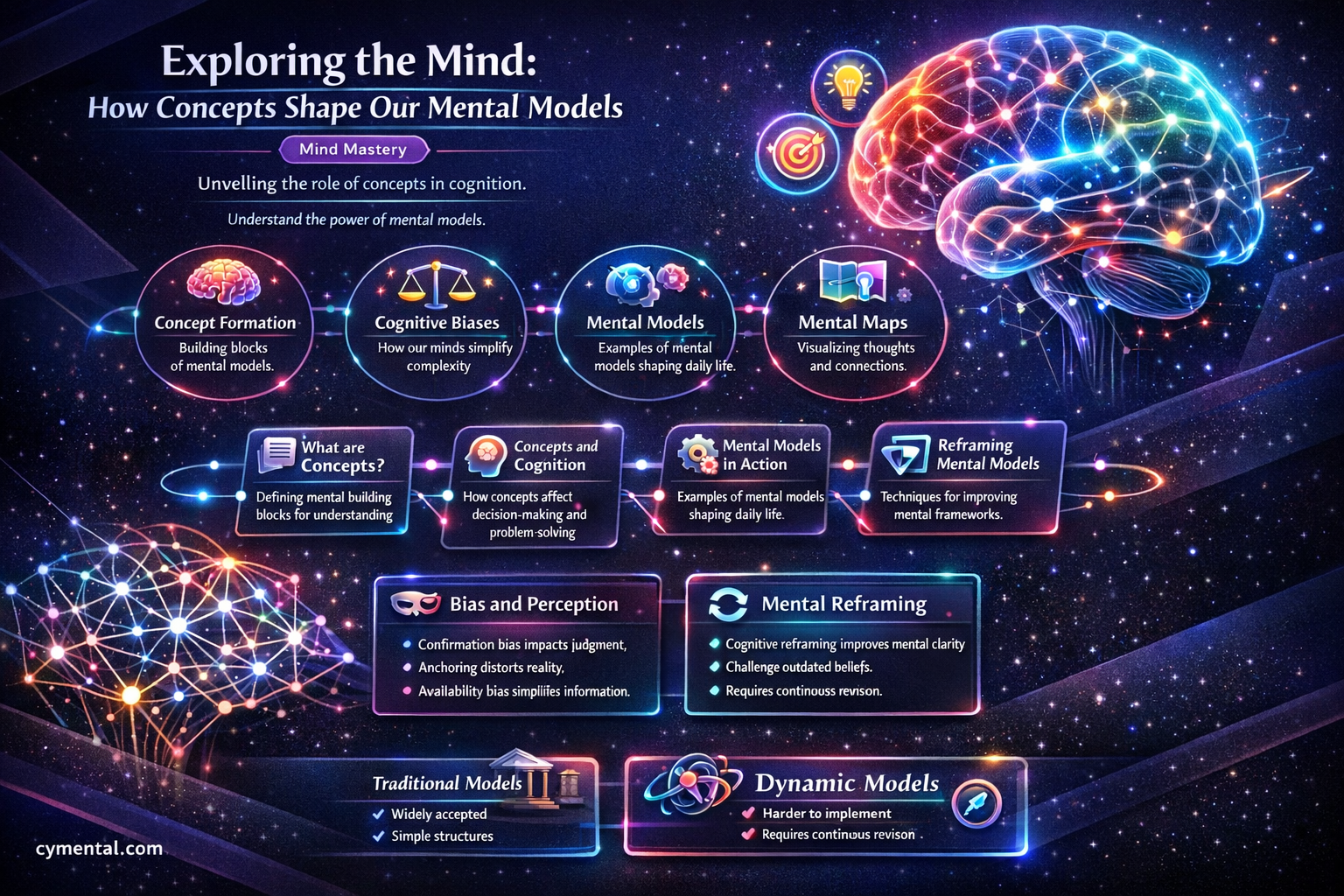
Concepts are indeed mental models that individuals use to understand and categorize the world around them. These models are abstract representations that help in simplifying complex information, allowing for more efficient processing and decision-making. By forming concepts, the human mind can group similar objects, ideas, or experiences together, creating a structured framework for knowledge. This structuring is essential for communication, problem-solving, and learning, as it provides a common ground for understanding and discussing various subjects. In essence, concepts serve as the building blocks of cognition, enabling individuals to navigate and make sense of their environment.
Explore related products


What You'll Learn
- Definition and Basics: Concepts as mental representations of ideas, objects, or events
- Formation: How concepts develop through experience, learning, and interaction with the environment
- Types of Concepts: Categories, prototypes, and exemplars as different forms of mental models
- Role in Cognition: Concepts' influence on perception, memory, and decision-making processes
- Applications: Use of concepts in problem-solving, creativity, and communication

Definition and Basics: Concepts as mental representations of ideas, objects, or events
Concepts serve as the building blocks of human cognition, allowing us to categorize and make sense of the world around us. They are mental representations that encapsulate ideas, objects, or events, enabling us to communicate, reason, and solve problems effectively. For instance, the concept of "dog" encompasses various attributes such as four legs, fur, and the ability to bark, which helps us identify and differentiate dogs from other animals.
The formation of concepts involves a complex interplay between sensory input, prior knowledge, and cognitive processes. When we encounter a new object or idea, our brains analyze its features and compare them to existing mental representations. If the new information aligns closely with an existing concept, we categorize it accordingly. However, if it deviates significantly, we may create a new concept or modify an existing one to accommodate the new information.
Concepts can be simple or complex, depending on the level of abstraction and the number of attributes they encompass. For example, the concept of "color" is relatively simple, involving the perception of light at different wavelengths. In contrast, the concept of "justice" is more complex, incorporating moral, legal, and social dimensions.
Understanding concepts is crucial for effective communication and problem-solving. When we share concepts with others, we convey not just words but the mental representations and associations that underlie them. This shared understanding allows us to collaborate, innovate, and build upon each other's ideas. Moreover, concepts provide a framework for critical thinking and decision-making, enabling us to evaluate information, identify patterns, and make informed choices.
In conclusion, concepts are fundamental to human cognition, serving as mental representations that help us make sense of the world. They are formed through a dynamic process of sensory input, prior knowledge, and cognitive analysis, and they can range from simple to complex depending on the level of abstraction and attributes involved. By understanding and effectively using concepts, we can enhance our communication, reasoning, and problem-solving abilities.
Seeking Help: A Guide to Voluntary Psychiatric Admission
You may want to see also
Explore related products


Formation: How concepts develop through experience, learning, and interaction with the environment
Concepts are not innate; they are constructed through a dynamic interplay of experience, learning, and environmental interaction. This process, known as concept formation, is a cornerstone of cognitive development. It begins with sensory input, where our perceptions of the world around us are the raw material from which concepts are eventually formed. As we interact with our environment, these sensory experiences are organized and categorized, gradually giving rise to more abstract mental representations.
One of the key mechanisms driving concept formation is learning. Through education and exposure to new information, we acquire knowledge that helps us to better understand and interpret our experiences. This knowledge is not merely a collection of facts; it is a framework that shapes how we perceive and conceptualize the world. For instance, learning about different types of animals can help us to distinguish between a dog and a cat, not just by their physical appearance but also by their behaviors and characteristics.
Experience also plays a crucial role in concept formation. Our personal experiences, whether they are positive or negative, contribute to the development of our conceptual understanding. For example, a child who has had a positive experience with a dog may develop a concept of dogs as friendly and approachable, while a child who has had a negative experience may develop a concept of dogs as scary or dangerous. These experiences can be direct, such as interacting with a dog, or indirect, such as observing a dog's behavior in a movie or book.
The environment in which we live and interact also influences concept formation. Cultural, social, and physical environments all provide cues and contexts that help us to make sense of our experiences and learning. For example, a child growing up in a rural area may develop a concept of nature that is very different from a child growing up in an urban area. The rural child may associate nature with open spaces, animals, and plants, while the urban child may associate nature with parks, zoos, and gardens.
Concept formation is an ongoing process that continues throughout our lives. As we encounter new experiences, learn new information, and interact with different environments, our concepts evolve and adapt. This process is not always linear or straightforward; sometimes, new information can challenge our existing concepts, leading to a period of cognitive dissonance before we are able to reconcile our new understanding with our previous knowledge.
In conclusion, concept formation is a complex and dynamic process that is shaped by experience, learning, and environmental interaction. It is through this process that we develop the mental models that allow us to make sense of the world around us and to navigate our daily lives. Understanding how concepts are formed can help us to better appreciate the role of experience and learning in shaping our perceptions and behaviors, and can also inform strategies for promoting cognitive development and lifelong learning.
Unlocking Your Mind: Strategies to Overcome Mental Barriers
You may want to see also
Explore related products


Types of Concepts: Categories, prototypes, and exemplars as different forms of mental models
Concepts, as mental models, manifest in various forms that help us navigate and understand the world around us. One way to categorize these mental models is by distinguishing between categories, prototypes, and exemplars. Each of these types serves a unique function in our cognitive processes, shaping how we perceive, classify, and reason about different entities and ideas.
Categories are broad mental models that group together objects, events, or ideas based on shared characteristics. They act as a fundamental organizing principle in our cognition, allowing us to quickly identify and classify new information. For instance, the category "furniture" encompasses a wide range of objects such as chairs, tables, and beds, all of which share the common function of being movable articles in a room or establishment that enhance its suitability for living or working.
Prototypes, on the other hand, are more specific mental models that represent the typical or ideal instance of a category. They serve as a reference point for evaluating whether something fits within a particular category. For example, when we think of the category "bird," the prototype might be a small, feathered creature with two wings, a beak, and the ability to fly. This prototype helps us determine whether an ostrich, which cannot fly, still fits within our understanding of what a bird is.
Exemplars are concrete instances or examples that illustrate a category or prototype. They are specific, memorable, and often vivid representations that help us understand and apply our knowledge of categories and prototypes in real-world situations. For instance, an exemplar for the category "furniture" could be a particular chair that you remember seeing in a friend's house. This exemplar helps you to not only identify other chairs but also to understand the variations and nuances within the category of furniture.
Understanding the differences between categories, prototypes, and exemplars can enhance our ability to communicate effectively, reason critically, and learn new information. By recognizing how these mental models operate, we can better organize our thoughts, make more informed decisions, and engage in more productive problem-solving activities.
Refresh Your Mind: A Guide to Mental Reset and Rejuvenation
You may want to see also
Explore related products


Role in Cognition: Concepts' influence on perception, memory, and decision-making processes
Concepts play a pivotal role in shaping our cognitive processes, particularly in how we perceive, remember, and make decisions about the world around us. They act as mental frameworks that categorize and organize our experiences, allowing us to make sense of complex information and stimuli. For instance, the concept of 'dog' helps us to quickly identify and differentiate a canine from other animals, leveraging our past experiences and knowledge to inform our present perceptions.
In terms of perception, concepts influence what we notice and how we interpret sensory information. They guide our attention to specific features and details that are relevant to the concept, while filtering out irrelevant information. This selective attention is crucial for efficient processing and understanding of our environment. For example, when looking at a crowded scene, our concept of 'friend' might lead us to quickly spot and recognize familiar faces among the crowd.
Memory is also significantly impacted by concepts. They help in encoding and storing information in a structured manner, making it easier to retrieve later. Concepts can act as mnemonic devices, aiding in the recall of associated details and experiences. For instance, remembering the concept of 'capital cities' can help us recall the names and locations of various capitals around the world. Moreover, concepts can influence the way we reconstruct memories, as our understanding of an event is often shaped by the concepts we use to describe and categorize it.
Decision-making processes are equally affected by concepts. They provide a basis for evaluating options and making choices, as we often rely on conceptual knowledge to predict outcomes and assess risks. Concepts can also bias our decisions, as our preconceived notions and stereotypes might lead us to favor certain options over others. For example, the concept of 'healthy food' might influence our dietary choices, leading us to select foods that align with our understanding of what is nutritious.
In conclusion, concepts are integral to our cognitive functioning, influencing how we perceive, remember, and make decisions about the world. They serve as mental models that organize our experiences and guide our cognitive processes, playing a crucial role in our ability to navigate and understand our environment. By recognizing the impact of concepts on cognition, we can better appreciate the complex interplay between our mental frameworks and our interactions with the world.
Navigating the Legal Process: Proving Mental Incapacity
You may want to see also
Explore related products


Applications: Use of concepts in problem-solving, creativity, and communication
Concepts serve as the building blocks of thought, enabling individuals to navigate complex problems, foster creativity, and communicate effectively. In problem-solving, concepts provide a framework for understanding and addressing challenges. For instance, the concept of "cause and effect" allows one to identify the root of a problem and predict potential outcomes of different solutions. Similarly, the concept of "systems thinking" encourages considering how various components of a problem interact, leading to more holistic and effective resolutions.
In the realm of creativity, concepts act as catalysts for generating innovative ideas. By combining disparate concepts, individuals can create novel solutions and artistic expressions. For example, the concept of "synergy" in chemistry, where the whole is greater than the sum of its parts, can inspire artists to blend different mediums or musicians to fuse diverse genres, resulting in unique and impactful creations.
Communication is another area where concepts play a crucial role. They provide a shared understanding that facilitates effective dialogue and collaboration. Concepts such as "empathy" and "active listening" are essential for building strong relationships and resolving conflicts. In professional settings, concepts like "SWOT analysis" (Strengths, Weaknesses, Opportunities, Threats) enable teams to strategize and make informed decisions by systematically evaluating various aspects of a project or business.
Moreover, concepts are instrumental in education, allowing students to grasp complex subjects by breaking them down into manageable parts. For instance, the concept of "fractions" in mathematics can be understood through the visual representation of dividing a whole into equal parts, making it easier for students to perform calculations and comprehend more advanced mathematical principles.
In conclusion, concepts are versatile mental models that underpin various aspects of human cognition and interaction. By leveraging concepts in problem-solving, creativity, and communication, individuals can enhance their ability to navigate challenges, innovate, and collaborate effectively, ultimately leading to personal and professional growth.
Unlocking Mental Commitment: A Guide to Its Four Essential Components
You may want to see also
Frequently asked questions
Concepts are mental models or representations that people use to understand and categorize the world around them. They are abstract ideas that help in organizing and making sense of experiences and information.
Concepts are formed through a combination of sensory experiences, learning, and cognitive processes. They develop as individuals encounter and process new information, often starting with concrete examples and gradually becoming more abstract.
Concepts play a crucial role in communication as they provide a shared framework for understanding. When people communicate, they use concepts to convey ideas, and the listener uses their own mental models to interpret and make sense of the information being shared.
Yes, concepts can evolve and change over time. As new information and experiences are encountered, individuals may refine or modify their mental models. Additionally, societal and cultural shifts can influence the development and transformation of concepts within a community.