Ava Ramirez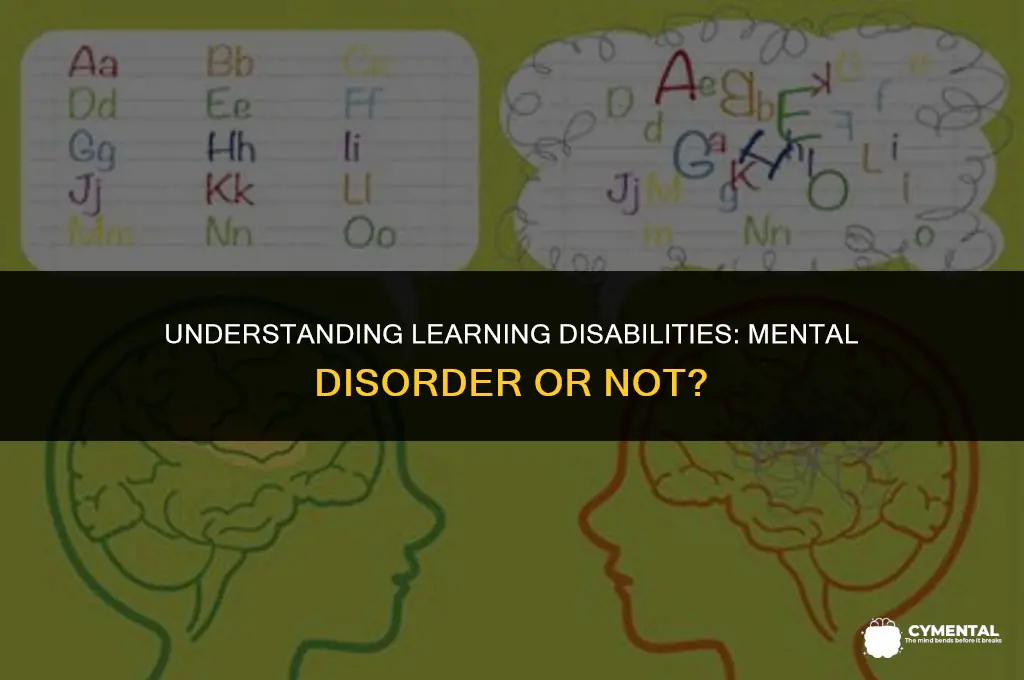
Learning disabilities are often misunderstood as mental disorders, but they are actually neurological conditions that affect how individuals process and retain information. These disabilities can manifest in various ways, such as difficulties with reading, writing, or mathematics, and are not a reflection of a person's intelligence or mental health. It's important to recognize that learning disabilities are distinct from mental disorders, as this distinction can significantly impact how individuals are supported and accommodated in educational and professional settings. Understanding the differences between these conditions can help promote a more inclusive and supportive environment for those affected.
| Characteristics | Values |
|---|---|
| Definition | Learning disabilities are a group of disorders that affect a person's ability to learn and process information. They are not a mental disorder, but rather a neurological condition that impacts cognitive functioning. |
| Types | There are several types of learning disabilities, including dyslexia, dysgraphia, dyscalculia, and non-verbal learning disabilities. Each type affects different aspects of learning and cognition. |
| Causes | Learning disabilities are typically caused by genetic factors, brain injury, or environmental factors such as exposure to toxins during pregnancy or early childhood. They are not caused by poor parenting or lack of intelligence. |
| Symptoms | Symptoms of learning disabilities can vary depending on the type and severity of the condition. Common symptoms include difficulty with reading, writing, math, memory, and attention. Individuals may also struggle with organization, time management, and social skills. |
| Diagnosis | Learning disabilities are typically diagnosed through a combination of psychological testing, medical evaluation, and educational assessment. A team of professionals, including psychologists, educators, and medical doctors, may be involved in the diagnostic process. |
| Treatment | Treatment for learning disabilities often involves a combination of educational interventions, such as specialized instruction and accommodations, as well as psychological and medical support. The goal of treatment is to help individuals with learning disabilities develop the skills and strategies they need to succeed in school and beyond. |
| Prognosis | The prognosis for individuals with learning disabilities varies depending on the type and severity of the condition, as well as the availability of support and resources. With appropriate interventions and support, many individuals with learning disabilities are able to achieve academic success and lead fulfilling lives. |
| Misconceptions | There are several misconceptions about learning disabilities, including the idea that they are a mental disorder, that individuals with learning disabilities are not intelligent, or that they are simply lazy. These misconceptions can be harmful and perpetuate stigma. |
| Advocacy | Advocacy for individuals with learning disabilities is important to ensure that they receive the support and resources they need to succeed. This can involve working with schools, policymakers, and community organizations to promote awareness and understanding of learning disabilities. |
| Resources | There are many resources available for individuals with learning disabilities, including educational materials, support groups, and online communities. These resources can provide valuable information, guidance, and support for individuals and their families. |
Explore related products


What You'll Learn

Definition and Classification
Learning disabilities are a group of disorders that affect a person's ability to learn and process information. They are characterized by difficulties in reading, writing, spelling, and sometimes in understanding spoken language. These disorders are not related to intelligence, but rather to the way the brain processes information. Learning disabilities are often diagnosed in childhood, but they can persist into adulthood and affect a person's ability to succeed in school, work, and other areas of life.
The classification of learning disabilities varies depending on the country and the diagnostic criteria used. In the United States, the Individuals with Disabilities Education Act (IDEA) defines learning disabilities as a category of disability that includes difficulties in reading, writing, spelling, and understanding spoken language. The Diagnostic and Statistical Manual of Mental Disorders (DSM-5) also includes learning disorders as a category of mental health conditions. However, the DSM-5 uses a more specific classification system that includes separate categories for learning disorders in reading, writing, and mathematics.
In the United Kingdom, learning disabilities are classified under the term "specific learning difficulties" (SLDs). SLDs are defined as difficulties in learning that are not related to intelligence, but rather to the way the brain processes information. The UK government provides a list of specific learning difficulties, which includes dyslexia, dyspraxia, dyscalculia, and dysgraphia.
In Australia, learning disabilities are classified under the term "specific learning disorder" (SLD). SLDs are defined as difficulties in learning that are not related to intelligence, but rather to the way the brain processes information. The Australian government provides a list of specific learning disorders, which includes dyslexia, dyspraxia, dyscalculia, and dysgraphia.
In Canada, learning disabilities are classified under the term "learning disability" (LD). LDs are defined as difficulties in learning that are not related to intelligence, but rather to the way the brain processes information. The Canadian government provides a list of specific learning disabilities, which includes dyslexia, dyspraxia, dyscalculia, and dysgraphia.
In conclusion, learning disabilities are a group of disorders that affect a person's ability to learn and process information. They are characterized by difficulties in reading, writing, spelling, and sometimes in understanding spoken language. These disorders are not related to intelligence, but rather to the way the brain processes information. Learning disabilities are often diagnosed in childhood, but they can persist into adulthood and affect a person's ability to succeed in school, work, and other areas of life. The classification of learning disabilities varies depending on the country and the diagnostic criteria used.
Understanding VA Ratings for Mental Disorders: A Comprehensive Guide
You may want to see also
Explore related products


Common Types of Learning Disabilities
Learning disabilities encompass a diverse range of conditions that affect an individual's ability to acquire and process information. These disabilities are not indicative of a person's intelligence but rather reflect differences in how the brain processes certain types of information. Common types of learning disabilities include dyslexia, dysgraphia, dyscalculia, and attention deficit hyperactivity disorder (ADHD). Each of these conditions presents unique challenges and requires tailored interventions to support affected individuals.
Dyslexia is perhaps the most well-known learning disability, characterized by difficulties with reading and writing. Individuals with dyslexia may struggle with letter and word recognition, spelling, and decoding text. This condition is not related to vision problems or a lack of intelligence but rather involves differences in brain structure and function that affect language processing.
Dysgraphia is a learning disability that impacts fine motor skills, particularly handwriting. Individuals with dysgraphia may have trouble forming letters and numbers, maintaining consistent spacing and alignment, and controlling the pressure of their writing instrument. This condition can also affect other fine motor tasks, such as buttoning clothes or using utensils.
Dyscalculia is a learning disability that affects an individual's ability to understand and work with numbers. People with dyscalculia may struggle with basic arithmetic operations, such as addition, subtraction, multiplication, and division. They may also have difficulty understanding mathematical concepts and solving problems that involve numbers.
Attention deficit hyperactivity disorder (ADHD) is a neurodevelopmental disorder that affects attention, impulse control, and hyperactivity. Individuals with ADHD may have trouble focusing on tasks, following instructions, and staying organized. They may also exhibit impulsive behaviors, such as interrupting others or acting without thinking.
It is important to note that learning disabilities are not mental disorders in the traditional sense. They are neurodevelopmental conditions that affect specific cognitive processes. While they can impact an individual's academic performance and daily functioning, they do not reflect a person's overall mental health or well-being. With appropriate support and interventions, individuals with learning disabilities can thrive and achieve their full potential.
Understanding Stockholm Syndrome: A Complex Psychological Phenomenon
You may want to see also
Explore related products


Causes and Risk Factors
Learning disabilities are often the result of a complex interplay between genetic and environmental factors. Research suggests that certain genetic mutations can predispose individuals to learning difficulties, affecting brain development and function. For instance, studies have identified specific genes associated with dyslexia and ADHD, which are common learning disorders. Environmental factors, such as prenatal exposure to toxins, poor nutrition, or infections during pregnancy, can also contribute to the development of learning disabilities.
Early childhood experiences play a crucial role in cognitive and social development. Children who experience neglect, abuse, or other forms of trauma may be at a higher risk of developing learning disabilities. Additionally, socioeconomic factors, such as poverty and lack of access to quality education, can exacerbate learning difficulties. Cultural and linguistic differences can also impact a child's ability to learn, particularly if they are not supported in their early years.
Certain medical conditions, such as epilepsy, brain injuries, or chronic illnesses, can lead to learning disabilities. Furthermore, substance abuse during pregnancy or early childhood can have long-lasting effects on brain development, increasing the risk of learning disorders. It is essential to consider these risk factors when assessing and diagnosing learning disabilities, as early intervention and support can significantly improve outcomes for affected individuals.
In summary, the causes and risk factors of learning disabilities are multifaceted, involving genetic predispositions, environmental influences, early childhood experiences, socioeconomic factors, cultural and linguistic differences, and medical conditions. Understanding these factors is crucial for developing effective strategies to prevent, diagnose, and treat learning disabilities, ensuring that individuals receive the support they need to thrive academically and socially.
Understanding Mental Health Disorders: A Comprehensive Guide
You may want to see also
Explore related products


Diagnosis and Assessment
The first step in the diagnosis and assessment process is to gather information about the child's developmental history, including milestones, medical history, and family background. This information helps professionals to identify potential risk factors and to understand the child's overall development. Next, a series of assessments are administered to evaluate the child's cognitive abilities, such as intelligence, memory, and problem-solving skills. These assessments help to identify areas of strength and weakness, which can inform the diagnosis.
In addition to cognitive assessments, academic performance is also evaluated through standardized tests and observations of the child's work in school. This helps to identify specific areas where the child is struggling, such as reading, writing, or math. Behavioral observations are also an important part of the assessment process, as they can provide insight into how the child interacts with others and responds to different situations.
Once the assessments are complete, a team of professionals, including psychologists, educators, and healthcare providers, review the results and collaborate to make a diagnosis. The diagnosis is based on the criteria outlined in the Diagnostic and Statistical Manual of Mental Disorders (DSM-5), which provides a standardized framework for diagnosing mental health conditions, including learning disabilities.
After the diagnosis is made, a treatment plan is developed to address the child's specific needs. This plan may include accommodations in school, such as extra time for tests or the use of assistive technology, as well as targeted interventions to improve academic skills and address behavioral challenges. Regular monitoring and reassessment are also important to ensure that the treatment plan is effective and to make adjustments as needed.
In conclusion, the diagnosis and assessment of learning disabilities is a complex process that requires a comprehensive approach. By considering various factors, including cognitive abilities, academic performance, and behavioral observations, professionals can make an accurate diagnosis and develop an effective treatment plan to support the child's learning and development.
Unraveling the Complexities: Compulsive Lying and Mental Health
You may want to see also
Explore related products


Treatment and Support Strategies
Individuals with learning disabilities often require tailored treatment and support strategies to help them overcome their challenges and achieve their full potential. One effective approach is the use of assistive technologies, such as text-to-speech software, speech recognition tools, and specialized computer programs that can help with reading, writing, and organization. These technologies can be particularly beneficial for individuals with dyslexia, dysgraphia, or attention deficit hyperactivity disorder (ADHD).
Another important strategy is the provision of specialized educational services, such as individualized education plans (IEPs) and 504 plans, which can provide accommodations and modifications to help students with learning disabilities succeed in school. These plans may include extra time for assignments, the use of assistive technologies, or the provision of a quiet, distraction-free environment for testing.
In addition to educational support, individuals with learning disabilities may also benefit from counseling and therapy services to help them cope with the emotional and psychological challenges associated with their condition. Cognitive-behavioral therapy (CBT) can be particularly effective in helping individuals with learning disabilities develop coping strategies and improve their self-esteem.
It is also important to involve parents and caregivers in the treatment and support process, as they can play a critical role in helping individuals with learning disabilities develop the skills and strategies they need to succeed. Parent training programs and support groups can provide valuable resources and guidance for families navigating the challenges of learning disabilities.
Finally, it is essential to recognize that individuals with learning disabilities are not defined by their condition and should be provided with opportunities to develop their strengths and pursue their interests. By focusing on a strengths-based approach and providing the necessary support and accommodations, individuals with learning disabilities can thrive and achieve their full potential.
Understanding Eating Disorders: Mental Health Classification and Support
You may want to see also
Frequently asked questions
Learning disabilities are not considered a mental disorder. They are a group of conditions that affect a person's ability to learn, understand, and use language or perform mathematical calculations.
Some examples of learning disabilities include dyslexia (difficulty with reading), dysgraphia (difficulty with writing), dyscalculia (difficulty with math), and attention deficit hyperactivity disorder (ADHD).
Learning disabilities primarily affect a person's cognitive abilities, such as reading, writing, or math skills. Mental disorders, on the other hand, affect a person's emotional, psychological, or behavioral well-being.
Yes, it is possible for people with learning disabilities to also have mental disorders. For example, someone with dyslexia may also experience anxiety or depression. However, the two are separate conditions and should be treated as such.