Lucas Bennett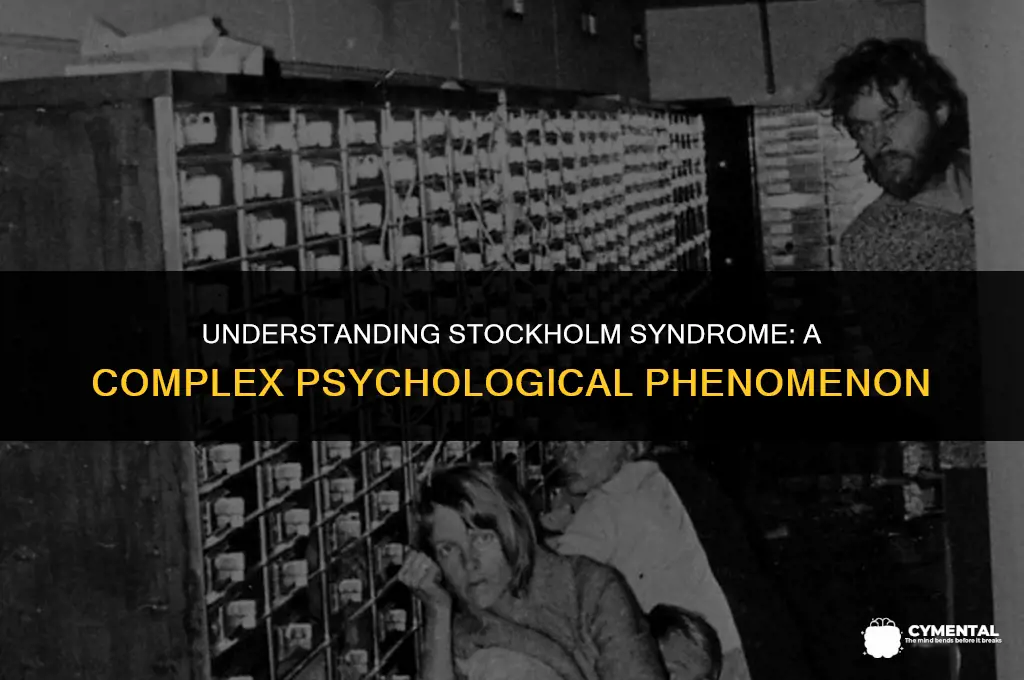
Stockholm syndrome is a psychological phenomenon in which hostages develop a bond with their captors, often leading to a sense of loyalty or affection towards them. This complex condition has been observed in various high-profile hostage situations and has sparked significant debate within the psychological community. While it is not officially recognized as a mental disorder in the Diagnostic and Statistical Manual of Mental Disorders (DSM), some experts argue that it should be classified as such due to its profound impact on the mental health and behavior of those affected. Understanding Stockholm syndrome requires delving into the intricate dynamics of trauma, attachment, and the human psyche's response to extreme stress.
| Characteristics | Values |
|---|---|
| Name | Stockholm Syndrome |
| Classification | Not officially recognized as a mental disorder by major psychiatric organizations |
| Symptoms | Irrational attachment to abuser, Fear of leaving or escaping, Denial of abuse, Blaming oneself for the abuse |
| Causes | Result of psychological manipulation and abuse, Often occurs in situations of captivity or extreme dependency |
| Prevalence | Exact prevalence is unknown, but it is considered relatively rare |
| Diagnosis | Not listed in the DSM-5 or ICD-11, Diagnosis is often made by mental health professionals based on observation and patient history |
| Treatment | Therapy focused on rebuilding self-esteem and independence, Support groups, Education about abuse and manipulation |
| Prognosis | Recovery is possible with appropriate support and therapy, Relapse can occur if the victim is not fully separated from the abuser |
| Controversy | Debate over whether it should be officially recognized as a mental disorder, Some argue it is a natural response to abuse rather than a disorder |
| Cultural References | Often portrayed in media and popular culture, Examples include films like "The Silence of the Lambs" and TV shows like "Criminal Minds" |
| Legal Implications | Can be used as a defense in criminal cases involving abuse, Courts may consider it when determining the victim's credibility |
| Research | Limited research on the syndrome, More studies are needed to understand its causes and effective treatments |
| Public Awareness | Increasing awareness through advocacy and education, Still often misunderstood or misrepresented in public discourse |
| Support Resources | Hotlines and online resources available for victims of abuse, Professional counseling and therapy services |
| Prevention | Education on healthy relationships and abuse prevention, Encouraging open communication and support networks |
Explore related products


What You'll Learn

Definition and criteria
Stockholm syndrome is not officially recognized as a mental disorder in the Diagnostic and Statistical Manual of Mental Disorders (DSM-5), which is the standard reference used by mental health professionals in the United States. However, it is mentioned as a condition that may be related to other disorders, such as post-traumatic stress disorder (PTSD) or acute stress disorder. The syndrome is characterized by a range of psychological responses that occur in individuals who have been subjected to prolonged periods of captivity, abuse, or extreme stress.
The term "Stockholm syndrome" was coined in 1973 after a bank robbery in Stockholm, Sweden, where four hostages developed a strong emotional bond with their captors. This unusual phenomenon led to a great deal of interest and research into the psychological mechanisms underlying such behavior. While there is no universally accepted definition of Stockholm syndrome, it is generally understood to involve a complex interplay of cognitive, emotional, and behavioral factors that lead to a victim's apparent identification with and loyalty to their abuser.
Some of the key criteria that have been proposed for diagnosing Stockholm syndrome include:
- A history of captivity or abuse: This is the primary precipitating factor for the development of Stockholm syndrome. The victim must have been subjected to a significant period of physical or psychological abuse, or both.
- Positive emotional responses towards the abuser: Despite the abuse, the victim develops positive feelings towards their captor. This may include feelings of affection, trust, or loyalty.
- Negative emotional responses towards others: The victim may develop negative feelings towards family, friends, or authorities who are perceived as threatening to the relationship with the abuser.
- Cognitive distortions: The victim may experience distorted thinking patterns, such as rationalizing the abuser's behavior or blaming themselves for the abuse.
- Behavioral changes: The victim may exhibit changes in behavior, such as becoming more submissive or compliant, or engaging in self-destructive behaviors.
It is important to note that Stockholm syndrome is a complex and controversial condition, and there is ongoing debate among mental health professionals about its validity and diagnostic criteria. Some experts argue that the syndrome is a manifestation of other underlying disorders, such as PTSD or borderline personality disorder, while others believe that it is a distinct condition that requires specific treatment approaches.
In conclusion, while Stockholm syndrome is not officially recognized as a mental disorder, it is a fascinating and complex phenomenon that has garnered significant attention and research. Understanding the psychological mechanisms underlying this condition can provide valuable insights into the nature of human relationships and the ways in which individuals cope with extreme stress and trauma.
Exploring Kanye West's Mental Health: A Compassionate Perspective
You may want to see also
Explore related products


Causes and risk factors
Stockholm syndrome, a psychological phenomenon where hostages develop a bond with their captors, is not officially recognized as a mental disorder in clinical diagnostic manuals. However, it involves complex psychological processes that can be understood through various theoretical frameworks. One perspective is that it represents a form of learned helplessness, where the hostage, subjected to prolonged abuse and control, begins to perceive their captor as a source of safety and security. This maladaptive coping mechanism can be seen as a survival strategy in extreme circumstances.
Another angle is to view Stockholm syndrome through the lens of attachment theory. In this context, the hostage may form an attachment to their captor as a result of the intense emotional experiences shared during the captivity. This attachment can be particularly strong if the captor displays a mix of kindness and cruelty, creating a confusing and powerful emotional bond. Understanding these dynamics can provide insight into why some individuals develop Stockholm syndrome while others do not.
Environmental factors also play a significant role in the development of Stockholm syndrome. The physical and psychological isolation of the hostage, combined with the captor's control over basic needs such as food, water, and sleep, can create a sense of dependency and vulnerability. Additionally, the hostage's prior experiences, personality traits, and coping mechanisms can influence their susceptibility to developing Stockholm syndrome. For example, individuals with a history of trauma or abuse may be more prone to forming such bonds as a way of coping with their current situation.
It is essential to note that Stockholm syndrome is not a deliberate choice or a sign of weakness. Rather, it is a complex psychological response to a highly stressful and threatening environment. Recognizing the causes and risk factors associated with Stockholm syndrome can help inform strategies for preventing and treating this phenomenon in various contexts, such as hostage situations, domestic violence, and cult involvement.
Exploring the Complexities: Psychopathy and Mental Health Disorders
You may want to see also
Explore related products


Symptoms and behavior
Individuals with Stockholm syndrome may exhibit a range of symptoms and behaviors that are paradoxical to their situation. They may develop a strong emotional bond with their captor, often idealizing them and displaying loyalty and affection. This can manifest in behaviors such as defending their captor, refusing to cooperate with authorities, and even assisting in their own captivity. Victims may also show signs of depression, anxiety, and post-traumatic stress disorder (PTSD), which can further complicate their psychological state.
One of the most striking symptoms of Stockholm syndrome is the victim's tendency to blame themselves for their predicament. They may feel guilty for their captor's actions or believe that they are responsible for the situation. This self-blame can lead to a sense of helplessness and hopelessness, making it difficult for victims to seek help or escape. In some cases, victims may even develop a sense of gratitude towards their captor, feeling that they are being protected or cared for.
The behavior of individuals with Stockholm syndrome can be highly erratic and unpredictable. They may oscillate between periods of compliance and resistance, making it challenging for observers to understand their actions. Victims may also engage in self-destructive behaviors, such as substance abuse or self-harm, as a coping mechanism for their trauma. It is essential to recognize these symptoms and behaviors as signs of a complex psychological response to captivity, rather than as indicators of the victim's character or personality.
In addition to these symptoms, individuals with Stockholm syndrome may experience a range of physical health problems. These can include chronic pain, gastrointestinal issues, and sleep disturbances. Victims may also be at risk for developing other mental health conditions, such as dissociative identity disorder or borderline personality disorder. It is crucial to provide comprehensive medical and psychological care to individuals who have experienced captivity and are exhibiting signs of Stockholm syndrome.
Understanding the symptoms and behaviors associated with Stockholm syndrome is essential for developing effective treatment strategies and supporting victims in their recovery. By recognizing the complex psychological responses that can occur in captivity, we can better equip ourselves to help those who have been affected by this traumatic experience.
Unveiling the Experts: Who Diagnoses Mental Disorders?
You may want to see also
Explore related products


Diagnosis and treatment
Diagnosis of Stockholm syndrome is complex and often requires a multidisciplinary approach involving psychologists, psychiatrists, and social workers. There are no specific diagnostic tests for Stockholm syndrome, so diagnosis is typically based on a thorough evaluation of the individual's symptoms, history, and current circumstances. Mental health professionals look for signs such as persistent positive feelings towards the abuser, negative feelings towards family or friends, and a sense of helplessness or dependency on the abuser.
Treatment for Stockholm syndrome usually involves a combination of psychotherapy, counseling, and sometimes medication. Cognitive-behavioral therapy (CBT) is often used to help individuals identify and change negative thought patterns and behaviors. Trauma-focused therapies, such as eye movement desensitization and reprocessing (EMDR), can also be effective in addressing the underlying trauma. Medications like antidepressants or anti-anxiety drugs may be prescribed to help manage symptoms of depression or anxiety that often accompany Stockholm syndrome.
It's important to note that treatment must be tailored to the individual's specific needs and circumstances. For example, someone who has been held captive for a long period may require more intensive and prolonged treatment than someone who has experienced a shorter period of abuse. Additionally, treatment may need to address not only the psychological effects of Stockholm syndrome but also any physical health issues that may have resulted from the abuse.
One of the challenges in treating Stockholm syndrome is that individuals may not recognize that they are suffering from a psychological disorder. They may believe that their feelings towards the abuser are genuine and that they are to blame for the abuse. Therefore, it's crucial to establish a trusting and non-judgmental relationship with the individual in order to help them understand their condition and engage in the treatment process.
In some cases, individuals with Stockholm syndrome may require hospitalization or residential treatment, especially if they are at risk of harm to themselves or others. However, this is typically a last resort and is only considered when outpatient treatment has not been effective or when the individual's safety is at risk.
Ultimately, the goal of treatment for Stockholm syndrome is to help individuals regain control over their lives, develop healthy relationships, and overcome the psychological effects of their traumatic experiences. With appropriate treatment and support, it is possible for individuals to recover from Stockholm syndrome and lead fulfilling lives.
Exploring the Complexities: Cannibalism and Mental Health Disorders
You may want to see also
Explore related products



Controversy and debate
The controversy surrounding Stockholm syndrome stems from its classification as a mental disorder. Some argue that it is not a distinct psychological condition but rather a manifestation of other disorders such as post-traumatic stress disorder (PTSD) or dissociative identity disorder. Critics contend that the symptoms of Stockholm syndrome, such as emotional attachment to an abuser and denial of abuse, can be better explained by these existing conditions. Furthermore, the lack of empirical research and the anecdotal nature of many Stockholm syndrome cases have led some to question its validity as a separate diagnosis.
On the other hand, proponents of Stockholm syndrome as a distinct mental disorder argue that it has unique features that are not fully captured by other diagnoses. They point to the specific context of captivity and abuse in which Stockholm syndrome occurs, and the complex psychological dynamics that can develop between victims and their abusers. Supporters also argue that recognizing Stockholm syndrome as a separate condition can help to improve understanding and treatment of victims of abuse.
The debate over Stockholm syndrome's classification has implications for the legal system as well. In some cases, victims of abuse who exhibit symptoms of Stockholm syndrome may be reluctant to testify against their abusers or may even defend them in court. This can make it difficult for prosecutors to build cases and for judges to determine the appropriate sentences for convicted abusers. The controversy surrounding Stockholm syndrome's classification as a mental disorder highlights the need for further research and a more nuanced understanding of the complex psychological effects of abuse.
The discussion around Stockholm syndrome also raises questions about the broader implications of trauma and abuse on mental health. It underscores the importance of recognizing and addressing the psychological impact of abuse on victims, and the need for comprehensive and compassionate mental health care for those who have experienced trauma. The controversy surrounding Stockholm syndrome serves as a reminder of the ongoing challenges in understanding and treating the complex effects of abuse on the human psyche.
Unraveling the Enigma: Marilyn Monroe's Mental Health Struggles
You may want to see also
Frequently asked questions
Stockholm syndrome is not officially classified as a mental disorder in the Diagnostic and Statistical Manual of Mental Disorders (DSM-5) or the International Classification of Diseases (ICD-11). It is considered a psychological phenomenon that may occur in individuals who have been kidnapped, held hostage, or experienced other forms of traumatic captivity.
Common symptoms of Stockholm syndrome include:
- Positive feelings towards the captor(s)
- Negative feelings towards the victim's own family or friends
- A sense of loyalty or attachment to the captor(s)
- A tendency to defend or justify the captor's actions
- Fear of escaping or being rescued
- A belief that the captor(s) will protect or care for them
Stockholm syndrome typically develops as a coping mechanism in response to a traumatic event, such as a kidnapping or hostage situation. The victim may experience a range of emotions, including fear, anxiety, and helplessness. Over time, they may begin to form a bond with their captor(s) as a way to survive the ordeal and regain a sense of control. This bond can lead to the development of Stockholm syndrome, characterized by positive feelings towards the captor(s) and negative feelings towards the victim's own family or friends.
Stockholm syndrome is more likely to occur in situations where the hostage is held captive for an extended period, has limited contact with the outside world, and experiences a high level of stress or trauma. It is also more common in cases where the captor(s) display a mix of kindness and cruelty towards the victim, creating a sense of uncertainty and dependency. However, it is important to note that Stockholm syndrome can occur in any type of hostage situation, and its development is influenced by a complex interplay of psychological, social, and environmental factors.