Ava Ramirez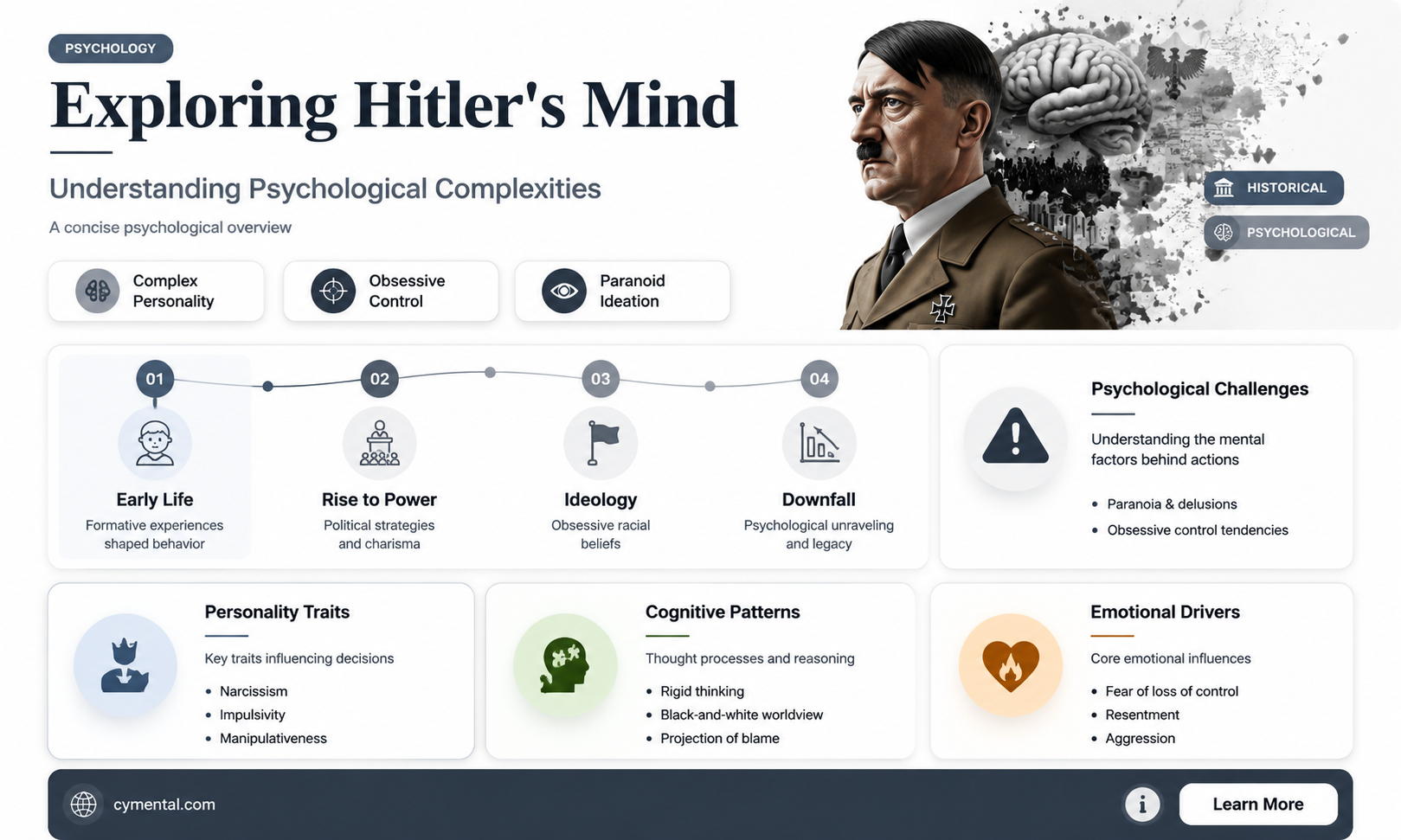
Adolf Hitler, the infamous leader of Nazi Germany, has been the subject of numerous psychological analyses, both during his lifetime and posthumously. While it is impossible to definitively diagnose someone with mental health issues without direct examination, many historians and psychologists have speculated about Hitler's mental state based on his behavior, writings, and speeches. Some theories suggest that Hitler may have exhibited traits of narcissistic personality disorder, paranoia, and possibly even schizophrenia. However, it is crucial to approach such discussions with caution, as they can oversimplify the complex historical context and perpetuate harmful stereotypes about mental illness. Ultimately, the question of whether Hitler had mental problems remains a topic of intense debate and ongoing research.
| Characteristics | Values |
|---|---|
| Historical Context | Adolf Hitler was a German politician who led the Nazi Party and served as Chancellor and Führer of Germany from 1933 to 1945. His leadership and ideologies resulted in World War II and the Holocaust. |
| Mental Health Speculations | There have been numerous speculations and analyses regarding Hitler's mental health. Some historians and psychologists have suggested he may have exhibited traits of various mental disorders. |
| Documented Behaviors | Hitler's documented behaviors include extreme paranoia, violent outbursts, and an intense need for control. He was also known for his erratic decision-making and impulsive actions. |
| Psychiatric Evaluations | While Hitler was never formally diagnosed by a psychiatrist during his lifetime, posthumous evaluations based on historical records have proposed several potential mental health conditions. |
| Proposed Diagnoses | Some of the proposed diagnoses include narcissistic personality disorder, paranoid schizophrenia, and antisocial personality disorder. However, these are speculative and based on limited historical data. |
| Controversial Nature | The topic of Hitler's mental health is highly controversial and debated among historians and mental health professionals. Some argue that attributing mental illness to Hitler oversimplifies the complexities of his actions and ideologies. |
| Ethical Considerations | Discussing Hitler's mental health raises ethical considerations, as it may inadvertently excuse or mitigate the atrocities committed under his regime. It is crucial to approach this topic with sensitivity and awareness of its implications. |
| Historical Records | Historical records provide insights into Hitler's behavior and personality, but they are limited in offering a comprehensive understanding of his mental state. Many records were destroyed or manipulated, and personal accounts may be biased or unreliable. |
| Psychological Profiling | Psychological profiling based on Hitler's speeches, writings, and actions has been used to infer aspects of his personality and potential mental health issues. However, these profiles are speculative and subject to interpretation. |
| Modern Perspectives | Modern perspectives on Hitler's mental health continue to evolve as new historical evidence emerges and psychological theories advance. The debate remains ongoing, with no definitive consensus reached. |
What You'll Learn
- Childhood Trauma: Hitler's early life experiences and their potential impact on his psychological development
- Paranoia and Delusions: Examination of Hitler's beliefs and behaviors suggesting paranoid tendencies
- Narcissistic Personality: Analysis of Hitler's self-image and behaviors indicative of narcissism
- Aggressive Behavior: Exploration of Hitler's aggressive actions and their possible psychological underpinnings
- Historical Context: Discussion of how Hitler's mental state might have been influenced by the socio-political environment of his time

Childhood Trauma: Hitler's early life experiences and their potential impact on his psychological development
Adolf Hitler's early life was marked by a series of traumatic experiences that likely had a profound impact on his psychological development. Born in 1889 in Braunau am Inn, Austria, Hitler's childhood was characterized by a tumultuous family dynamic, marked by his father's abusive behavior and his mother's submissive demeanor. Alois Hitler, Adolf's father, was known for his violent outbursts and strict discipline, often beating his children. This environment of fear and intimidation would have had a lasting effect on young Adolf, shaping his worldview and emotional responses.
Hitler's relationship with his mother, Klara, was also complex. While she was protective and nurturing, her inability to stand up to her husband's abuse may have contributed to Adolf's feelings of powerlessness and resentment. The death of his younger brother, Edmund, when Adolf was just six years old, further compounded his emotional trauma. This loss, coupled with the constant tension at home, likely led to feelings of insecurity and abandonment.
In addition to his family life, Hitler's early years were also influenced by his experiences at school. He was an average student but often clashed with his teachers, who he felt were unjust and overly strict. These conflicts may have reinforced his sense of rebellion and distrust of authority figures. Hitler's artistic inclinations were also evident during this time, but his father's disapproval of his creative pursuits likely stifled his self-expression and contributed to his growing sense of frustration.
The culmination of these early life experiences may have laid the groundwork for Hitler's later psychological issues, including his megalomania, paranoia, and propensity for violence. His inability to cope with the trauma of his childhood could have led to a distorted sense of reality and a need for control and dominance, which would later manifest in his political ideology and actions. While it is impossible to pinpoint a single cause for Hitler's mental state, his childhood trauma undoubtedly played a significant role in shaping his psyche and, ultimately, his historical legacy.
Exploring the Depths of Emotional Numbness: A Journey to Understanding
You may want to see also
Paranoia and Delusions: Examination of Hitler's beliefs and behaviors suggesting paranoid tendencies
Hitler's beliefs and behaviors exhibit several indicators of paranoid tendencies. One of the most striking aspects is his persistent belief in a Jewish conspiracy to undermine the German nation. This delusion led him to scapegoat Jews for Germany's economic and political problems, culminating in the Holocaust. His writings and speeches are filled with references to a supposed Jewish cabal that controlled the media, finance, and politics, which is a classic symptom of paranoid thinking.
Another indicator of Hitler's paranoia is his extreme distrust of others, even those within his own ranks. He frequently purged his government and military of individuals he deemed disloyal or incompetent, often without substantial evidence. This behavior created an atmosphere of fear and suspicion within the Nazi regime, as no one was safe from Hitler's wrath. His inability to trust others also led to a concentration of power in his own hands, further exacerbating his paranoid tendencies.
Hitler's megalomania and grandiose plans for world domination also suggest a paranoid mindset. He believed that he was destined to rule the world and that any opposition to his plans was part of a larger conspiracy against him. This belief led him to launch aggressive wars against multiple countries, ultimately resulting in the devastation of Europe and the loss of millions of lives. His refusal to accept defeat and his continued belief in victory even as the war turned against him further demonstrate his paranoid thinking.
In conclusion, Hitler's beliefs and behaviors strongly suggest that he suffered from paranoid tendencies. His delusions of a Jewish conspiracy, extreme distrust of others, and megalomaniacal plans for world domination are all classic symptoms of paranoia. These mental health issues likely played a significant role in shaping his actions and decisions, with disastrous consequences for the world.
Navigating Mental Health Conversations: A Guide for Couples
You may want to see also
Narcissistic Personality: Analysis of Hitler's self-image and behaviors indicative of narcissism
Adolf Hitler's self-image and behaviors are often analyzed through the lens of narcissistic personality disorder. This psychological condition is characterized by an inflated sense of self-importance, a deep need for admiration, and a lack of empathy for others. Hitler's actions and beliefs, particularly his grandiose vision of himself as a savior of the German people and his ruthless pursuit of power, align with many of the traits associated with narcissism.
One of the key indicators of narcissism is an exaggerated sense of self-worth. Hitler's speeches and writings frequently emphasized his own greatness and the superiority of the Aryan race. He believed himself to be a chosen leader, destined to guide Germany to world domination. This inflated self-image is a hallmark of narcissistic personality disorder, as individuals with this condition often see themselves as exceptional and entitled to special treatment.
Another trait commonly associated with narcissism is a lack of empathy. Hitler's policies and actions during World War II, such as the Holocaust and the brutal treatment of prisoners of war, demonstrate a profound disregard for the suffering of others. Narcissists often prioritize their own needs and desires over the well-being of others, which can lead to cruel and inhumane behavior.
Hitler's need for admiration is also indicative of narcissism. He cultivated a cult of personality, using propaganda and public speaking to create an image of himself as a heroic and infallible leader. This need for validation and adoration is a key feature of narcissistic personality disorder, as individuals with this condition often seek constant reassurance of their own importance and greatness.
In conclusion, an analysis of Hitler's self-image and behaviors reveals strong evidence of narcissistic personality disorder. His inflated sense of self-worth, lack of empathy, and need for admiration are all characteristic of this psychological condition. While it is impossible to definitively diagnose Hitler with narcissism without a thorough psychological evaluation, the historical record provides ample evidence to suggest that he exhibited many of the traits associated with this disorder.
Unlocking the Mind: A Guide to Calculating Your Mental Age
You may want to see also
Aggressive Behavior: Exploration of Hitler's aggressive actions and their possible psychological underpinnings
Adolf Hitler's aggressive behavior is a subject of extensive historical and psychological analysis. His actions, particularly during World War II, exhibited a level of brutality and disregard for human life that has been the focus of numerous studies. One possible psychological underpinning of Hitler's aggression could be his narcissistic tendencies. Many historians and psychologists have suggested that Hitler's grandiose sense of self-importance and his need for admiration may have driven his aggressive actions. He often spoke of his vision for a "master race" and his belief in the superiority of the Aryan people, which could be seen as a manifestation of his narcissistic delusions.
Another potential psychological factor contributing to Hitler's aggression is his paranoid tendencies. He was known to be highly suspicious and distrustful of others, often believing that he was being betrayed or undermined. This paranoia may have led him to lash out aggressively against perceived threats, both internal and external. For example, his purge of the German military leadership in 1938, known as the Blomberg-Fritsch affair, was motivated by his suspicion that they were plotting against him.
Hitler's aggressive behavior may also be linked to his experiences during World War I. He was a decorated soldier who was wounded in action and awarded the Iron Cross. However, he was also deeply traumatized by the war, and his experiences may have contributed to his later aggression. Some historians have suggested that Hitler's belief in the "stab-in-the-back" myth, which blamed the German defeat on internal enemies, may have been a coping mechanism for his own feelings of guilt and shame about the war.
In addition to these psychological factors, Hitler's aggressive behavior may also be attributed to his political ideology. He was a staunch nationalist who believed in the use of force to achieve his goals. His aggressive actions, such as the invasion of Poland and the Soviet Union, were driven by his desire to expand German territory and create a "Greater Germany." Hitler's ideology was also deeply rooted in anti-Semitism, which led to the Holocaust and the systematic persecution of Jews and other minorities.
In conclusion, Hitler's aggressive behavior was likely the result of a complex interplay of psychological and ideological factors. His narcissistic tendencies, paranoid tendencies, experiences during World War I, and political ideology all contributed to his aggressive actions. While it is impossible to definitively diagnose Hitler with a mental illness, it is clear that his behavior was driven by a combination of psychological and ideological factors that led to some of the most devastating consequences in human history.
Exploring Mental Sets: Understanding the Power of Cognitive Frameworks
You may want to see also
Historical Context: Discussion of how Hitler's mental state might have been influenced by the socio-political environment of his time
The socio-political environment of Hitler's time played a significant role in shaping his mental state. Growing up in Austria during the late 19th and early 20th centuries, Hitler was exposed to a climate of political instability and social unrest. The collapse of the Austro-Hungarian Empire and the subsequent rise of nationalism across Europe created a fertile ground for extremist ideologies. Hitler's experiences during World War I, where he served in the German army, further radicalized his views and contributed to his growing sense of disillusionment and anger.
The Treaty of Versailles, which ended World War I, imposed harsh penalties on Germany and fueled widespread resentment and humiliation. Hitler's mental state was deeply affected by these events, as he became increasingly obsessed with the idea of restoring Germany's greatness and seeking revenge against those he perceived as enemies. The economic turmoil of the 1920s and 1930s, including the Great Depression, exacerbated social tensions and provided Hitler with an opportunity to capitalize on the fears and frustrations of the German people.
Hitler's rise to power in 1933 was facilitated by his ability to tap into the collective psyche of a nation in crisis. His charismatic leadership and promises of a better future resonated with many Germans who were desperate for change. However, his mental state continued to deteriorate as he became increasingly paranoid and megalomaniacal. The pressures of leadership and the demands of his own ambition led to a further decline in his mental health, culminating in his eventual suicide in 1945.
In conclusion, the socio-political environment of Hitler's time had a profound impact on his mental state. The instability and unrest of his early years, combined with the trauma of World War I and the subsequent economic and political turmoil, created a perfect storm that shaped Hitler's worldview and ultimately led to his downfall. Understanding the historical context of Hitler's life is crucial in comprehending the complexities of his mental state and the devastating consequences of his actions.
Exploring Mental Acuity: Understanding the Sharpness of Your Mind
You may want to see also
Frequently asked questions
The question of whether Hitler had mental problems is a subject of debate among historians and psychologists. While some argue that his behavior and actions suggest the possibility of mental illness, others contend that he was a rational actor driven by ideological beliefs.
Various mental health conditions have been speculated about in relation to Hitler, including narcissistic personality disorder, paranoid schizophrenia, and antisocial personality disorder. However, it is important to note that these are speculative diagnoses and not definitive.
There are no documented instances of Hitler's mental health being evaluated by professionals during his lifetime. Any assessments of his mental health are based on historical records and observations by those who knew him.
The debate about Hitler's mental health has implications for our understanding of his actions and the Holocaust. If Hitler is viewed as having mental problems, it may lead some to see his actions as the result of a disturbed mind rather than a deliberate and rational choice. However, others argue that attributing his actions to mental illness risks downplaying the ideological and political factors that contributed to the Holocaust.
Discussing Hitler's mental health raises ethical considerations, including the risk of stigmatizing individuals with mental illness and the potential for trivializing the atrocities committed during the Holocaust. It is important to approach such discussions with sensitivity and awareness of these ethical implications.