Lucas Bennett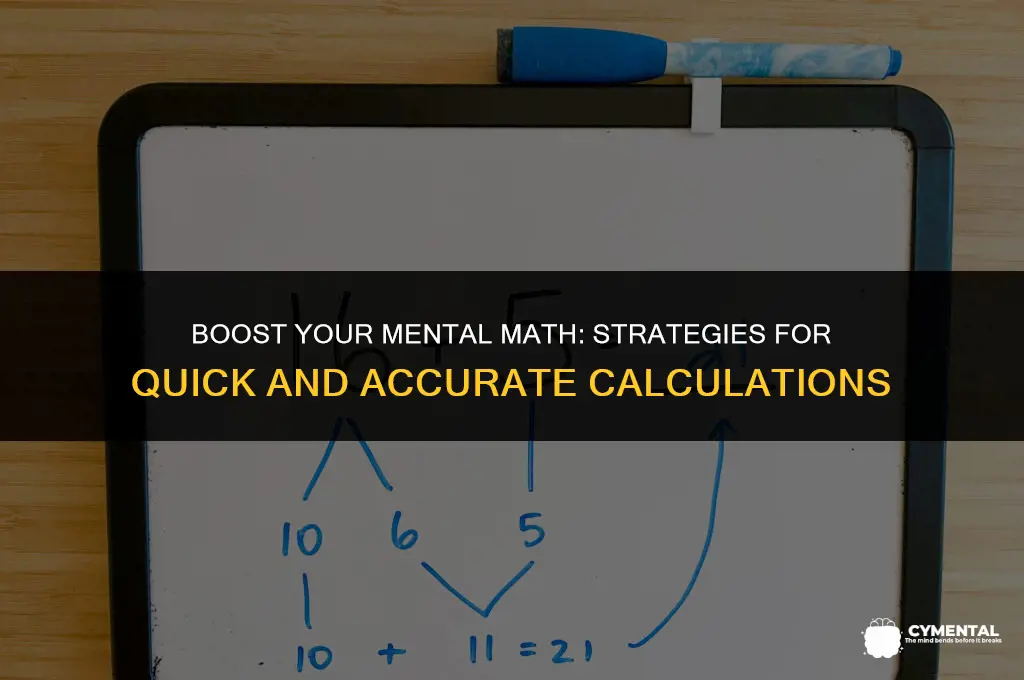
Improving mental arithmetic is a valuable skill that can enhance cognitive abilities and simplify daily tasks. Mental arithmetic involves performing mathematical calculations in your head without the aid of physical tools like calculators or paper. This skill is not only useful for quick calculations but also helps in developing problem-solving abilities, memory, and concentration. To improve mental arithmetic, one can practice regularly, use mnemonic devices, and develop strategies for breaking down complex problems into simpler parts. Additionally, understanding the basics of number theory and patterns can make mental calculations more efficient and accurate. With consistent practice and the right techniques, anyone can enhance their mental arithmetic skills and reap the benefits in both academic and real-world situations.
Explore related products


What You'll Learn
- Practice regularly: Consistent practice helps improve mental arithmetic skills over time
- Use visualization: Visualize numbers and operations to make mental calculations easier
- Learn shortcuts: Memorize common arithmetic shortcuts to speed up calculations
- Break down problems: Divide complex problems into smaller, manageable parts
- Stay focused: Maintain concentration and avoid distractions while performing mental arithmetic

Practice regularly: Consistent practice helps improve mental arithmetic skills over time
Regular practice is the cornerstone of improving mental arithmetic skills. It's akin to building muscle memory; the more you exercise your brain with arithmetic problems, the stronger and more efficient it becomes at performing these tasks. This doesn't mean mindlessly repeating the same problems over and over. Instead, it involves engaging with a variety of problems that challenge different aspects of mental arithmetic, such as addition, subtraction, multiplication, and division.
One effective method is to set aside a specific time each day for practice. This could be as little as 10-15 minutes, but consistency is key. During this time, focus on a particular type of problem or a set of problems that you find challenging. For example, you might spend one day working on two-digit addition problems, another on three-digit subtraction, and so on. As you become more comfortable with a particular type of problem, increase the difficulty level by introducing larger numbers or more complex operations.
Another strategy is to incorporate mental arithmetic into your daily routine. For instance, when you're out shopping, try to calculate the total cost of your purchases in your head before you reach the checkout. When you're driving, estimate the distance to your destination or the time it will take to get there based on your speed. These small exercises can add up over time and help to reinforce your mental arithmetic skills in a practical, real-world context.
It's also important to track your progress and celebrate your successes. Keep a record of the problems you've solved and the time it took you to solve them. Over time, you should see an improvement in both your speed and accuracy. This can be a great motivator to continue practicing and pushing yourself to improve even further.
Finally, don't be afraid to mix things up. Try different practice methods, such as using flashcards, playing arithmetic games, or working through problem sets in a workbook. Variety can help to keep your practice sessions interesting and prevent boredom from setting in. Remember, the goal is to make mental arithmetic a habit, something that you do regularly and enjoy. With consistent practice and a positive attitude, you can significantly improve your mental arithmetic skills over time.
Exploring the Mental Set: How Psychology Defines It
You may want to see also
Explore related products



Use visualization: Visualize numbers and operations to make mental calculations easier
Imagine you're standing in a grocery store, trying to calculate the total cost of your items. Instead of fumbling with numbers in your head, you can use visualization to make the process easier. For instance, if you have three items costing $4.99, $2.50, and $1.75, you can visualize them as blocks stacked on top of each other. The tallest block represents $4.99, the medium-sized block $2.50, and the smallest block $1.75. By mentally adding the heights of these blocks, you can quickly estimate the total cost to be around $9.24.
Visualization can be particularly helpful when dealing with complex operations like multiplication or division. For example, if you need to multiply 12 by 8, you can visualize 12 rows of 8 dots each. By counting the dots in each row and adding them up, you can easily arrive at the answer, 96. This method can be extended to more challenging multiplications, such as 37 by 24, by breaking them down into smaller, more manageable parts.
Another technique is to use visual landmarks to anchor your calculations. For instance, if you're trying to calculate 25% of 240, you can visualize a number line from 0 to 240 and mark the quarter point at 60. This visual cue can help you quickly arrive at the answer, 60, without having to perform the actual calculation.
Visualization can also be used to improve your estimation skills. For example, if you're trying to estimate the number of people in a crowded room, you can divide the room into smaller sections and estimate the number of people in each section. By adding up these estimates, you can arrive at a reasonable approximation of the total number of people in the room.
In conclusion, visualization is a powerful tool that can help you improve your mental arithmetic skills. By using visual representations of numbers and operations, you can make calculations easier and more accurate. Whether you're adding up grocery items, multiplying large numbers, or estimating quantities, visualization can be a valuable aid in your mental math toolkit.
Exploring the Cognitive Demands of Complex Mental Processing
You may want to see also
Explore related products


Learn shortcuts: Memorize common arithmetic shortcuts to speed up calculations
One effective strategy to enhance mental arithmetic skills is to learn and memorize common arithmetic shortcuts. These shortcuts can significantly speed up calculations by allowing you to bypass lengthy procedures and arrive at answers more efficiently. For instance, knowing that 10% of a number is equivalent to multiplying it by 0.1 can save time when calculating discounts or tips. Similarly, understanding that adding or subtracting multiples of 10 or 100 can simplify the process of rounding numbers or estimating totals.
Memorizing shortcuts involves more than just rote learning; it requires understanding the underlying principles that make these shortcuts work. By grasping the concepts behind these arithmetic tricks, you can apply them flexibly in various situations. For example, the shortcut for squaring numbers ending in 5 (e.g., 25^2 = 625) is based on the algebraic identity (a+b)^2 = a^2 + 2ab + b^2. When you understand this identity, you can easily adapt it to square numbers ending in other digits.
To effectively learn these shortcuts, it's essential to practice them regularly. Incorporate them into your daily routine by using them in real-life scenarios, such as calculating change, determining the cost of items on sale, or estimating distances. The more you use these shortcuts, the more they will become second nature, and the faster you will be able to perform mental arithmetic.
Another useful approach is to create visual or auditory associations with the shortcuts. For example, you might associate the shortcut for calculating 20% (multiplying by 0.2) with the image of a dime, since a dime represents 10% of a dollar. These associations can help reinforce the shortcuts in your memory and make them easier to recall when needed.
In conclusion, learning arithmetic shortcuts is a valuable technique for improving mental arithmetic skills. By memorizing these shortcuts and understanding the principles behind them, you can perform calculations more quickly and efficiently. Regular practice and the use of visual or auditory associations can further enhance your ability to recall and apply these shortcuts in various situations.
Mastering the Mindset: Your Guide to Interview Preparation
You may want to see also
Explore related products


Break down problems: Divide complex problems into smaller, manageable parts
One effective strategy to enhance mental arithmetic skills is to break down complex problems into smaller, more manageable parts. This approach, often referred to as decomposition, allows individuals to tackle each component of a problem separately, reducing the cognitive load and increasing the likelihood of accurate calculations. For instance, when faced with a multi-step arithmetic problem, such as calculating the total cost of items including tax and discounts, breaking it down into individual steps—first finding the subtotal, then calculating the tax, and finally applying the discount—can make the process less daunting and more approachable.
Decomposition is particularly useful for problems involving multiple operations, such as addition, subtraction, multiplication, and division. By isolating each operation, individuals can focus their attention on one task at a time, minimizing errors and improving overall performance. This method can also be applied to more abstract mathematical concepts, such as algebra and calculus, where breaking down complex equations into simpler components can aid in understanding and solving them.
To implement this strategy effectively, it is essential to identify the key elements of a problem and determine the most logical order in which to address them. This may involve working backward from the final answer or breaking the problem down into smaller sub-problems that can be solved independently. Additionally, using visual aids, such as diagrams or charts, can help to organize the components of a problem and make the decomposition process more intuitive.
In conclusion, breaking down problems into smaller, manageable parts is a powerful technique for improving mental arithmetic skills. By reducing complex problems to their constituent elements, individuals can perform calculations more accurately and efficiently, ultimately enhancing their overall mathematical abilities.
Cultivating Unshakeable Resilience: A Guide to Mental Fortitude
You may want to see also
Explore related products


Stay focused: Maintain concentration and avoid distractions while performing mental arithmetic
Maintaining concentration is crucial when performing mental arithmetic. One effective strategy is to create a mental workspace free from distractions. This can be achieved by finding a quiet environment or using noise-cancelling headphones to block out external noise. Additionally, it's important to clear your mind of any unrelated thoughts or worries before starting the calculation.
Another technique to stay focused is to break down the arithmetic problem into smaller, manageable steps. This not only makes the problem less overwhelming but also allows you to concentrate on one part of the calculation at a time. For example, if you're trying to solve a complex multiplication problem, you can break it down into smaller multiplications and then add the results together.
Visualization can also be a powerful tool in maintaining concentration. Try to visualize the numbers and the operations you're performing on them. This can help to keep your mind engaged and focused on the task at hand. Additionally, using mnemonic devices or creating associations between numbers and objects can help to improve your concentration and memory.
It's also important to practice regularly to improve your mental arithmetic skills. Set aside a specific time each day to practice, and gradually increase the difficulty of the problems you're solving. This will not only help to improve your concentration but also your overall arithmetic skills.
Finally, taking breaks is essential to maintaining concentration. If you find yourself getting frustrated or losing focus, take a short break and come back to the problem later. This will help to refresh your mind and improve your ability to concentrate on the task at hand.
Exploring the Mind: How Concepts Shape Our Mental Models
You may want to see also
Frequently asked questions
Effective strategies include practicing regularly, breaking down problems into smaller steps, using visualization techniques, and learning shortcuts and patterns.
You can practice mental arithmetic by performing calculations in your head during everyday activities, such as shopping, cooking, or commuting. You can also use mental math apps or play games that involve arithmetic.
Common mistakes include rushing through calculations, not double-checking answers, and struggling with large numbers or complex operations. To avoid these mistakes, take your time, break down problems, and practice regularly.
Yes, techniques such as the lattice method, the grid method, and the Russian peasant multiplication can be helpful for multiplying large numbers mentally. These methods involve breaking down the numbers and performing smaller, more manageable calculations.
To improve speed and accuracy, focus on practicing basic arithmetic operations regularly, learning and memorizing multiplication tables, and using mental math tricks and shortcuts. Additionally, try to stay calm and focused when performing calculations.