Madison Cole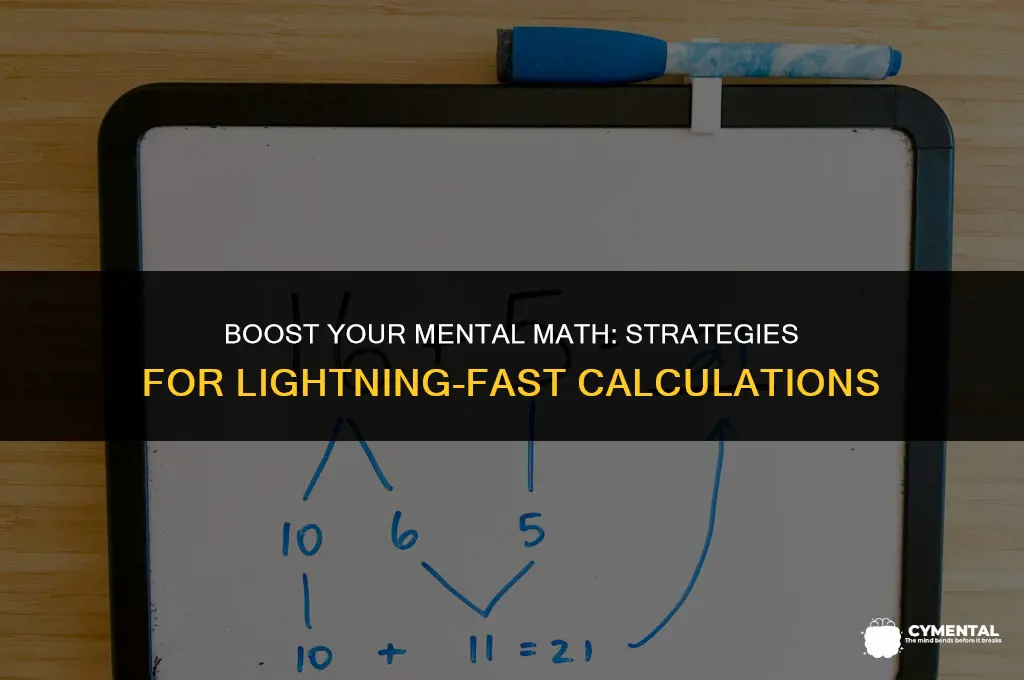
Improving mental calculation is a valuable skill that can enhance cognitive abilities and simplify everyday tasks. Mental math involves performing arithmetic operations in your head without the aid of a calculator or pen and paper. It's a skill that can be developed with practice and patience. In this guide, we'll explore various techniques and strategies to help you sharpen your mental calculation abilities. From understanding the basics of arithmetic to advanced methods for tackling complex problems, we'll cover it all. So, whether you're a student looking to improve your math grades or an adult seeking to enhance your numerical literacy, read on to discover practical tips and exercises for mastering mental math.
Explore related products


What You'll Learn
- Practice Regularly: Consistent practice enhances mental math skills. Try daily exercises and puzzles
- Use Visualization: Associate numbers with images or objects to improve recall and speed
- Learn Shortcuts: Develop or learn quick calculation methods, like multiplying by 10 and adjusting
- Build Number Sense: Understand number relationships and patterns to estimate and calculate more efficiently
- Stay Focused: Minimize distractions and concentrate on the problem at hand to boost accuracy

Practice Regularly: Consistent practice enhances mental math skills. Try daily exercises and puzzles
Regular practice is the cornerstone of improving mental math skills. It's akin to building muscle memory; the more you exercise, the stronger and more efficient your mental arithmetic becomes. To make practice effective, it should be consistent and varied. Daily exercises keep your mind sharp and accustomed to performing calculations quickly. Incorporating puzzles, such as Sudoku or logic problems, adds an element of challenge and engages different cognitive skills that support mental math.
One effective strategy is to start with simple arithmetic operations like addition and subtraction, gradually increasing the complexity to multiplication and division. As you become more comfortable, introduce mental math tricks and shortcuts, like the ones used in Vedic mathematics or the mental multiplication techniques popularized by mathematicians like Terence Tao. These methods not only speed up calculations but also make the process more engaging and enjoyable.
Another important aspect of regular practice is to apply mental math in real-life situations. For instance, when shopping, try to calculate the total cost of items in your head before reaching the checkout. This practical application reinforces the relevance of mental math and helps in developing the ability to perform calculations under pressure or in distracting environments.
Technology can also be a valuable tool in enhancing mental math skills. Apps and online platforms offer a wide range of exercises and games designed to improve mental arithmetic. These tools often provide immediate feedback, allowing you to track your progress and identify areas that need more work. Additionally, they can adapt to your skill level, offering increasingly challenging problems as you improve.
In conclusion, consistent and varied practice is key to enhancing mental math skills. By incorporating daily exercises, puzzles, practical applications, and technological tools, you can develop a strong foundation in mental arithmetic. This not only improves your ability to perform calculations quickly and accurately but also boosts your cognitive abilities and problem-solving skills in various aspects of life.
Navigating the Legal Process: Proving Mental Incapacity
You may want to see also
Explore related products

![The Secrets of Mental Math (DVD) (Great Courses / Teaching Compan (1905-07-18) [DVD]](https://m.media-amazon.com/images/I/71FSlhUxjRL._AC_UY218_.jpg)


Use Visualization: Associate numbers with images or objects to improve recall and speed
Our brains are wired to remember images more effectively than raw numbers. This is why visualization can be a powerful tool in improving mental calculation skills. By associating numbers with images or objects, you can create mental shortcuts that make arithmetic operations faster and more accurate.
For example, imagine you're trying to remember the multiplication table for the number 7. Instead of simply memorizing the facts, you could create a visual representation of each product. Picture a row of 7 apples, 7 oranges, 7 bananas, and so on. This creates a mental image that you can easily recall when you need to multiply 7 by a number.
Another technique is to use visualization to break down complex calculations into smaller, more manageable parts. For instance, if you're trying to calculate 345 + 278, you could visualize the numbers as two separate groups of objects. Picture 345 as a collection of 3 hundreds, 4 tens, and 5 ones, and 278 as a collection of 2 hundreds, 7 tens, and 8 ones. Then, add the corresponding groups together: 3 hundreds + 2 hundreds = 5 hundreds, 4 tens + 7 tens = 11 tens, and 5 ones + 8 ones = 13 ones. This visualization makes the calculation easier to perform mentally.
Visualization can also be used to improve your ability to estimate quantities. For example, if you're trying to estimate the number of people in a crowded room, you could visualize the room as a grid of squares, with each square representing a certain number of people. Then, count the number of squares and multiply by the number of people per square to get an estimate.
To make visualization more effective, try to use vivid, colorful images that are easy to remember. The more distinct and memorable the image, the more likely you are to recall it when you need to perform a mental calculation. Additionally, practice using visualization regularly to build your skills and confidence.
In conclusion, visualization is a powerful technique for improving mental calculation skills. By associating numbers with images or objects, breaking down complex calculations into smaller parts, and estimating quantities using visual representations, you can perform arithmetic operations more quickly and accurately. With regular practice, visualization can become a valuable tool in your mental math toolkit.
Mastering Mental Resilience: Techniques to Lock In and Stay Focused
You may want to see also
Explore related products


Learn Shortcuts: Develop or learn quick calculation methods, like multiplying by 10 and adjusting
One effective strategy to enhance mental calculation skills is to develop or learn various shortcuts. These shortcuts can significantly reduce the time and effort required to perform calculations mentally. For instance, multiplying numbers by 10 is a fundamental shortcut that can be applied in numerous situations. When faced with a multiplication problem involving 10, instead of performing the actual multiplication, you can simply append a zero to the original number. This technique is not only quick but also foolproof, as it eliminates the possibility of errors that might occur during the multiplication process.
Another useful shortcut involves adjusting numbers to make calculations easier. This method is particularly helpful when dealing with numbers that are close to a multiple of 10 but not quite. For example, if you need to multiply 97 by 4, you can adjust 97 to 100, perform the multiplication (100 x 4 = 400), and then subtract the excess (400 - 12 = 388). This approach simplifies the calculation and reduces the likelihood of mistakes.
In addition to these basic shortcuts, there are more advanced techniques that can be employed to further improve mental calculation abilities. For instance, the use of mental benchmarks can help in estimating products quickly. By memorizing the squares of numbers up to 10, you can easily estimate the product of two numbers by finding the nearest square and adjusting accordingly. This method is especially useful for multiplying numbers that are not exact multiples of 10.
Moreover, practicing these shortcuts regularly can help in building mental agility and confidence in performing calculations. It is essential to incorporate these techniques into daily practice to reinforce muscle memory and ensure that they become second nature. By doing so, you will find that mental calculations become increasingly effortless and accurate over time.
In conclusion, learning and developing shortcuts is a crucial aspect of improving mental calculation skills. These techniques not only save time but also enhance accuracy and reduce the mental strain associated with performing calculations. By mastering these shortcuts and incorporating them into regular practice, individuals can significantly boost their mental math abilities and become more proficient in handling numerical problems.
Exploring the Depths of Social Media Intelligence (SMI)
You may want to see also
Explore related products



Build Number Sense: Understand number relationships and patterns to estimate and calculate more efficiently
Understanding number relationships and patterns is crucial for efficient mental calculation. One effective strategy is to recognize and utilize benchmarks, which are reference numbers that help you estimate and compare other numbers quickly. For example, knowing that 10% of 100 is 10 can help you approximate percentages of other numbers. Similarly, being familiar with perfect squares and cubes, such as 25 (5^2) and 125 (5^3), can aid in rapid mental calculations involving these numbers.
Another technique to build number sense is to look for patterns in numbers. This can involve identifying sequences, such as arithmetic or geometric progressions, or noticing repeating digits in large numbers. For instance, the sequence 2, 4, 6, 8, ... follows a simple arithmetic progression where each number is 2 more than the previous one. Recognizing such patterns can help you predict future numbers in the sequence or perform calculations more efficiently.
Estimation is a key component of number sense. By developing the ability to estimate quantities accurately, you can simplify complex calculations and arrive at approximate answers quickly. One way to improve estimation skills is to practice rounding numbers to the nearest ten or hundred. This helps you focus on the most significant digits and ignore less important details, making mental calculations easier and faster.
Building number sense also involves understanding the properties of numbers and how they interact with each other. For example, knowing that multiplying a number by 10 adds a zero to the end can help you perform multiplications involving large numbers. Similarly, being aware that dividing a number by 10 removes a zero can aid in rapid division calculations.
To further enhance your number sense, try engaging in mental math exercises regularly. This can include simple tasks like adding or subtracting numbers in your head, as well as more complex challenges like calculating percentages or solving algebraic equations mentally. The more you practice, the more comfortable and efficient you will become with mental calculations.
In conclusion, building number sense is a valuable skill that can significantly improve your ability to perform mental calculations efficiently. By recognizing patterns, utilizing benchmarks, practicing estimation, and understanding number properties, you can develop a strong foundation in number sense and become more adept at handling mathematical tasks in your daily life.
Unlocking Your Mind: Strategies to Overcome Mental Barriers
You may want to see also
Explore related products


$10.6 $19.99


Stay Focused: Minimize distractions and concentrate on the problem at hand to boost accuracy
In the realm of mental calculation, focus is the cornerstone of accuracy. To minimize distractions and concentrate on the problem at hand, it's essential to create an environment conducive to mental clarity. This might involve finding a quiet space, away from the hustle and bustle of daily life, where you can dedicate uninterrupted time to your calculations. Additionally, consider using tools like noise-cancelling headphones or white noise machines to block out any residual background noise.
Another strategy to enhance focus is to practice mindfulness techniques. Mindfulness meditation, for instance, can help train your brain to stay present and avoid wandering off into thoughts unrelated to the task at hand. Regular practice can improve your ability to concentrate for longer periods, which is particularly beneficial when tackling complex mental calculations.
It's also crucial to manage your time effectively. Break down your calculation into smaller, manageable chunks, and allocate specific time slots for each part. This not only helps prevent mental fatigue but also allows you to track your progress and adjust your approach as needed. Furthermore, taking short breaks between sessions can help refresh your mind and maintain a high level of focus throughout your calculation.
In terms of mental preparation, it's important to approach each problem with a clear and open mind. Avoid preconceived notions or biases that might influence your thought process. Instead, focus on understanding the problem thoroughly before attempting to solve it. This involves reading the question carefully, identifying key elements, and breaking down the problem into its constituent parts.
Lastly, practice is key. The more you engage in mental calculation, the more adept you'll become at focusing on the task at hand. Start with simple problems and gradually increase the complexity as your skills improve. This progressive approach not only builds your confidence but also enhances your ability to concentrate on more challenging calculations.
By implementing these strategies, you can create an optimal environment for mental calculation, improve your focus, and ultimately boost your accuracy. Remember, the key to success lies in your ability to minimize distractions and maintain a clear, concentrated mind.
Rebuilding Resilience: A Guide to Recovery After a Mental Breakdown
You may want to see also