Ava Ramirez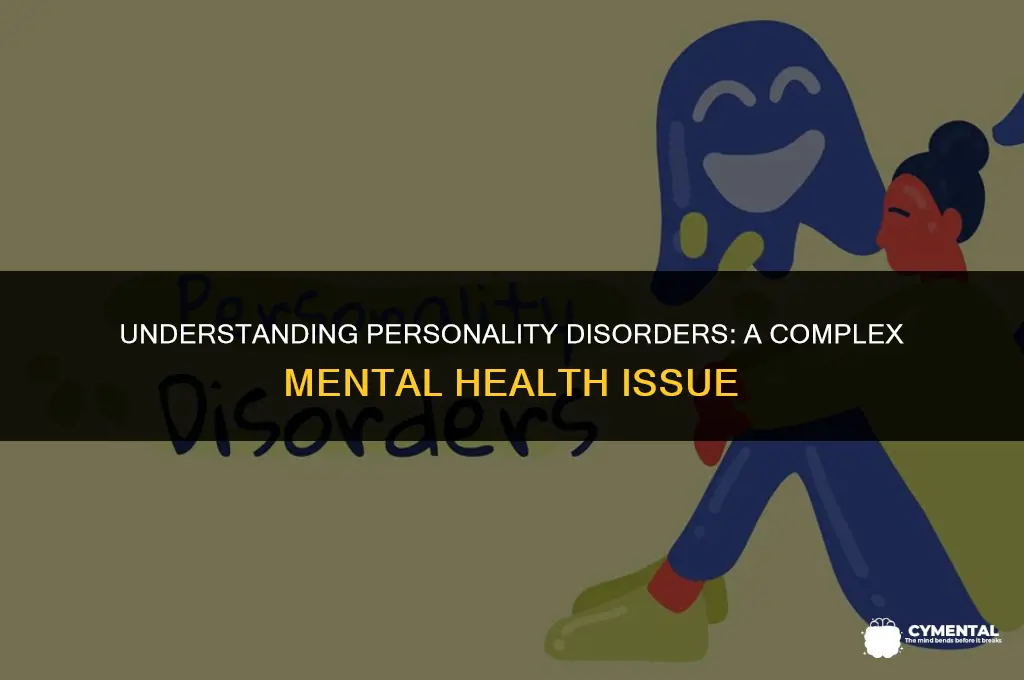
Personality disorders are a category of mental health conditions characterized by long-standing patterns of thinking, feeling, and behaving that deviate significantly from societal norms and expectations. These disorders can cause significant distress and impairment in various aspects of a person's life, including relationships, work, and overall well-being. While the concept of personality disorders is widely recognized in psychiatric diagnosis, there is ongoing debate among mental health professionals about their classification, diagnosis, and treatment. Some argue that personality disorders are distinct mental disorders that require specific interventions, while others view them as variations of normal personality traits that do not necessarily warrant a psychiatric diagnosis. This discussion highlights the complexities and nuances involved in understanding and addressing personality disorders within the broader context of mental health.
| Characteristics | Values |
|---|---|
| Definition | A personality disorder is a type of mental disorder characterized by a long-term pattern of thoughts and behaviors that differ significantly from what is considered typical or normal in a culture. |
| Types | There are several types of personality disorders, including but not limited to: Antisocial, Avoidant, Borderline, Dependent, Histrionic, Narcissistic, Obsessive-Compulsive, Paranoid, Schizoid, and Schizotypal. |
| Symptoms | Symptoms vary depending on the type of personality disorder but may include: Difficulty in social interactions, Impulsive behavior, Emotional instability, Rigid thinking patterns, and Difficulty in maintaining relationships. |
| Causes | The exact causes of personality disorders are not fully understood but may involve a combination of genetic, environmental, and psychological factors. |
| Diagnosis | Diagnosis is typically made by a mental health professional through a combination of interviews, questionnaires, and observation of behavior over time. |
| Treatment | Treatment may include psychotherapy, medication, or a combination of both. The goal of treatment is to help individuals manage their symptoms and improve their quality of life. |
| Prognosis | The prognosis for individuals with personality disorders varies depending on the type and severity of the disorder, as well as the individual's willingness to seek and engage in treatment. |
| Prevalence | Personality disorders are relatively common, with estimates suggesting that they affect approximately 10-15% of the general population. |
| Impact on Daily Life | Personality disorders can significantly impact an individual's daily life, affecting their relationships, work, and overall well-being. |
| Stigma | There is often stigma associated with personality disorders, which can lead to individuals feeling isolated or misunderstood. |
| Research | Ongoing research is focused on better understanding the causes, diagnosis, and treatment of personality disorders. |
| Support | Support groups and resources are available for individuals with personality disorders and their families. |
Explore related products


$14.2 $24.95


What You'll Learn
- Definition and Classification: Understanding the criteria and categories within personality disorders
- Types of Personality Disorders: Exploring the different clusters and specific disorders recognized by DSM-5
- Causes and Risk Factors: Investigating genetic, environmental, and psychological contributors to personality disorders
- Diagnosis and Assessment: Methods and tools used by professionals to diagnose personality disorders accurately
- Treatment and Management: Examining therapeutic approaches, medications, and strategies for managing personality disorders

Definition and Classification: Understanding the criteria and categories within personality disorders
Personality disorders are a group of mental health conditions characterized by long-standing patterns of thinking, feeling, and behaving that deviate significantly from societal norms and expectations. These disorders are deeply ingrained and pervasive, affecting various aspects of an individual's life, including interpersonal relationships, work, and overall well-being. The Diagnostic and Statistical Manual of Mental Disorders (DSM-5) provides a framework for classifying personality disorders into ten distinct categories, each with its own set of diagnostic criteria.
The classification of personality disorders in the DSM-5 is based on a dimensional model, which views personality as a complex interplay of various traits and characteristics. This model recognizes that individuals may exhibit a range of personality traits, some of which may be adaptive and beneficial, while others may be maladaptive and cause distress or impairment. The ten personality disorders listed in the DSM-5 are: paranoid, schizoid, schizotypal, antisocial, borderline, histrionic, narcissistic, avoidant, dependent, and obsessive-compulsive.
Each personality disorder has its own unique set of diagnostic criteria, which typically include a combination of specific personality traits, behaviors, and symptoms. For example, individuals with borderline personality disorder may exhibit intense emotional instability, impulsivity, and a pattern of unstable relationships. In contrast, those with obsessive-compulsive personality disorder may be characterized by a preoccupation with orderliness, perfectionism, and control.
Understanding the criteria and categories within personality disorders is crucial for accurate diagnosis and effective treatment. Mental health professionals use these classifications to guide their assessments, develop treatment plans, and communicate with other healthcare providers. Additionally, these categories can help individuals with personality disorders better understand their own experiences and seek appropriate support and resources.
It is important to note that the classification of personality disorders is not without controversy. Some critics argue that these categories are overly broad or narrow, and that they may not fully capture the complexity and diversity of human personality. Furthermore, there is ongoing debate about the validity and reliability of these diagnoses, as well as concerns about potential stigma and discrimination faced by individuals with personality disorders.
Despite these challenges, the classification of personality disorders remains an essential tool for mental health professionals and researchers. By providing a common language and framework for understanding these conditions, the DSM-5 helps to facilitate communication, research, and the development of effective interventions for individuals struggling with personality disorders.
Unraveling the Puzzle: Understanding Your Mental Health Symptoms
You may want to see also
Explore related products


Types of Personality Disorders: Exploring the different clusters and specific disorders recognized by DSM-5
The Diagnostic and Statistical Manual of Mental Disorders, Fifth Edition (DSM-5) categorizes personality disorders into three distinct clusters: Cluster A, Cluster B, and Cluster C. Each cluster encompasses specific personality disorders characterized by unique patterns of thinking, feeling, and behaving.
Cluster A personality disorders, often referred to as the "odd" or "eccentric" cluster, include Paranoid Personality Disorder, Schizoid Personality Disorder, and Schizotypal Personality Disorder. Individuals with these disorders may exhibit suspiciousness, social withdrawal, and unusual thought patterns. For instance, someone with Paranoid Personality Disorder might constantly believe that others are plotting against them, while an individual with Schizoid Personality Disorder may show little interest in social relationships and have a restricted range of emotional expression.
Cluster B personality disorders, sometimes called the "dramatic" or "emotional" cluster, consist of Antisocial Personality Disorder, Borderline Personality Disorder, Histrionic Personality Disorder, and Narcissistic Personality Disorder. These disorders are marked by intense emotional experiences, impulsivity, and difficulties in maintaining stable relationships. For example, a person with Borderline Personality Disorder may struggle with emotional regulation, leading to rapid mood swings and unstable interpersonal relationships.
Cluster C personality disorders, known as the "anxious" or "fearful" cluster, include Avoidant Personality Disorder, Dependent Personality Disorder, and Obsessive-Compulsive Personality Disorder. Individuals with these disorders tend to experience anxiety, fear, and a desire for security and stability. Someone with Avoidant Personality Disorder might avoid social interactions due to feelings of inadequacy and fear of rejection, while a person with Obsessive-Compulsive Personality Disorder may be preoccupied with orderliness, perfectionism, and control.
It's important to note that personality disorders are complex and often require a comprehensive evaluation by a mental health professional for accurate diagnosis and treatment. While these clusters and specific disorders provide a framework for understanding different patterns of personality functioning, they should not be used to stigmatize or label individuals without proper clinical assessment.
Debunking Myths: Unveiling Truths About Mental Health Disorders
You may want to see also
Explore related products


Causes and Risk Factors: Investigating genetic, environmental, and psychological contributors to personality disorders
Personality disorders are complex mental health conditions that arise from a combination of genetic, environmental, and psychological factors. Research suggests that genetic predispositions play a significant role in the development of these disorders. For instance, studies have identified specific genes that may contribute to the risk of developing borderline personality disorder (BPD) or antisocial personality disorder (ASPD). However, genetic factors alone do not determine the onset of a personality disorder; environmental influences also play a crucial role.
Environmental factors such as childhood trauma, neglect, or abuse can significantly increase the risk of developing a personality disorder. For example, individuals who experience emotional or physical abuse during childhood are more likely to develop BPD or narcissistic personality disorder (NPD). Additionally, exposure to chronic stress or living in a chaotic household environment can contribute to the development of these disorders. Psychological factors, such as cognitive biases, emotional regulation difficulties, and maladaptive coping mechanisms, also play a role in the manifestation of personality disorders.
Investigating these causes and risk factors is essential for developing effective prevention and treatment strategies. By understanding the interplay between genetic, environmental, and psychological factors, mental health professionals can tailor interventions to address the specific needs of individuals with personality disorders. For instance, dialectical behavior therapy (DBT) has been shown to be effective in treating BPD by helping individuals develop emotional regulation skills and improve interpersonal relationships. Similarly, cognitive-behavioral therapy (CBT) can help individuals with NPD or ASPD address maladaptive thought patterns and behaviors.
In conclusion, personality disorders are multifaceted conditions that result from a complex interplay of genetic, environmental, and psychological factors. By examining these contributors, researchers and clinicians can develop more targeted and effective interventions to help individuals with personality disorders lead healthier, more fulfilling lives.
Understanding Schizophrenia: Prevalence and Misconceptions
You may want to see also
Explore related products


Diagnosis and Assessment: Methods and tools used by professionals to diagnose personality disorders accurately
Accurate diagnosis of personality disorders requires a multifaceted approach, combining clinical interviews, behavioral observations, and psychological assessments. Professionals typically begin with a thorough clinical interview to gather information about the individual's symptoms, personal history, and interpersonal relationships. This initial step helps to identify potential patterns of behavior and thought that may indicate a personality disorder.
Following the clinical interview, behavioral observations are conducted to corroborate the information gathered. This may involve observing the individual in various settings, such as at home, work, or in social situations, to assess their interactions with others and their environment. These observations provide valuable insights into the individual's behavioral patterns and help to confirm or refute the presence of a personality disorder.
Psychological assessments are also a crucial component of the diagnostic process. These assessments may include standardized tests, such as the Minnesota Multiphasic Personality Inventory (MMPI) or the NEO Personality Inventory (NEO-PI), which are designed to measure various aspects of personality and identify potential disorders. Additionally, projective tests, such as the Rorschach inkblot test or the Thematic Apperception Test (TAT), may be used to explore the individual's unconscious thoughts and feelings, providing further information about their personality structure.
In some cases, professionals may also consult with colleagues or review the individual's medical and psychiatric history to gather additional information. This collaborative approach helps to ensure a comprehensive and accurate diagnosis. It is important to note that the diagnosis of personality disorders can be complex and challenging, as these disorders often involve deeply ingrained patterns of behavior and thought that may not be immediately apparent. Therefore, a thorough and systematic assessment process is essential to ensure that individuals receive an accurate diagnosis and appropriate treatment.
Understanding Personality Disorders: A Guide to Their Unique Traits
You may want to see also
Explore related products





Treatment and Management: Examining therapeutic approaches, medications, and strategies for managing personality disorders
Therapeutic approaches for personality disorders often involve a combination of psychotherapy and medication. Cognitive-behavioral therapy (CBT) is a common choice, aiming to help individuals identify and change negative thought patterns and behaviors. Dialectical behavior therapy (DBT) is another effective approach, particularly for borderline personality disorder, focusing on teaching skills to manage emotions, tolerate distress, and improve relationships. Medications such as selective serotonin reuptake inhibitors (SSRIs) and mood stabilizers may be prescribed to alleviate symptoms like depression, anxiety, and mood swings. However, medication alone is typically not sufficient and should be combined with psychotherapy for optimal results.
In addition to traditional therapeutic methods, newer approaches like mindfulness-based therapies and schema therapy are showing promise in the treatment of personality disorders. Mindfulness practices can help individuals become more aware of their thoughts and emotions, reducing impulsivity and improving emotional regulation. Schema therapy, on the other hand, targets deep-seated patterns and beliefs that contribute to personality disorder symptoms, aiming to reshape these schemas and promote healthier coping mechanisms.
Strategies for managing personality disorders also include lifestyle modifications and social support. Regular exercise, a balanced diet, and adequate sleep are essential for maintaining overall well-being and can help mitigate symptoms. Building a strong support network of friends, family, and mental health professionals is crucial for individuals with personality disorders, providing them with the necessary encouragement and assistance during challenging times.
It's important to note that treatment for personality disorders can be complex and may require a multidisciplinary approach involving psychiatrists, psychologists, social workers, and other mental health professionals. Treatment plans should be tailored to the individual's specific needs and symptoms, and ongoing monitoring and adjustments may be necessary to ensure the best possible outcomes. With the right combination of therapeutic approaches, medications, and support strategies, individuals with personality disorders can learn to manage their symptoms and lead fulfilling lives.
Exploring the Intricacies: Is Love a Mental Disorder?
You may want to see also
Frequently asked questions
Yes, personality disorders are classified as mental disorders. They are characterized by long-standing patterns of thinking and behavior that deviate from societal norms and cause significant distress or impairment in various areas of life.
Some common types of personality disorders include Antisocial Personality Disorder, Borderline Personality Disorder, Histrionic Personality Disorder, Narcissistic Personality Disorder, and Obsessive-Compulsive Personality Disorder.
Personality disorders are typically diagnosed by mental health professionals through clinical interviews, psychological assessments, and observation of behavior over time. The Diagnostic and Statistical Manual of Mental Disorders (DSM-5) provides criteria for diagnosing specific personality disorders.
Yes, personality disorders can be treated. Treatment often involves psychotherapy, such as cognitive-behavioral therapy or dialectical behavior therapy, and in some cases, medication may be prescribed to manage associated symptoms.
The prognosis for individuals with personality disorders varies depending on the specific disorder, the severity of symptoms, and the individual's willingness to engage in treatment. With appropriate treatment and support, many individuals with personality disorders can experience significant improvement in their quality of life.





![The Dark Psychology Playbook [9-in-1]: 100+ Techniques of Influence and Manipulation Exposed. A Powerful Guide to Brainwashing, Lie Detection, Mental Warfare, Mind Control, NLP, Persuasion, & More](https://m.media-amazon.com/images/I/61jj45AtgbL._AC_UL320_.jpg)