Harper Lewis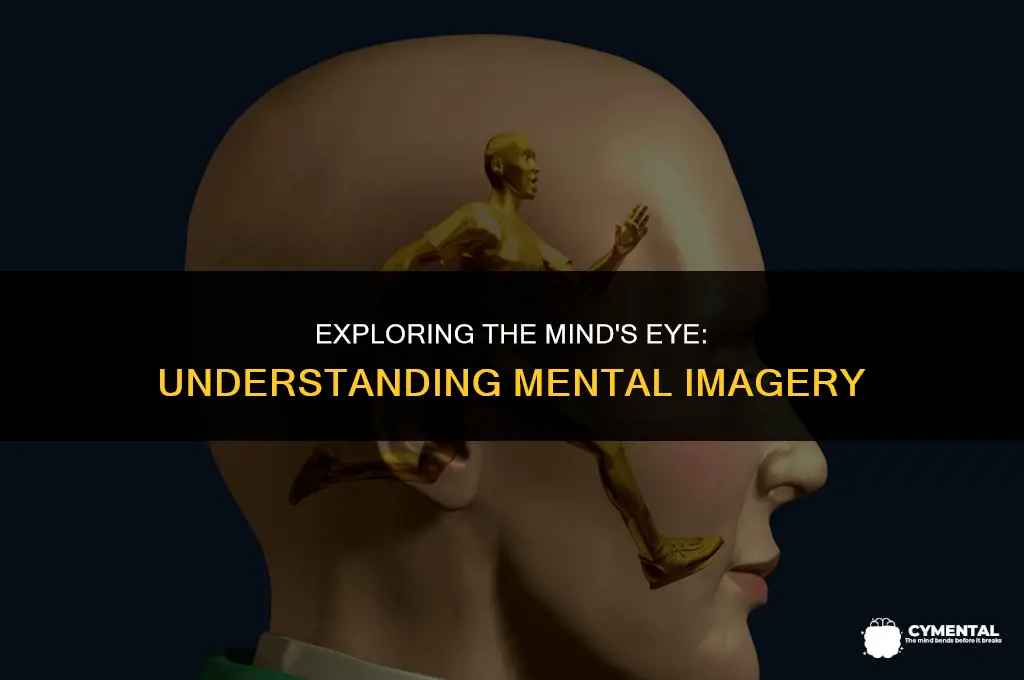
Mental imagery, also known as visualization, is the process of creating vivid mental pictures or scenes without the use of external sensory input. It involves the ability to imagine and manipulate visual, auditory, tactile, or other sensory experiences in one's mind. This cognitive process is a fundamental aspect of human consciousness, playing a crucial role in various mental activities such as memory, creativity, problem-solving, and emotional regulation. By harnessing the power of mental imagery, individuals can enhance their cognitive abilities, improve their focus and concentration, and even influence their physical performance in sports and other activities.
Explore related products


$16.49 $29.95

$18.6 $24.99


What You'll Learn
- Definition: Mental imagery refers to the process of creating visual representations in the mind
- Types: Includes visual, auditory, tactile, olfactory, and gustatory imagery, each engaging different senses
- Functions: Used in memory recall, problem-solving, creativity, and rehearsal of actions without physical movement
- Neural Basis: Involves activation of sensory and motor areas of the brain, similar to actual sensory experiences
- Applications: Utilized in sports psychology, cognitive therapy, and enhancing creative performance

Definition: Mental imagery refers to the process of creating visual representations in the mind
Mental imagery, the process of creating visual representations in the mind, is a complex cognitive function that involves the activation of various brain regions. This process is not merely a passive reception of visual stimuli but an active construction of mental pictures. It's akin to the brain's ability to simulate visual experiences without the presence of external visual input. This capability is crucial for tasks such as memory recall, spatial reasoning, and creative thinking.
One of the key aspects of mental imagery is its role in memory. When we remember a past event or a familiar place, we often conjure up a mental image associated with that memory. This visual component of memory is thought to be linked to the hippocampus, a brain structure critical for memory formation and retrieval. Mental imagery can also enhance memory retention; for instance, studies have shown that visualizing information can improve recall compared to simply reading or hearing it.
In the realm of creativity, mental imagery is a powerful tool. Artists, writers, and inventors often use mental imagery to conceptualize their ideas before bringing them to life. This process involves not just visual imagination but also the integration of other sensory modalities, such as sound, touch, and even smell, to create a rich and detailed mental representation.
Mental imagery also plays a significant role in sports and physical performance. Athletes often use visualization techniques to mentally rehearse their skills, which can improve their actual performance. This practice, known as mental rehearsal, involves creating vivid mental images of executing a skill or maneuver, which can help in building muscle memory and enhancing coordination.
In therapeutic contexts, mental imagery can be used as a tool for relaxation and stress reduction. Techniques such as guided imagery involve creating peaceful and calming mental scenes, which can help in reducing anxiety and promoting a sense of well-being. This application of mental imagery leverages the mind-body connection, where mental states can influence physical sensations and vice versa.
In conclusion, mental imagery is a multifaceted cognitive process that underlies various mental activities, from memory and creativity to sports performance and therapeutic practices. Its ability to simulate visual experiences in the absence of external stimuli makes it a valuable tool for enhancing cognitive functions and improving overall well-being.
Unlocking the Mind: Understanding the Power of Mental Conditioning
You may want to see also
Explore related products


Types: Includes visual, auditory, tactile, olfactory, and gustatory imagery, each engaging different senses
Mental imagery encompasses a wide array of sensory experiences that go beyond mere visual pictures. It includes auditory, tactile, olfactory, and gustatory imagery, each engaging different senses and contributing to a rich, multi-dimensional mental landscape.
Auditory imagery involves the mental recreation of sounds, such as music, voices, or environmental noises. This type of imagery can be particularly vivid for individuals with a strong auditory memory, allowing them to replay conversations or songs in their minds with remarkable clarity.
Tactile imagery refers to the mental sensation of touch, including textures, temperatures, and physical sensations like pain or pleasure. This form of imagery can be used in therapeutic settings to help individuals process and overcome traumatic experiences by revisiting them in a controlled, mental environment.
Olfactory imagery involves the mental perception of smells, which can be surprisingly powerful in evoking memories and emotions. The sense of smell is closely linked to the limbic system, which processes emotions and long-term memory, making olfactory imagery a potent tool for triggering nostalgic recollections.
Gustatory imagery, or the mental experience of taste, can range from the vivid recollection of a favorite food to the unpleasant memory of a bitter medicine. This type of imagery can be used in culinary arts to help chefs visualize and refine their recipes, or in medical settings to assist patients in managing their dietary needs.
Each type of mental imagery engages different neural pathways and can be used in various applications, from creative problem-solving to psychological therapy. By understanding and harnessing the power of these diverse forms of imagery, individuals can unlock new dimensions of mental exploration and self-discovery.
Unlocking Your Inner Child: Discover Your Mental Age Today!
You may want to see also
Explore related products


Functions: Used in memory recall, problem-solving, creativity, and rehearsal of actions without physical movement
Mental imagery serves as a powerful tool in memory recall, allowing individuals to vividly recreate past experiences in their minds. This function is particularly useful in situations where remembering specific details is crucial, such as in eyewitness testimonies or when recalling important information for academic or professional purposes. By mentally rehearsing these memories, individuals can strengthen their recall abilities and improve their overall memory retention.
In addition to memory recall, mental imagery plays a significant role in problem-solving. By visualizing different scenarios and outcomes, individuals can better assess potential solutions and make more informed decisions. This technique is often used in strategic planning and critical thinking exercises, where the ability to mentally simulate various possibilities can lead to more effective problem-solving strategies.
Creativity is another area where mental imagery excels. Artists, writers, and musicians often rely on their ability to visualize their work before bringing it to life. This process allows them to experiment with different ideas and concepts, refining their creative vision before committing to a physical medium. Mental imagery can also help overcome creative blocks by providing a mental space for free-form exploration and idea generation.
Furthermore, mental imagery is essential for the rehearsal of actions without physical movement. Athletes, for example, often use visualization techniques to mentally practice their skills, improving their performance and reducing the risk of injury. This method can also be applied to other areas, such as public speaking or learning a new instrument, where mental rehearsal can help build confidence and proficiency before actual practice.
Overall, the functions of mental imagery in memory recall, problem-solving, creativity, and action rehearsal highlight its versatility and importance in various aspects of human cognition and performance. By harnessing the power of mental imagery, individuals can enhance their abilities in these areas, leading to improved overall functioning and success.
Exploring Psychoactive Drugs: A Guide to Substances That Slow Mental and Physical Activity
You may want to see also
Explore related products


Neural Basis: Involves activation of sensory and motor areas of the brain, similar to actual sensory experiences
The neural basis of mental imagery involves the activation of sensory and motor areas of the brain, closely mirroring the neural activity observed during actual sensory experiences. This concept is rooted in the understanding that mental imagery engages similar brain regions as those involved in processing real-world sensory information. For instance, when an individual imagines seeing a vivid scene, the visual cortex, which is responsible for processing visual information, becomes active. Similarly, imagining a sound or a touch engages the auditory and somatosensory cortices, respectively.
Research using neuroimaging techniques such as functional magnetic resonance imaging (fMRI) and electroencephalography (EEG) has provided substantial evidence supporting this idea. Studies have shown that the brain's activity patterns during mental imagery are remarkably similar to those during actual sensory experiences, suggesting that the same neural mechanisms are at play. This overlap in neural activity is not limited to sensory areas; motor regions of the brain are also activated when individuals imagine performing actions, even in the absence of actual movement.
The implications of this neural overlap are profound. It suggests that mental imagery can be a powerful tool for influencing brain function and behavior. For example, mental rehearsal of a physical task can lead to improvements in performance, as the brain's motor areas are activated and strengthened through repeated mental practice. This concept has been applied in various fields, including sports psychology, where athletes use mental imagery to enhance their skills, and rehabilitation, where mental imagery can aid in the recovery of motor function following injury.
Furthermore, the neural basis of mental imagery has implications for our understanding of consciousness and the nature of subjective experience. If mental imagery can activate the same brain regions as actual sensory experiences, it raises questions about the distinction between imagined and real events. This has led to philosophical and scientific debates about the nature of reality and the extent to which our perceptions shape our understanding of the world.
In conclusion, the neural basis of mental imagery highlights the intricate relationship between the brain's sensory and motor systems and our ability to generate vivid mental experiences. This understanding has far-reaching implications for fields ranging from psychology and neuroscience to philosophy and beyond, offering insights into the complex mechanisms underlying human cognition and behavior.
Understanding Mental Abuse: Is It Considered Domestic Violence?
You may want to see also
Explore related products


Applications: Utilized in sports psychology, cognitive therapy, and enhancing creative performance
Mental imagery plays a pivotal role in sports psychology, where athletes use visualization techniques to mentally rehearse their performances. This practice helps in building confidence, reducing anxiety, and improving overall performance. For instance, a golfer might visualize the perfect swing before stepping up to the tee, or a swimmer might mentally navigate the pool before a race. These mental rehearsals can be as effective as physical practice in enhancing muscle memory and fine-tuning skills.
In cognitive therapy, mental imagery is utilized to help individuals overcome phobias, anxieties, and other mental health challenges. Therapists guide patients through imagined scenarios that trigger their fears, allowing them to confront and gradually desensitize their responses. This technique, known as exposure therapy, can be particularly effective in treating conditions like post-traumatic stress disorder (PTSD) and obsessive-compulsive disorder (OCD). By repeatedly visualizing and processing traumatic or anxiety-inducing situations in a controlled environment, patients can learn to manage their symptoms and regain control over their lives.
Mental imagery also serves as a powerful tool for enhancing creative performance. Artists, musicians, and writers often use visualization to generate ideas, refine their work, and overcome creative blocks. For example, a painter might visualize the composition of a new piece before putting brush to canvas, or a composer might mentally hear a melody before writing it down. This process allows creatives to explore different possibilities, experiment with new concepts, and bring their visions to life more effectively.
Moreover, mental imagery can be applied in various other fields, such as education, business, and personal development. Students can use visualization to improve their memory and concentration, while professionals can use it to prepare for presentations, negotiations, and other high-pressure situations. In personal development, mental imagery can help individuals set and achieve goals, build self-esteem, and cultivate a positive mindset.
In conclusion, mental imagery is a versatile and powerful tool with a wide range of applications. By harnessing the power of visualization, individuals can enhance their performance, overcome challenges, and unlock their creative potential. Whether used in sports, therapy, or creative pursuits, mental imagery offers a valuable technique for achieving personal and professional success.
Exploring Mental Sets: Understanding the Power of Cognitive Frameworks
You may want to see also
Frequently asked questions
Mental imagery is the process of creating visual representations in your mind. It involves using your imagination to form pictures or scenes without the need for external stimuli.
Mental imagery works by activating the visual cortex of your brain, which is responsible for processing visual information. When you imagine something, your brain creates a mental picture by combining memories, emotions, and other sensory information.
Mental imagery has several benefits, including improving memory, enhancing creativity, and reducing stress. It can also be used as a tool for problem-solving and decision-making, as well as for improving athletic performance and public speaking skills.