Caleb Wright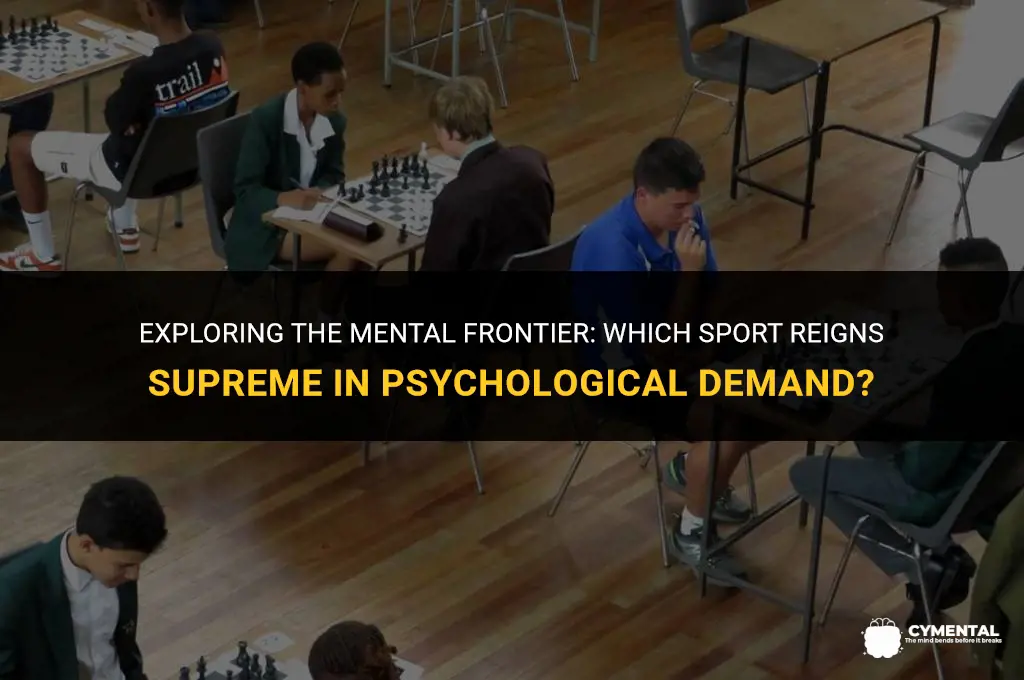
Determining the most mentally demanding sport is a complex task that involves analyzing various factors such as cognitive load, decision-making speed, strategic depth, and psychological resilience. While physical prowess is crucial in many sports, mental strength often plays a decisive role in achieving success. Sports like chess, Go, and bridge are traditionally recognized for their high cognitive demands, requiring players to think several moves ahead, anticipate opponents' strategies, and maintain intense focus over extended periods. However, other sports such as basketball, soccer, and tennis also require quick decision-making, adaptability, and mental toughness to perform under pressure. Ultimately, the most mentally demanding sport may vary depending on individual perspectives and the specific mental skills being evaluated.
Explore related products


What You'll Learn
- Chess: Strategic thinking, problem-solving, and foresight are essential in this intellectual battle
- Go: This ancient game demands profound concentration, planning, and adaptability
- Poker: Mental fortitude, risk assessment, and emotional control are key in this psychological game
- Bridge: Communication, teamwork, and complex decision-making under pressure define this card game
- E-Sports: Reflexes, strategic planning, and teamwork are crucial in competitive video gaming

Chess: Strategic thinking, problem-solving, and foresight are essential in this intellectual battle
Chess, often hailed as the ultimate mental sport, demands a unique blend of strategic thinking, problem-solving, and foresight. Unlike other games that may rely on physical prowess or quick reflexes, chess is a battle of wits where every move is a calculated decision with far-reaching consequences. Players must constantly analyze the board, anticipate their opponent's actions, and plan several moves ahead, making it a rigorous exercise in mental agility.
One of the key aspects of chess that sets it apart as a mental sport is its emphasis on strategic thinking. This involves not just reacting to the current state of the board but also envisioning the future possibilities and positioning pieces to gain a long-term advantage. For instance, a player might sacrifice a piece in the short term to create a more favorable position for their remaining pieces, demonstrating the kind of foresight and planning that is crucial in chess.
Problem-solving is another critical skill in chess. Players are constantly faced with complex positions that require them to find the best possible move. This often involves evaluating multiple options, considering the potential outcomes of each, and choosing the one that maximizes their chances of success. The ability to solve these intricate problems under pressure is a testament to the mental acuity required in chess.
Moreover, chess is a game of incomplete information, where players can never be certain of their opponent's next move. This uncertainty adds an extra layer of complexity, as players must be prepared to adapt their strategies on the fly. The ability to think critically and make sound decisions in the face of uncertainty is a valuable skill that chess players develop over time.
In conclusion, chess stands out as the most mental sport due to its demanding requirements of strategic thinking, problem-solving, and foresight. It is a game that challenges players to think critically, plan ahead, and adapt to changing circumstances, making it a rigorous and rewarding intellectual pursuit.
Rebuilding Resilience: A Guide to Recovery After a Mental Breakdown
You may want to see also
Explore related products


Go: This ancient game demands profound concentration, planning, and adaptability
Go, an ancient board game originating from East Asia, is renowned for its complexity and depth, demanding profound concentration, strategic planning, and adaptability from its players. The game's objective is deceptively simple: to control a larger territory than one's opponent by placing black or white stones on a grid. However, the intricacies of Go quickly become apparent as players delve into the game's many layers.
One of the key aspects that makes Go a highly mental sport is the need for intense focus and concentration. Players must carefully consider each move, anticipating their opponent's responses and adjusting their strategy accordingly. This requires not only a deep understanding of the game's rules and tactics but also the ability to read one's opponent's intentions and adapt to changing circumstances.
Strategic planning is another crucial element of Go. Unlike chess, where the ultimate goal is to checkmate the opponent's king, Go's objective is more nuanced. Players must balance the need to expand their territory with the requirement to defend their existing positions. This often involves making difficult decisions about where to place stones, when to attack, and when to defend. The game's complexity is further heightened by the fact that there are countless possible moves, making it impossible to rely solely on brute force calculations.
Adaptability is also essential in Go. As the game progresses, players must be prepared to adjust their strategies in response to their opponent's moves. This requires a high degree of flexibility and the ability to think creatively. Go players often describe the game as a form of meditation, where the act of playing helps to clear the mind and promote a sense of inner peace.
In conclusion, Go is a highly mental sport that demands profound concentration, strategic planning, and adaptability from its players. Its unique blend of simplicity and complexity makes it a fascinating game that continues to captivate players around the world. Whether played casually or competitively, Go offers a rich and rewarding experience that challenges the mind and promotes mental agility.
Exploring Rhymes: A Mental Journey Through Language and Sound
You may want to see also
Explore related products


Poker: Mental fortitude, risk assessment, and emotional control are key in this psychological game
Poker, often regarded as a game of chance, is in fact a deeply psychological sport that demands a high degree of mental fortitude. Players must possess the ability to remain calm under pressure, make quick decisions based on incomplete information, and control their emotions to avoid giving away their hand. The mental toughness required in poker is multifaceted, encompassing both the ability to withstand the stress of high-stakes games and the discipline to stick to a well-thought-out strategy.
Risk assessment is another crucial component of poker. Players must constantly evaluate the potential outcomes of their actions, weighing the odds of winning against the risk of losing. This involves not only understanding the mathematical probabilities of different hands but also reading the behavior of opponents to anticipate their moves. Effective risk assessment in poker requires a keen analytical mind and the ability to adapt to changing circumstances.
Emotional control is perhaps the most challenging aspect of poker. The game is designed to elicit strong emotional responses, from the thrill of a big win to the disappointment of a bad beat. Players who can maintain their composure and avoid letting their emotions dictate their decisions have a significant advantage. This emotional resilience is developed through experience and practice, as well as a deep understanding of the psychological aspects of the game.
In addition to these key mental skills, poker also requires a high degree of focus and concentration. Players must be able to block out distractions and maintain their attention on the game for extended periods. This level of mental discipline is essential for making accurate decisions and staying ahead of opponents.
Overall, poker is a sport that demands a unique combination of mental skills, including fortitude, risk assessment, emotional control, and focus. Those who excel in these areas are more likely to succeed in the game, demonstrating that poker is indeed one of the most mentally challenging sports.
Navigating the Legal Process: Proving Mental Incapacity
You may want to see also
Explore related products

$24.99 $24.99


Bridge: Communication, teamwork, and complex decision-making under pressure define this card game
Bridge, a card game renowned for its complexity and depth, epitomizes the concept of a mental sport. It demands not only strategic thinking but also acute communication skills and the ability to function seamlessly as part of a team. Players must navigate a myriad of conventions and bidding strategies, all while maintaining a poker face and deducing their opponents' intentions.
One of the key mental challenges in bridge lies in its unique partnership dynamic. Unlike other team sports where communication is often verbal and explicit, bridge partners must rely on subtle cues and a deep understanding of each other's playing styles. This silent communication is crucial during the bidding phase, where partners exchange information about their hand strength and suit preferences through a series of bids. A single miscommunication can lead to a disastrous hand, making bridge a high-stakes game of psychological nuance.
The decision-making process in bridge is equally demanding. Players must constantly evaluate the probability of various outcomes, taking into account not only their own cards but also the likely holdings of their opponents. This requires a sophisticated understanding of combinatorics and probability theory, as well as the ability to think several moves ahead. The pressure is further amplified by the fact that bridge is often played in competitive settings, where the consequences of a wrong decision can be significant.
Bridge also stands out as a mental sport due to its emphasis on adaptability and creativity. No two hands are ever the same, and players must be able to adjust their strategies on the fly in response to unexpected developments. This requires a flexible mindset and the ability to think outside the box, traits that are highly valued in many other areas of life.
In conclusion, bridge is a quintessential mental sport that challenges players to excel in communication, teamwork, and complex decision-making under pressure. Its unique blend of strategic depth and psychological nuance makes it a fascinating and rewarding pursuit for those who enjoy intellectual challenges.
Unveiling Mental Abuse: A Guide for Divorce Proceedings
You may want to see also
Explore related products


E-Sports: Reflexes, strategic planning, and teamwork are crucial in competitive video gaming
E-Sports, or competitive video gaming, is a rapidly growing field that demands a unique combination of mental skills. At its core, E-Sports requires players to possess exceptional reflexes, enabling them to react quickly to in-game situations. This is particularly evident in fast-paced games like Counter-Strike: Global Offensive and Overwatch, where split-second decisions can mean the difference between victory and defeat.
However, reflexes alone are not sufficient to excel in E-Sports. Strategic planning is also a critical component, as players must be able to anticipate their opponents' moves and adapt their tactics accordingly. This involves a deep understanding of the game's mechanics, as well as the ability to analyze and interpret data in real-time. For example, in games like League of Legends and Dota 2, players must carefully manage their resources, plan their attacks, and coordinate with their teammates to outmaneuver their opponents.
Teamwork is another essential skill in E-Sports, as many games require players to work together to achieve a common goal. Effective communication, trust, and collaboration are key to success in team-based games like Rocket League and Apex Legends. Players must be able to quickly identify their roles within the team, make strategic decisions, and execute their plans with precision.
The mental demands of E-Sports are further compounded by the pressure of competition. Players must be able to maintain their focus and composure under intense scrutiny, often in high-stakes environments with large audiences. This requires a high degree of mental resilience, as well as the ability to manage stress and anxiety.
In conclusion, E-Sports is a highly mental sport that demands a unique combination of reflexes, strategic planning, and teamwork. Players must be able to react quickly to in-game situations, anticipate their opponents' moves, and work together with their teammates to achieve victory. The mental demands of E-Sports are significant, requiring players to possess exceptional focus, composure, and resilience.
Embracing Self-Care: A Journey to Nurture Your Mind, Body, and Soul
You may want to see also
Frequently asked questions
Chess is often considered the most mental sport due to its requirement for strategic thinking, problem-solving, and foresight.
Chess demands intense concentration, analytical skills, and the ability to anticipate an opponent's moves, making it a game that heavily relies on mental prowess.
Yes, sports like Go, bridge, and even poker are known for their mental demands, requiring players to think critically and strategically.
Unlike physical sports that emphasize bodily strength and agility, chess focuses on mental strength, endurance, and the ability to outthink an opponent, making it a unique challenge.