Lucas Bennett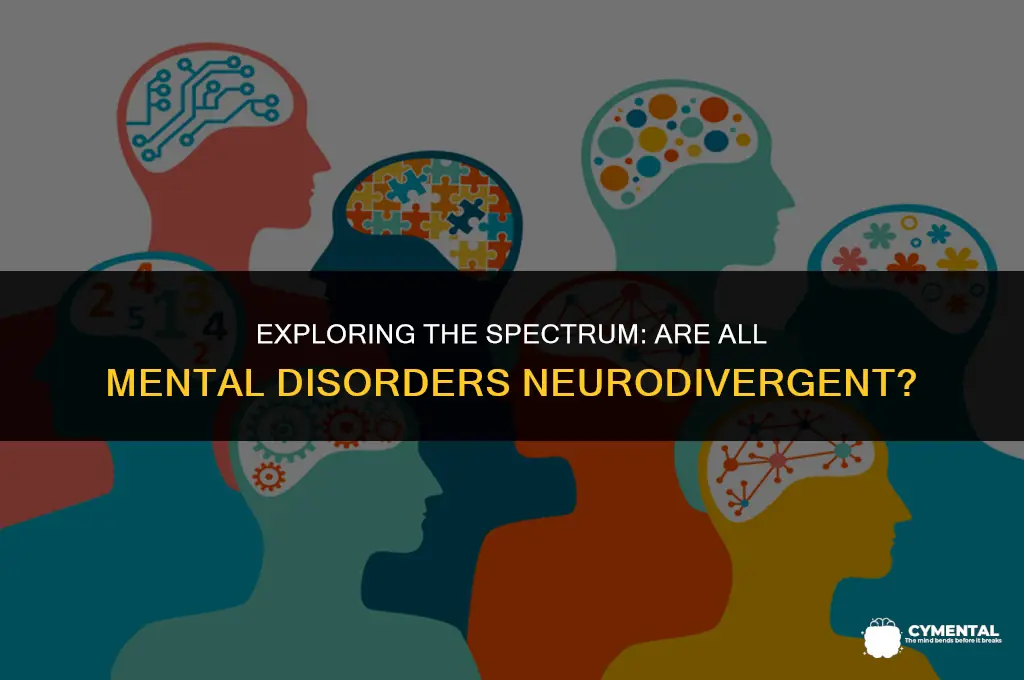
Neurodivergence is a term used to describe individuals whose brain functions differ from what is considered typical. It encompasses a range of conditions, including autism, ADHD, dyslexia, and Tourette's syndrome. The question of whether all mental disorders are neurodivergent is a complex one, as it requires careful consideration of the definitions and characteristics of both neurodivergence and mental disorders. While some mental health conditions, such as depression or anxiety, may not necessarily involve neurodivergent traits, others, like autism or ADHD, are often considered neurodivergent. It's important to recognize that neurodivergence is not inherently positive or negative; rather, it's a natural variation in human brain function that can bring both strengths and challenges.
| Characteristics | Values |
|---|---|
| Definition | Neurodivergence refers to variations in brain function and structure that affect how individuals perceive, process, and interact with the world. Mental disorders are conditions that affect mood, thinking, and behavior. |
| Inclusion | Not all mental disorders are considered neurodivergent. Neurodivergence is a broader term that encompasses a range of neurological differences, including but not limited to mental disorders. |
| Examples of Neurodivergent Conditions | Autism Spectrum Disorder (ASD), Attention Deficit Hyperactivity Disorder (ADHD), Dyslexia, Tourette Syndrome, Bipolar Disorder, Schizophrenia. |
| Examples of Mental Disorders Not Considered Neurodivergent | Depression, Anxiety Disorders, Post-Traumatic Stress Disorder (PTSD), Obsessive-Compulsive Disorder (OCD), Eating Disorders. |
| Diagnostic Criteria | Neurodivergent conditions are typically diagnosed based on specific criteria outlined in diagnostic manuals such as the DSM-5 or ICD-11. These criteria often include behavioral observations, cognitive assessments, and sometimes genetic testing. |
| Impact on Daily Life | Neurodivergent conditions can significantly impact daily life, affecting social interactions, communication, learning, and emotional regulation. The impact varies widely depending on the individual and the specific condition. |
| Treatment Approaches | Treatment for neurodivergent conditions often involves a combination of medication, therapy, and support services. The goal is to help individuals manage symptoms and improve their quality of life. |
| Stigma and Awareness | There is ongoing stigma surrounding both neurodivergent conditions and mental disorders. Increasing awareness and understanding is crucial for reducing stigma and promoting acceptance. |
| Research and Development | Research into neurodivergent conditions is ongoing, with a focus on understanding the underlying causes, developing more effective treatments, and improving diagnostic methods. |
| Community and Support | There are many communities and support groups available for individuals with neurodivergent conditions and their families. These groups provide valuable resources, information, and emotional support. |
Explore related products


What You'll Learn
- Defining neurodivergence: Understanding the concept and its implications for mental health classification
- Historical context: Tracing the evolution of neurodivergence as a framework for viewing mental disorders
- Current debates: Exploring the ongoing discussions and controversies surrounding neurodivergence in psychiatry
- Neurodivergent conditions: Examining specific conditions like ADHD, autism, and dyslexia within the neurodivergent paradigm
- Implications for treatment: Considering how a neurodivergent approach might influence therapeutic strategies and interventions

Defining neurodivergence: Understanding the concept and its implications for mental health classification
Neurodivergence refers to the natural variations in human brain function and structure that result in different cognitive and behavioral traits. It encompasses a range of conditions, including autism, ADHD, dyslexia, and Tourette's syndrome, among others. These conditions are characterized by differences in information processing, social interaction, communication, and motor control.
The concept of neurodivergence challenges the traditional view of mental health classification, which often focuses on diagnosing and treating conditions as if they were illnesses or disorders. Instead, neurodivergence emphasizes the idea that these conditions are simply different ways of being, with their own unique strengths and challenges. This perspective encourages a more inclusive and accepting approach to mental health, one that values diversity and individuality.
One of the key implications of neurodivergence for mental health classification is the need to move away from a deficit-based model, which focuses on identifying and correcting perceived weaknesses or abnormalities. Instead, a neurodivergent approach would emphasize identifying and building on individual strengths and abilities, while providing support and accommodations to help individuals thrive.
Another important implication is the need to recognize that neurodivergent conditions are not inherently pathological or disabling. While they may present challenges in certain contexts, they can also confer unique advantages, such as enhanced creativity, problem-solving skills, and attention to detail. By reframing these conditions as natural variations rather than disorders, we can work towards creating a more inclusive and supportive society that values the contributions of all individuals.
In practice, this might involve providing alternative educational and employment opportunities that cater to different learning styles and cognitive strengths. It could also mean offering targeted support and interventions that focus on enhancing individual abilities, rather than trying to "fix" perceived deficits. By embracing the concept of neurodivergence, we can work towards a more nuanced and compassionate understanding of mental health, one that recognizes and celebrates the diversity of human experience.
Understanding ADHD: A Mental Health Disorder or Not?
You may want to see also
Explore related products


Historical context: Tracing the evolution of neurodivergence as a framework for viewing mental disorders
The concept of neurodivergence as a framework for understanding mental disorders is a relatively recent development in the field of psychology and psychiatry. Historically, mental disorders were viewed through a medical lens, with an emphasis on diagnosing and treating symptoms. However, in the late 20th century, a shift began to occur, as researchers and clinicians started to recognize the importance of understanding the underlying neurological and cognitive differences that contribute to mental health conditions.
One of the key figures in this shift was Dr. Temple Grandin, an autistic psychologist who began to advocate for a more nuanced understanding of autism and other neurodevelopmental disorders. Grandin's work highlighted the importance of recognizing the unique strengths and challenges of individuals with these conditions, rather than simply pathologizing their differences.
The neurodivergence framework builds on this idea, proposing that mental disorders are not simply medical conditions to be treated, but rather natural variations in human brain function and behavior. This perspective emphasizes the importance of acceptance, accommodation, and support for individuals with neurodivergent conditions, rather than trying to change or "fix" them.
The evolution of the neurodivergence framework has been influenced by a number of factors, including advances in neuroscience, changes in societal attitudes towards mental health, and the growing recognition of the importance of diversity and inclusion. Today, the neurodivergence framework is increasingly being adopted by mental health professionals, educators, and policymakers, as a more holistic and compassionate approach to understanding and supporting individuals with mental health conditions.
However, the neurodivergence framework is not without its critics. Some argue that it can be too broad, encompassing a wide range of conditions that may not share a common underlying cause. Others worry that it may lead to a lack of attention to the very real challenges and suffering that individuals with mental health conditions often experience.
Despite these criticisms, the neurodivergence framework represents an important step forward in our understanding of mental health and mental disorders. By recognizing the inherent value and diversity of all individuals, regardless of their neurological makeup, we can work towards creating a more inclusive and supportive society for everyone.
Understanding Gender Dysphoria: DSM-5 Classification and Beyond
You may want to see also
Explore related products


Current debates: Exploring the ongoing discussions and controversies surrounding neurodivergence in psychiatry
The debate surrounding neurodivergence in psychiatry is multifaceted and ongoing. At its core, it challenges the traditional medical model of mental health, which often views mental disorders as illnesses to be cured. In contrast, the neurodiversity paradigm posits that mental differences should be recognized and respected as natural variations of the human brain, rather than stigmatized as disorders.
One of the key controversies in this debate is the question of whether all mental disorders can be classified as neurodivergent. Proponents of the neurodiversity model argue that conditions such as autism, ADHD, and bipolar disorder are not illnesses, but rather neurological differences that can offer unique strengths and perspectives. They contend that these conditions should not be pathologized, but rather accommodated and supported within society.
Critics, however, argue that some mental disorders, such as schizophrenia and severe depression, may not fit neatly into the neurodiversity framework. They suggest that these conditions can cause significant distress and impairment, and may require medical intervention and treatment. Furthermore, they argue that the neurodiversity model may overlook the complex interplay between biological, psychological, and social factors that contribute to mental health issues.
Another point of contention is the role of psychiatry in the neurodiversity movement. Some argue that psychiatry has historically been complicit in the stigmatization and marginalization of neurodivergent individuals, and that it should play a more active role in promoting neurodiversity awareness and acceptance. Others, however, argue that psychiatry should maintain its focus on diagnosing and treating mental disorders, and that the neurodiversity movement should operate independently of the medical establishment.
Ultimately, the debate surrounding neurodivergence in psychiatry is complex and nuanced, with valid arguments on both sides. As our understanding of mental health and neurodiversity continues to evolve, it is likely that this debate will persist, challenging us to rethink our assumptions about mental illness and the role of psychiatry in society.
Understanding Adjustment Disorder: Is It a Mental Illness?
You may want to see also
Explore related products


Neurodivergent conditions: Examining specific conditions like ADHD, autism, and dyslexia within the neurodivergent paradigm
ADHD, autism, and dyslexia are among the most recognized neurodivergent conditions. Each represents a unique way of experiencing and interacting with the world, characterized by distinct cognitive and behavioral patterns. ADHD, or Attention Deficit Hyperactivity Disorder, is often marked by difficulties with sustained attention, impulsivity, and hyperactivity. Autism, formally known as Autism Spectrum Disorder, encompasses a range of social, communication, and behavioral challenges. Dyslexia, a learning disorder, primarily affects reading and writing abilities.
Within the neurodivergent paradigm, these conditions are not viewed as disorders to be cured but as natural variations of the human brain. This perspective emphasizes the importance of understanding and accommodating the unique needs and strengths of neurodivergent individuals. For instance, people with ADHD may excel in tasks requiring creativity and quick thinking, while autistic individuals might possess exceptional attention to detail and pattern recognition skills. Those with dyslexia often demonstrate strengths in spatial reasoning and problem-solving.
The neurodivergent paradigm advocates for a shift from a deficit-based approach, which focuses on what individuals cannot do, to a strengths-based approach, which highlights their abilities and potential. This involves creating environments that are inclusive and supportive, providing resources and accommodations that enable neurodivergent individuals to thrive. In educational settings, this might mean offering alternative learning methods, such as visual or kinesthetic aids for dyslexic students, or providing structured routines and clear communication for autistic students.
Moreover, the neurodivergent perspective encourages self-advocacy and empowerment. It recognizes that neurodivergent individuals are the experts of their own experiences and should be actively involved in decisions that affect their lives. This includes participating in the development of individualized education plans, workplace accommodations, and healthcare strategies.
In conclusion, examining ADHD, autism, and dyslexia within the neurodivergent paradigm offers a more nuanced and respectful understanding of these conditions. It highlights the importance of recognizing and valuing the unique contributions of neurodivergent individuals, fostering a society that is more inclusive and supportive of diverse cognitive styles.
Unveiling the Most Prevalent Mental Health Condition: A Comprehensive Guide
You may want to see also
Explore related products


Implications for treatment: Considering how a neurodivergent approach might influence therapeutic strategies and interventions
A neurodivergent approach to mental health treatment could significantly influence therapeutic strategies and interventions. This perspective emphasizes the importance of recognizing and respecting the unique cognitive and behavioral patterns of neurodivergent individuals, rather than attempting to "fix" or normalize them. In practice, this might involve a shift away from traditional deficit-based models of treatment, which often focus on identifying and correcting perceived abnormalities. Instead, therapists might adopt a more strengths-based approach, helping clients to identify and build upon their individual talents and abilities.
One potential implication of this approach is the need for greater flexibility and adaptability in therapeutic interventions. Neurodivergent individuals may respond differently to traditional treatment methods, and may require more personalized and creative approaches. For example, a therapist working with an autistic client might use visual aids or other non-verbal communication tools to facilitate understanding and expression. Similarly, a therapist working with an ADHD client might incorporate movement or other physical activities into sessions to help the client stay focused and engaged.
Another important consideration is the need to address the social and environmental factors that can impact the mental health of neurodivergent individuals. This might involve working with clients to identify and navigate social barriers, such as stigma or discrimination, and to develop strategies for coping with sensory overload or other environmental challenges. By taking a more holistic approach to treatment, therapists can help neurodivergent clients to thrive in their unique contexts.
Ultimately, a neurodivergent approach to mental health treatment requires a fundamental shift in perspective, from viewing neurodivergence as a problem to be solved, to recognizing it as a natural and valuable aspect of human diversity. By embracing this perspective, therapists can develop more effective and compassionate interventions that support the well-being and self-determination of neurodivergent individuals.
Exploring the Intricacies: Is Love a Mental Disorder?
You may want to see also
Frequently asked questions
No, not all mental disorders are considered neurodivergent. Neurodivergence refers to natural variations in the human brain that result in different cognitive styles and behaviors, such as autism, ADHD, and dyslexia. Mental disorders, on the other hand, are conditions that affect a person's thinking, feeling, or behavior in a way that causes distress or impairment, such as depression, anxiety, or schizophrenia. While some mental disorders may have neurodivergent aspects, they are not the same thing.
Yes, a person can be both neurodivergent and have a mental disorder. For example, someone with autism (a neurodivergent condition) may also experience depression or anxiety (mental disorders). It's important to recognize that neurodivergence and mental health conditions can coexist and may interact in complex ways.
No, neurodivergence is not a mental disorder. Neurodivergence refers to natural variations in the human brain that result in different cognitive styles and behaviors. These variations are not inherently pathological or disordered, but they may present challenges or advantages in certain contexts.
Neurodivergent conditions and mental disorders often require different approaches to treatment. Neurodivergent conditions may not necessarily require treatment, as they are natural variations in the human brain. However, some neurodivergent individuals may benefit from accommodations, therapies, or medications that help them manage their symptoms or thrive in their environment. Mental disorders, on the other hand, typically require treatment to address the underlying causes and alleviate symptoms. Treatment may include therapy, medication, or other interventions aimed at improving mental health and well-being.
Yes, there is a relationship between neurodivergence and mental health stigma. Both neurodivergent individuals and those with mental disorders may face stigma and discrimination due to their differences from the majority population. This stigma can lead to negative attitudes, behaviors, and policies that marginalize and disadvantage these groups. It's important to challenge and address stigma in order to promote understanding, acceptance, and inclusion of all individuals, regardless of their neurological or mental health status.