Lucas Bennett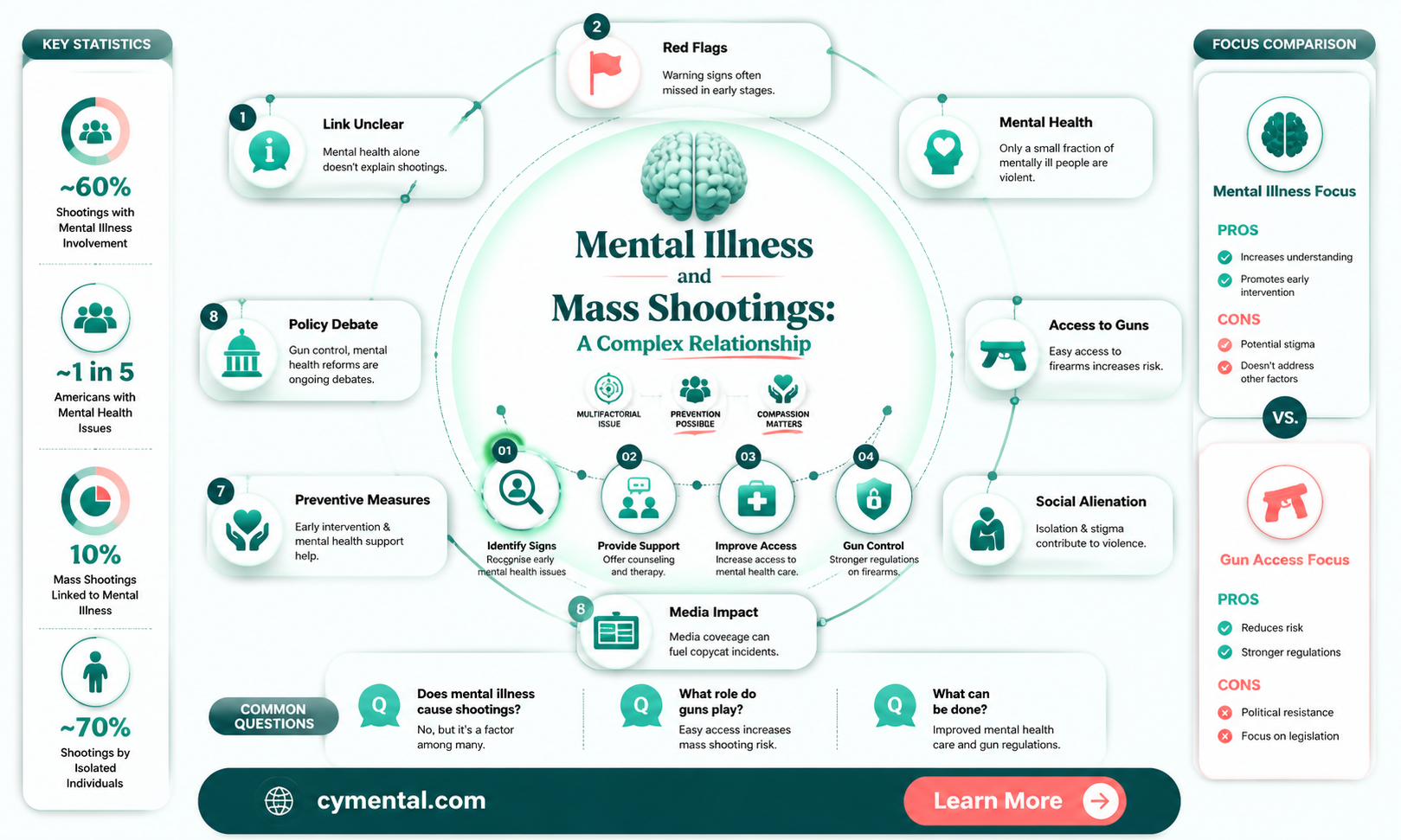
The relationship between mass shootings and mental illness is a complex and contentious issue. While some high-profile cases have involved perpetrators with documented mental health issues, experts caution against oversimplifying the connection. Research suggests that the vast majority of people with mental illnesses are not violent, and that factors such as access to firearms, societal pressures, and personal grievances play a more significant role in mass shootings. It is crucial to approach this topic with nuance and evidence-based perspectives, avoiding stigmatization of those with mental health conditions while also addressing the multifaceted causes of gun violence.
| Characteristics | Values |
|---|---|
| Causality | Complex interplay between mental illness and other factors |
| Definition | Mass shootings: rare, premeditated attacks in public spaces |
| Mental Illness | Often present but not the sole cause |
| Other Factors | Social isolation, access to firearms, political/ideological beliefs |
| Statistical Link | Weak correlation between mental illness and mass shootings |
| Media Representation | Sensationalized portrayal of shooters as mentally ill |
| Public Perception | Misconceptions about mental illness and violence |
| Policy Implications | Need for comprehensive approaches addressing multiple factors |
Explore related products


What You'll Learn
- Correlation vs. Causation: Exploring whether mental illness directly causes mass shootings or if other factors are more influential
- Stigma and Stereotypes: Addressing how media portrayal of mental illness impacts public perception and potentially stigmatizes individuals
- Access to Mental Health Care: Discussing the role of available mental health resources and their impact on preventing violent acts
- Red Flag Laws and Intervention: Evaluating the effectiveness of laws allowing for the temporary removal of firearms from individuals deemed a risk
- Comprehensive Solutions: Considering a multifaceted approach to preventing mass shootings, including mental health, gun control, and societal factors

Correlation vs. Causation: Exploring whether mental illness directly causes mass shootings or if other factors are more influential
The debate surrounding the relationship between mental illness and mass shootings is complex and multifaceted. While there is a common perception that mental illness is a primary cause of such tragic events, a closer examination reveals that the connection is not as straightforward as it may seem. Research indicates that the vast majority of individuals with mental illnesses do not engage in violent behavior, and that other factors, such as access to firearms, socioeconomic conditions, and cultural influences, may play a more significant role in the perpetration of mass shootings.
One of the key challenges in understanding the relationship between mental illness and mass shootings is distinguishing between correlation and causation. Correlation refers to the statistical association between two variables, while causation implies a direct, causal relationship between them. In the context of mental illness and mass shootings, it is essential to recognize that even if there is a correlation between the two, it does not necessarily mean that mental illness causes mass shootings. Other factors, such as substance abuse, trauma, and social isolation, may also be correlated with both mental illness and violent behavior, making it difficult to establish a direct causal link.
Furthermore, the stigmatization of mental illness can have harmful consequences, leading to increased discrimination and decreased access to mental health care for those who need it. By focusing solely on mental illness as the cause of mass shootings, we may overlook other critical factors that contribute to these events, such as the glorification of violence in media, the proliferation of hate speech, and the lack of adequate gun control measures. A more nuanced approach is necessary, one that acknowledges the complexity of the issue and considers the interplay of multiple factors in the perpetration of mass shootings.
In conclusion, while mental illness may be a contributing factor in some cases of mass shootings, it is essential to recognize that the relationship is not as clear-cut as it may seem. By distinguishing between correlation and causation, and by considering the broader social and cultural context in which these events occur, we can develop a more comprehensive understanding of the issue and work towards more effective solutions to prevent such tragedies in the future.
Exploring the Link: Bladder Infections and Mental Confusion
You may want to see also
Explore related products


Stigma and Stereotypes: Addressing how media portrayal of mental illness impacts public perception and potentially stigmatizes individuals
The media's portrayal of mental illness plays a significant role in shaping public perception and can often lead to the stigmatization of individuals with mental health conditions. Sensationalized news stories and fictional depictions in movies and television shows frequently perpetuate harmful stereotypes, suggesting that people with mental illnesses are violent, unpredictable, or dangerous. This can result in increased fear and misunderstanding among the general population, leading to social exclusion and discrimination against those who are already vulnerable.
One of the most damaging stereotypes is the association between mental illness and mass shootings. While it is true that some perpetrators of mass violence have been found to have mental health issues, this is not a universal characteristic. The vast majority of people with mental illnesses are not violent, and the media's focus on these rare cases can create a distorted view of the relationship between mental health and violence. This can lead to harmful consequences, such as increased stigma, reduced access to mental health care, and the perpetuation of harmful myths.
To address this issue, it is essential to promote more accurate and nuanced representations of mental illness in the media. This can be achieved through responsible reporting practices, such as avoiding sensationalism and providing context about the complexities of mental health issues. Additionally, media outlets can feature stories that highlight the positive contributions of people with mental illnesses, helping to humanize and destigmatize these conditions.
Another important strategy is to increase public education and awareness about mental health. By providing accurate information about mental illnesses, their causes, and their treatments, we can help to dispel myths and reduce stigma. This can be done through a variety of channels, including schools, community organizations, and online resources.
Ultimately, addressing the stigma and stereotypes surrounding mental illness requires a multifaceted approach that involves both the media and the broader public. By working together to promote accurate representations and increase understanding, we can help to create a more compassionate and inclusive society for all individuals, regardless of their mental health status.
Unveiling the Mind: Mental Illnesses Behind Hallucinations
You may want to see also
Explore related products


Access to Mental Health Care: Discussing the role of available mental health resources and their impact on preventing violent acts
Access to mental health care plays a critical role in preventing violent acts, including mass shootings. Research indicates that individuals who commit such acts often have a history of mental health issues that, if addressed, could potentially mitigate the risk of violence. The availability and accessibility of mental health resources can significantly impact an individual's ability to seek help and manage their mental health effectively.
One of the key challenges in addressing mental health issues related to violent acts is the stigma associated with seeking help. Many individuals may be reluctant to access mental health care due to fear of being labeled or judged. Additionally, there may be systemic barriers, such as lack of insurance coverage or limited availability of mental health professionals in certain areas, that prevent individuals from receiving the care they need.
To address these challenges, it is essential to increase awareness about the importance of mental health care and to work towards reducing the stigma associated with seeking help. This can be achieved through public education campaigns, community outreach programs, and initiatives that promote mental health literacy. Furthermore, policymakers must work to ensure that mental health care is accessible and affordable for all individuals, regardless of their socioeconomic status or geographic location.
In addition to increasing access to mental health care, it is also important to focus on early intervention and prevention strategies. This includes identifying individuals who may be at risk of committing violent acts and providing them with appropriate support and resources. Mental health professionals can play a crucial role in this process by conducting assessments and developing individualized treatment plans that address the specific needs of each person.
Ultimately, improving access to mental health care and implementing effective prevention strategies can help to reduce the incidence of violent acts, including mass shootings. By addressing the underlying mental health issues that contribute to such acts, we can work towards creating a safer and more supportive community for all individuals.
Exploring the Link Between Cannabis Use and Mental Health
You may want to see also
Explore related products


Red Flag Laws and Intervention: Evaluating the effectiveness of laws allowing for the temporary removal of firearms from individuals deemed a risk
Red flag laws have emerged as a legislative response to the growing concern over mass shootings in the United States. These laws allow for the temporary removal of firearms from individuals who are deemed to be a risk to themselves or others. The premise is that by identifying and intervening with individuals exhibiting warning signs, such as threatening behavior or mental health crises, potential tragedies can be averted.
The effectiveness of red flag laws is a subject of ongoing debate. Proponents argue that these laws provide a crucial tool for law enforcement and mental health professionals to prevent gun violence. They point to cases where red flag laws have successfully prevented potential mass shootings by removing firearms from individuals who were later found to be planning such attacks.
However, critics raise concerns about the potential for abuse and the impact on individual rights. They argue that red flag laws can lead to the wrongful seizure of firearms from law-abiding citizens based on vague or unsubstantiated claims. Additionally, there are concerns about the stigmatization of individuals with mental health issues and the potential for these laws to disproportionately affect marginalized communities.
Research on the effectiveness of red flag laws is limited, and the results are mixed. Some studies suggest that these laws may be associated with a reduction in gun-related suicides and homicides, while others find no significant impact. The lack of comprehensive data and the variability in how these laws are implemented across different jurisdictions make it challenging to draw definitive conclusions about their effectiveness.
Despite the ongoing debate, red flag laws continue to be enacted in states across the country. As these laws evolve, it is crucial to carefully evaluate their impact and to address the concerns raised by critics. This includes ensuring that the laws are implemented in a way that respects individual rights and does not disproportionately affect vulnerable populations. By doing so, we can work towards developing effective and equitable solutions to the complex problem of gun violence.
Unraveling the Triggers: A Deep Dive into Mental Breakdowns
You may want to see also
Explore related products


$4.38 $19.99


Comprehensive Solutions: Considering a multifaceted approach to preventing mass shootings, including mental health, gun control, and societal factors
While mental illness is often scapegoated as the primary cause of mass shootings, a more nuanced examination reveals that these tragic events are typically the result of a complex interplay between various factors. A comprehensive approach to prevention must consider the roles of mental health, gun control, and societal influences.
Addressing mental health is crucial, but it's essential to move beyond simplistic notions of "fixing" mental illness. This involves increasing access to quality mental healthcare, promoting early intervention and support, and reducing stigma around seeking help. However, it's also important to recognize that the vast majority of people with mental health conditions do not engage in violent behavior, and that mental illness alone is not a sufficient explanation for mass shootings.
Gun control measures are another critical component of a multifaceted approach. This includes implementing universal background checks, closing loopholes that allow individuals to purchase firearms without proper vetting, and restricting access to high-capacity weapons and ammunition. Additionally, red flag laws that allow for the temporary removal of firearms from individuals deemed to be a risk to themselves or others can be an effective tool in preventing mass shootings.
Societal factors also play a significant role in shaping the context in which mass shootings occur. This includes addressing issues such as social isolation, bullying, and the glorification of violence in media and culture. It also involves promoting a sense of community and belonging, as well as providing support for individuals who may be struggling with social or economic challenges.
Ultimately, preventing mass shootings requires a comprehensive and sustained effort that addresses the complex interplay between mental health, gun control, and societal factors. By taking a multifaceted approach, we can work towards creating a safer and more resilient society that is better equipped to prevent these tragic events.
Unraveling the Link: Mental Illness and Pathological Lying Explored
You may want to see also
Frequently asked questions
The relationship between mental illness and mass shootings is complex and often misunderstood. While some shooters have been found to have mental health issues, it is not accurate to say that mental illness is the primary cause of mass shootings. Many factors contribute to such events, including social, economic, and cultural influences.
Mental health can play a role in mass shootings, but it is typically not the sole factor. Research suggests that a small percentage of mass shooters have been diagnosed with a mental illness. However, it is important to note that the vast majority of people with mental illnesses do not engage in violent behavior, and many mass shooters may not have a diagnosable mental illness.
Preventing mass shootings requires a multifaceted approach that addresses various contributing factors. This includes implementing stricter gun control laws, improving access to mental health services, addressing social and economic inequalities, and promoting community engagement and support systems. By focusing on these broader issues, we can work towards reducing the incidence of mass shootings.
One common misconception is that mental illness is the primary cause of mass shootings. This oversimplifies the issue and can lead to stigmatization of people with mental illnesses. Another misconception is that people with mental illnesses are inherently violent, which is not supported by research. The majority of people with mental illnesses are not violent, and many mass shooters may not have a diagnosable mental illness.
Improving public understanding requires education and awareness campaigns that highlight the complexities of mass shootings and the role of various factors, including but not limited to mental illness. It is important to emphasize that mental illness is not the sole cause of mass shootings and that the vast majority of people with mental illnesses do not engage in violent behavior. By promoting accurate information and reducing stigma, we can foster a more informed and compassionate public discourse on this issue.