Caleb Wright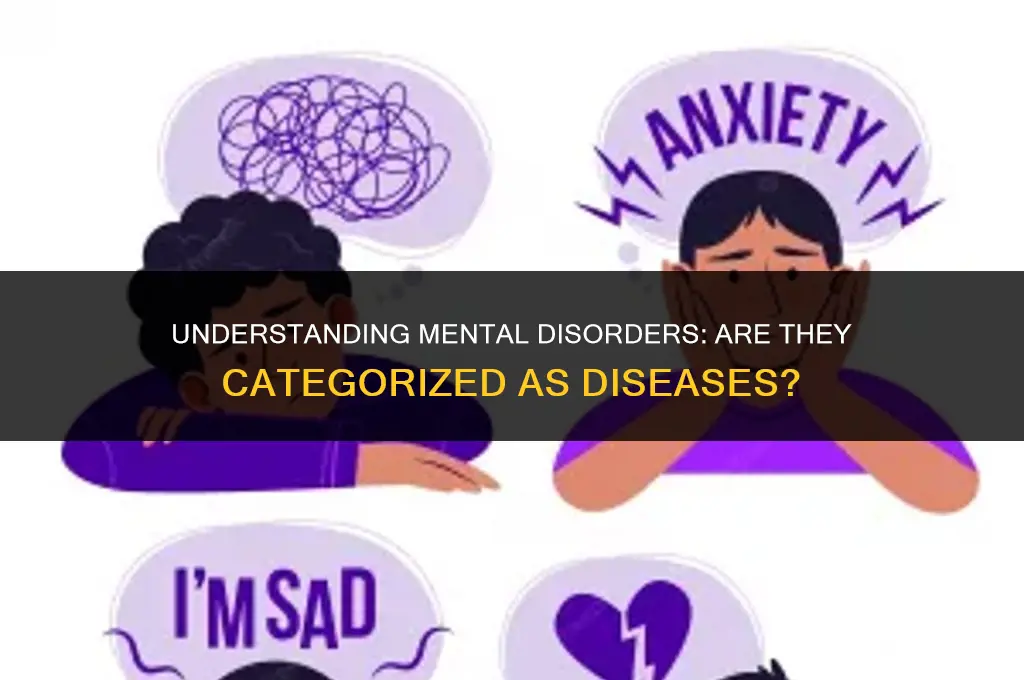
Mental disorders are often a subject of debate in the medical and psychological communities regarding their classification as diseases. This discussion centers on whether conditions such as depression, anxiety, and schizophrenia should be viewed and treated as diseases, akin to physical illnesses like diabetes or cancer. Proponents argue that mental disorders have identifiable symptoms, can be diagnosed, and often require treatment, thus fitting the criteria for diseases. Opponents, however, contend that mental disorders are more complex and multifaceted, influenced by social, cultural, and psychological factors, and may not be appropriately categorized under the traditional disease model. This debate has significant implications for how mental health is perceived, treated, and integrated into overall healthcare systems.
| Characteristics | Values |
|---|---|
| Classification | Mental disorders are classified as diseases in the International Classification of Diseases (ICD) and the Diagnostic and Statistical Manual of Mental Disorders (DSM). |
| Definition | Mental disorders are defined as conditions that affect thinking, feeling, behavior, and overall mental health, causing distress or impairment in daily functioning. |
| Types | Common types include anxiety disorders, mood disorders, psychotic disorders, personality disorders, and substance use disorders. |
| Causes | Causes are complex and multifaceted, often involving genetic, environmental, psychological, and social factors. |
| Symptoms | Symptoms vary widely depending on the specific disorder but may include changes in mood, behavior, thoughts, and perceptions. |
| Diagnosis | Diagnosis is typically made by mental health professionals through clinical interviews, observations, and sometimes psychological testing. |
| Treatment | Treatment options include psychotherapy, medication, lifestyle changes, and support groups, tailored to the individual's needs. |
| Prognosis | Prognosis varies by disorder and individual, but many mental disorders are treatable, and recovery is possible with appropriate intervention. |
| Stigma | Mental disorders often carry a stigma, leading to discrimination and barriers to seeking help. |
| Research | Ongoing research aims to improve understanding, diagnosis, and treatment of mental disorders, including the development of new therapies and medications. |
| Public Health Impact | Mental disorders have a significant impact on public health, contributing to disability, mortality, and healthcare costs. |
| Cultural Perspectives | Cultural perspectives on mental disorders vary, influencing how they are perceived, diagnosed, and treated in different societies. |
| Legal Considerations | Legal considerations include the rights of individuals with mental disorders, such as the right to informed consent and protection from discrimination. |
| Educational Resources | Educational resources are available to increase awareness and understanding of mental disorders, including online courses, workshops, and publications. |
| Support Organizations | Support organizations provide resources, advocacy, and community for individuals affected by mental disorders and their families. |
Explore related products


What You'll Learn
- Definition and Classification: Exploring how mental disorders are defined and categorized in medical literature
- Diagnostic Criteria: Discussing the specific symptoms and criteria used to diagnose various mental disorders
- Etiology and Risk Factors: Investigating the causes and contributing factors that lead to the development of mental disorders
- Treatment Approaches: Overviewing common treatment methods, including therapy, medication, and alternative interventions
- Social and Cultural Perspectives: Examining how mental disorders are perceived and addressed in different societies and cultures

Definition and Classification: Exploring how mental disorders are defined and categorized in medical literature
Mental disorders are defined and classified in medical literature through a systematic process that involves both clinical observation and empirical research. The Diagnostic and Statistical Manual of Mental Disorders (DSM), published by the American Psychiatric Association, serves as the primary reference for the classification of mental disorders in the United States. The DSM provides a standardized set of criteria for diagnosing mental disorders, which helps ensure consistency and accuracy in clinical practice.
The classification of mental disorders in the DSM is based on a multiaxial system, which takes into account multiple dimensions of a person's mental health. Axis I disorders are clinical syndromes, such as depression or anxiety, that are characterized by specific symptoms and diagnostic criteria. Axis II disorders are personality disorders and intellectual disabilities, which are considered to be more enduring and pervasive than Axis I disorders. Axis III disorders are general medical conditions that are not classified as mental disorders but may have a significant impact on a person's mental health.
In addition to the DSM, the International Classification of Diseases (ICD) is another important reference for the classification of mental disorders. The ICD is published by the World Health Organization and provides a global standard for the classification of all diseases, including mental disorders. The ICD uses a different coding system than the DSM, but both systems are designed to facilitate accurate diagnosis and treatment of mental health conditions.
One of the challenges in defining and classifying mental disorders is the subjective nature of many psychiatric symptoms. Unlike physical diseases, which can often be diagnosed through objective measures such as blood tests or imaging studies, mental disorders are typically diagnosed based on self-reported symptoms and clinical observation. This can lead to variability in diagnosis and treatment, as different clinicians may interpret symptoms differently.
Another challenge is the ongoing debate about the validity and reliability of psychiatric diagnoses. Some critics argue that mental disorders are not distinct entities but rather constructs that are created by the psychiatric profession. Others argue that the DSM and ICD are overly broad and include conditions that should not be classified as mental disorders. Despite these challenges, the systematic approach to defining and classifying mental disorders in medical literature has led to significant advances in our understanding and treatment of these conditions.
Understanding Suicidal Ideation: Is It a Mental Health Disorder?
You may want to see also
Explore related products


$11.99 $27.95


Diagnostic Criteria: Discussing the specific symptoms and criteria used to diagnose various mental disorders
The diagnosis of mental disorders is a complex process that relies on a set of specific symptoms and criteria. These criteria are outlined in various diagnostic manuals, such as the Diagnostic and Statistical Manual of Mental Disorders (DSM) in the United States and the International Classification of Diseases (ICD) globally. The DSM, for example, provides detailed descriptions of mental disorders, including the symptoms that must be present for a diagnosis to be made.
One of the key aspects of diagnostic criteria is the requirement for a certain number of symptoms to be present over a specific period. For instance, to be diagnosed with major depressive disorder, an individual must experience at least five symptoms, such as persistent sadness, loss of interest in activities, and changes in sleep patterns, for at least two weeks. These symptoms must also cause significant distress or impairment in daily functioning.
Another important aspect of diagnostic criteria is the consideration of cultural and contextual factors. Mental health professionals must take into account an individual's cultural background, as well as any social or environmental stressors that may be contributing to their symptoms. This helps to ensure that diagnoses are accurate and culturally sensitive.
In addition to symptom-based criteria, some mental disorders also have specific exclusion criteria. These are conditions that must not be present in order for a diagnosis to be made. For example, to be diagnosed with schizophrenia, an individual must not have symptoms that are better explained by another mental disorder, such as bipolar disorder or major depressive disorder.
The use of standardized diagnostic criteria helps to ensure consistency and reliability in the diagnosis of mental disorders. However, it is important to note that these criteria are not always clear-cut, and there can be some degree of subjectivity involved in making a diagnosis. Mental health professionals must use their clinical judgment and expertise to interpret the criteria and make an accurate diagnosis.
In conclusion, the diagnostic criteria for mental disorders provide a framework for identifying and categorizing mental health conditions. These criteria are based on specific symptoms and take into account cultural and contextual factors. While they help to ensure consistency and reliability in diagnosis, they are not without limitations, and mental health professionals must use their judgment to make accurate diagnoses.
Understanding ADHD: Is Attention Deficit Disorder a Mental Illness?
You may want to see also
Explore related products


Etiology and Risk Factors: Investigating the causes and contributing factors that lead to the development of mental disorders
The etiology of mental disorders is a complex and multifaceted field of study that seeks to understand the underlying causes and risk factors contributing to their development. Research in this area has identified a variety of biological, psychological, and environmental factors that can influence an individual's susceptibility to mental health issues. For instance, genetic predispositions have been found to play a significant role in the development of disorders such as schizophrenia and bipolar disorder. Additionally, brain chemistry and structure, particularly in regions associated with mood regulation and cognitive function, have been implicated in the pathophysiology of mental disorders.
Environmental factors also contribute substantially to the risk of developing mental health issues. Traumatic experiences, such as physical or emotional abuse, neglect, or exposure to violence, can have long-lasting effects on an individual's psychological well-being. Chronic stress, whether resulting from socioeconomic factors, relationship problems, or workplace pressures, can further exacerbate the risk of mental disorders. Moreover, lifestyle factors, including substance use, diet, and physical activity levels, have been shown to impact mental health outcomes.
Psychological factors, such as personality traits and coping mechanisms, also play a role in the etiology of mental disorders. Certain personality traits, like neuroticism or perfectionism, can increase the likelihood of developing anxiety or depressive disorders. Ineffective coping strategies, such as avoidance or rumination, can further contribute to the development and maintenance of mental health issues.
Investigating the causes and contributing factors of mental disorders is crucial for developing effective prevention and intervention strategies. By understanding the complex interplay between biological, psychological, and environmental factors, researchers and clinicians can work towards identifying high-risk individuals and implementing targeted interventions to mitigate the onset or progression of mental health issues. This knowledge also informs the development of evidence-based treatments that address the underlying mechanisms contributing to mental disorders.
In conclusion, the etiology of mental disorders involves a dynamic interaction between genetic, environmental, and psychological factors. Unraveling these complexities is essential for advancing our understanding of mental health and developing comprehensive approaches to prevention, diagnosis, and treatment. By focusing on the unique aspects of etiology and risk factors, we can gain valuable insights into the origins of mental disorders and improve outcomes for those affected.
Legal Obligations and Mental Health: What Disorders Must Be Reported?
You may want to see also
Explore related products


Treatment Approaches: Overviewing common treatment methods, including therapy, medication, and alternative interventions
Cognitive-behavioral therapy (CBT) is a widely used treatment approach for mental disorders. It focuses on identifying and changing negative thought patterns and behaviors that contribute to the disorder. CBT is often used to treat anxiety, depression, and post-traumatic stress disorder (PTSD). During CBT sessions, patients work with a therapist to develop coping strategies and learn how to manage their symptoms.
Medication is another common treatment method for mental disorders. Antidepressants, anti-anxiety drugs, and antipsychotics are among the most frequently prescribed medications. These drugs can help alleviate symptoms, but they often come with side effects and may not be suitable for everyone. It's essential for patients to work closely with their healthcare provider to find the right medication and dosage for their specific needs.
Alternative interventions, such as mindfulness-based therapies and art therapy, are also gaining popularity in the treatment of mental disorders. These approaches focus on promoting relaxation, reducing stress, and fostering self-expression. Mindfulness-based therapies, for example, teach patients how to cultivate awareness and acceptance of their thoughts and emotions. Art therapy, on the other hand, uses creative activities like painting and drawing to help patients express and process their feelings.
In addition to these traditional treatment methods, there is a growing interest in digital therapies and online support groups. These platforms offer convenient and accessible ways for patients to receive support and guidance. Online cognitive-behavioral therapy (iCBT) programs, for instance, allow patients to complete CBT exercises and receive feedback from a therapist remotely. Support groups on social media and online forums provide a space for patients to connect with others who are experiencing similar challenges.
It's important to note that treatment approaches should be tailored to the individual's specific needs and circumstances. What works for one person may not work for another. A combination of different treatment methods may be necessary to achieve the best results. Patients should work closely with their healthcare provider to develop a personalized treatment plan that addresses their unique symptoms and goals.
Unraveling the Link: Childhood Trauma and Mental Health Disorders
You may want to see also
Explore related products



Social and Cultural Perspectives: Examining how mental disorders are perceived and addressed in different societies and cultures
In various societies and cultures, mental disorders are perceived and addressed through diverse lenses, reflecting the intricate interplay between social norms, cultural values, and psychological understanding. For instance, in some cultures, mental illness is viewed as a spiritual or moral issue rather than a medical condition, leading to treatments that involve religious rituals or community support rather than psychiatric intervention. This highlights the subjective nature of mental health categorization and the influence of cultural beliefs on the interpretation of mental disorders.
The social context also plays a crucial role in shaping the experience and treatment of mental illness. In collectivist societies, where the well-being of the group is prioritized over individual needs, mental disorders may be seen as a disruption to social harmony, necessitating interventions that restore balance to the community. Conversely, in individualistic societies, mental health issues are often framed as personal challenges to be overcome through individual effort and professional help.
Furthermore, socioeconomic factors significantly impact the perception and treatment of mental disorders. In resource-limited settings, mental health services may be scarce, leading to a reliance on traditional healers or informal support networks. This underscores the importance of considering the broader social and economic context when examining mental health issues.
Cultural stigma surrounding mental illness can also influence how individuals seek help and are treated by society. In some cultures, admitting to a mental health problem may be seen as a sign of weakness or shame, deterring individuals from seeking professional help. Addressing this stigma requires a multifaceted approach that includes education, advocacy, and the promotion of mental health awareness.
In conclusion, the categorization of mental disorders as diseases is not a universal concept but is deeply influenced by social and cultural factors. Understanding these perspectives is essential for developing culturally sensitive and effective mental health interventions that address the unique needs of diverse populations.
Exploring the Thin Line: Perfectionism and Mental Health
You may want to see also
Frequently asked questions
Yes, mental disorders are categorized as diseases. They are recognized as medical conditions that affect the mind and behavior, often causing significant distress or impairment in daily functioning.
Mental disorders are diagnosed through a combination of clinical evaluation, patient history, and sometimes psychological testing. Mental health professionals, such as psychiatrists and psychologists, use criteria outlined in diagnostic manuals like the DSM-5 to identify and classify mental disorders.
Some common types of mental disorders include anxiety disorders (such as generalized anxiety disorder and panic disorder), mood disorders (like depression and bipolar disorder), personality disorders (such as borderline personality disorder), and psychotic disorders (including schizophrenia).