Caleb Wright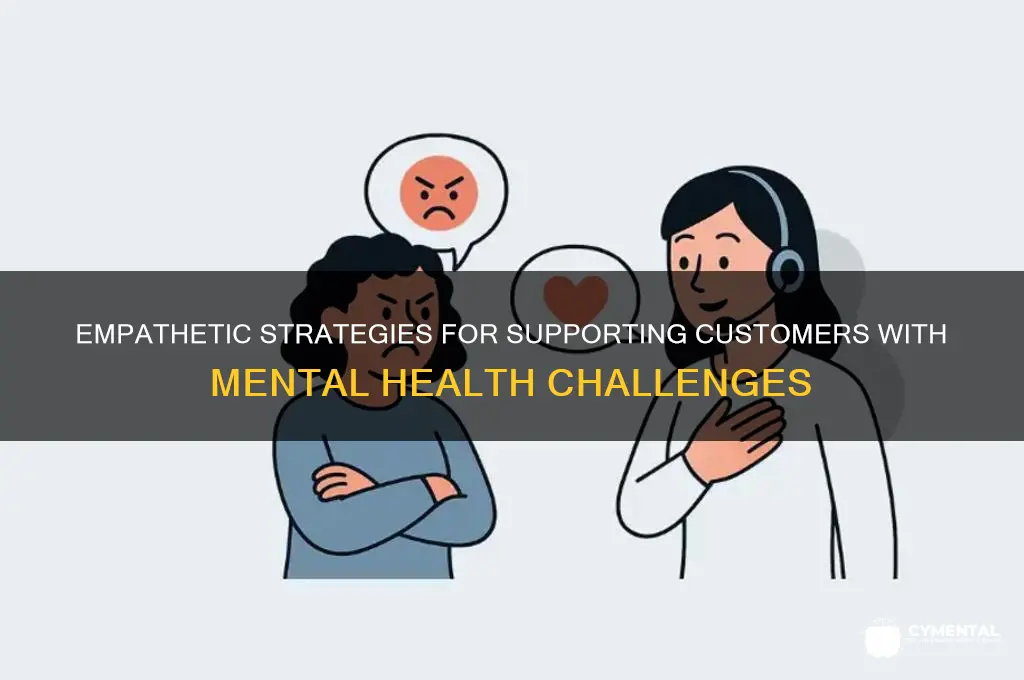
Dealing with customers who may be experiencing mental health issues requires a compassionate, patient, and informed approach. It’s essential for customer service representatives to recognize signs of distress, such as agitation, confusion, or emotional outbursts, while maintaining a calm and non-judgmental demeanor. Active listening, empathy, and clear communication are key to de-escalating situations and ensuring the customer feels heard and supported. Training in mental health awareness can equip staff with the tools to respond appropriately, such as offering simple solutions, avoiding confrontation, and knowing when to involve a supervisor or mental health professional. Above all, prioritizing the customer’s dignity and well-being fosters trust and reflects a commitment to inclusive and caring service.
Explore related products


What You'll Learn
- Active Listening Techniques: Focus on empathy, patience, and non-judgmental responses to build trust and understanding
- Recognizing Triggers: Identify signs of distress and avoid actions that may escalate the situation
- Setting Boundaries: Maintain professionalism while offering support without overstepping personal or emotional limits
- De-escalation Strategies: Use calm tones, clear communication, and reassurance to reduce tension effectively
- Referral Resources: Provide information on mental health services or helplines when appropriate and necessary

Active Listening Techniques: Focus on empathy, patience, and non-judgmental responses to build trust and understanding
Customers with mental health issues often communicate through layers of emotion, fear, or frustration. Active listening becomes a bridge to their world, but it requires more than silence and nods. It demands empathy, patience, and a deliberate absence of judgment. These techniques aren’t just skills—they’re acts of respect that signal, "I see you, I hear you, and I’m here to help."
Consider the mechanics of empathy in active listening. Mirroring the customer’s tone or pace isn’t manipulation; it’s a subconscious signal of alignment. For instance, if a customer speaks haltingly, a rushed response can feel dismissive. Instead, pause slightly longer than feels natural before replying. This micro-adjustment communicates, "I’m not hurrying you." Similarly, paraphrasing their concerns ("It sounds like you’re feeling overwhelmed by the options") validates their experience without assuming. The goal is to reflect, not fix—a distinction often lost in customer service scripts.
Patience, however, is where most interactions falter. A mentally distressed customer might repeat themselves, struggle to articulate needs, or abruptly shift topics. Resist the urge to interrupt or steer the conversation. Research shows that interruptions, even well-intentioned ones, can heighten anxiety in vulnerable individuals. Instead, use verbal cues like "Tell me more" or "I want to understand this fully" to encourage them to continue. If silence stretches uncomfortably, remember: for someone in distress, being heard is often more urgent than being solved.
Non-judgmental responses are the cornerstone of trust, yet they’re deceptively difficult. Phrases like "You shouldn’t feel that way" or "Just try to calm down" can invalidate emotions, even when intended to soothe. Replace these with neutral, open-ended questions: "What’s making this particularly difficult today?" or "How can I support you right now?" Avoid diagnosing or offering unsolicited advice—your role is to facilitate, not therapize. For example, a customer service agent once diffused a tense call by simply saying, "It’s okay to feel this way. Let’s figure this out together at your pace." The customer, who later disclosed their anxiety disorder, praised the interaction for its rare lack of pressure.
Finally, active listening isn’t a one-time gesture—it’s a sustained commitment. After the interaction, document the customer’s preferences or triggers (with consent) to inform future encounters. For instance, noting "Prefers email follow-ups; avoids phone calls due to social anxiety" can prevent retraumatization. This continuity shows that your empathy extends beyond the call, fostering long-term trust. In a world where customer service often prioritizes speed over humanity, these techniques transform transactions into connections—and for customers with mental health issues, that can make all the difference.
Compassionate Steps: Guiding Mental Health Admissions with Care and Understanding
You may want to see also
Explore related products


Recognizing Triggers: Identify signs of distress and avoid actions that may escalate the situation
Customers exhibiting signs of distress may display subtle yet distinct behaviors that, when recognized, can prevent a situation from escalating. For instance, a customer might speak in a heightened tone, repeat the same concern multiple times, or exhibit physical signs like fidgeting or avoiding eye contact. These behaviors often stem from underlying anxiety, frustration, or feelings of helplessness. By observing these cues, you can shift your approach to de-escalate the situation rather than inadvertently fueling their distress.
Analyzing the context of the interaction is crucial. A trigger for one customer might be a perceived lack of control, while for another, it could be feeling rushed or dismissed. For example, a customer with OCD might become distressed if pressured to make a quick decision, whereas someone with PTSD could react strongly to loud noises or abrupt movements. Understanding these potential triggers allows you to adapt your communication style—slowing down, offering choices, or creating a quieter environment—to minimize further agitation.
A persuasive approach to handling these situations involves reframing your role as a problem-solver rather than a gatekeeper. Instead of insisting on standard procedures, acknowledge the customer’s emotions and validate their experience. Phrases like, "I understand this is frustrating," or "Let’s work together to find a solution," can diffuse tension by showing empathy and cooperation. This not only calms the customer but also positions you as an ally, reducing the likelihood of escalation.
Comparing effective and ineffective responses highlights the importance of avoiding common pitfalls. For instance, saying, "Calm down," or "It’s not that big of a deal," can invalidate the customer’s feelings and worsen the situation. Conversely, maintaining a calm tone, using open-ended questions, and offering specific solutions (e.g., "Would it help if I extended your deadline?") demonstrate respect and practicality. The takeaway? Your response should aim to empower, not diminish, the customer’s agency.
In practice, here’s a step-by-step guide: First, pause and assess the customer’s behavior for signs of distress. Second, adjust your tone and pace to match their needs—speak softly and slowly if they’re agitated, or clearly and concisely if they’re overwhelmed. Third, avoid phrases that might trigger defensiveness, such as "You need to…" or "That’s against policy." Instead, focus on collaborative language like, "How can we resolve this together?" Finally, if the situation remains volatile, involve a supervisor or offer to continue the conversation at a later time, ensuring the customer feels heard and supported.
Empathetic Strategies for Communicating with Individuals Facing Mental Health Challenges
You may want to see also
Explore related products


Setting Boundaries: Maintain professionalism while offering support without overstepping personal or emotional limits
Customers with mental health issues may require a delicate balance of empathy and professionalism. Setting clear boundaries is essential to ensure both their well-being and your own. Start by defining your role: you are a service provider, not a therapist. This distinction is crucial, as it prevents emotional enmeshment while allowing you to offer meaningful support within your scope. For instance, if a customer shares personal struggles, acknowledge their feelings with phrases like, "I hear you, and I’m here to help with [specific issue related to your service]." This response validates their experience without inviting further personal disclosure.
One practical strategy is to establish time limits for interactions, especially if conversations veer into emotionally charged territory. For example, if a customer begins discussing their anxiety during a routine call, gently steer the conversation back to the service-related issue at hand. You might say, "I understand this is difficult for you. Let’s focus on resolving [specific problem] today, and I’ll ensure we address it thoroughly." This approach maintains professionalism while demonstrating care. Additionally, familiarize yourself with your organization’s policies on handling such situations, including when and how to escalate concerns to a supervisor or mental health professional.
A comparative analysis reveals that boundary-setting is not about detachment but about creating a safe, structured environment. Consider two scenarios: in the first, a customer service representative listens extensively to a customer’s personal struggles, only to feel overwhelmed and unable to resolve the issue. In the second, the representative acknowledges the customer’s emotions, offers a brief expression of support, and refocuses on the task at hand. The latter approach not only resolves the issue efficiently but also leaves the customer feeling heard and respected. The key takeaway is that boundaries protect both parties, fostering a productive and respectful interaction.
Finally, self-care is an often-overlooked aspect of boundary-setting. Interacting with customers in distress can be emotionally taxing, so implement strategies to protect your mental health. After challenging interactions, take a brief pause to reset—whether by practicing deep breathing, stepping outside, or journaling. Regularly reflect on your emotional capacity and adjust your boundaries as needed. By prioritizing your well-being, you ensure you can continue providing effective, compassionate service without burnout. Remember, maintaining professionalism and offering support are not mutually exclusive—they are interconnected practices that enhance both customer experience and your own resilience.
Navigating Mental Health: Strategies for Resilience and Healing in Daily Life
You may want to see also
Explore related products


De-escalation Strategies: Use calm tones, clear communication, and reassurance to reduce tension effectively
In high-stress customer interactions, especially with individuals experiencing mental health challenges, the tone of your voice can either fuel the fire or extinguish it. Research in psycholinguistics shows that vocal cues—pitch, pace, and volume—account for 38% of emotional interpretation in communication. A calm, measured tone signals safety to the brain’s amygdala, reducing the fight-or-flight response. For instance, lowering your pitch by 10-15% and slowing speech to 120-140 words per minute (compared to the average 150) can create a physiological shift in the listener, mirroring your composure. Avoid abrupt pauses or rushed sentences, as these can heighten anxiety. Instead, use deliberate pauses (2-3 seconds) to allow the customer to process information without feeling pressured.
Clarity in communication isn’t just about choosing simple words—it’s about structuring information to minimize cognitive load. Individuals in distress often experience "cognitive fog," where working memory capacity drops by up to 50%. Break instructions into 2-3 step sequences, using active verbs and concrete nouns. For example, instead of "Let’s resolve this," say, "I’ll check your account now, then explain the next steps in 5 minutes." Visual aids, like a shared screen or written summary, can reinforce verbal communication. However, avoid jargon or ambiguous phrases like "It should work," which can trigger frustration. Always confirm understanding with open-ended questions: "Does this make sense so far?" rather than a yes/no query, which may feel dismissive.
Reassurance is a dual-edged tool—effective when specific, counterproductive when generic. Phrases like "I understand" or "Stay calm" often backfire, as they can feel insincere or patronizing. Instead, validate the customer’s experience with observable facts: "I see you’ve been on hold for 20 minutes—that’s frustrating." Follow with a commitment to action: "I’ll prioritize your case and update you every 15 minutes." Studies in crisis intervention show that perceived control reduces distress. Offer micro-choices when possible: "Would you prefer I call you back in 10 minutes, or shall we continue now?" This shifts the dynamic from confrontation to collaboration, leveraging the psychological principle of autonomy support.
The interplay of tone, clarity, and reassurance creates a de-escalation framework rooted in neuroscience and psychology. Calm tones lower cortisol levels in both parties, fostering a parasympathetic response. Clear communication reduces cognitive overload, preventing further agitation. Reassurance rebuilds trust, a cornerstone of emotional regulation. For example, a customer service agent who combines these strategies—"Speaking slowly, I’ll outline three steps to fix this, and I’ll stay with you until it’s resolved"—transforms a potential crisis into a manageable interaction. However, this approach requires practice: role-playing scenarios with recorded feedback can improve tone modulation and phrasing. Remember, de-escalation isn’t about fixing the customer’s mental health—it’s about creating a safe space to address their immediate needs with dignity.
Spirituality and Mental Health: Healing the Mind, Body, and Soul
You may want to see also
Explore related products


$11.97 $14.95


Referral Resources: Provide information on mental health services or helplines when appropriate and necessary
Recognizing when a customer’s behavior stems from mental health struggles requires empathy and discretion. While your role isn’t to diagnose or counsel, you can offer a lifeline by connecting them to professional support. This is where referral resources become critical. Keep a list of local and national mental health services, crisis hotlines, and online support platforms readily accessible. For instance, in the U.S., the National Alliance on Mental Illness (NAMI) Helpline (1-800-950-NAMI) provides free, confidential assistance, while the Crisis Text Line (text HOME to 741741) offers immediate support via text. Knowing these resources ensures you’re prepared to act when the situation calls for it.
Providing referral resources isn’t just about handing out a phone number; it’s about doing so with sensitivity and timing. Approach the conversation indirectly, using phrases like, “If you ever feel like talking to someone, there are resources available that can help.” Avoid language that could stigmatize or alienate, such as “You should see a therapist.” Instead, frame the suggestion as a supportive option, not an obligation. For example, if a customer expresses overwhelming anxiety, you might say, “There’s a helpline specifically for moments like this—would you like me to share the details?” This approach respects their autonomy while offering a pathway to help.
Not all mental health resources are created equal, and understanding their scope is essential. Crisis hotlines like the 988 Suicide & Crisis Lifeline are ideal for immediate, life-threatening situations, while organizations like the Anxiety and Depression Association of America (ADAA) offer long-term tools and education. For customers dealing with chronic conditions, consider suggesting peer support groups or apps like Calm or Headspace, which provide mindfulness and coping strategies. Tailor your referral to the customer’s needs, ensuring the resource aligns with their situation. For instance, a young adult might benefit from The Trevor Project (focused on LGBTQ+ youth), while an older adult could find solace in the Depression and Bipolar Support Alliance.
While offering referral resources is a compassionate act, it’s not without challenges. Some customers may react defensively or decline help, and it’s crucial to respect their boundaries. Never force information on someone or make them feel pressured. Additionally, ensure your own training includes recognizing signs of distress and understanding the limits of your role. You’re a bridge, not a therapist. Regularly update your resource list, as contact information and services can change. Finally, take care of yourself—dealing with these situations can be emotionally taxing, and accessing your own support systems is equally important.
Incorporating referral resources into your customer service toolkit transforms your role from transactional to potentially life-changing. By knowing when and how to offer these resources, you create a safer, more inclusive environment for all customers. Remember, the goal isn’t to fix their struggles but to show they’re not alone and that help is available. A well-timed referral can be the first step toward healing, and that’s a powerful impact no matter your industry.
Supporting Your Partner Through Mental Health Challenges: A Compassionate Guide
You may want to see also
Frequently asked questions
Look for signs such as unusual behavior, difficulty communicating, heightened emotions, or disorientation. However, avoid diagnosing; instead, focus on being empathetic and responsive to their needs.
Use a calm, patient, and non-judgmental tone. Speak clearly and avoid rushing the conversation. Show empathy and respect to help them feel safe and understood.
Stay calm, listen actively, and avoid arguing. Acknowledge their feelings, offer reassurance, and, if necessary, involve a trained colleague or mental health professional. Prioritize safety for both the customer and yourself.
While sharing personal experiences can build rapport, it’s not always appropriate. Focus on the customer’s needs first. If you feel it could help, share briefly and professionally, but ensure it doesn’t shift the focus away from their situation.