Ava Ramirez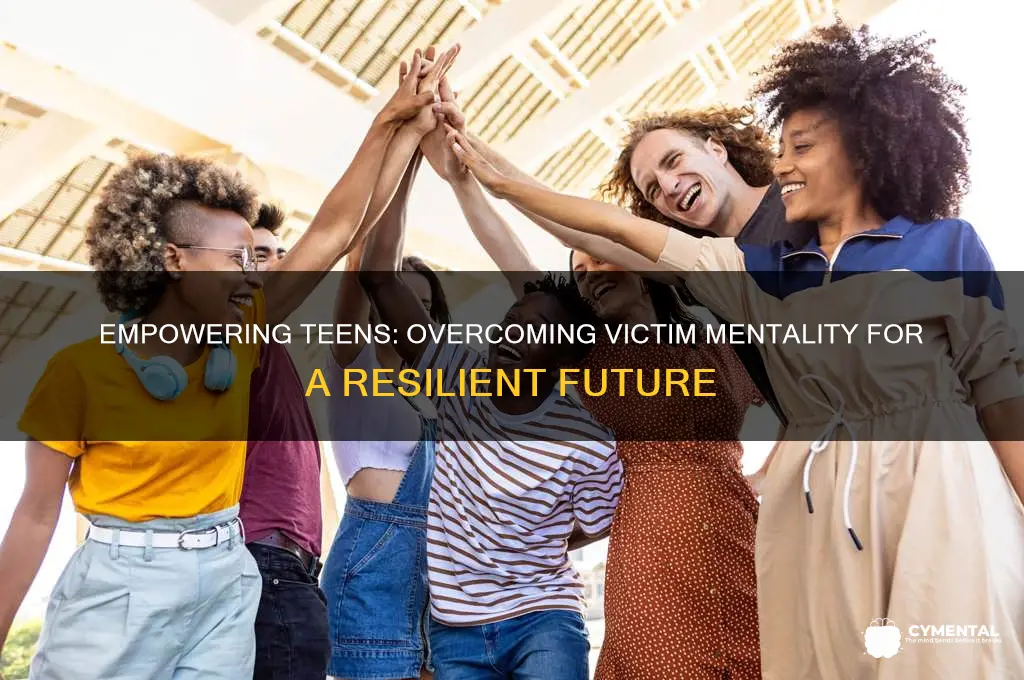
Helping teenagers break free from a victim mentality is crucial for their emotional growth and resilience. Often, adolescents may feel powerless or overly focused on external circumstances, which can hinder their ability to take responsibility for their actions and seek solutions. To support them, it's essential to foster self-awareness, encourage problem-solving skills, and promote a growth mindset. Parents, educators, and mentors can play a pivotal role by validating their emotions while gently challenging negative thought patterns, teaching them to reframe challenges as opportunities, and empowering them to make proactive choices. By nurturing a sense of agency and optimism, teenagers can shift from feeling victimized to becoming active participants in shaping their own lives.
| Characteristics | Values |
|---|---|
| Empowerment | Encourage self-reliance, decision-making, and problem-solving skills. |
| Accountability | Help them take responsibility for their actions and choices without blame. |
| Positive Reframing | Teach them to view challenges as opportunities for growth rather than setbacks. |
| Emotional Regulation | Provide tools to manage emotions, such as mindfulness, journaling, or therapy. |
| Building Resilience | Foster adaptability and coping strategies to handle adversity. |
| Setting Boundaries | Guide them in establishing healthy limits in relationships and situations. |
| Encouraging Gratitude | Promote a focus on what they have rather than what they lack. |
| Challenging Negative Thought Patterns | Help identify and replace victim-minded thoughts with constructive ones. |
| Role Modeling | Demonstrate a proactive, solution-focused mindset in your own behavior. |
| Supportive Communication | Use non-judgmental, empathetic, and solution-oriented conversations. |
| Goal Setting | Assist in setting achievable, positive goals to shift focus from problems to progress. |
| Limiting External Blame | Encourage focusing on controllable factors rather than external circumstances. |
| Promoting Self-Compassion | Teach kindness toward oneself, reducing self-criticism and guilt. |
| Exposing Them to Positive Role Models | Introduce stories or people who overcame adversity without adopting a victim mentality. |
| Consistent Encouragement | Regularly acknowledge their efforts and progress in adopting a more empowered mindset. |
| Professional Support | Seek therapy or counseling if the victim mentality persists or is deeply ingrained. |
Explore related products


What You'll Learn
- Foster Self-Awareness: Teach teens to recognize self-pity patterns and their triggers
- Encourage Responsibility: Help them focus on actions they can control and change
- Build Problem-Solving Skills: Guide teens to find solutions instead of dwelling on problems
- Promote Gratitude: Encourage daily reflection on positive aspects of their lives
- Strengthen Support Systems: Connect them with mentors, friends, or therapists for encouragement

Foster Self-Awareness: Teach teens to recognize self-pity patterns and their triggers
Teens often slip into victim mentality without realizing it, mistaking self-pity for valid emotional expression. This pattern—complaining about unfairness, blaming others, or fixating on problems—becomes a default response to stress or setbacks. The first step in breaking this cycle is helping them recognize it. Start by pointing out observable behaviors in a non-judgmental way: *"I notice you often say, ‘Why does this always happen to me?’ after small issues. Does that feel true, or is it a habit?"* This approach avoids confrontation while planting the seed of self-reflection.
Self-awareness isn’t innate; it’s a skill honed through practice. Encourage teens to keep a brief daily journal, not for venting, but for pattern-spotting. Prompt them to log moments of frustration or self-doubt alongside their immediate thoughts and reactions. After a week, review the entries together, highlighting recurring themes. For instance, a teen might notice they feel victimized every time a friend cancels plans, even if it’s a rare occurrence. This exercise shifts focus from external events to internal responses, fostering accountability without blame.
Triggers for self-pity often stem from unmet expectations or perceived slights, but teens may lack the vocabulary to articulate these connections. Teach them to ask themselves three questions in moments of distress: *What just happened? What story am I telling myself about it? Is that story entirely true?* For example, a failed test might trigger *"I’m just bad at math,"* but probing deeper could reveal fear of not meeting parental expectations. This cognitive reframing, practiced consistently, rewires automatic thought patterns over time.
While fostering self-awareness, beware of over-analyzing or labeling emotions as "wrong." Teens may resist if they feel criticized or pressured to "just be positive." Instead, frame the process as a collaborative exploration of their inner world. Use metaphors like *"Your mind is like a garden—we’re just weeding out the thoughts that don’t serve you."* Pair this with actionable strategies, such as setting a daily limit (e.g., 5 minutes) for self-pity before shifting to problem-solving. This balances empathy with structure, empowering teens to navigate their emotions without drowning in them.
Running's Transformative Power: Physical, Social, and Mental Benefits Unveiled
You may want to see also
Explore related products


Encourage Responsibility: Help them focus on actions they can control and change
Teenagers often feel overwhelmed by circumstances beyond their control, which can fuel a victim mentality. To counter this, shift their focus to actionable steps they can take. Start by identifying areas where they have agency—whether it’s managing their time, improving a skill, or choosing how to respond to challenges. For instance, instead of dwelling on a failed test, encourage them to create a study plan for the next one. This reframing empowers them to see themselves as active participants in their lives rather than passive observers.
One practical strategy is to use the "Circle of Control" exercise. Draw a large circle and label it "Things I Can Control." Inside, list actions like effort, attitude, and communication. Outside, draw a larger circle labeled "Things I Can’t Control" and include external factors like others’ opinions or past events. This visual tool helps teenagers prioritize their energy on what they can influence, reducing feelings of helplessness. For example, a 15-year-old struggling with peer pressure might focus on setting personal boundaries instead of obsessing over others’ behaviors.
Encouraging responsibility also involves setting clear expectations and consequences. For younger teens (13–15), break tasks into manageable steps, such as completing homework in 30-minute intervals with short breaks. For older teens (16–19), allow them to take ownership of larger responsibilities, like managing their extracurricular schedule or contributing to family decisions. Consistency is key—avoid rescuing them from natural consequences, as this reinforces dependency. For instance, if they forget their lunch, let them experience the discomfort rather than delivering it to school.
Finally, model accountability in your own behavior. Teenagers learn by observing, so demonstrate how you take responsibility for your actions, admit mistakes, and problem-solve. Share personal examples of overcoming setbacks, emphasizing the steps you took rather than external factors. For instance, discuss how you handled a work conflict by focusing on your communication style instead of blaming others. This not only teaches them by example but also fosters a culture of responsibility within the household.
By consistently directing their attention to controllable actions, teenagers can gradually shift from a victim mindset to one of proactive problem-solving. This approach builds resilience, self-efficacy, and a sense of ownership over their lives—essential skills for navigating adulthood.
Gaming's Surprising Benefits: Boosting Mental Health and Well-Being
You may want to see also
Explore related products


Build Problem-Solving Skills: Guide teens to find solutions instead of dwelling on problems
Teens often get stuck in a cycle of rehashing problems rather than actively seeking solutions, which reinforces a victim mentality. Breaking this pattern requires shifting their focus from the problem itself to actionable steps they can take. Start by teaching them the S.T.O.P. method: Stop (pause the negative thought loop), Think (identify one small, manageable action), Open up (discuss the plan with a trusted person), and Proceed (take the first step). For example, if a teen feels overwhelmed by schoolwork, instead of dwelling on the stress, they could break tasks into 20-minute chunks using the Pomodoro Technique, immediately reducing the problem’s perceived size.
Analyzing the root cause of a problem is a critical skill that empowers teens to move beyond surface-level complaints. Encourage them to ask "Why?" five times to dig deeper. For instance, if a teen says, “I’m failing math,” guide them through: *Why?* “I don’t understand the material.” *Why?* “I’m not asking questions in class.” *Why?* “I feel embarrassed.” *Why?* “I think others will judge me.” *Why?* “I care too much about what they think.” This process reveals that the real issue isn’t math but fear of judgment, allowing them to address the core problem rather than the symptom.
Problem-solving thrives in an environment of accountability and practice. Set up weekly “Solution Sessions” where teens present a problem and brainstorm solutions with a parent, mentor, or peer. Use the 4-3-2 rule: list 4 possible solutions, pick 3 to explore further, and commit to trying 2. For a teen struggling with peer conflict, solutions might include role-playing responses, setting boundaries, or seeking mediation. Caution against over-reliance on others’ input; the goal is to build their confidence in generating and testing ideas independently.
Comparing the problem-solving mindset to a muscle highlights the need for consistent training. Just as athletes strengthen their bodies through repetition, teens can strengthen their problem-solving skills by tackling small challenges daily. Assign them “Micro-Challenges” like planning a family meal within a budget or resolving a minor dispute with a sibling. These tasks, though minor, teach them to approach problems methodically and celebrate small wins, gradually shifting their mindset from “I can’t” to “I can figure this out.”
Finally, reframe failure as a necessary step in the problem-solving process. Teens often avoid taking action for fear of making mistakes, but this stalls growth. Introduce the concept of “Fail Forward”: every setback provides data to refine their approach. For a teen who tries a new study method but doesn’t see immediate results, ask, “What did you learn from this?” and “How can you adjust your strategy?” Over time, this perspective transforms problems from insurmountable obstacles into opportunities for learning and resilience.
Ice Bucket Challenge: Uniting Communities, Raising Awareness, and Boosting Mental Health
You may want to see also
Explore related products


$16.99 $14.95


Promote Gratitude: Encourage daily reflection on positive aspects of their lives
Teenagers often fixate on what’s missing or going wrong, a mindset that fuels victim mentality. Shifting their focus to what’s present and positive can disrupt this cycle. Gratitude practices, when done consistently, rewire neural pathways to prioritize optimism over negativity. Start by introducing a daily reflection routine—five minutes each evening is enough. Provide a notebook or app where they can jot down three specific things they’re grateful for, no matter how small. The key is specificity: instead of “my friends,” encourage “my friend who listened when I was upset today.” This trains their brain to scan for positives rather than defaults to complaints.
The science backs this up. Studies show that gratitude practices reduce stress hormones and increase dopamine, creating a biochemical foundation for resilience. For teenagers, who are biologically wired for emotional intensity, this can be particularly impactful. Pair reflection with a sensory cue—like a specific candle scent or calming music—to anchor the practice in their routine. Over time, the cue alone will signal their brain to shift into a grateful mindset. Caution: avoid forcing gratitude or dismissing their struggles. Authenticity is critical; let them choose what feels meaningful to them, even if it’s something seemingly trivial like “my dog wagging his tail.”
Comparing gratitude practices to other mindset shifts highlights their efficiency. While therapy or journaling about problems can be valuable, gratitude reflection is actionable, immediate, and requires no special skills. It’s also less confrontational for teens resistant to change. Frame it as an experiment: “Try this for two weeks and see how you feel.” Track progress by asking them to rate their mood on a scale of 1–10 each day. Most notice a gradual uplift, which reinforces the habit. For added impact, share your own gratitude list occasionally—modeling vulnerability normalizes the practice.
A common pitfall is treating gratitude as a one-size-fits-all solution. Tailor the approach to their personality. Visual teens might prefer a gratitude jar where they drop in notes, while tech-savvy ones could use an app like Gratitude365. Gamify it for competitive types by setting a challenge: “Who can find the most unique thing to be grateful for this week?” For reluctant starters, begin with just one item daily and gradually increase. The goal isn’t perfection but consistency. Even on bad days, finding one genuine positive—“I’m grateful for my warm bed”—can prevent a downward spiral into victimhood.
In conclusion, promoting gratitude isn’t about ignoring problems but reframing perspective. Daily reflection becomes a tool for teenagers to reclaim agency over their mindset. It’s simple, scientifically grounded, and adaptable to individual needs. Start small, stay consistent, and let the practice evolve naturally. Over time, what begins as a forced exercise can transform into a genuine habit, equipping them with a lifelong skill to counter victim mentality.
Are Mental Institutions Truly Helpful? Exploring Their Impact and Effectiveness
You may want to see also
Explore related products




Strengthen Support Systems: Connect them with mentors, friends, or therapists for encouragement
Teenagers trapped in a victim mentality often isolate themselves, believing no one understands their struggles. This isolation reinforces their sense of helplessness, creating a self-perpetuating cycle. Breaking this cycle requires intentional connection with individuals who can offer perspective, empathy, and actionable encouragement. Mentors, friends, and therapists serve as anchors, grounding the teenager in reality and modeling resilience.
Consider the role of a mentor as a bridge between the teenager’s current mindset and a more empowered future. A mentor, ideally someone who has overcome similar challenges, provides tangible proof that change is possible. For instance, pairing a teenager struggling with academic self-doubt with a college student who once faced the same fears can shift their narrative from “I can’t” to “If they did it, so can I.” Practical steps include identifying mentors through school programs, community organizations, or even online platforms. Aim for weekly check-ins, whether in-person or virtual, to maintain consistency without overwhelming the teenager.
Friends, on the other hand, offer peer-level support that feels less formal but equally vital. Encourage the teenager to spend time with friends who embody positivity and accountability. Group activities like team sports, art clubs, or volunteer work foster a sense of belonging and shared purpose. However, be cautious of toxic friendships that validate victimhood rather than challenge it. Parents or caregivers can subtly guide this process by suggesting activities or inviting supportive peers to join family outings, creating natural opportunities for connection.
Therapists provide a structured, professional framework for addressing the root causes of victim mentality. Cognitive-behavioral therapy (CBT), for example, is particularly effective for teenagers, as it focuses on identifying and changing negative thought patterns. Sessions should ideally occur weekly for at least 3–6 months, depending on the severity of the mindset. Encourage the teenager to view therapy not as a punishment but as a tool for self-discovery and growth. Normalize the process by sharing stories of successful therapy outcomes or even attending a session together if they’re hesitant.
The key to strengthening support systems lies in diversity and balance. Mentors offer wisdom, friends provide camaraderie, and therapists deliver expertise. Together, they create a network that surrounds the teenager with encouragement from multiple angles. For instance, a mentor might help set goals, a friend might celebrate small wins, and a therapist might reframe setbacks as learning opportunities. This multi-faceted approach ensures the teenager doesn’t rely on a single source of support, reducing the risk of dependency and fostering independence.
Finally, monitor progress by observing changes in the teenager’s language and behavior. Do they speak more proactively? Are they initiating plans with friends or seeking advice from their mentor? These shifts signal a move away from victimhood toward agency. Remember, the goal isn’t to rush the process but to provide consistent, compassionate support as they rebuild their sense of self.
Supporting Your Spouse Through Mental Illness: Compassionate Strategies for Healing
You may want to see also
Frequently asked questions
A victim mentality is a mindset where an individual perceives themselves as constantly being wronged or powerless in their circumstances. In teenagers, this may manifest as blaming others for their problems, feeling helpless, avoiding responsibility, or seeking sympathy excessively.
Encourage accountability by helping the teenager focus on solutions rather than problems. Ask open-ended questions like, "What can you do to improve the situation?" and praise their efforts when they take initiative. Avoid rescuing them from natural consequences, as this reinforces dependency.
Empathy is crucial, but it should be balanced with empowerment. Acknowledge their feelings without validating a victim mindset. For example, say, "I understand this feels unfair, but let’s think about how you can handle it differently next time." This validates their emotions while shifting focus to growth.
Build resilience by teaching problem-solving skills, fostering a growth mindset, and encouraging small, achievable challenges. Help them identify past successes and reflect on how they overcame difficulties. Consistent support and positive reinforcement can gradually shift their perspective from victimhood to empowerment.