Lucas Bennett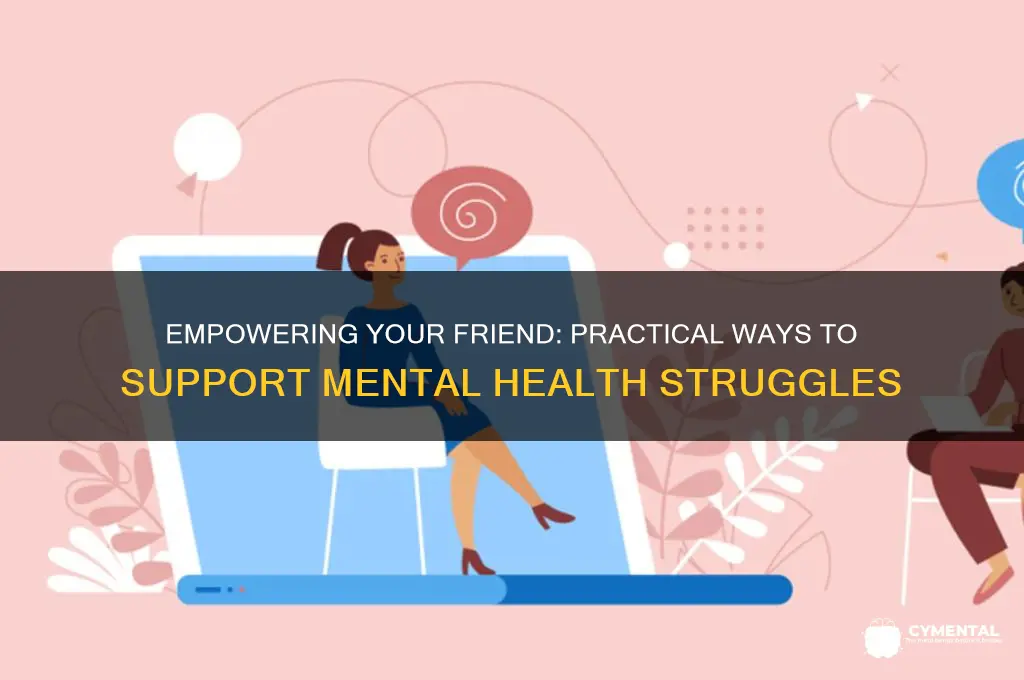
Supporting a friend with mental health issues requires empathy, patience, and understanding. It’s essential to create a safe, non-judgmental space where they feel comfortable sharing their feelings without fear of dismissal or criticism. Start by actively listening, validating their emotions, and avoiding the urge to offer quick fixes or unsolicited advice. Educate yourself about their specific struggles to better understand their experience, but remember that every person’s journey is unique. Encourage them to seek professional help if needed, while also being a consistent presence in their life through small gestures like checking in regularly or spending quality time together. Above all, take care of your own well-being, as supporting someone with mental health challenges can be emotionally demanding, and maintaining your own balance is crucial for both of you.
Explore related products


What You'll Learn
- Listen Actively: Give undivided attention, avoid judgment, and validate their feelings without interrupting or offering solutions
- Educate Yourself: Learn about their condition to better understand their experiences and reduce stigma
- Encourage Professional Help: Gently suggest therapy or counseling, offering to assist with finding resources
- Check In Regularly: Show consistent support by reaching out, even if it’s just a quick message
- Be Patient: Mental health recovery takes time; avoid pressuring them to get better quickly

Listen Actively: Give undivided attention, avoid judgment, and validate their feelings without interrupting or offering solutions
Active listening is a cornerstone of supporting a friend with mental health issues, yet it’s often misunderstood as merely hearing words rather than engaging fully. When your friend speaks, silence your phone, maintain eye contact, and eliminate distractions. This isn’t about being polite—it’s about signaling that their thoughts and emotions matter more than anything else in that moment. Research shows that feeling heard reduces stress and fosters emotional safety, which is critical for someone navigating mental health challenges.
Validation is the bridge between listening and understanding. Instead of dismissing their feelings with phrases like “It’ll get better” or “At least it’s not worse,” reflect back what they’ve shared. For example, say, “It sounds like you’re feeling overwhelmed by this situation,” or “I can see how much this is hurting you.” This acknowledges their experience without minimizing it. Validation doesn’t mean you agree—it means you respect their reality. Studies in psychology highlight that validation reduces defensiveness and encourages openness, making it easier for your friend to process their emotions.
Interrupting or jumping to solutions, even with good intentions, can inadvertently shut down the conversation. Phrases like “Have you tried…?” or “You should just…” can make your friend feel judged or inadequate. Mental health struggles are complex, and quick fixes rarely apply. Instead, ask open-ended questions like, “How can I support you right now?” or “What’s been most challenging for you?” This shifts the focus from problem-solving to empathy, allowing your friend to feel understood rather than analyzed.
Practicing active listening requires self-awareness and patience. Notice if you’re formulating a response while they’re still speaking—this is a common habit that undermines genuine connection. Take a breath, focus on their tone and body language, and let them finish before you respond. Remember, your role isn’t to fix their pain but to hold space for it. Over time, this approach builds trust and strengthens your relationship, creating a safe environment where your friend feels comfortable sharing their struggles without fear of judgment or interruption.
Mastering Mental Health: Effective Strategies to Manage and Thrive
You may want to see also
Explore related products


Educate Yourself: Learn about their condition to better understand their experiences and reduce stigma
Understanding your friend's mental health condition is a powerful act of solidarity. It's not about becoming an expert overnight, but rather, equipping yourself with the knowledge to offer informed support. Imagine trying to navigate a foreign city without a map; learning about their condition provides that essential guide, helping you both find your way.
Researching reputable sources like the National Alliance on Mental Illness (NAMI) or the World Health Organization (WHO) offers insights into symptoms, triggers, and treatment options. This knowledge allows you to recognize patterns, anticipate challenges, and respond with empathy rather than judgment. For example, understanding the cyclical nature of bipolar disorder can help you differentiate between a friend's genuine enthusiasm and a potential manic episode, allowing you to offer appropriate support.
However, education isn't just about facts and figures. It's about challenging your own assumptions and biases. Mental health stigma often stems from misinformation and fear. By learning about the realities of conditions like depression or anxiety, you dismantle these misconceptions, fostering a more compassionate and supportive environment. Remember, knowledge is a tool for connection, not a weapon for diagnosis. Avoid armchair psychology and respect your friend's autonomy in seeking professional help.
Your learning journey doesn't have to be solitary. Encourage open conversations with your friend about their experiences. Ask questions, listen actively, and validate their feelings. This not only deepens your understanding but also strengthens your bond, showing your friend they're not alone in their struggle. Remember, education is an ongoing process, and your willingness to learn is a powerful demonstration of your commitment to their well-being.
Spotting Early Mental Health Signs: A Guide to Awareness and Action
You may want to see also
Explore related products





Encourage Professional Help: Gently suggest therapy or counseling, offering to assist with finding resources
One of the most impactful ways to support a friend struggling with mental health is to encourage them to seek professional help. While your presence and empathy are invaluable, therapy or counseling can provide tools and strategies that go beyond what a friend can offer. However, suggesting professional help requires sensitivity and tact. Start by expressing your concern in a non-judgmental way, such as, "I’ve noticed you’ve been going through a tough time, and I think talking to someone professionally might really help." Avoid phrases like "You need therapy," which can feel dismissive or stigmatizing.
The next step is to offer concrete assistance in finding resources. Many people avoid seeking help due to overwhelm or uncertainty about where to start. Research local therapists, counselors, or mental health clinics in their area, and share a few options with them. Websites like Psychology Today, BetterHelp, or local mental health organizations often have directories that filter by location, specialization, and insurance acceptance. If cost is a concern, suggest sliding-scale clinics or free community resources. Offering to help with the logistics, such as scheduling an appointment or accompanying them to the first session, can also reduce barriers.
It’s essential to acknowledge the stigma and fear surrounding therapy. Some friends may worry about being labeled as "crazy" or feel that seeking help is a sign of weakness. Normalize the conversation by sharing personal experiences or anecdotes about others who have benefited from therapy. For example, "A friend of mine started therapy last year, and they’ve said it’s been life-changing for managing their anxiety." This approach humanizes the process and reduces the fear of the unknown.
Finally, be patient and respectful of their autonomy. Not everyone will be receptive to the idea of therapy, and pushing too hard can create resentment. Let them know that your suggestion comes from a place of care and that you’re there to support them regardless of their decision. If they’re hesitant, suggest starting small, such as a single session or a consultation call, to ease them into the process. Remember, your role is to guide, not to force, and sometimes the most powerful support is simply holding space for their journey.
Supporting Your Spouse: Navigating Mental Health Challenges Together with Compassion
You may want to see also
Explore related products




Check In Regularly: Show consistent support by reaching out, even if it’s just a quick message
Regular, consistent contact is a lifeline for someone struggling with mental health issues. It’s not about grand gestures or lengthy conversations—it’s about showing up, even in small ways. A quick text like, “Thinking of you,” or “How’s your day going?” can make a world of difference. These micro-moments of connection remind your friend they’re not alone, especially on days when their mental health feels overwhelming. Think of it as emotional maintenance: just as you’d check in on a friend recovering from surgery, mental health deserves the same level of attention.
The key is consistency. Aim to reach out at least once a week, but adjust based on your friend’s needs. For instance, if they’re going through a particularly tough period, daily check-ins might be more appropriate. Use reminders if necessary—set a recurring alarm on your phone or mark it on your calendar. The goal isn’t to smother them but to create a predictable pattern of support. Over time, this regularity can help stabilize their sense of security, knowing someone cares enough to reach out routinely.
However, be mindful of your approach. Avoid phrases like, “Are you feeling better?” which can unintentionally pressure them to recover on your timeline. Instead, opt for open-ended questions like, “What’s been on your mind lately?” or simply share something lighthearted, like a funny meme or a photo of your pet. The content matters less than the act of reaching out itself. It’s about creating a safe, non-judgmental space where they feel seen and heard.
One practical tip is to vary your methods of communication. Sometimes a text is enough, but other times a voice note or a quick call might feel more personal. If they’re comfortable with it, suggest a brief video chat—seeing their face can deepen the connection. The medium should match their comfort level and the nature of your relationship. For example, a close friend might appreciate a spontaneous call, while an acquaintance might prefer a thoughtful email.
Finally, don’t underestimate the power of your own consistency. Mental health struggles often involve isolation and self-doubt, and your regular check-ins can counteract these feelings. Even if they don’t respond immediately—or at all—know that your efforts matter. You’re planting seeds of support that may take time to grow. By showing up consistently, you’re not just helping them manage their mental health; you’re reinforcing the message that they’re valued, worthy, and never truly alone.
Gallbladder-Brain Connection: Uncovering Mental Health Links to Gallbladder Issues
You may want to see also
Explore related products


Be Patient: Mental health recovery takes time; avoid pressuring them to get better quickly
Mental health recovery is a marathon, not a sprint. Imagine urging a friend with a broken leg to run a race before their cast comes off—it’s not just unrealistic, it’s harmful. Similarly, pressuring someone to "snap out of" depression, anxiety, or any other mental health struggle ignores the complex, often invisible nature of their experience. Recovery involves rewiring neural pathways, rebuilding emotional resilience, and sometimes managing chronic conditions. This process doesn’t adhere to a timeline dictated by impatience or well-intentioned but misguided encouragement.
Consider the analogy of a garden. A seed doesn’t bloom overnight, even with the best soil, sunlight, and water. It grows in stages, and forcing it to sprout faster can damage its roots. Mental health recovery is the same. Pushing a friend to "feel better already" can deepen their sense of failure or inadequacy, especially if they’re already grappling with self-criticism. Instead, acknowledge the small steps they’re taking, no matter how incremental. A day without a panic attack, a moment of laughter, or even just getting out of bed—these are victories worth celebrating, not dismissing as insufficient progress.
Patience also means resisting the urge to "fix" their struggles. Offering solutions like "Have you tried yoga?" or "Just think positively" can feel dismissive, as if their condition is a simple puzzle you can solve for them. Mental health is deeply personal, and what works for one person may not work for another. Your role isn’t to be their therapist or coach but to be a steady presence. Ask open-ended questions like, "How are you feeling today?" or "What’s been helping you lately?" This shows you’re engaged without imposing expectations.
Finally, patience with a friend’s mental health journey requires self-awareness. It’s natural to feel frustrated or helpless when someone you care about is suffering, but projecting those feelings onto them can be counterproductive. Set boundaries if needed—supporting someone doesn’t mean sacrificing your own well-being. Seek support for yourself, whether through friends, a therapist, or support groups. By modeling patience and self-care, you not only sustain your ability to help but also demonstrate healthy coping mechanisms they might emulate.
In essence, patience is an act of respect—for the complexity of mental health, for your friend’s autonomy, and for the unpredictable nature of healing. It’s about showing up consistently, without an agenda, and trusting that your presence alone can be a source of strength. Recovery may take weeks, months, or years, but by avoiding pressure and embracing patience, you create a safe space where growth, however slow, can flourish.
America's Health Care Gap: Ignoring Mental Health in the System
You may want to see also
Frequently asked questions
Approach the topic with empathy and sensitivity. Choose a private, calm moment and use open-ended questions like, "How have you been feeling lately?" or "I’ve noticed you seem a bit down. Is there anything you’d like to talk about?" Let them know you’re there to listen without judgment.
Respect their boundaries and let them know you’re available whenever they’re ready. Continue to show support through small gestures like checking in regularly, spending time together, or offering to help with daily tasks. Avoid pressuring them to open up, as this can create more stress.
Set clear boundaries and prioritize your own well-being. Encourage your friend to seek professional help if needed, and remember you’re not their therapist. Take breaks, practice self-care, and seek support from others to ensure you can continue being a reliable source of help.