Caleb Wright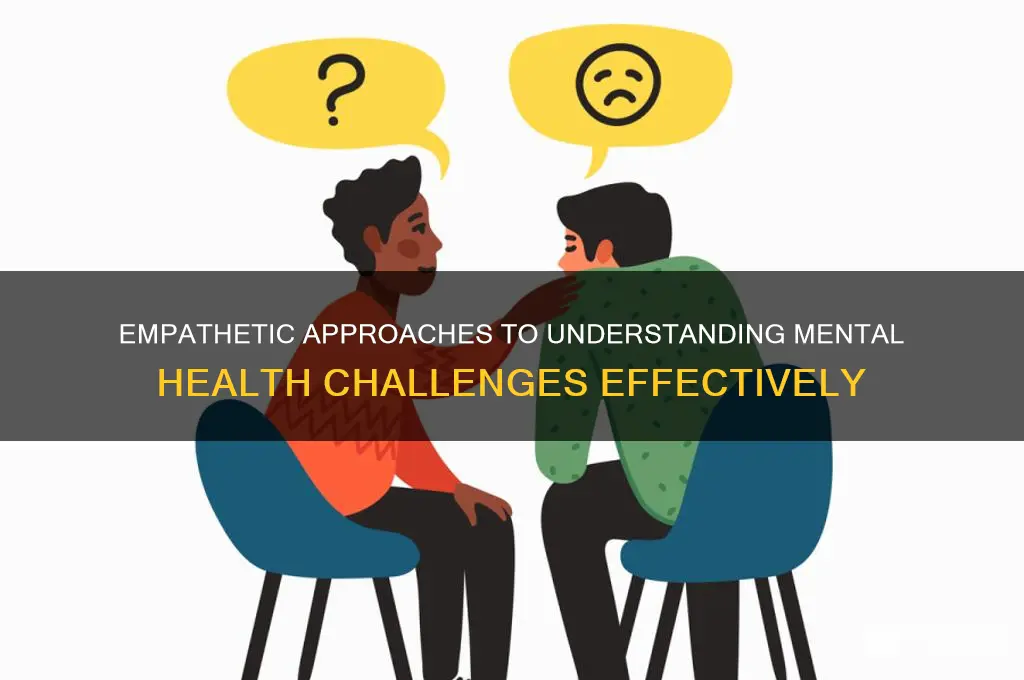
Understanding someone with mental health issues requires empathy, patience, and a willingness to listen without judgment. It’s essential to recognize that mental health struggles are unique to each individual, and what works for one person may not work for another. Start by educating yourself about their specific condition, but remember that knowledge alone isn’t enough—genuine connection comes from active listening and validating their feelings. Avoid minimizing their experiences or offering quick fixes; instead, create a safe space where they feel heard and supported. Encourage professional help when needed, but also respect their boundaries and pace. Above all, approach the situation with compassion, understanding that recovery is a journey, and your presence can make a meaningful difference.
Explore related products


$27.94 $34.99


$74.24 $94.99


What You'll Learn
- Active Listening: Focus on their words, avoid interrupting, and show empathy through non-verbal cues
- Educate Yourself: Learn about their specific condition to better understand their experiences
- Avoid Judgment: Refrain from criticizing or dismissing their feelings or behaviors
- Offer Support: Let them know you’re there without pushing or forcing help
- Patience is Key: Mental health recovery takes time; be consistent and understanding

Active Listening: Focus on their words, avoid interrupting, and show empathy through non-verbal cues
Effective communication with someone experiencing mental health challenges begins with active listening—a skill that demands more than just hearing words. It requires a deliberate focus on the speaker’s message, filtering out distractions and internal judgments. When engaging with someone in this state, start by minimizing external interruptions: silence your phone, choose a quiet space, and maintain eye contact where culturally appropriate. This creates a safe environment where the person feels their words are valued. For instance, if they mention feeling overwhelmed by work, resist the urge to immediately offer solutions like “You should take a break.” Instead, repeat back what you hear: “It sounds like your workload is really weighing on you.” This validates their experience and shows you’re fully present.
Non-verbal cues play a pivotal role in conveying empathy, often more powerfully than words. Research in psychology highlights that up to 93% of communication is non-verbal, including tone, facial expressions, and body language. When someone shares their struggles, mirror their emotional tone without exaggerating—a slight nod, a softened expression, or an open posture signals understanding. Avoid crossing your arms or fidgeting, as these can subconsciously communicate disinterest or impatience. For example, if they describe feeling isolated, a gentle tilt of the head or a brief touch on the arm (if consent is clear) can communicate solidarity without words. These subtle actions bridge emotional gaps where verbal reassurance might fall short.
Active listening also involves patience—a virtue often tested when conversations touch on sensitive topics. Studies show that the average person listens for only 17 seconds before interrupting, but individuals with mental health issues may need more time to articulate their thoughts. Practice the “2-second rule”: after they finish speaking, pause for two seconds before responding. This prevents accidental interruptions and demonstrates respect for their pace. For instance, if they pause mid-sentence, resist filling the silence with questions like “But why do you feel that way?” Instead, use phrases like “Take your time” or “I’m here whenever you’re ready.” This fosters trust and encourages deeper sharing.
Finally, active listening is not about fixing the problem but about holding space for the person’s emotions. A common mistake is to shift the focus from their experience to your advice, which can inadvertently minimize their feelings. For example, if someone shares anxiety about a social event, avoid saying “Just think positive thoughts.” Instead, acknowledge the complexity: “It seems like this event is triggering a lot of worry for you.” This approach honors their reality and reinforces that you’re there to listen, not to solve. Over time, this consistency builds a foundation of trust, making it easier for them to express themselves authentically.
In practice, active listening is a skill honed through repetition and self-awareness. Start small: in your next conversation, challenge yourself to ask one open-ended question (“How did that make you feel?”) and maintain eye contact for at least 30 seconds. Reflect on your non-verbal habits—are you leaning in, or are your gestures closed off? With intentional effort, these techniques become second nature, transforming how you connect with those navigating mental health challenges. Remember, the goal isn’t perfection but progress—one attentive moment at a time.
Empathetic Strategies for Communicating with Individuals Facing Mental Health Challenges
You may want to see also
Explore related products




Educate Yourself: Learn about their specific condition to better understand their experiences
Understanding someone with mental health issues begins with recognizing that their experiences are shaped by specific conditions, each with its own complexities. For instance, anxiety disorders are not just about feeling nervous; they can manifest as panic attacks, obsessive thoughts, or debilitating avoidance behaviors. Similarly, depression is more than sadness—it can drain energy, distort thinking, and even alter physical health. By learning about these conditions, you move beyond surface-level sympathy to a deeper, more informed empathy. This knowledge equips you to recognize triggers, interpret behaviors, and respond in ways that genuinely support the individual.
To educate yourself effectively, start with reliable sources such as the National Institute of Mental Health, the World Health Organization, or peer-reviewed articles. Avoid sensationalized media or anecdotal accounts that may perpetuate myths. For example, understanding that schizophrenia involves a combination of hallucinations, delusions, and cognitive challenges—not a split personality—can help dispel harmful stereotypes. Focus on the symptoms, causes, and treatment options for the specific condition the person is dealing with. This foundational knowledge will help you avoid misattributing behaviors or offering uninformed advice.
Practical steps include reading books written by mental health professionals or individuals with lived experience. For instance, *The Noonday Demon* by Andrew Solomon offers profound insights into depression, while *An Unquiet Mind* by Kay Redfield Jamison provides a firsthand account of bipolar disorder. Online courses, such as those offered by Coursera or FutureLearn, can also deepen your understanding. If the person is open to it, ask them to recommend resources or share their own experiences. This not only educates you but also fosters trust and communication.
However, educating yourself is not without its challenges. Mental health conditions are highly individualized, and what you learn may not perfectly align with the person’s unique experience. For example, while generalized anxiety disorder often involves excessive worry, one person might struggle with social situations, while another might fixate on health concerns. Be cautious not to assume you fully understand their reality based on general information. Instead, use your knowledge as a framework to ask thoughtful questions and listen actively.
Ultimately, educating yourself about their specific condition is an act of respect and care. It demonstrates a willingness to meet them where they are, rather than expecting them to conform to your understanding. For instance, knowing that someone with PTSD may experience flashbacks or hypervigilance can help you create a safe, predictable environment for them. This proactive approach not only strengthens your relationship but also empowers you to be a more effective ally in their journey toward healing. Remember, the goal is not to become an expert but to cultivate compassion and competence in supporting their mental health.
Navigating Job Searches: Strategies for Success with Mental Health Challenges
You may want to see also
Explore related products





Avoid Judgment: Refrain from criticizing or dismissing their feelings or behaviors
Judgment can be a silent saboteur in conversations about mental health, often stemming from a lack of understanding or fear of the unfamiliar. When someone shares their struggles, criticism or dismissal can shut down communication, reinforcing feelings of isolation and shame. Consider this: if a friend confided in you about chronic pain, you wouldn’t accuse them of exaggerating or suggest they “just toughen up.” Mental health deserves the same empathy. The first step in avoiding judgment is recognizing that feelings and behaviors, no matter how perplexing, are valid expressions of a person’s experience.
To actively refrain from judgment, practice reflective listening. Instead of jumping to conclusions or offering unsolicited advice, repeat back what you hear to confirm understanding. For example, if someone says, “I can’t get out of bed,” respond with, “It sounds like you’re feeling overwhelmed and exhausted.” This approach validates their emotions without imposing your perspective. Research shows that reflective listening reduces defensiveness and fosters trust, creating a safe space for open dialogue. Remember, your role isn’t to fix or evaluate—it’s to listen and acknowledge.
A common pitfall is dismissing behaviors as “attention-seeking” or “overreacting.” For instance, someone with anxiety might avoid social gatherings, while a person with depression may cancel plans repeatedly. Instead of labeling these actions as inconvenient or dramatic, consider the underlying distress. Ask yourself: What might this behavior be communicating? Often, it’s a cry for understanding or a coping mechanism. By reframing your perspective, you shift from judgment to curiosity, paving the way for deeper connection.
Finally, educate yourself about mental health to dismantle biases. Judgment often arises from misconceptions or stereotypes. For example, knowing that anxiety disorders affect 40 million adults in the U.S. alone can humanize the experience, making it harder to trivialize. Practical tips include following reputable mental health organizations, reading personal narratives, or attending workshops. The more you understand, the less room there is for judgment. Empathy isn’t innate—it’s cultivated through awareness and effort.
In conclusion, avoiding judgment requires intentionality and self-awareness. By listening reflectively, reframing behaviors, and educating yourself, you create an environment where someone feels safe to share their struggles. Judgment closes doors; empathy opens them. The takeaway? Your words and attitudes can either deepen someone’s pain or help them feel seen. Choose the latter.
Supporting Mental Health: Practical Ways to Help Others Heal and Thrive
You may want to see also
Explore related products

$8.96 $14.99


Offer Support: Let them know you’re there without pushing or forcing help
Offering support to someone with mental health issues requires a delicate balance between presence and patience. It’s not about inserting yourself into their space but about creating an environment where they feel safe to reach out when they’re ready. Start by letting them know you’re available—a simple “I’m here if you need me” can be more powerful than unsolicited advice or intrusive questions. Avoid phrases like “Let me know what I can do,” which can place the burden on them to articulate their needs. Instead, offer specific, low-pressure options: “I’m free to talk tonight if you want” or “I can bring over dinner tomorrow if that helps.” This approach respects their autonomy while signaling your willingness to engage on their terms.
Consider the analogy of a lifeline: your role is to hold the rope, not pull them to shore. Pushing help—whether it’s therapy suggestions, self-help books, or well-intentioned pep talks—can feel overwhelming and dismissive of their experience. For instance, saying “You should try meditation” might come across as minimizing their struggle, especially if they’ve already tried it. Instead, focus on active listening and validation. Reflect their emotions back to them: “It sounds like you’re feeling really overwhelmed right now.” This shows you’re paying attention and acknowledges their pain without trying to “fix” it. Over time, this builds trust, making them more likely to accept help when they’re ready.
Practical tips can make this process more tangible. For example, if they’re comfortable with physical gestures, a gentle hand on their shoulder or a quiet sit-together can communicate support without words. If they’re more reserved, sending a brief check-in text once a week—“Thinking of you, no need to reply”—can remind them of your presence without demanding a response. Be mindful of their boundaries, especially if they’ve expressed a need for space. Respecting their limits doesn’t mean you’re abandoning them; it means you’re honoring their agency, which is crucial for rebuilding trust in relationships affected by mental health struggles.
Finally, remember that offering support is a long-term commitment, not a one-time gesture. Mental health challenges don’t resolve overnight, and neither does the process of feeling understood. Avoid keeping a mental tally of your efforts or expecting gratitude—this can create resentment on both sides. Instead, approach it as an act of care, not a transaction. Over time, your consistent, non-intrusive presence can become a stabilizing force in their life, even if the impact isn’t immediately visible. This kind of support isn’t flashy, but it’s often the most meaningful.
Mastering Mental Health Advocacy: A Guide to Public Speaking
You may want to see also
Explore related products


Patience is Key: Mental health recovery takes time; be consistent and understanding
Mental health recovery is not a linear process. It’s a journey filled with setbacks, breakthroughs, and moments of stagnation. For those supporting someone through this, the temptation to rush progress or seek quick fixes can be overwhelming. Yet, the most effective approach is often the simplest: patience. Recovery takes time, and the pace is rarely predictable. Think of it as tending to a garden—some plants bloom quickly, while others require months of care before they flourish. The same principle applies here: consistency and understanding are the nutrients that foster growth.
Consider the analogy of rebuilding a house after a storm. You wouldn’t expect the foundation to be laid, the walls erected, and the roof installed in a single day. Mental health recovery is similar—it involves rebuilding emotional, psychological, and sometimes physical structures. For instance, someone recovering from depression might need weeks or months to reestablish healthy sleep patterns, let alone regain the energy to engage in social activities. Pushing them to “snap out of it” or comparing their progress to others can be counterproductive, eroding trust and deepening feelings of inadequacy. Instead, small, consistent acts of support—like checking in without judgment or offering to accompany them to therapy—can make a significant difference.
Patience also means managing your own expectations. It’s easy to feel frustrated or helpless when progress seems slow, but remember that recovery is not a performance for your benefit. It’s a deeply personal process, often fraught with internal battles that are invisible to outsiders. For example, someone with anxiety might appear “fine” one day and overwhelmed the next, not because they’re inconsistent, but because managing anxiety is an ongoing effort. By being patient, you signal that you’re in it for the long haul, which can alleviate the pressure they feel to “get better” on a timeline that doesn’t align with their reality.
Practical patience involves setting realistic goals and celebrating small victories. If your loved one is working on reducing panic attacks, focus on incremental progress—like going from three attacks a week to two—rather than expecting them to stop entirely. Tools like journaling or shared calendars can help track these milestones without feeling intrusive. Additionally, educate yourself about their specific condition; understanding the challenges they face can deepen your empathy and inform how you offer support. For instance, learning about the cognitive fatigue associated with depression can explain why they might cancel plans at the last minute, allowing you to respond with compassion instead of disappointment.
Ultimately, patience is an act of respect—it acknowledges the complexity of mental health struggles and honors the individual’s autonomy in their recovery. It’s about showing up consistently, even when the progress is imperceptible, and trusting that your presence matters. Recovery is not a race, and neither is your role in supporting it. By embracing patience, you create a safe, nonjudgmental space where healing can unfold at its own pace, one step at a time.
Proving Mental Stability: A Guide to Demonstrating Sound Mental Health
You may want to see also
Frequently asked questions
Listen actively without judgment, use empathetic and non-confrontational language, and avoid offering unsolicited advice. Let them know you’re there to support them, and ask how they prefer to be helped.
Common signs include changes in mood, behavior, or energy levels, withdrawal from social activities, difficulty concentrating, or expressing feelings of hopelessness or worthlessness.
Respect their autonomy, ask if they’re open to talking or receiving help, and offer resources like therapy or support groups. Avoid pressuring them and focus on being a consistent, non-judgmental presence.