Caleb Wright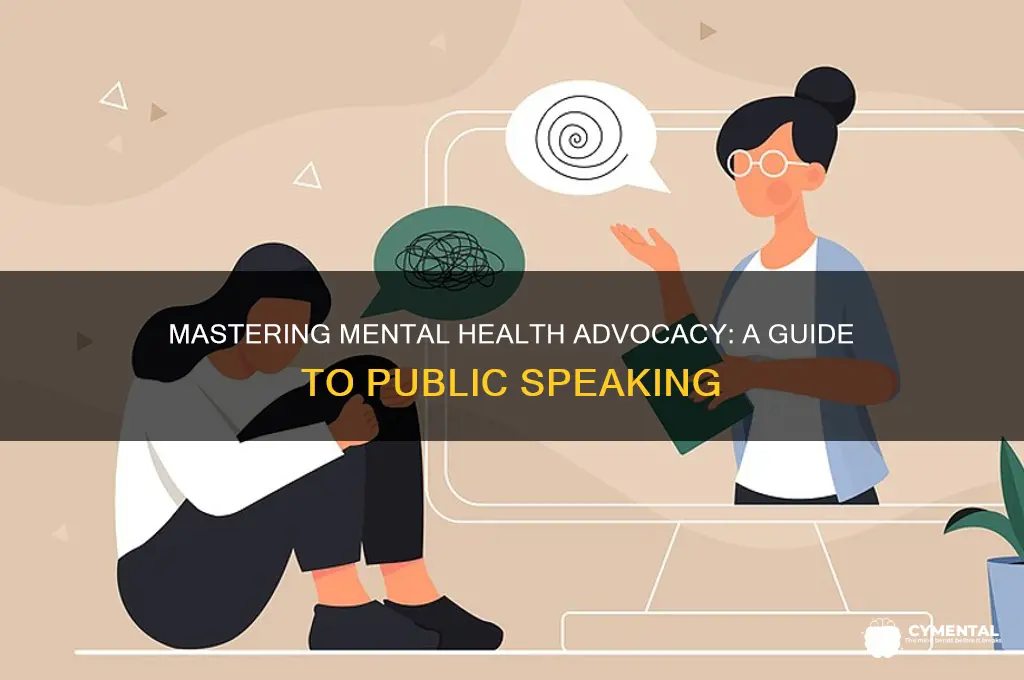
Becoming a public speaker on mental health issues requires a combination of passion, knowledge, and effective communication skills. Start by educating yourself thoroughly on mental health topics, staying updated on research, and understanding the stigma and challenges surrounding these issues. Develop empathy and a genuine desire to help others, as authenticity resonates with audiences. Practice public speaking through smaller, low-stakes opportunities like local events or online platforms to build confidence and refine your message. Engage with mental health organizations or support groups to gain insights and establish credibility. Craft compelling narratives that balance personal stories with factual information, ensuring your message is both relatable and informative. Finally, prioritize self-care to maintain your own mental well-being while advocating for others, as this authenticity will strengthen your impact as a speaker.
Explore related products


What You'll Learn

Understanding Mental Health Basics
Mental health literacy begins with recognizing that mental illnesses are as real and debilitating as physical ailments. Anxiety disorders, for instance, affect 1 in 13 people globally, yet only a third receive treatment. Depression, another prevalent condition, often manifests not just as sadness but as persistent fatigue, irritability, or even physical pain. Understanding these symptoms as potential red flags is crucial for early intervention. Public speakers must ground their talks in such evidence-based facts to dispel myths and foster empathy.
To effectively communicate mental health basics, break down complex concepts into relatable analogies. For example, explain neurotransmitters like serotonin as "brain messengers" that regulate mood, much like how traffic lights control the flow of vehicles. Use visuals or metaphors to illustrate how stress hormones like cortisol can disrupt sleep patterns or weaken immunity over time. This approach makes abstract ideas tangible, ensuring your audience grasps the biological underpinnings of mental health without feeling overwhelmed by jargon.
A common pitfall in mental health discussions is oversimplification. Avoid phrases like "just stay positive" or "snap out of it," which trivialize struggles. Instead, emphasize the multifaceted nature of mental health, influenced by genetics, environment, and lifestyle. For instance, research shows that regular exercise can reduce symptoms of depression by 26%, but it’s not a standalone cure. Pair such statistics with actionable advice, like recommending 30 minutes of moderate exercise daily, to empower listeners with practical tools.
When addressing stigma, adopt a persuasive tone backed by storytelling. Share anonymized case studies or personal narratives (with consent) to humanize mental health challenges. For example, a story of a high-achieving professional who struggled silently with burnout can resonate more than abstract data. Conclude with a call to action, such as encouraging audience members to check in on colleagues or loved ones, reinforcing that small acts of understanding can make a significant difference.
Finally, tailor your message to your audience’s age and cultural context. Teenagers may respond better to discussions about social media’s impact on self-esteem, while older adults might benefit from insights on managing loneliness. Incorporate culturally sensitive examples; for instance, in collectivist societies, frame mental health as a community responsibility rather than an individual burden. This customization ensures your message is not only informative but also culturally relevant and actionable.
Prevent Mental Health Issues: Practical Strategies for a Healthier Mind
You may want to see also
Explore related products



Crafting Impactful, Empathetic Speeches
Public speaking on mental health demands more than facts—it requires connection. Audiators need to feel seen, heard, and understood. Crafting impactful, empathetic speeches begins with a shift in perspective: speak *to* your audience, not *at* them. Ditch the clinical tone and embrace vulnerability. Share personal anecdotes (when appropriate) or weave in relatable stories that humanize the data. For instance, instead of stating, "Depression affects 280 million people globally," say, "Imagine 280 million silent battles, each one a friend, a neighbor, or someone sitting right here in this room." This immediacy bridges the gap between statistic and shared experience.
Empathy thrives on specificity. Avoid vague generalizations like "mental health struggles are hard." Dive into the nuances. Describe the physical weight of anxiety—the clenched jaw, the racing heart—or the isolating fog of depression. Use sensory details to paint a picture. For example, "Imagine waking up each morning to a room that feels heavier than your own body, the curtains a mockery of the sunlight you can’t seem to reach." Such vivid imagery invites listeners into the experience, fostering understanding without demanding it.
Structure your speech as a journey, not a lecture. Start with a hook that disrupts assumptions. For instance, "What if I told you the strongest person in this room is the one fighting a battle no one sees?" Then, build with a mix of data, narrative, and reflection. Use the "what-so what-now what" framework: present a fact, explain its emotional or societal impact, and end with actionable takeaways. For example, after sharing suicide statistics, don’t leave the audience in despair. Offer concrete steps: "If you notice a friend withdrawing, start with a simple text: ‘I’m here. No pressure, just here.’"
Caution: empathy without boundaries can lead to emotional overload. Balance vulnerability with professionalism. Avoid oversharing or dramatizing pain for effect. Instead, use pauses and pacing to honor the gravity of the topic. Practice the "3-second rule": after a heavy statement, pause for three seconds to let it land. This gives the audience space to process and prevents emotional numbness. Similarly, end on a note of hope or resilience. A speech on mental health should leave listeners feeling empowered, not burdened.
Finally, rehearse with intention. Record yourself and analyze not just your words, but your tone, body language, and eye contact. Do you soften when sharing a personal story? Do you lean in during a call to action? These nonverbals amplify empathy. And remember: perfection isn’t the goal. Authenticity is. A slight crack in your voice or a moment of silence can communicate more than polished delivery ever could. Your speech isn’t just about mental health—it’s a testament to the humanity behind it.
Supporting Educators: Strategies for Teachers Managing Mental Health Challenges
You may want to see also
Explore related products


Building Confidence on Stage
Confidence on stage isn’t built overnight; it’s a muscle trained through deliberate practice and mindset shifts. Start by reframing nervousness as excitement. Research shows that labeling pre-performance jitters as "excitement" can improve confidence and performance. Before stepping on stage, take two minutes to focus on your breath: inhale for four seconds, hold for four, exhale for six. This activates the parasympathetic nervous system, reducing cortisol levels and calming the mind. Pair this with a power pose—standing tall with hands on hips—for at least two minutes to increase testosterone and decrease stress hormones. These physiological changes create a foundation for confidence that audiences will perceive as authenticity.
Next, anchor your presence by grounding your speech in personal stories. Audiences connect with vulnerability, not perfection. Share a specific, 2-3 minute anecdote that illustrates your journey with mental health. For example, describe a moment when you sought help and the impact it had. This not only humanizes you but shifts the focus from self-doubt to the message. Practice this story until it feels natural, not memorized. Record yourself and analyze body language: are your gestures open, or do you cross your arms? Small adjustments, like maintaining eye contact with one person for 5-7 seconds before moving to another, build rapport and reduce the feeling of being "on display."
A common mistake is overloading slides or notes with information as a crutch. Instead, use the "rule of three": structure your talk into three key points, each supported by a story, statistic, or question. This simplicity ensures clarity and reduces cognitive load, allowing you to engage more fully with the audience. For instance, if discussing stigma, start with a startling statistic (e.g., "1 in 4 adults experience mental illness annually"), follow with a personal story, and end with a call to action. Rehearse this structure five times aloud, each time reducing reliance on notes until you can deliver it conversationally. This repetition builds muscle memory, making you feel more in control on stage.
Finally, embrace imperfection as part of the process. Even seasoned speakers stumble over words or forget lines. When this happens, pause, take a breath, and rephrase. Audiences respect transparency more than flawless delivery. After each talk, jot down three things that went well and one area to improve. Over time, this practice shifts focus from fear of failure to growth. Remember: confidence isn’t about eliminating doubt but performing despite it. Each stage appearance, no matter how small, compounds your ability to stand tall in the spotlight.
Understanding Stigma: How Society Treats Those with Mental Health Issues
You may want to see also
Explore related products




Engaging Audience Effectively
Public speaking on mental health requires more than expertise—it demands connection. Audiences crave authenticity, not lectures. Begin by anchoring your talk in a personal story or relatable anecdote. For instance, sharing a moment of vulnerability, like a panic attack during a presentation, humanizes you and creates empathy. This isn’t about oversharing but about strategically revealing enough to bridge the gap between speaker and listener. Research shows that narratives activate the brain’s sensory regions, making your message more memorable and impactful.
Next, leverage interactive elements to break the monotony of a one-sided conversation. Incorporate polls, Q&A sessions, or even silent reflection moments. For example, ask the audience to raise their hands if they’ve ever felt overwhelmed by stress, then pause to let them see they’re not alone. Tools like Mentimeter or Kahoot can gamify participation, especially with younger audiences (ages 18–30). However, avoid overloading the session—limit interactive segments to 2–3 per 45-minute talk to maintain focus.
Visual aids are powerful, but they must complement, not compete with, your message. Use slides with minimal text and striking imagery—a single statistic on depression rates paired with a thought-provoking photo can resonate more than bullet points. For virtual talks, ensure your background is clean and your lighting flattering; poor production quality can distract and diminish credibility. Pro tip: Practice your gestures and eye contact while presenting slides to avoid becoming a talking head.
Finally, tailor your tone and language to your audience. Speaking to healthcare professionals? Use clinical terms and data-driven insights. Addressing high school students? Simplify concepts and incorporate pop culture references. A 2022 study found that audience-specific language increases engagement by 40%. Always end with a call to action—whether it’s sharing resources, encouraging self-reflection, or committing to one small change. Leave them with something tangible, not just inspiration.
Engaging an audience effectively isn’t about perfection; it’s about presence. Rehearse, but don’t memorize. Be prepared to adapt if the room’s energy shifts. Remember, your goal isn’t to deliver a speech—it’s to spark a conversation that continues long after you’ve left the stage.
Supporting Mental Health in Special Needs: Strategies for Care and Understanding
You may want to see also
Explore related products

$10.99 $18.99


Handling Sensitive Q&A Sessions
Sensitive Q&A sessions on mental health demand precision and empathy, as questions can veer into deeply personal or triggering territory. Begin by setting clear boundaries at the outset. Announce that you reserve the right to rephrase, redirect, or decline questions that may harm the audience or violate confidentiality. For instance, if asked, “What should I do if my friend is suicidal?” respond with a general framework like the QPR (Question, Persuade, Refer) method rather than specific advice tailored to an individual case. This protects both the audience and your professional integrity.
The tone of your responses is as critical as the content. Use a calm, measured delivery to model emotional regulation, even when confronted with hostility or skepticism. For example, if someone challenges the validity of therapy, acknowledge their perspective with a phrase like, “It’s understandable to feel that way, especially if past experiences didn’t meet expectations,” before pivoting to evidence-based outcomes. This approach disarms tension while reinforcing your credibility. Keep responses concise—aim for 60-90 seconds—to maintain focus and prevent monopolization by a single participant.
Prepare for recurring themes by categorizing potential questions into buckets: stigma, personal experiences, treatment options, and crisis intervention. For each category, script a brief, adaptable response. For instance, if asked about your own mental health journey, decide in advance how much to disclose. A balanced answer might be, “I’ve experienced anxiety, which taught me the importance of seeking support, but today I’m here to discuss strategies that have helped many, not just my story.” This shifts the focus from the personal to the actionable.
Anticipate triggers and have a de-escalation plan. If a question or response causes visible distress in the audience, pause and say, “Let’s take a moment to breathe deeply,” then offer a grounding technique, such as naming five things in the room. Signal the availability of support by mentioning on-site counselors or hotlines. After the session, follow up with organizers to ensure resources are distributed, such as crisis contact sheets or self-care guides. This proactive approach demonstrates your commitment to audience well-being beyond the stage.
Finally, reflect on each Q&A session as a learning opportunity. Note which questions surprised you, which responses landed well, and where you felt uncertain. Use this feedback to refine your approach, perhaps by consulting with mental health professionals or joining speaker networks for peer advice. Over time, this iterative process will sharpen your ability to navigate sensitivity with confidence, ensuring your message resonates without compromising care.
Approaching Mental Health Conversations: Compassionate Strategies for Supportive Connections
You may want to see also
Frequently asked questions
While formal qualifications can enhance credibility, they are not mandatory. A strong understanding of mental health, personal experience, or training in psychology, counseling, or related fields can be beneficial. Passion, empathy, and effective communication skills are essential. Consider certifications in mental health advocacy or public speaking to build expertise.
Start small by practicing in low-pressure environments, such as with friends or local groups. Join public speaking clubs like Toastmasters, and focus on storytelling to connect with your audience. Educate yourself thoroughly on the topic to feel more secure in your knowledge, and remember that vulnerability can make your message more relatable.
Look for platforms like schools, community centers, workplaces, conferences, and mental health organizations. Reach out to local nonprofits, universities, or mental health advocacy groups to offer your services. Social media and online webinars are also great ways to share your message and build an audience.
Research your audience to tailor your content to their needs and knowledge level. Use personal stories and data to make your message relatable and credible. Avoid stigmatizing language and focus on hope, resilience, and resources. Encourage questions and provide actionable steps for listeners to take care of their mental health or support others.