Noah Parker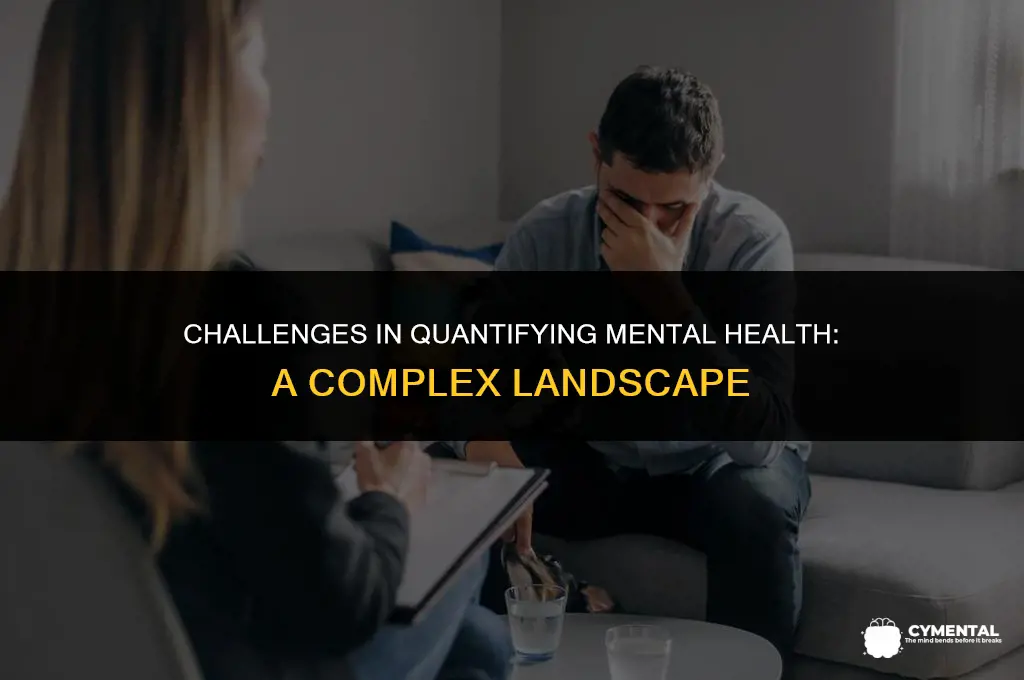
Measuring mental health issues presents a complex challenge due to the subjective nature of psychological experiences. Unlike physical health, which can often be quantified through objective measures like blood tests or imaging scans, mental health relies heavily on self-reported symptoms and behavioral observations. This inherent subjectivity can lead to variability in diagnoses and treatment plans, as different individuals may express and experience mental health issues in unique ways. Additionally, cultural differences, language barriers, and societal stigmas surrounding mental illness can further complicate the measurement process, making it difficult to develop standardized tools that are universally applicable. As a result, researchers and clinicians must navigate these challenges to ensure accurate assessments and effective interventions for mental health issues.
Explore related products



What You'll Learn
- Subjective Experience: Mental health issues are deeply personal and can vary greatly from one individual to another
- Lack of Objective Tests: Unlike physical health, there are no straightforward, objective tests to diagnose mental health issues
- Stigma and Reporting: Fear of stigma or repercussions may prevent individuals from reporting their mental health struggles accurately
- Cultural Differences: What is considered a mental health issue can differ significantly across cultures, affecting diagnosis and treatment
- Evolving Definitions: The criteria for diagnosing mental health issues are periodically revised, which can complicate longitudinal studies and treatment planning

Subjective Experience: Mental health issues are deeply personal and can vary greatly from one individual to another
Mental health issues manifest uniquely in each individual, shaped by a complex interplay of biological, psychological, and environmental factors. This subjective experience poses significant challenges in measurement, as traditional quantitative methods often struggle to capture the nuanced and personal nature of mental health. For instance, two individuals may exhibit similar symptoms of depression, yet their underlying emotional experiences and coping mechanisms could differ drastically. This variability underscores the need for more sophisticated and multifaceted approaches to assessing mental health.
One of the primary difficulties in measuring mental health issues is the reliance on self-reporting, which can be influenced by various biases and limitations. Individuals may underreport or overreport symptoms due to factors such as social desirability bias, memory lapses, or differing interpretations of symptom severity. Moreover, cultural differences in the expression and perception of mental health symptoms can further complicate self-reporting measures. For example, in some cultures, emotional distress may be more readily expressed through physical symptoms rather than verbal articulation, leading to potential misdiagnosis or underdiagnosis.
To address these challenges, researchers and clinicians are increasingly turning to mixed-methods approaches that combine quantitative measures with qualitative, in-depth interviews. This allows for a more comprehensive understanding of an individual's mental health experience, capturing both the breadth and depth of their symptoms. Additionally, the integration of technology, such as mobile apps and wearable devices, offers new avenues for continuous monitoring and real-time assessment of mental health, providing a more dynamic and accurate picture of an individual's well-being.
Another critical aspect to consider is the impact of stigma and discrimination on mental health measurement. Fear of judgment or repercussions may lead individuals to conceal their symptoms or avoid seeking help altogether, resulting in underreporting and delayed intervention. Addressing stigma through public awareness campaigns and fostering a culture of empathy and support can help mitigate these issues and encourage more accurate reporting of mental health concerns.
In conclusion, the subjective nature of mental health issues presents significant challenges in measurement, necessitating a multifaceted and nuanced approach. By combining quantitative and qualitative methods, leveraging technology, and addressing stigma, we can improve the accuracy and comprehensiveness of mental health assessments, ultimately leading to better outcomes for individuals struggling with these deeply personal issues.
Navigating Mental Health: Understanding General Appointments and Specialized Care
You may want to see also
Explore related products


Lack of Objective Tests: Unlike physical health, there are no straightforward, objective tests to diagnose mental health issues
Unlike physical health, where a simple blood test or X-ray can provide clear, objective results, mental health issues are often diagnosed through subjective assessments and self-reported symptoms. This lack of objective tests presents a significant challenge in accurately identifying and treating mental health conditions. Mental health professionals rely heavily on patient interviews, questionnaires, and behavioral observations, which can be influenced by various factors such as the patient's willingness to disclose information, their current emotional state, and the clinician's own biases and interpretations.
One of the primary difficulties with this approach is the inherent subjectivity involved. Two clinicians may interpret the same patient's symptoms differently, leading to inconsistent diagnoses and treatment plans. Additionally, patients may not always accurately report their symptoms or may be unaware of certain signs of their condition, further complicating the diagnostic process. This subjectivity can also lead to misdiagnosis, where a patient is incorrectly labeled with a mental health issue they do not actually have, or underdiagnosis, where a patient's condition is not fully recognized.
Another challenge is the lack of a standardized framework for diagnosing mental health issues. While there are diagnostic manuals such as the DSM-5 (Diagnostic and Statistical Manual of Mental Disorders), these guides are periodically updated and can vary in their criteria and classifications. This can result in confusion and inconsistency among healthcare providers, researchers, and patients. Furthermore, the DSM-5 and similar manuals are often criticized for being overly broad or narrow in their definitions, leading to debates about the validity and reliability of certain diagnoses.
The absence of objective tests also hinders research into mental health conditions. Without clear, measurable indicators, it becomes difficult to study the causes, progression, and effectiveness of treatments for these issues. This can limit the development of new therapies and interventions, as well as the ability to track outcomes and improve patient care. Moreover, the reliance on self-reported data can introduce biases and inaccuracies into research findings, making it challenging to draw definitive conclusions about mental health issues.
In conclusion, the lack of objective tests for diagnosing mental health issues poses a significant obstacle in the field of psychiatry and psychology. It leads to subjectivity in diagnoses, inconsistency among healthcare providers, and challenges in research and treatment development. Addressing this issue will require the development of more reliable and standardized diagnostic tools, as well as a better understanding of the complex interplay between biological, psychological, and social factors that contribute to mental health conditions.
ACA's Impact: Transforming Behavioral and Mental Health Care Access
You may want to see also
Explore related products






Stigma and Reporting: Fear of stigma or repercussions may prevent individuals from reporting their mental health struggles accurately
Individuals struggling with mental health issues often face a significant barrier in seeking help or reporting their conditions accurately due to the fear of stigma. This fear can stem from societal attitudes that view mental illness as a weakness or a personal failing, leading to potential discrimination, social exclusion, or negative impacts on one's career and relationships. As a result, many people may underreport their symptoms or avoid seeking professional help altogether, complicating efforts to measure and address mental health issues effectively.
The stigma surrounding mental health can manifest in various ways, including negative stereotypes, prejudice, and discrimination. These factors can influence how individuals perceive themselves and their willingness to disclose their mental health struggles. For instance, a person experiencing depression may fear being labeled as "crazy" or "unstable," which could deter them from seeking treatment or discussing their feelings with others. This reluctance to report mental health issues can lead to inaccurate data collection, making it challenging for researchers and policymakers to understand the true prevalence and impact of these conditions.
Moreover, the fear of repercussions can further exacerbate the issue. Individuals may worry about the potential consequences of disclosing their mental health struggles, such as losing their job, facing discrimination in the workplace, or damaging their reputation. This fear can be particularly pronounced in certain professions or cultural contexts where mental illness is viewed as a taboo subject. As a result, people may choose to suffer in silence rather than risk the perceived negative outcomes of seeking help or reporting their conditions.
To address these challenges, it is essential to create a more supportive and understanding environment for individuals struggling with mental health issues. This can involve efforts to reduce stigma through public awareness campaigns, education, and advocacy. Additionally, policymakers and healthcare providers can work to ensure that mental health services are accessible, confidential, and free from discrimination. By fostering a culture of acceptance and support, we can encourage more individuals to report their mental health struggles accurately, leading to better measurement, treatment, and outcomes for those affected.
Identifying Mental Health Challenges in Students: A School's Guide
You may want to see also
Explore related products


Cultural Differences: What is considered a mental health issue can differ significantly across cultures, affecting diagnosis and treatment
Cultural differences play a significant role in shaping how mental health issues are perceived, diagnosed, and treated across various societies. What may be considered a mental health concern in one culture might be viewed as a normal aspect of life or even a positive trait in another. This variation can lead to challenges in accurately identifying and addressing mental health problems, particularly in multicultural or diverse settings.
For instance, in some cultures, experiencing intense emotions or having spiritual visions might be seen as a sign of mental illness, while in others, these experiences could be interpreted as a natural part of emotional expression or a connection to the divine. Similarly, certain behaviors, such as talking to oneself or displaying strong emotional reactions, might be stigmatized in some societies but accepted or even encouraged in others.
These cultural nuances can affect the diagnostic process, as mental health professionals may need to consider the cultural context of their patients to avoid misdiagnosis. For example, a clinician working with a patient from a culture where spiritual experiences are common might need to differentiate between a genuine spiritual encounter and a symptom of a mental health disorder like schizophrenia.
Treatment approaches can also be influenced by cultural differences. Some cultures may prefer traditional healing methods, such as herbal remedies or spiritual practices, over Western-style psychotherapy or medication. In other cases, cultural values around family and community may emphasize the importance of involving loved ones in the treatment process, while in more individualistic cultures, a more solitary approach might be preferred.
To navigate these complexities, mental health professionals must be culturally competent, meaning they have an understanding of and respect for the cultural backgrounds of their patients. This includes being aware of cultural differences in symptom expression, diagnosis, and treatment preferences, as well as being able to communicate effectively with patients from diverse backgrounds. By taking a culturally sensitive approach, clinicians can provide more accurate diagnoses and effective treatments, ultimately improving mental health outcomes for individuals from all cultural backgrounds.
Is Burnout a Mental Health Issue? Understanding the Impact and Solutions
You may want to see also
Explore related products



Evolving Definitions: The criteria for diagnosing mental health issues are periodically revised, which can complicate longitudinal studies and treatment planning
The periodic revision of diagnostic criteria for mental health issues presents significant challenges for longitudinal studies. Researchers must navigate the complexities of aligning data collected over time with evolving definitions, which can lead to inconsistencies and difficulties in tracking changes in mental health status. For instance, a study that began using the DSM-IV criteria may need to adapt its findings to fit the updated DSM-5 framework, requiring careful consideration of how new and old criteria intersect.
In treatment planning, evolving definitions can also create obstacles. Clinicians must stay abreast of the latest diagnostic guidelines to ensure accurate assessments and effective interventions. However, the transition between old and new criteria can be fraught with uncertainty, as the nuances of each definition may alter the interpretation of symptoms and the selection of appropriate treatments. This can result in a period of adjustment where treatment plans may need to be revised or updated to reflect the new diagnostic landscape.
Moreover, the evolving nature of mental health definitions can impact the way mental health issues are perceived and understood by both professionals and the public. As criteria change, so too may the language used to describe mental health conditions, potentially leading to shifts in stigma, awareness, and access to care. For example, the reclassification of certain disorders or the introduction of new diagnostic categories can influence how individuals identify with their mental health experiences and seek support.
To mitigate these challenges, it is essential for researchers and clinicians to engage in ongoing education and training to stay current with the latest diagnostic criteria. Additionally, efforts should be made to develop more standardized and adaptable methods for collecting and analyzing mental health data, allowing for easier integration of new definitions and criteria over time. By addressing these issues proactively, the mental health field can better navigate the complexities of evolving definitions and improve the overall quality of care and research.
Transgender Identities: Exploring Genetic Influences vs. Mental Health Perspectives
You may want to see also
Frequently asked questions
Measuring mental health issues is complex due to their subjective nature, the variability in individual experiences, and the lack of objective biomarkers. Additionally, cultural differences and language barriers can affect how symptoms are reported and understood.
Researchers and clinicians use a combination of self-report questionnaires, clinical interviews, and observational methods to assess mental health. They also consider the context in which symptoms occur and use standardized criteria to diagnose mental health conditions.
The difficulties in measuring mental health issues can lead to misdiagnosis or underdiagnosis, which can impact treatment outcomes. Additionally, these challenges can affect the development of policies and programs aimed at addressing mental health needs, as accurate data is essential for informing these initiatives.






![Mental Status Examination: A Comprehensive Core Skills Guide For All Health Professionals [Booklet]](https://m.media-amazon.com/images/I/51zXTPH8MPS._AC_UL320_.jpg)