Lucas Bennett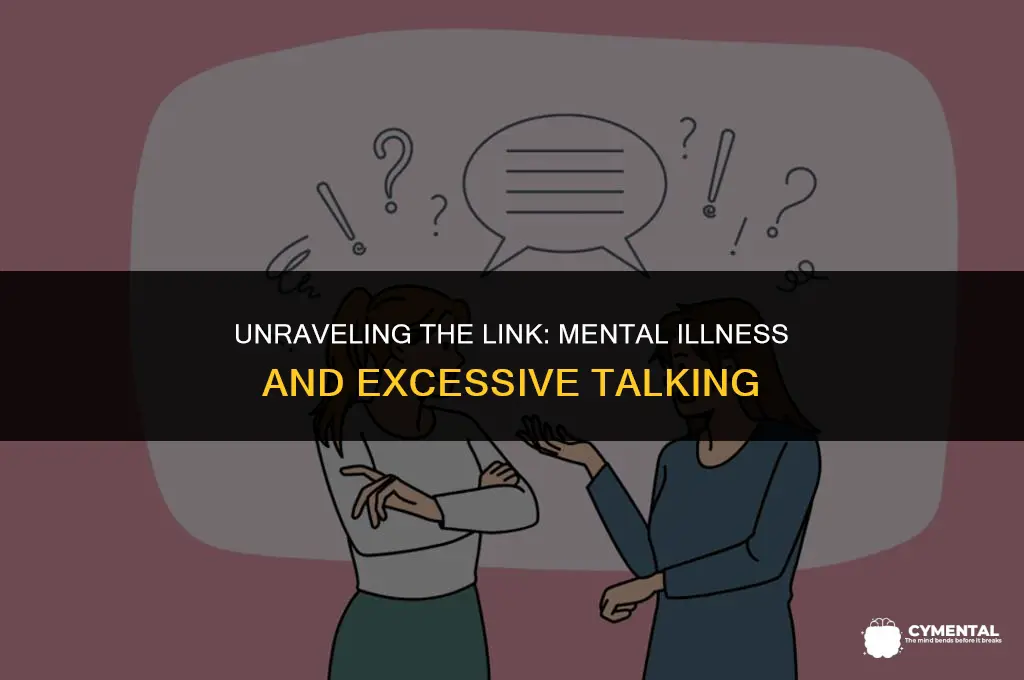
Excessive talking, also known as logorrhea, can be a symptom of various mental health conditions. While it's common for people to engage in lengthy conversations or share detailed stories, excessive talking that disrupts social interactions or daily activities may indicate an underlying issue. Conditions such as bipolar disorder, attention deficit hyperactivity disorder (ADHD), and certain types of anxiety disorders can manifest through excessive talking. Additionally, some personality disorders, like narcissistic personality disorder, may also be characterized by a tendency to talk excessively. Understanding the root cause of excessive talking is crucial for providing appropriate support and treatment to individuals experiencing this symptom.
| Characteristics | Values |
|---|---|
| Illness Name | Logorrhea |
| Symptoms | Excessive talking, often without regard for social context or others' reactions |
| Causes | Neurological conditions, psychiatric disorders, or as a side effect of certain medications |
| Associated Conditions | Mania, bipolar disorder, schizophrenia, ADHD, anxiety disorders |
| Treatment | Medications, psychotherapy, behavioral interventions |
| Prognosis | Varies depending on the underlying cause and the individual's response to treatment |
Explore related products

$13.58 $14.5



What You'll Learn
- Mania in Bipolar Disorder: Characterized by elevated mood, increased energy, and rapid speech
- Attention Deficit Hyperactivity Disorder (ADHD): Can cause impulsivity and difficulty controlling speech, leading to excessive talking
- Anxiety Disorders: Excessive talking can be a coping mechanism or a symptom of heightened anxiety
- Schizophrenia: May involve disorganized speech patterns, including excessive talking due to thought disorganization
- Personality Disorders: Certain personality disorders, like histrionic personality disorder, can involve excessive talking as a behavioral trait

Mania in Bipolar Disorder: Characterized by elevated mood, increased energy, and rapid speech
Mania in bipolar disorder is a distinct and intense phase characterized by a significant elevation in mood, energy levels, and speech patterns. This phase can be identified by a person's unusually upbeat and energetic demeanor, often accompanied by a rapid and pressured manner of speaking. During manic episodes, individuals may experience a decreased need for sleep, increased impulsivity, and a heightened sense of self-importance or grandiose beliefs. These symptoms can lead to behaviors that are out of character, such as excessive spending, risky sexual behaviors, or grandiose plans and projects.
One of the key features of mania is the rapid cycling of thoughts, which can manifest as a torrent of words and ideas. This is often referred to as "pressured speech," where the individual speaks quickly, with little regard for the listener's ability to keep up. The speech may be tangential, with topics changing rapidly and sometimes without clear connections. This can make it challenging for others to understand or engage in meaningful conversations with the person experiencing the manic episode.
It's important to note that while mania can be a hallmark of bipolar disorder, it is not the only symptom, and not everyone with bipolar disorder will experience mania in the same way. Some individuals may have milder forms of mania, known as hypomania, which can be less disruptive to daily life but still require treatment. Others may experience more severe forms of mania that can lead to hospitalization and intensive treatment.
Treatment for mania typically involves a combination of medication and psychotherapy. Mood stabilizers, such as lithium or valproate, are often used to help regulate mood and prevent future manic episodes. Antipsychotic medications may also be prescribed to help manage symptoms of mania. In addition to medication, cognitive-behavioral therapy (CBT) and other forms of psychotherapy can be helpful in teaching individuals coping strategies and improving their ability to manage their symptoms.
In conclusion, mania in bipolar disorder is a complex and multifaceted symptom that can significantly impact an individual's life and relationships. Understanding the characteristics of mania, including elevated mood, increased energy, and rapid speech, is crucial for recognizing and treating this condition effectively. With the right combination of medication and psychotherapy, individuals with bipolar disorder can learn to manage their symptoms and lead fulfilling lives.
Exploring the Link: Malnutrition and Mental Health Concerns
You may want to see also
Explore related products


$31.3 $32.95


Attention Deficit Hyperactivity Disorder (ADHD): Can cause impulsivity and difficulty controlling speech, leading to excessive talking
Attention Deficit Hyperactivity Disorder (ADHD) is a neurodevelopmental condition characterized by symptoms such as inattention, hyperactivity, and impulsivity. One of the less commonly discussed aspects of ADHD is its impact on speech and communication. Individuals with ADHD may experience difficulty controlling their speech, leading to excessive talking. This can manifest as interrupting others, monopolizing conversations, or blurting out thoughts without considering the context or audience.
The impulsivity associated with ADHD can contribute significantly to excessive talking. Impulsivity refers to the tendency to act or speak without fully considering the consequences or appropriateness of one's actions. In the context of communication, this can result in a person with ADHD saying things they later regret or dominating conversations without realizing they are doing so. This behavior can be particularly challenging in social and professional settings, where effective communication and turn-taking are essential.
Research suggests that individuals with ADHD may have differences in brain structure and function that affect their ability to regulate speech and impulses. Specifically, areas of the brain responsible for executive functions, such as the prefrontal cortex, may be underactive or less developed in people with ADHD. Executive functions include the ability to plan, organize, and control one's behavior, which are all critical for managing speech and communication effectively.
Strategies for managing excessive talking in ADHD often involve a combination of behavioral interventions and medication. Behavioral strategies may include setting specific goals for communication, practicing active listening, and using visual cues to remind oneself to pause and consider before speaking. Medications such as stimulants, which are commonly used to treat ADHD, can also help improve impulse control and reduce excessive talking by enhancing the functioning of the brain's executive systems.
It is important to note that while excessive talking can be a symptom of ADHD, it is not the only possible cause. Other mental health conditions, such as anxiety or bipolar disorder, can also lead to increased talkativeness. Therefore, a comprehensive evaluation by a healthcare professional is necessary to determine the underlying cause of excessive talking and develop an appropriate treatment plan.
In conclusion, ADHD can contribute to excessive talking due to the impulsivity and difficulty with speech control that are hallmarks of the disorder. Understanding the neurological basis of these symptoms and implementing targeted interventions can help individuals with ADHD manage their communication more effectively and improve their social and professional interactions.
Exploring the Link: Kidney Failure and Altered Mental Status
You may want to see also
Anxiety Disorders: Excessive talking can be a coping mechanism or a symptom of heightened anxiety
Excessive talking, often perceived as a mere social quirk, can have deeper psychological roots, particularly in individuals experiencing anxiety disorders. This behavior can manifest as a coping mechanism or a symptom of heightened anxiety, shedding light on the complex interplay between mental health and social interactions.
In the context of anxiety disorders, excessive talking can serve as a maladaptive coping strategy. Individuals may use verbosity as a means to distract themselves from their internal distress or to fill a perceived void in social interactions. This behavior can be particularly pronounced in social anxiety disorder, where the fear of being judged or evaluated by others may drive individuals to overcompensate through excessive communication.
On the other hand, excessive talking can also be a direct symptom of heightened anxiety. The physiological and psychological arousal associated with anxiety can lead to a racing mind, making it difficult for individuals to filter their thoughts and regulate their speech. This can result in a torrent of words, as the individual attempts to verbalize their overwhelming thoughts and emotions.
It is crucial to recognize that excessive talking, while potentially indicative of an anxiety disorder, is not a definitive diagnostic criterion. Mental health professionals consider a range of factors, including the context, frequency, and impact of the behavior, as well as the presence of other symptoms, to make an accurate diagnosis.
In addressing excessive talking as a symptom or coping mechanism of anxiety disorders, cognitive-behavioral therapy (CBT) can be an effective intervention. CBT helps individuals identify and challenge maladaptive thought patterns and behaviors, replacing them with healthier coping strategies. Additionally, mindfulness-based interventions can aid in regulating emotions and improving self-awareness, enabling individuals to better manage their anxiety and related behaviors.
Ultimately, understanding the relationship between excessive talking and anxiety disorders can foster greater empathy and support for those struggling with mental health challenges. By recognizing the potential underlying causes of this behavior, we can move beyond superficial judgments and offer meaningful assistance to those in need.
Exploring the Link: Childhood Head Injuries and Mental Health
You may want to see also
Schizophrenia: May involve disorganized speech patterns, including excessive talking due to thought disorganization
Schizophrenia is a complex mental illness that can significantly impact an individual's speech patterns. One of the hallmark symptoms of schizophrenia is disorganized speech, which can manifest as excessive talking due to thought disorganization. This excessive talking is not merely a matter of verbosity but is deeply rooted in the cognitive disturbances associated with schizophrenia.
In schizophrenia, the disorganization of thoughts can lead to a phenomenon known as "word salad," where speech becomes incoherent and lacks logical structure. This can result in a torrent of words that may seem nonsensical or unrelated to the topic at hand. The excessive talking can be a coping mechanism for individuals with schizophrenia, as they may feel compelled to express their fragmented thoughts in an attempt to make sense of their inner experiences.
It is important to note that excessive talking in schizophrenia is not a deliberate choice but rather a symptom of the underlying cognitive and neurological disturbances. Individuals with schizophrenia may struggle to filter and organize their thoughts, leading to the overwhelming urge to verbalize their inner turmoil. This can be particularly challenging for those around them, as the excessive talking may be difficult to follow and may lead to misunderstandings.
In addition to excessive talking, individuals with schizophrenia may also experience other speech-related symptoms, such as echolalia (repeating words or phrases) or neologisms (inventing new words). These symptoms can further contribute to the disorganized speech patterns characteristic of schizophrenia.
Understanding the link between schizophrenia and excessive talking is crucial for providing appropriate support and treatment for individuals affected by this illness. By recognizing the underlying causes of this symptom, caregivers and mental health professionals can develop strategies to help individuals with schizophrenia better manage their speech patterns and improve their overall quality of life.
Unraveling the Triggers: A Deep Dive into Mental Breakdowns
You may want to see also
Personality Disorders: Certain personality disorders, like histrionic personality disorder, can involve excessive talking as a behavioral trait
Histrionic personality disorder (HPD) is a mental health condition characterized by a pattern of excessive emotionality and attention-seeking behavior. Individuals with HPD often engage in behaviors designed to draw attention to themselves, including excessive talking. This behavioral trait can manifest in various ways, such as dominating conversations, interrupting others, or speaking in a loud and dramatic manner.
The excessive talking associated with HPD can serve multiple purposes. It may be a way for individuals to express their emotions, gain validation from others, or simply fill a perceived void in their lives. In some cases, individuals with HPD may talk excessively as a means of manipulating others or gaining control over a situation.
It is important to note that while excessive talking can be a symptom of HPD, it is not the only symptom. Other common traits of HPD include a need for approval, a tendency to dramatize situations, and a lack of self-awareness. Individuals with HPD may also experience difficulties in maintaining relationships, as their behaviors can be perceived as overwhelming or insincere by others.
Diagnosing HPD typically involves a thorough evaluation by a mental health professional, who will assess the individual's symptoms and behaviors over time. Treatment for HPD often includes psychotherapy, which can help individuals develop healthier coping mechanisms and improve their interpersonal relationships.
In conclusion, while excessive talking can be a behavioral trait of histrionic personality disorder, it is essential to consider the broader context of an individual's symptoms and behaviors when making a diagnosis. Understanding the underlying causes of excessive talking can help mental health professionals provide more effective treatment and support for individuals with HPD.
Understanding Mental Retardation: Causes and Prevention Strategies
You may want to see also
Frequently asked questions
Excessive talking can be a symptom of several mental health conditions, but it is most commonly associated with bipolar disorder, particularly during manic episodes. Other conditions that may present with excessive talking include attention deficit hyperactivity disorder (ADHD), anxiety disorders, and personality disorders such as borderline personality disorder.
Normal talking typically involves a balance between speaking and listening, and the content is usually relevant and appropriate for the context. Excessive talking related to a mental illness may be characterized by rapid speech, difficulty interrupting, talking over others, and discussing topics that are not relevant to the situation. Additionally, the person may exhibit other symptoms such as increased energy, decreased need for sleep, and impulsive behavior.
Treatment for excessive talking depends on the underlying mental health condition. For bipolar disorder, mood stabilizers and antipsychotic medications may be prescribed to manage manic symptoms. ADHD may be treated with stimulant medications and behavioral therapy. Anxiety disorders often respond to selective serotonin reuptake inhibitors (SSRIs) and cognitive-behavioral therapy (CBT). Borderline personality disorder may be managed with dialectical behavior therapy (DBT) and medications to stabilize mood and reduce impulsivity.
Yes, excessive talking can sometimes be a sign of other underlying health issues. For example, it can be a symptom of hyperthyroidism, where an overactive thyroid gland leads to increased metabolism and energy levels. Additionally, excessive talking can be a side effect of certain medications, such as those used to treat Parkinson's disease or restless leg syndrome. It is important to consult with a healthcare professional to rule out any physical health conditions that may be contributing to the symptom.