Lucas Bennett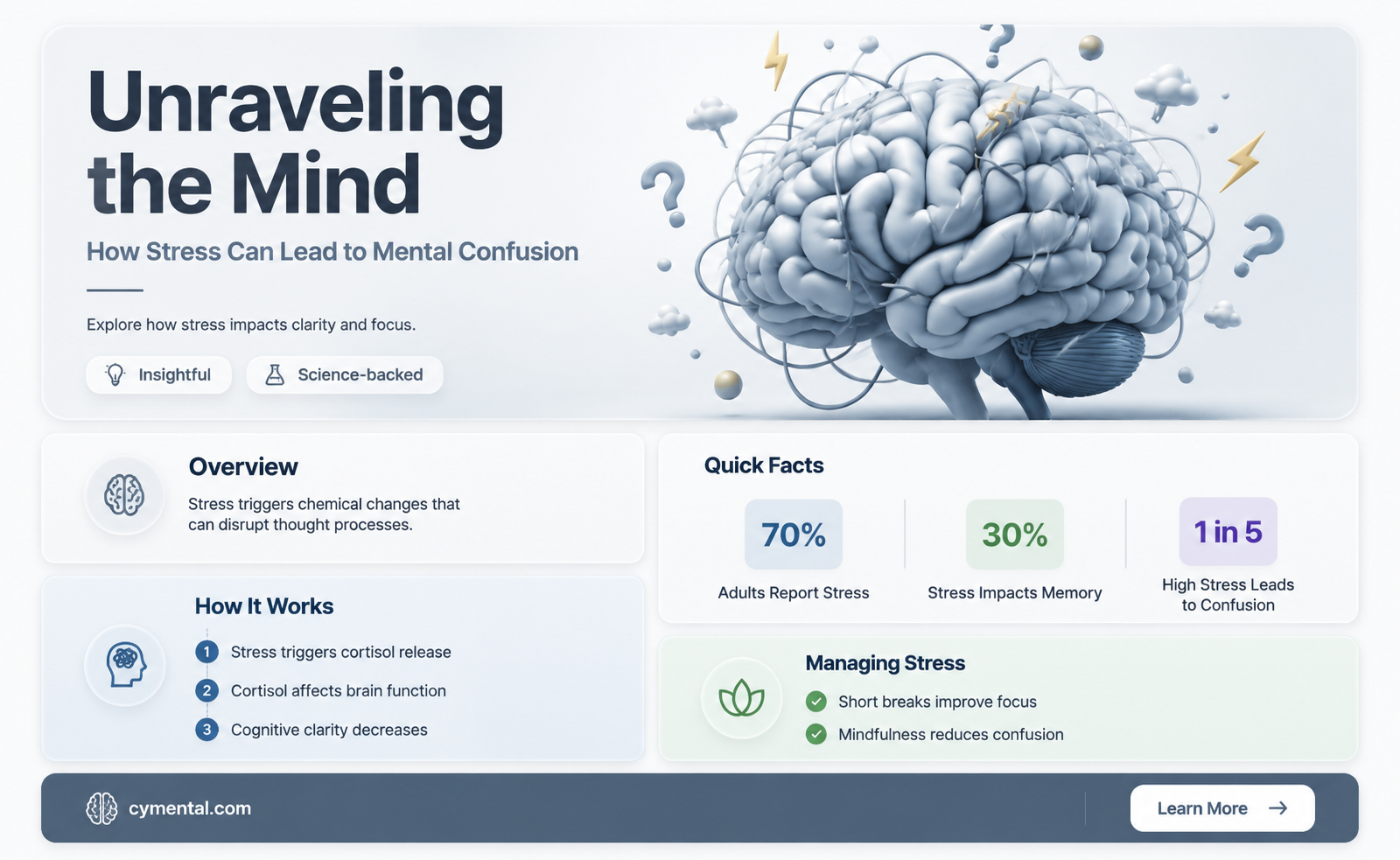
Stress is a pervasive aspect of modern life, affecting individuals across various demographics and socioeconomic backgrounds. It is well-documented that chronic stress can have detrimental effects on both physical and mental health. One area of particular interest is the relationship between stress and mental confusion. Mental confusion, characterized by difficulties in concentration, memory, and decision-making, can significantly impair an individual's cognitive functioning and overall quality of life. Research suggests that prolonged exposure to stress can lead to changes in brain structure and function, potentially contributing to the development of mental confusion. This paragraph aims to explore the intricate relationship between stress and mental confusion, examining the underlying mechanisms and potential interventions to mitigate these effects.
| Characteristics | Values |
|---|---|
| Direct Cause | Stress can directly cause mental confusion by overwhelming the brain's ability to process information effectively. |
| Indirect Cause | Chronic stress can lead to physical health issues that may contribute to mental confusion, such as sleep deprivation or cardiovascular problems. |
| Cognitive Impact | Stress can impair cognitive functions like memory, attention, and decision-making, leading to mental confusion. |
| Emotional Impact | High stress levels can result in anxiety and depression, which often accompany mental confusion. |
| Neurological Effect | Stress hormones like cortisol can interfere with neural communication, causing mental confusion. |
| Duration | Acute stress can cause temporary mental confusion, while chronic stress may lead to more persistent cognitive issues. |
| Individual Variation | People may experience mental confusion due to stress differently, with some being more resilient than others. |
| Age Factor | Older adults may be more susceptible to mental confusion caused by stress due to age-related cognitive decline. |
| Reversibility | In many cases, reducing stress levels can help alleviate mental confusion, though severe or prolonged stress may have lasting effects. |
| Coping Mechanisms | Developing healthy coping strategies, such as exercise, meditation, or therapy, can help mitigate the impact of stress on mental clarity. |
Explore related products


What You'll Learn
- Impact of chronic stress on cognitive function: Explore how prolonged stress affects memory, attention, and decision-making abilities
- Neurological mechanisms of stress-induced confusion: Discuss the brain regions and neurotransmitters involved in stress responses and their effects on mental clarity
- Differentiating between stress-related confusion and other mental health conditions: Examine how to distinguish stress-induced symptoms from those of anxiety, depression, or ADHD
- Coping strategies to mitigate stress-related mental confusion: Provide practical techniques and lifestyle changes to manage stress and improve cognitive function
- Case studies and personal experiences with stress-induced confusion: Share real-life examples or testimonials illustrating the effects of stress on mental clarity and daily functioning

Impact of chronic stress on cognitive function: Explore how prolonged stress affects memory, attention, and decision-making abilities
Chronic stress has a profound impact on cognitive function, affecting various aspects of mental performance. One of the primary areas influenced by prolonged stress is memory. Research indicates that elevated levels of cortisol, the stress hormone, can impair the hippocampus's ability to form and retrieve memories. This can lead to difficulties in learning new information and recalling past events, a condition often referred to as "brain fog."
Attention is another cognitive function significantly affected by chronic stress. The constant state of alertness and heightened arousal can make it challenging to focus on tasks and maintain concentration. This can result in decreased productivity and an increased likelihood of making errors. Furthermore, chronic stress can lead to a narrowing of attention, causing individuals to become overly focused on immediate threats and less aware of their broader environment.
Decision-making abilities are also compromised under chronic stress. The prefrontal cortex, responsible for executive functions such as decision-making and problem-solving, is particularly vulnerable to the effects of stress. Prolonged exposure to stress hormones can lead to a decrease in the prefrontal cortex's volume and function, resulting in impaired judgment and an increased tendency to make impulsive decisions. This can have significant consequences in both personal and professional settings, as individuals may struggle to weigh options and consider long-term outcomes.
In addition to these cognitive impairments, chronic stress can also exacerbate existing mental health conditions and increase the risk of developing new ones. For example, individuals under chronic stress are more likely to experience symptoms of anxiety and depression, which can further impair cognitive function. Moreover, chronic stress can lead to changes in brain structure and function that may contribute to the development of neurological disorders such as Alzheimer's disease and dementia.
To mitigate the impact of chronic stress on cognitive function, it is essential to adopt effective stress management strategies. Techniques such as mindfulness meditation, regular exercise, and social support can help reduce stress levels and improve mental performance. Additionally, maintaining a healthy lifestyle, including a balanced diet and adequate sleep, is crucial for supporting cognitive function and overall well-being. By addressing chronic stress, individuals can enhance their memory, attention, and decision-making abilities, leading to improved quality of life and better mental health outcomes.
Exploring the Link: Childhood Head Injuries and Mental Health
You may want to see also
Explore related products


Neurological mechanisms of stress-induced confusion: Discuss the brain regions and neurotransmitters involved in stress responses and their effects on mental clarity
The brain's response to stress involves a complex interplay of regions and neurotransmitters that can significantly impact mental clarity. One key player in this process is the hypothalamus-pituitary-adrenal (HPA) axis, which regulates the body's stress response. When activated, the HPA axis releases cortisol, a hormone that prepares the body for "fight or flight" by increasing heart rate, blood pressure, and glucose levels. However, chronically elevated cortisol levels can impair cognitive function, particularly in the prefrontal cortex, which is responsible for executive functions such as decision-making, planning, and attention.
Another important brain region involved in stress responses is the amygdala, which processes emotions and triggers the release of stress hormones. The amygdala's heightened activity during stress can lead to increased emotional reactivity and decreased ability to focus on tasks. Additionally, stress can disrupt the balance of neurotransmitters such as serotonin, dopamine, and norepinephrine, which play crucial roles in mood regulation, motivation, and attention. For example, decreased serotonin levels can contribute to feelings of anxiety and depression, while reduced dopamine levels can impair cognitive flexibility and problem-solving abilities.
The hippocampus, a region critical for memory formation and spatial navigation, is also vulnerable to the effects of stress. Chronic stress can lead to the atrophy of hippocampal neurons, impairing memory and learning abilities. Furthermore, stress can increase the production of pro-inflammatory cytokines, which can negatively impact brain function and contribute to cognitive decline.
In summary, the neurological mechanisms underlying stress-induced confusion involve a complex interplay of brain regions and neurotransmitters. Chronic stress can lead to impairments in cognitive function, emotional regulation, and memory, highlighting the importance of effective stress management strategies to maintain mental clarity and overall brain health.
Exploring the Link: Vertigo and Mental Confusion Explained
You may want to see also
Explore related products


Differentiating between stress-related confusion and other mental health conditions: Examine how to distinguish stress-induced symptoms from those of anxiety, depression, or ADHD
Stress-related confusion can often be mistaken for other mental health conditions due to overlapping symptoms. However, there are distinct differences that can help in distinguishing one from the other. For instance, while anxiety may present with excessive worry and fear, stress-induced confusion is more likely to manifest as difficulty concentrating and making decisions. Depression, on the other hand, is characterized by persistent feelings of sadness and loss of interest, whereas stress-related confusion may not necessarily involve these emotional states.
ADHD (Attention Deficit Hyperactivity Disorder) is another condition that can be confused with stress-related confusion. ADHD typically involves symptoms such as inattention, hyperactivity, and impulsiveness, which can also be present in individuals experiencing high levels of stress. However, ADHD is a neurodevelopmental disorder that usually begins in childhood and persists into adulthood, whereas stress-related confusion is a more transient state that can occur at any time in response to stressful events.
To differentiate between these conditions, it is important to consider the context and timing of symptom onset. Stress-related confusion is often triggered by a specific stressful event or situation, while anxiety, depression, and ADHD are more chronic conditions that may not have a clear precipitant. Additionally, the severity and duration of symptoms can provide clues. Stress-related confusion is typically short-lived and resolves once the stressful situation has passed, whereas anxiety, depression, and ADHD are ongoing conditions that may require long-term treatment.
In some cases, it may be necessary to consult with a mental health professional to accurately diagnose the condition. A thorough evaluation, including a review of symptoms, medical history, and psychological assessment, can help in distinguishing between stress-related confusion and other mental health conditions. Treatment approaches may vary depending on the specific diagnosis, so it is crucial to obtain an accurate assessment to ensure appropriate care.
Exploring the Link: Malnutrition and Mental Health Concerns
You may want to see also
Explore related products





Coping strategies to mitigate stress-related mental confusion: Provide practical techniques and lifestyle changes to manage stress and improve cognitive function
One effective coping strategy to mitigate stress-related mental confusion is to practice mindfulness meditation. This technique involves focusing your attention on the present moment, without judgment, to increase awareness of your thoughts and emotions. Regular mindfulness practice can help reduce stress by promoting relaxation and improving emotional regulation. To get started, find a quiet place to sit comfortably for 5-10 minutes each day, close your eyes, and focus on your breath. When your mind wanders, gently bring your attention back to your breath without judgment.
Another practical technique to manage stress and improve cognitive function is to engage in regular physical exercise. Exercise has been shown to reduce stress hormones, such as cortisol, and increase the production of endorphins, which are natural mood elevators. Aim for at least 30 minutes of moderate-intensity exercise, such as brisk walking, cycling, or swimming, most days of the week. In addition to improving mood and reducing stress, exercise can also enhance cognitive function by increasing blood flow to the brain and promoting the growth of new brain cells.
Lifestyle changes can also play a significant role in managing stress and improving cognitive function. One important change is to prioritize sleep. Aim for 7-9 hours of sleep each night to allow your brain to rest and recover. Establishing a consistent sleep schedule and creating a relaxing bedtime routine can help improve sleep quality. Additionally, consider reducing or eliminating caffeine and alcohol intake, as these substances can exacerbate stress and negatively impact cognitive function.
Social support is another crucial factor in managing stress. Connecting with friends and family can provide emotional support and help reduce feelings of isolation and overwhelm. Consider joining a social group or participating in community activities to expand your social network. Talking to a mental health professional can also be beneficial in developing coping strategies and addressing underlying issues contributing to stress and mental confusion.
Finally, time management and organization can help reduce stress by minimizing feelings of being overwhelmed and in control. Prioritize tasks, set realistic goals, and break down large projects into smaller, manageable steps. Using tools such as to-do lists, calendars, and reminders can help keep you on track and reduce mental clutter. By implementing these coping strategies and lifestyle changes, you can effectively manage stress and improve cognitive function, leading to a clearer and more focused mind.
Exploring the Link: Kidney Failure and Altered Mental Status
You may want to see also
Explore related products






Case studies and personal experiences with stress-induced confusion: Share real-life examples or testimonials illustrating the effects of stress on mental clarity and daily functioning
Sarah, a 32-year-old marketing professional, found herself increasingly overwhelmed by her workload. As deadlines piled up and her responsibilities expanded, she began to experience frequent episodes of mental confusion. Simple tasks, like drafting an email or analyzing data, became daunting challenges. She would often stare blankly at her computer screen, unable to focus or recall important information. Sarah's experience is not uncommon; many individuals report similar struggles with stress-induced confusion in their daily lives.
In a study published in the Journal of Cognitive Psychology, researchers examined the effects of stress on cognitive performance. Participants were subjected to a series of stressful scenarios, such as public speaking or solving complex problems under time pressure. The results showed a significant decline in mental clarity and problem-solving abilities among the stressed individuals. This decline was attributed to the body's physiological response to stress, which includes the release of cortisol and other stress hormones that can impair cognitive function.
Another compelling case is that of John, a 45-year-old businessman who experienced a major breakdown due to chronic stress. John had always been a high achiever, but as his career advanced, the demands on his time and energy became unsustainable. He began to suffer from severe anxiety and depression, which manifested in episodes of confusion and disorientation. John's story highlights the potential long-term consequences of unmanaged stress on mental health and cognitive function.
These examples underscore the importance of recognizing and addressing stress-induced confusion. By understanding the physiological and psychological mechanisms underlying this phenomenon, individuals can take proactive steps to mitigate its effects. Strategies such as mindfulness meditation, regular exercise, and effective time management can help reduce stress levels and improve mental clarity. Additionally, seeking support from mental health professionals can provide valuable guidance and resources for managing stress-related cognitive impairments.
In conclusion, the case studies and personal experiences presented here offer a vivid illustration of the impact of stress on mental clarity and daily functioning. By shedding light on this critical issue, we can empower individuals to take control of their mental health and well-being, ultimately leading to more fulfilling and productive lives.
Exploring the Link: Constipation and Mental Confusion Uncovered
You may want to see also
Frequently asked questions
Yes, stress can indeed cause mental confusion. When the body is under stress, it releases hormones like cortisol and adrenaline, which can interfere with cognitive functions, leading to symptoms such as difficulty concentrating, memory problems, and confusion.
Stress affects the brain by altering the levels of neurotransmitters like serotonin and dopamine, which are crucial for mood regulation and cognitive functions. Chronic stress can also lead to the degeneration of neurons in the hippocampus, a region of the brain important for memory and learning.
Common symptoms of stress-related mental confusion include forgetfulness, difficulty concentrating, racing thoughts, anxiety, irritability, and mood swings. These symptoms can significantly impact daily life and overall well-being.
Yes, there is a difference. Acute stress, which is short-term, can cause immediate symptoms of mental confusion, such as difficulty focusing or remembering things. Chronic stress, which is long-term, can lead to more severe and persistent cognitive issues, including impaired memory, reduced cognitive flexibility, and increased risk of mental health disorders like depression and anxiety.
Strategies to reduce stress and improve mental clarity include regular exercise, mindfulness meditation, deep breathing techniques, getting enough sleep, maintaining a healthy diet, and engaging in activities that bring joy and relaxation. Seeking support from friends, family, or a mental health professional can also be beneficial in managing stress and its effects on mental health.