Noah Parker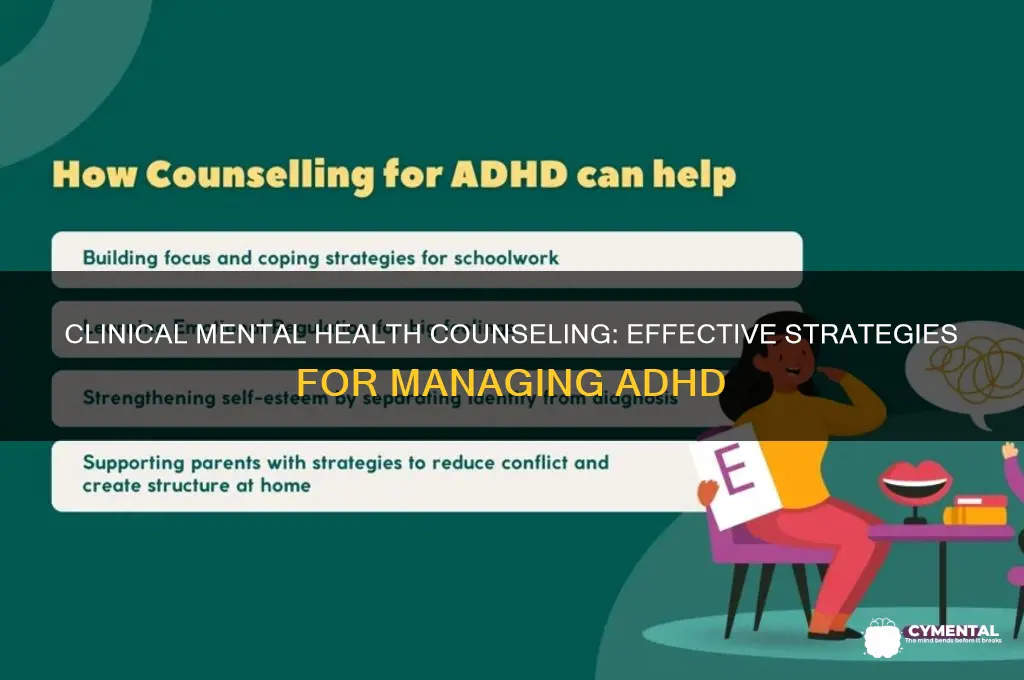
Clinical mental health counseling plays a pivotal role in supporting individuals with ADHD by offering tailored strategies to manage symptoms and improve overall well-being. Through evidence-based approaches such as cognitive-behavioral therapy (CBT), counselors help clients develop organizational skills, time management techniques, and coping mechanisms to address challenges like impulsivity, inattention, and hyperactivity. Counseling also provides a safe space for individuals to explore emotional struggles, build self-esteem, and foster healthier relationships. Additionally, therapists often collaborate with clients to create personalized treatment plans, which may include medication management, mindfulness practices, and lifestyle adjustments. By addressing both the psychological and practical aspects of ADHD, clinical mental health counseling empowers individuals to lead more balanced, productive, and fulfilling lives.
| Characteristics | Values |
|---|---|
| Symptom Management | Helps individuals develop strategies to manage ADHD symptoms such as inattention, hyperactivity, and impulsivity. |
| Behavioral Therapy | Cognitive Behavioral Therapy (CBT) is commonly used to address negative thought patterns and improve problem-solving skills. |
| Skill Building | Focuses on enhancing organizational skills, time management, and goal-setting abilities. |
| Emotional Regulation | Teaches techniques to manage emotions, reduce stress, and improve emotional resilience. |
| Coping Strategies | Provides tools to cope with challenges related to ADHD, such as frustration, procrastination, and social difficulties. |
| Self-Esteem Improvement | Helps individuals build self-confidence and a positive self-image by addressing ADHD-related challenges. |
| Family and Relationship Support | Offers guidance to families and partners to improve communication and understanding of ADHD. |
| Medication Management | Collaborates with psychiatrists to monitor medication effectiveness and side effects, ensuring a holistic treatment approach. |
| Education and Awareness | Increases understanding of ADHD, reducing stigma and promoting self-awareness. |
| Personalized Treatment Plans | Tailors counseling approaches to individual needs, considering unique strengths and challenges. |
| Long-Term Support | Provides ongoing support to maintain progress and address new challenges as they arise. |
| Improved Academic/Work Performance | Helps individuals develop strategies to succeed in academic or professional settings. |
| Mindfulness and Relaxation Techniques | Incorporates mindfulness practices to improve focus and reduce anxiety. |
| Social Skills Training | Enhances interpersonal skills, communication, and social interactions. |
| Reduction of Co-Occurring Disorders | Addresses common co-occurring conditions like anxiety, depression, or substance abuse. |
What You'll Learn
- Improving Focus Techniques: Teaches strategies like mindfulness and task prioritization to enhance concentration
- Behavioral Management: Helps develop routines and habits to reduce impulsivity and hyperactivity
- Emotional Regulation: Provides tools to manage mood swings and emotional outbursts effectively
- Organizational Skills: Assists in creating systems for time management and task completion
- Social Skills Training: Enhances communication and relationship-building abilities for better social interactions

Improving Focus Techniques: Teaches strategies like mindfulness and task prioritization to enhance concentration
One of the most effective ways clinical mental health counseling addresses ADHD is by teaching focus-enhancing techniques tailored to individual needs. Mindfulness, for instance, is not just a buzzword but a scientifically backed method to improve attention regulation. Studies show that practicing mindfulness for as little as 10 minutes daily can significantly reduce ADHD symptoms like impulsivity and inattention. Counselors often guide clients through mindfulness exercises, such as deep breathing or body scans, to anchor their attention in the present moment. This practice trains the brain to resist distractions, a common challenge for those with ADHD.
Task prioritization is another critical skill counselors impart. ADHD often leads to feeling overwhelmed by multiple demands, resulting in procrastination or incomplete tasks. Counselors use frameworks like the Eisenhower Matrix, which categorizes tasks into urgent, important, not urgent, and not important. For example, a client might learn to tackle urgent and important tasks first, delegate less critical ones, and eliminate time-wasters. This structured approach reduces mental clutter and increases productivity. Practical tools like digital planners or color-coded to-do lists can further reinforce this skill, making it easier to apply in daily life.
The combination of mindfulness and task prioritization creates a synergistic effect. Mindfulness enhances the ability to focus on the task at hand, while prioritization ensures the right tasks are being focused on. Counselors often encourage clients to start small, such as dedicating 15 minutes to a prioritized task after a brief mindfulness exercise. Over time, this builds momentum and confidence. For children and adolescents, counselors might incorporate gamified techniques, like earning points for completing prioritized tasks, to make the process engaging and rewarding.
However, these techniques are not without challenges. Mindfulness can feel frustrating for individuals with ADHD, as their minds naturally wander. Counselors address this by emphasizing that mindfulness is about noticing distractions, not eliminating them. Similarly, task prioritization requires consistent practice to become second nature. Counselors often recommend setting reminders or pairing prioritization with daily routines, such as reviewing tasks during breakfast or before bed. By integrating these strategies into counseling sessions and providing ongoing support, mental health professionals empower clients to take control of their focus and, ultimately, their lives.
Yoga's Transformative Power: Enhancing Mental Health and Well-being Naturally
You may want to see also
Behavioral Management: Helps develop routines and habits to reduce impulsivity and hyperactivity
Impulsivity and hyperactivity, hallmark symptoms of ADHD, often stem from difficulties with self-regulation and executive functioning. Behavioral management techniques, a cornerstone of clinical mental health counseling for ADHD, target these challenges by fostering structured routines and intentional habits. This approach doesn't aim to suppress these traits but rather to channel them into more productive and manageable patterns.
Imagine a child with ADHD who struggles to settle down for homework after school. A counselor might work with them to establish a consistent after-school routine: a snack, 30 minutes of free play, followed by a dedicated homework time in a quiet space. This predictable sequence, practiced daily, helps the child transition from high-energy activities to focused work, reducing impulsive outbursts and improving concentration.
The key to successful behavioral management lies in breaking down larger goals into smaller, achievable steps. For instance, instead of simply instructing a teenager to "be more organized," a counselor might help them create a visual schedule using color-coded folders and a planner. This visual representation provides structure and reduces the cognitive load associated with remembering tasks and deadlines. Gradually, as these smaller steps become habitual, they build towards larger behavioral changes.
It's crucial to remember that behavioral management is a collaborative process. Counselors work alongside individuals with ADHD to identify specific areas of difficulty, set realistic goals, and tailor strategies to their unique needs and preferences. This personalized approach ensures that the routines and habits developed are sustainable and empowering, fostering a sense of control and self-efficacy.
While behavioral management techniques are highly effective, they require consistency and patience. Think of it as building a muscle: regular practice strengthens the ability to self-regulate. Counselors often employ positive reinforcement, celebrating small successes and providing encouragement throughout the process. This positive feedback loop motivates individuals to continue practicing new habits, even when faced with setbacks. By integrating behavioral management strategies into daily life, individuals with ADHD can learn to manage their impulsivity and hyperactivity, leading to improved focus, organization, and overall well-being.
Unplugging for Peace: How Social Media Breaks Boost Mental Health
You may want to see also
Emotional Regulation: Provides tools to manage mood swings and emotional outbursts effectively
Emotional dysregulation is a hallmark of ADHD, often manifesting as rapid mood swings, intense emotional reactions, or impulsive outbursts. These symptoms can strain relationships, hinder daily functioning, and exacerbate stress. Clinical mental health counseling addresses this challenge by equipping individuals with evidence-based tools to recognize, understand, and manage their emotional responses effectively. Through structured interventions, clients learn to replace reactive behaviors with intentional strategies, fostering greater emotional stability and resilience.
One cornerstone of emotional regulation in ADHD counseling is dialectical behavior therapy (DBT), a modality originally designed for borderline personality disorder but highly effective for ADHD-related emotional challenges. DBT teaches skills in four key areas: mindfulness, distress tolerance, emotion regulation, and interpersonal effectiveness. For instance, mindfulness practices, such as grounding exercises or breathwork, help individuals stay present during emotional storms, reducing the likelihood of impulsive reactions. Distress tolerance techniques, like the "TIPP" skill (Temperature, Intense exercise, Paced breathing, Paired muscle relaxation), offer immediate relief in moments of overwhelm. Counselors often recommend practicing these skills daily, even when calm, to build muscle memory for high-stress situations.
Another practical approach is cognitive restructuring, which targets the thought patterns fueling emotional outbursts. ADHD individuals often experience "emotional flooding," where minor triggers provoke disproportionate reactions. Counselors guide clients in identifying distorted thoughts (e.g., "Everything is ruined") and replacing them with balanced perspectives (e.g., "This is frustrating, but I can handle it"). Journaling is a useful adjunct tool; spending 10 minutes daily to reflect on emotional triggers and responses can enhance self-awareness and pattern recognition. For children and adolescents, counselors may incorporate visual aids, like emotion thermometers, to help them articulate feelings before they escalate.
A comparative analysis of emotional regulation strategies reveals the importance of tailoring interventions to individual needs. While DBT and cognitive restructuring are widely effective, some clients benefit from biofeedback or neurofeedback, which use real-time physiological data to teach self-regulation. For example, heart rate variability (HRV) training helps individuals learn to calm their nervous system through controlled breathing, reducing emotional reactivity. However, these technologies require specialized equipment and are typically adjunctive to traditional counseling. A simpler, cost-effective alternative is progressive muscle relaxation, which can be practiced anywhere and has been shown to decrease anxiety and improve emotional control in ADHD populations.
Ultimately, the goal of emotional regulation in ADHD counseling is not to eliminate emotions but to transform their impact. By integrating these tools into daily life, individuals can navigate emotional challenges with greater ease, fostering healthier relationships and improved quality of life. Consistency is key; counselors often encourage clients to track progress using mood logs or apps, celebrating small victories to reinforce new habits. For families, psychoeducation about ADHD-related emotional dysregulation can reduce misunderstandings and promote collaborative problem-solving. With time and practice, emotional regulation becomes less of a struggle and more of a skill—one that empowers individuals to thrive despite ADHD’s complexities.
Sea Moss Gel: A Natural Boost for Mental Health?
You may want to see also
Organizational Skills: Assists in creating systems for time management and task completion
Individuals with ADHD often struggle with executive functioning, which includes the ability to plan, organize, and complete tasks efficiently. Clinical mental health counseling steps in as a transformative tool, offering strategies to build organizational skills that directly address these challenges. Through structured sessions, counselors help clients develop personalized systems for time management and task completion, turning chaos into manageable routines.
Consider the process as a tailored blueprint for productivity. Counselors begin by assessing the client’s current organizational habits, identifying pain points such as procrastination, forgetfulness, or overwhelm. For instance, a 28-year-old professional might admit to missing deadlines despite working long hours, while a 15-year-old student could struggle with keeping track of assignments. Based on these insights, counselors introduce evidence-based techniques like the Pomodoro Technique (25 minutes of focus followed by a 5-minute break) or the use of visual tools like Kanban boards to prioritize tasks. These methods are not one-size-fits-all; they are adapted to the individual’s lifestyle, preferences, and ADHD subtype.
One practical tip counselors often emphasize is the "time blocking" method, where specific hours of the day are dedicated to particular tasks. For example, a client might allocate 9–11 a.m. for deep work, 11:30 a.m.–12:30 p.m. for emails, and 2–3 p.m. for creative tasks. This approach reduces decision fatigue and creates a predictable rhythm. Another strategy is the "two-minute rule," where tasks taking less than two minutes are completed immediately to prevent backlog. These techniques are paired with accountability measures, such as weekly check-ins or digital reminders, to ensure consistency.
However, building organizational skills isn’t just about adopting new habits—it’s also about addressing the emotional barriers tied to ADHD. Many individuals feel shame or frustration over their perceived disorganization, which can hinder progress. Counselors work to reframe these feelings, emphasizing that ADHD is a neurodevelopmental condition, not a personal failing. By fostering self-compassion, clients become more motivated to stick with their new systems. For instance, a counselor might encourage a client to celebrate small wins, like completing one task on time, to build momentum.
The takeaway is clear: clinical mental health counseling doesn’t just teach organizational skills—it empowers individuals with ADHD to reclaim control over their lives. By combining structured techniques with emotional support, counselors help clients transform overwhelming to-do lists into achievable steps. Whether it’s a teenager learning to manage homework or an adult streamlining their workday, these systems create a foundation for long-term success, proving that with the right tools, ADHD doesn’t have to be a barrier to productivity.
Moving Out: A Mental Health Boost or Added Stress?
You may want to see also
Social Skills Training: Enhances communication and relationship-building abilities for better social interactions
Individuals with ADHD often face challenges in social situations due to difficulties with impulse control, emotional regulation, and attention. These struggles can lead to misunderstandings, strained relationships, and social isolation. Social Skills Training (SST) emerges as a targeted intervention within clinical mental health counseling to address these specific deficits. By systematically teaching and practicing essential social behaviors, SST empowers individuals with ADHD to navigate social interactions more effectively.
Social Skills Training operates on the principle that social competence is a learnable skill set. Through structured sessions, individuals learn to decode social cues, engage in active listening, initiate and maintain conversations, and manage their emotions in social contexts. This training often involves role-playing scenarios, feedback from therapists, and homework assignments to practice skills in real-world settings. For example, a teenager with ADHD might practice introducing themselves confidently, maintaining eye contact, and asking open-ended questions during a mock party scenario.
The effectiveness of SST lies in its structured and repetitive nature. Sessions typically occur weekly for 8-12 weeks, with each session focusing on specific skills like assertiveness, conflict resolution, or empathy. This consistent practice allows individuals to internalize new behaviors and build confidence in their social abilities. Research demonstrates that SST can lead to significant improvements in peer relationships, reduced social anxiety, and increased social acceptance for individuals with ADHD.
A crucial aspect of SST is tailoring the training to the individual's age and developmental stage. For younger children, SST might focus on basic skills like sharing, taking turns, and recognizing facial expressions. Adolescents may benefit from training in more complex skills like managing peer pressure, understanding sarcasm, and navigating romantic relationships. Adults with ADHD might focus on workplace communication, conflict resolution in personal relationships, and setting healthy boundaries.
Beyond the structured sessions, therapists often provide practical tips for integrating social skills into daily life. This could include encouraging participation in group activities, volunteering, or joining clubs to provide opportunities for real-world practice. Parents and caregivers can also play a vital role by modeling positive social behaviors, providing constructive feedback, and creating a supportive environment for skill development.
Social Skills Training is not a quick fix, but a powerful tool for individuals with ADHD to build lasting social competence. By addressing specific social challenges and providing structured practice, SST empowers individuals to connect with others more meaningfully, fostering a sense of belonging and improving overall well-being.
Finding Support: Where to Get Mental Health Help and Resources
You may want to see also
Frequently asked questions
Clinical mental health counseling for ADHD is a therapeutic approach that helps individuals with Attention-Deficit/Hyperactivity Disorder manage their symptoms, improve their daily functioning, and enhance their overall well-being. Counselors use evidence-based techniques to address challenges like inattention, impulsivity, and hyperactivity, while also supporting emotional regulation and coping skills.
While medication can help manage ADHD symptoms by balancing brain chemicals, clinical mental health counseling focuses on behavioral, emotional, and cognitive strategies. Counseling helps individuals develop skills to organize tasks, improve time management, and build healthier relationships. It also addresses co-occurring issues like anxiety or low self-esteem, providing a holistic approach to treatment.
Clinical mental health counseling is beneficial for both children and adults with ADHD. For adults, counseling can help address challenges related to work, relationships, and self-esteem, as well as teach strategies for managing responsibilities and reducing stress. It’s never too late to seek support and develop effective coping mechanisms.