Lucas Bennett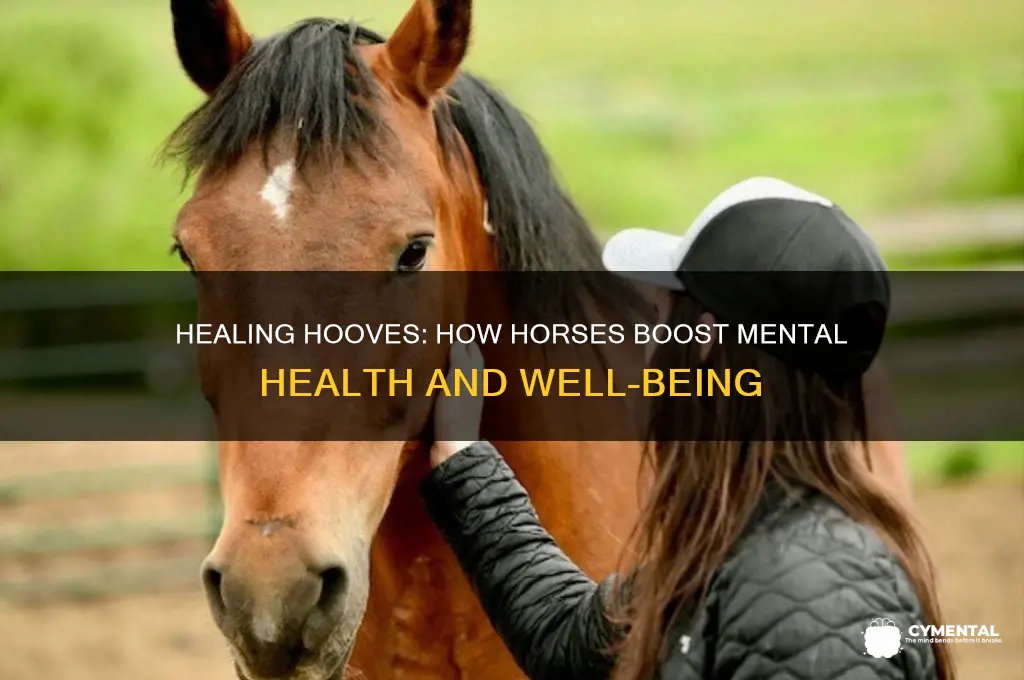
Horses have long been recognized as powerful allies in supporting human mental health, offering unique therapeutic benefits through their intuitive nature and non-judgmental presence. Equine-assisted therapy and activities leverage the bond between humans and horses to address a range of mental health challenges, including anxiety, depression, PTSD, and trauma. Interacting with horses encourages mindfulness, emotional regulation, and self-awareness, as their sensitive and responsive behavior mirrors human emotions, fostering trust and communication. Additionally, the physical and emotional demands of caring for and riding horses promote confidence, responsibility, and a sense of accomplishment, making them invaluable companions in the journey toward mental well-being.
Explore related products


What You'll Learn
- Reducing Stress and Anxiety: Horses' calm presence lowers cortisol, promoting relaxation and emotional well-being in humans
- Boosting Confidence and Self-Esteem: Interacting with horses fosters trust, assertiveness, and a sense of accomplishment
- Improving Emotional Regulation: Equine therapy helps individuals process and manage emotions through nonverbal communication
- Enhancing Social Skills: Group horse activities encourage teamwork, empathy, and improved interpersonal relationships
- Providing PTSD Relief: Horses offer grounding and emotional support, aiding trauma recovery and reducing flashbacks

Reducing Stress and Anxiety: Horses' calm presence lowers cortisol, promoting relaxation and emotional well-being in humans
The mere presence of a horse can trigger a physiological response in humans, notably reducing cortisol levels, often referred to as the stress hormone. Studies have shown that interacting with horses, even for as little as 15-30 minutes, can lead to a measurable decrease in cortisol, promoting a sense of calm and relaxation. This effect is particularly pronounced in individuals experiencing high levels of stress or anxiety, making equine-assisted activities a valuable tool for mental health management.
Consider the following scenario: a person struggling with anxiety enters a stable, greeted by the gentle nicker of a horse. As they begin to groom the animal, their focus shifts from internal worries to the present moment, fostering a sense of mindfulness. This simple act of care not only strengthens the human-animal bond but also encourages the release of oxytocin, a hormone associated with social bonding and stress reduction. For optimal results, aim for at least 2-3 sessions per week, each lasting 30-60 minutes, to maintain a consistent reduction in cortisol levels and promote long-term emotional well-being.
From a comparative perspective, equine-assisted therapy stands out among other stress-reduction methods due to its unique combination of physical activity, social interaction, and emotional connection. Unlike traditional talk therapy or medication, which often target specific symptoms, horse-based interventions address the whole person, encouraging self-awareness, confidence, and resilience. For instance, a study published in the *Journal of Alternative and Complementary Medicine* found that participants engaging in equine-assisted activities experienced a 25% reduction in anxiety symptoms after just 8 weeks, compared to a 12% reduction in a control group practicing conventional relaxation techniques.
To maximize the stress-relieving benefits of horses, incorporate practical tips into your routine. Start by finding a reputable equine therapy program or stable that aligns with your needs and comfort level. Wear comfortable clothing and closed-toe shoes to ensure safety and ease of movement. During interactions, practice deep breathing exercises while grooming or walking the horse to enhance relaxation. For those new to equine activities, begin with guided sessions led by a trained professional to build confidence and establish a positive connection with the animal.
In conclusion, the calming presence of horses offers a powerful, natural remedy for reducing stress and anxiety. By lowering cortisol levels and promoting relaxation, equine interactions provide a holistic approach to emotional well-being. Whether through structured therapy or casual engagement, incorporating horses into one’s routine can yield significant mental health benefits, making it a valuable practice for individuals seeking balance and tranquility in their lives.
Reading the Bible: A Path to Mental Health and Healing?
You may want to see also
Explore related products


$19.95 $19.95


Boosting Confidence and Self-Esteem: Interacting with horses fosters trust, assertiveness, and a sense of accomplishment
Horses, with their innate sensitivity and responsiveness, serve as powerful mirrors for human behavior, reflecting both strengths and areas for growth. When individuals engage in equine-assisted activities, they are often thrust into situations that demand clear communication and assertiveness. For instance, a rider must give precise cues to guide a horse, and the animal’s immediate feedback—whether compliance or resistance—teaches the rider to adjust their approach. This dynamic interaction fosters a sense of control and efficacy, as participants learn to influence outcomes through their actions. Over time, this builds confidence, proving that one’s decisions and presence matter, even in complex or unpredictable scenarios.
Consider the structured environment of therapeutic riding programs, where participants are guided through a series of tasks designed to challenge and empower. A teenager struggling with self-doubt might be tasked with leading a horse through an obstacle course, requiring them to give clear directions and remain composed under pressure. The horse’s willingness to follow—or its refusal to cooperate—provides instant, non-judgmental feedback, encouraging the rider to refine their assertiveness. Studies show that such activities can lead to measurable improvements in self-esteem, particularly in adolescents and young adults, who often report feeling more capable and respected after consistent interaction with horses.
To maximize the confidence-building benefits of equine interaction, it’s essential to tailor activities to individual needs and abilities. For children aged 8–12, starting with groundwork exercises—such as grooming or leading the horse at a walk—can build trust and familiarity before progressing to more complex tasks. Adults, especially those recovering from trauma or anxiety, may benefit from unmounted activities like liberty work, where they guide a horse’s movements from the ground using body language alone. This fosters a sense of accomplishment without the added pressure of riding. Consistency is key; weekly sessions over 8–12 weeks have been shown to yield significant improvements in self-esteem and assertiveness.
One of the most compelling aspects of equine-assisted therapy is its ability to provide tangible, immediate rewards for effort. Unlike traditional talk therapy, where progress can feel abstract, working with horses offers clear milestones—a horse that responds willingly, a successfully completed course, or even a moment of calm connection. These achievements, no matter how small, accumulate to create a profound sense of accomplishment. For individuals battling low self-worth, such concrete evidence of their capabilities can be transformative, shifting their self-perception from doubt to confidence.
Incorporating horses into mental health practices isn’t just about riding or grooming; it’s about leveraging their unique ability to challenge and support humans in equal measure. By demanding clarity, patience, and assertiveness, horses push individuals to step outside their comfort zones and discover their potential. Whether through structured therapy programs or casual interaction, these experiences offer a rare opportunity to rebuild confidence from the ground up, one hoofbeat at a time. For anyone seeking to strengthen their self-esteem, the partnership with a horse can be a powerful, enduring catalyst for change.
Overcoming Mental Blocks: Strategies to Support Athletes' Performance and Resilience
You may want to see also
Explore related products


![[Healing For Horses] [Author: Coates, Margrit] [May, 2001]](https://m.media-amazon.com/images/I/41f+SrWDT4L._AC_UY218_.jpg)


Improving Emotional Regulation: Equine therapy helps individuals process and manage emotions through nonverbal communication
Horses, with their innate sensitivity to human emotions, serve as powerful mirrors in equine therapy, reflecting unspoken feelings and fostering emotional regulation. Unlike humans, horses communicate primarily through body language, forcing individuals to tune into nonverbal cues—a skill that translates directly to managing personal emotions. For instance, a tense posture or rapid breathing in a horse often mirrors the handler’s anxiety, providing immediate feedback that encourages self-awareness and adjustment. This dynamic interaction helps individuals recognize and modulate their emotional states in real time, a cornerstone of emotional regulation.
To harness this benefit, therapists often structure sessions around specific exercises designed to amplify nonverbal communication. One common practice involves leading a horse through an obstacle course without speaking. The handler must rely on subtle movements, tone of voice, and intention to guide the horse, fostering mindfulness and emotional control. For children aged 8–12, simpler tasks like grooming or walking alongside the horse can achieve similar results, teaching them to remain calm and focused under pressure. Consistency is key; weekly sessions over 8–12 weeks have been shown to yield measurable improvements in emotional regulation, particularly in individuals with anxiety or trauma histories.
Critics might argue that relying on nonverbal communication limits the depth of emotional processing, but this approach actually deepens it. Horses, being prey animals, are acutely attuned to threats and respond instinctively to human energy. This forces individuals to confront and manage their emotions authentically, as horses do not respond to forced calmness or masked feelings. For example, a teenager struggling with anger might find that their raised voice causes a horse to retreat, prompting reflection on how their emotions affect others. This immediate, tangible feedback is often more impactful than verbal discussions alone.
Practical tips for maximizing this aspect of equine therapy include wearing comfortable clothing to ensure freedom of movement, as physical tension can inadvertently communicate stress to the horse. Additionally, handlers should practice deep breathing exercises before sessions to establish a baseline of calmness. For parents or caregivers, observing sessions can provide insights into a child’s emotional patterns, offering opportunities for reinforcement outside therapy. While equine therapy is not a one-size-fits-all solution, its focus on nonverbal communication makes it uniquely effective for improving emotional regulation across diverse populations.
Explore related products


Enhancing Social Skills: Group horse activities encourage teamwork, empathy, and improved interpersonal relationships
Horses, with their innate sensitivity and non-verbal communication, serve as powerful catalysts for enhancing social skills in group activities. When individuals participate in equine-assisted group sessions, they are naturally drawn into a collaborative environment where teamwork becomes essential. For instance, during a group trail ride or a team obstacle course, participants must coordinate their actions, communicate effectively, and rely on one another to ensure the safety and success of the group. This dynamic mirrors real-life social interactions, fostering a deeper understanding of cooperation and mutual dependence.
Consider the role of empathy in these interactions. Horses, being highly perceptive animals, respond to human emotions and intentions. In a group setting, participants often observe how their peers interact with the horses, noticing subtle changes in the animal’s behavior based on the handler’s approach. This observation encourages individuals to reflect on their own actions and consider the impact they have on others, both human and animal. For example, a participant who handles a horse gently and patiently may inspire others to adopt a similar demeanor, creating a ripple effect of empathy within the group. This heightened awareness of others’ emotions and needs translates into improved interpersonal relationships outside the arena.
Practical implementation of these activities requires careful planning. Group sizes should ideally range from 4 to 6 participants to ensure everyone has meaningful interactions without feeling overwhelmed. Sessions typically last 60 to 90 minutes, with a structured format that includes icebreakers, horse-handling tasks, and reflective discussions. Facilitators should emphasize clear communication and active listening, as these skills are critical for both human-horse and human-human interactions. For younger participants (ages 10–14), simpler tasks like grooming or leading a horse in pairs can effectively teach teamwork, while older teens and adults may benefit from more complex challenges, such as navigating a horse through a precision course as a group.
One cautionary note is the importance of creating a safe and inclusive environment. Participants may have varying levels of comfort around horses, and some may struggle with social interactions due to anxiety or past experiences. Facilitators should provide clear instructions, offer support, and ensure that no one feels pressured to perform beyond their comfort level. Additionally, debriefing sessions after activities are crucial for processing emotions and reinforcing social lessons. These discussions allow participants to articulate their experiences, share insights, and build connections with their peers, further solidifying the social skills developed during the activity.
In conclusion, group horse activities offer a unique and effective way to enhance social skills by fostering teamwork, empathy, and improved interpersonal relationships. Through structured, horse-centered tasks, participants learn to communicate, collaborate, and consider the perspectives of others in a tangible and immediate way. Whether for children, teens, or adults, these activities provide valuable lessons that extend far beyond the stables, equipping individuals with the tools to navigate social interactions with greater confidence and understanding.
Explore related products



Providing PTSD Relief: Horses offer grounding and emotional support, aiding trauma recovery and reducing flashbacks
Horses, with their innate sensitivity and non-judgmental presence, have emerged as powerful allies in the battle against PTSD. Their ability to provide grounding and emotional support is particularly effective in helping individuals manage the overwhelming symptoms of trauma. For those suffering from PTSD, the world can feel chaotic and unpredictable, but the rhythmic movement of a horse’s gait and the tactile experience of grooming can anchor them in the present moment, reducing the frequency and intensity of flashbacks. This sensory engagement acts as a bridge back to reality, offering a safe space to reconnect with oneself.
Consider the structured nature of equine-assisted therapy sessions. Participants often begin with simple tasks, such as leading a horse in a controlled environment. This activity requires focus and mindfulness, diverting attention away from intrusive thoughts. Over time, as trust builds between the individual and the horse, more complex interactions, like riding, can be introduced. These progressive steps not only foster a sense of accomplishment but also teach valuable coping mechanisms. For instance, learning to read a horse’s body language can translate into better emotional regulation in human relationships, a critical skill for PTSD recovery.
One of the most compelling aspects of horses in PTSD treatment is their ability to mirror human emotions without judgment. Horses are highly attuned to energy and can sense anxiety or tension, often responding with calmness that encourages the individual to do the same. This dynamic creates a unique feedback loop where the person learns to manage their emotional state in real-time. For example, a veteran experiencing hypervigilance might notice a horse’s relaxed posture and consciously work to mirror that calmness, effectively reducing their own arousal levels.
Practical implementation of equine therapy for PTSD often involves weekly sessions lasting 60–90 minutes, tailored to the individual’s needs. Programs like the Equine-Assisted Growth and Learning Association (EAGALA) emphasize goal-setting and measurable outcomes, ensuring that progress is tracked and celebrated. While this therapy is beneficial for adults, it’s also being adapted for adolescents and children, with age-appropriate activities that focus on building resilience and emotional intelligence. However, it’s crucial to work with trained professionals who understand both equine behavior and trauma-informed care to ensure safety and effectiveness.
In conclusion, horses offer a unique and profound avenue for PTSD relief, combining physical engagement, emotional connection, and psychological grounding. Their presence encourages individuals to confront and process trauma in a supportive environment, reducing flashbacks and fostering long-term healing. As this field continues to grow, it underscores the transformative potential of human-animal bonds in mental health care. For those struggling with PTSD, equine therapy may not be a cure-all, but it is a powerful tool that can significantly improve quality of life.
Frequently asked questions
Horses have a calming presence that can lower cortisol levels (the stress hormone) in humans. Interacting with horses, such as grooming or riding, promotes mindfulness and relaxation, helping individuals focus on the present moment and reduce anxiety.
Yes, equine-assisted therapy has been shown to boost mood and self-esteem. The bond formed with a horse, combined with physical activity like riding, releases endorphins and provides a sense of accomplishment, which can alleviate symptoms of depression.
Horses are highly intuitive and respond to human emotions, encouraging individuals to become more aware of their feelings and learn to regulate them. Interacting with horses also fosters nonverbal communication, improving emotional expression and interpersonal skills.