Noah Parker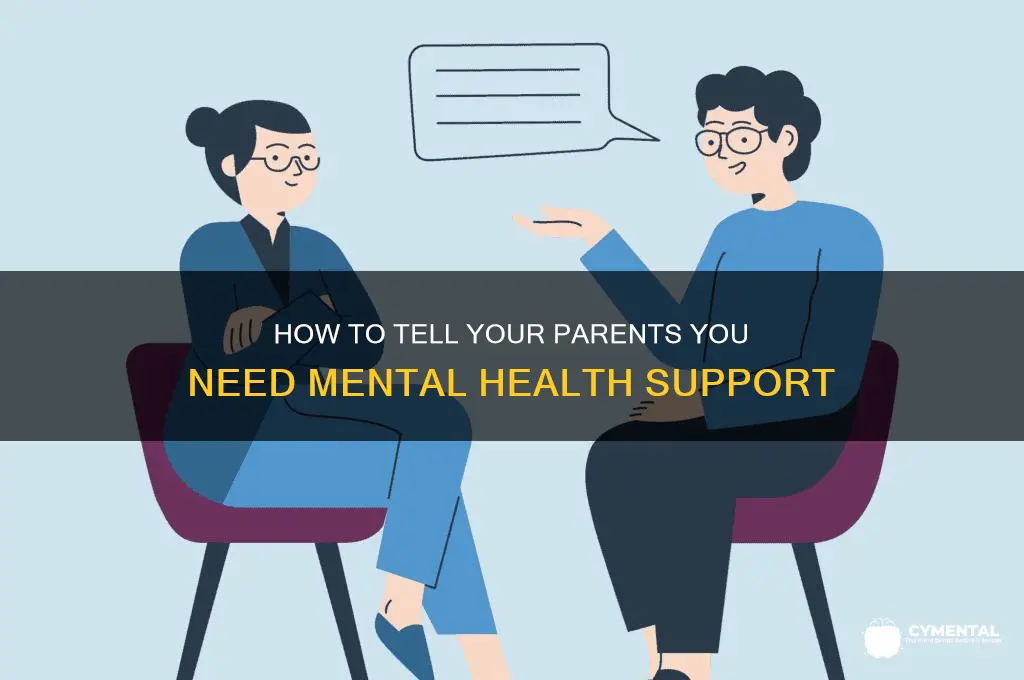
Telling your parents that you need mental health support can feel overwhelming, but it’s a courageous and necessary step toward healing. Start by choosing a calm, private moment when everyone is relaxed and open to conversation. Be honest and direct, using clear language to express how you’ve been feeling and why you think professional help would benefit you. It’s okay to admit you’re struggling—vulnerability shows strength, not weakness. Prepare for their reactions, which may range from immediate understanding to confusion or concern, and remember that their response often comes from a place of love, even if it feels misaligned at first. If you’re unsure how to begin, consider writing your thoughts down or practicing with a trusted friend. Remember, seeking help is a sign of self-awareness and resilience, and your mental well-being is worth prioritizing.
Explore related products

$16.98 $30


What You'll Learn
- Choosing the Right Time: Pick a calm, private moment when everyone is relaxed and distractions are minimal
- Be Honest and Clear: Use simple, direct language to express your feelings and concerns without blame
- Prepare for Reactions: Anticipate their emotions (shock, worry) and remain patient, allowing them to process
- Share Resources: Bring information about therapy, counseling, or support options to guide the conversation
- Ask for Their Support: Clearly state what you need from them, whether it’s understanding or help finding care

Choosing the Right Time: Pick a calm, private moment when everyone is relaxed and distractions are minimal
Timing is everything when you’re preparing to tell your parents you need mental health support. Imagine trying to have a serious conversation during a chaotic family dinner or while they’re rushing out the door for work. The stress of the moment will only amplify their initial reactions, making it harder for them to focus on what you’re saying. Instead, aim for a window when the household is calm—perhaps a quiet evening after chores are done or a weekend morning when there’s no immediate pressure. This creates a buffer, allowing them to process your words without the distraction of looming responsibilities.
Choosing the right time also means considering your parents’ emotional state. If they’ve just had a long day or are preoccupied with a personal issue, they might not be as receptive. Observe their mood and energy levels; a relaxed, neutral moment increases the likelihood of a thoughtful response. For example, if your dad unwinds by reading the newspaper after dinner, or your mom enjoys her morning coffee in silence, these could be ideal opportunities. The goal is to catch them when they’re mentally available, not just physically present.
Privacy is another critical factor. A conversation about mental health is deeply personal, and you don’t want to risk interruptions or overheard fragments. Avoid public spaces or areas where siblings or roommates might wander in. If you live in a busy household, suggest a walk around the block or a drive to a quiet spot. Even if it feels staged, creating a private environment ensures the focus remains on your message, not the setting.
Finally, be mindful of your own emotional state when choosing the time. If you’re feeling overwhelmed or exhausted, you might struggle to articulate your thoughts clearly. Pick a moment when you’re relatively calm and collected, but not so detached that your parents might misinterpret your tone. A balanced emotional state helps you communicate effectively and respond to their reactions with patience. Remember, this isn’t just about their timing—it’s about finding a moment that works for both of you.
In practice, this might mean waiting a day or two for the perfect opportunity rather than forcing the conversation prematurely. For instance, if you notice your parents are unusually stressed about an upcoming event, it’s better to delay the talk until after the situation has passed. By prioritizing calmness, privacy, and mutual availability, you set the stage for a conversation that feels safe and supportive, increasing the chances of a positive outcome.
Traveling and Mental Health: A Case for FMLA Benefits
You may want to see also
Explore related products




Be Honest and Clear: Use simple, direct language to express your feelings and concerns without blame
Honesty is the cornerstone of any meaningful conversation, especially when discussing mental health with parents. Start by acknowledging your feelings without embellishment. For instance, instead of saying, "I’ve been feeling off lately," try, "I’ve been struggling with anxiety and it’s affecting my daily life." This directness eliminates ambiguity and ensures your parents understand the gravity of your situation. Avoid jargon or vague terms; simplicity ensures clarity, which is critical when addressing something as complex as mental health.
Blame has no place in this conversation. Phrases like, "You don’t understand me," or, "If only you were more supportive," can derail the dialogue. Focus on *I* statements to own your experience: "I feel overwhelmed," or, "I need help managing my emotions." This approach fosters empathy rather than defensiveness. Remember, the goal is to invite collaboration, not to assign fault. Even if past experiences have been challenging, framing your concerns as a shared problem can create a more supportive environment.
Consider the timing and setting to reinforce your message. Choose a moment when both you and your parents are calm and undisturbed. Begin with a clear, concise statement, such as, "Mom, Dad, I need to talk to you about something important. I’ve been dealing with [specific issue] and I think I need professional help." Follow this with actionable steps, like suggesting a therapist or counselor you’ve researched. Providing a plan demonstrates initiative and makes it easier for your parents to engage constructively.
Finally, practice self-compassion throughout this process. Being honest about mental health struggles requires courage, and it’s normal to feel vulnerable. If the conversation doesn’t go as planned, remind yourself that openness is a step toward healing. Keep in mind that clarity and directness are tools, not guarantees, but they significantly increase the likelihood of your parents understanding and supporting your needs.
Swimming to Serenity: How Fish Can Boost Your Mental Health
You may want to see also
Explore related products


Prepare for Reactions: Anticipate their emotions (shock, worry) and remain patient, allowing them to process
Your parents’ initial reaction to your disclosure may feel like a tidal wave—shock, worry, even denial. Understanding this is less about their love and more about the sudden confrontation with a problem they might not have fully grasped. Imagine learning your child has been silently struggling; it’s a lot to process. Their emotions aren’t a rejection of you but a reflection of their own fears and uncertainties. Recognizing this can help you brace for their response without taking it personally.
To navigate this, practice empathy in advance. Role-play their potential reactions in your mind: “What if they ask why I didn’t say anything sooner?” or “What if they think it’s just a phase?” By anticipating these questions, you can prepare calm, clear responses that address their concerns without escalating tension. For instance, instead of reacting defensively to “Why now?” you could say, “I’ve been trying to handle it on my own, but I realized I need your support to get better.”
Patience is your greatest tool here. Allow them time to absorb what you’ve shared—minutes, hours, or even days. Avoid pressuring them for an immediate solution or emotional validation. If they seem overwhelmed, suggest revisiting the conversation later. This isn’t avoidance; it’s respect for their process. Remember, they’re not just parents; they’re humans grappling with new information about someone they deeply care about.
Finally, set boundaries while remaining open. If their reaction becomes dismissive or hurtful, gently but firmly reiterate your needs. For example, “I know this is hard to hear, but I’m telling you because I trust you and need your help.” This balances assertiveness with vulnerability, guiding them toward understanding without alienating them. Their journey to acceptance may not be linear, but your patience and clarity can pave the way for meaningful support.
Recognizing Signs Your Child May Need Mental Health Support
You may want to see also
Explore related products


$7.84 $14.99




Share Resources: Bring information about therapy, counseling, or support options to guide the conversation
Arming yourself with information about mental health resources isn't just about educating your parents; it's about empowering yourself. Knowing the options available shifts the conversation from a vague "I need help" to a concrete "Here's how we can address this." It demonstrates initiative, maturity, and a willingness to actively participate in your own well-being.
Think of it as bringing a map to a journey you're both about to embark on.
Step 1: Research Local Options
Start by identifying therapists, counselors, or support groups in your area. Many online directories, like Psychology Today or GoodTherapy, allow you to filter by location, specialization, and insurance acceptance. Note down contact information, areas of expertise, and any relevant details about their approach. For example, some therapists specialize in cognitive behavioral therapy (CBT), which is effective for anxiety and depression, while others might focus on family therapy or trauma-informed care.
If cost is a concern, research sliding-scale clinics or community mental health centers that offer services based on income. Many universities also have counseling centers that provide affordable options for students.
Step 2: Understand Different Modalities
Don't assume your parents know the difference between a psychiatrist, psychologist, and counselor. Prepare to explain the various types of mental health professionals and the services they offer. For instance, psychiatrists are medical doctors who can prescribe medication, while psychologists and counselors typically provide talk therapy.
Step 3: Address Potential Concerns
Anticipate questions or hesitations your parents might have. Will therapy be expensive? Will it take up a lot of time? Is it really necessary? Have concrete answers ready. For example, explain that many insurance plans cover mental health services, and sessions typically last 45-60 minutes, often scheduled weekly or bi-weekly. Emphasize that seeking help is a sign of strength, not weakness, and that early intervention can prevent more serious issues down the line.
Step 4: Present Information Clearly
Organize your research into a concise format. Create a list of potential therapists with their contact information, areas of expertise, and any relevant notes. You could also print out brochures or articles about the benefits of therapy and different therapeutic approaches. Visual aids can be powerful in conveying information and making the conversation feel more tangible.
Remember, sharing resources isn't about overwhelming your parents with information; it's about providing them with a roadmap to understand your needs and actively participate in finding solutions. By approaching the conversation with knowledge and preparedness, you're taking a crucial step towards getting the support you deserve.
Seeking Mental Health Support: Can 111 Be a Helpful Resource?
You may want to see also
Explore related products



Ask for Their Support: Clearly state what you need from them, whether it’s understanding or help finding care
Directness is your ally when asking for support. Parents often want to help but may not know how, especially when mental health is involved. Begin by clearly stating your needs: “Mom, Dad, I’ve been struggling with my mental health and need your support. I’m not sure how to handle this on my own.” This straightforward approach eliminates guesswork and invites them to engage actively. Avoid vague statements like “I’ve been feeling down”—specificity ensures they understand the gravity of the situation and what’s expected of them.
Tailor your request to their role. Not all parents are equipped to provide emotional support, and that’s okay. If you need them to help find care, phrase it as a collaborative task: “I’ve been researching therapists, but I’m overwhelmed. Can we look at options together?” If understanding is your priority, guide them with examples: “I need you to listen without judgment when I share how I’m feeling, even if it’s hard to hear.” This clarity ensures they know exactly how to contribute, reducing the risk of miscommunication or inaction.
Anticipate their reactions and prepare responses. Some parents may feel guilty, defensive, or unsure how to respond. For instance, if they ask, “What did we do wrong?” gently redirect the focus to your needs: “This isn’t about blame; it’s about me getting the help I need right now.” If they minimize your struggles, provide concrete examples: “When I say I’m anxious, I mean I can’t sleep or focus on school. It’s affecting my daily life.” This approach keeps the conversation solution-focused rather than emotional.
Set boundaries while inviting partnership. Let them know what kind of support is helpful and what isn’t. For example, “I appreciate your advice, but right now, I just need you to listen.” If they’re hesitant to seek professional help, frame it as a team effort: “I know therapy might seem unfamiliar, but it’s a proven way to manage what I’m going through. Can we start by calling this hotline or scheduling an appointment?” This balances assertiveness with inclusivity, making them feel involved without overwhelming them.
Follow up to reinforce their role. After the initial conversation, check in to remind them of your needs and acknowledge their efforts. For instance, “Thanks for helping me find a therapist. It means a lot that you’re taking this seriously.” If they’re struggling to provide the support you requested, gently reiterate: “I know it’s hard, but when you ask how I’m doing without offering solutions, it really helps me feel heard.” This ongoing dialogue ensures they remain invested in your journey while respecting their limits.
Nurturing Mental Well-Being: Essential Strategies for a Healthier Mind
You may want to see also
Frequently asked questions
Begin by choosing a calm, private moment and express your feelings honestly. You could say, "I’ve been feeling overwhelmed lately, and I think I need some help with my mental health."
Be prepared to explain how your mental health is affecting your daily life. Share specific examples and emphasize that seeking help is a sign of strength, not weakness.
Use resources like articles, videos, or personal stories to educate them about mental health. Let them know it’s as important as physical health and deserves attention.
Research affordable options like therapy, support groups, or school counseling services beforehand. Address stigma by emphasizing that seeking help is common and necessary for well-being.
Acknowledge their concern but firmly explain why professional help is needed. You could say, "I appreciate your support, but I think talking to a professional would really help me manage this better."