Harper Lewis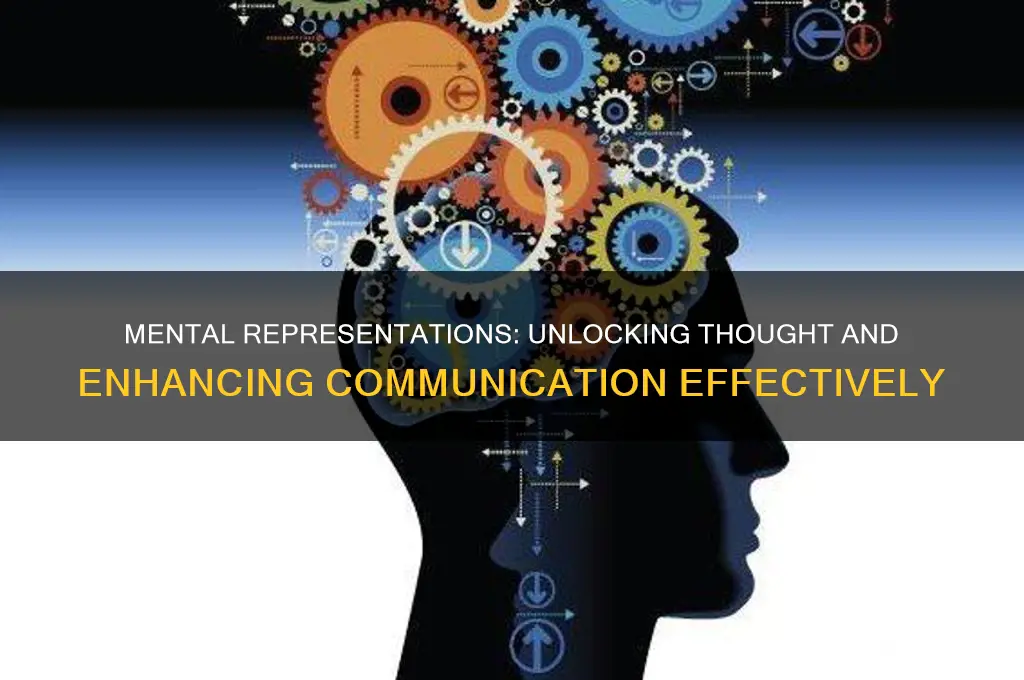
Mental representations, the internal cognitive structures that encode knowledge and experiences, play a pivotal role in shaping how we think and communicate. These representations, which can be visual, linguistic, symbolic, or abstract, serve as the building blocks of thought, enabling us to organize, interpret, and manipulate information. By storing and retrieving these mental constructs, individuals can reason, solve problems, and make decisions more efficiently. In communication, mental representations facilitate shared understanding by allowing people to encode their thoughts into words, gestures, or symbols and decode the messages of others. This process bridges the gap between individual minds, fostering collaboration and the exchange of ideas. Ultimately, mental representations act as the invisible scaffolding that underpins both cognitive processes and interpersonal interaction.
| Characteristics | Values |
|---|---|
| Cognitive Organization | Mental representations structure information, aiding in categorization and retrieval. |
| Abstract Thinking | Enable reasoning about concepts, ideas, and scenarios not physically present. |
| Language and Communication | Provide the foundation for forming words, sentences, and conveying meaning. |
| Problem Solving | Facilitate simulating solutions and predicting outcomes in the mind. |
| Memory Encoding and Retrieval | Help encode, store, and recall information efficiently. |
| Perceptual Interpretation | Assist in making sense of sensory input by comparing it to stored knowledge. |
| Decision Making | Support evaluating options by mentally representing potential consequences. |
| Creativity | Allow combining and transforming existing representations to generate new ideas. |
| Social Understanding | Aid in interpreting others' thoughts, emotions, and intentions. |
| Learning and Adaptation | Enable updating representations based on new experiences and knowledge. |
| Planning and Goal Setting | Help simulate future actions and outcomes to achieve objectives. |
| Emotional Processing | Representations of emotions guide reactions and responses to stimuli. |
| Cultural Transmission | Facilitate sharing and understanding cultural norms, values, and practices. |
| Symbolic Thinking | Allow using symbols (e.g., words, images) to represent complex concepts. |
| Flexibility in Thought | Enable shifting perspectives and considering multiple viewpoints. |
Explore related products


$15.69 $33.95


What You'll Learn
- Visualizing Concepts: Mental images simplify complex ideas, aiding understanding and explanation
- Language Processing: Representations link words to meanings, enabling clear communication
- Problem Solving: Internal models help simulate solutions before execution
- Memory Recall: Organized mental structures enhance retrieval of information
- Social Cognition: Representations of others’ thoughts improve empathy and interaction

Visualizing Concepts: Mental images simplify complex ideas, aiding understanding and explanation
Mental representations, particularly visual ones, serve as a bridge between abstract concepts and tangible understanding. When we visualize a concept, we transform it from a nebulous idea into something concrete that our minds can grasp. For instance, consider the concept of a "network." Without a mental image, it remains a vague term. However, when you visualize a web of interconnected nodes, the idea becomes clear, allowing you to understand and explain it more effectively. This process is not just about seeing; it’s about creating a cognitive framework that simplifies complexity.
To harness the power of mental images, start by breaking down the concept into its core components. For example, if you’re explaining the water cycle, visualize it as a circular diagram with evaporation, condensation, and precipitation as distinct yet connected stages. This visual breakdown not only aids your own understanding but also makes your explanation more accessible to others. Research shows that pairing visual aids with verbal explanations increases retention by up to 65%, particularly for complex topics. The key is to ensure the image is simple yet accurate, avoiding unnecessary details that could distract from the main idea.
One practical tip for creating effective mental images is to use analogies or metaphors. For instance, comparing the human brain to a computer can help visualize its functions—memory as storage, neurons as processors, and synapses as connections. This technique works because it leverages existing mental representations, making new concepts easier to integrate. However, be cautious: analogies should be relevant and not oversimplify to the point of inaccuracy. For example, while the brain-computer analogy is useful, it falls short in explaining emotions or creativity, which are uniquely human.
Children, in particular, benefit from visual mental representations due to their developing cognitive abilities. Studies show that children aged 5–12 learn best when abstract ideas are paired with visual or hands-on activities. For instance, teaching fractions using pie charts or physical objects like apples helps them grasp the concept more intuitively. This approach not only enhances understanding but also builds a foundation for more complex thinking later in life. Parents and educators can apply this by incorporating visual tools like diagrams, models, or even digital animations into learning activities.
In conclusion, visualizing concepts is a powerful tool for simplifying complexity and enhancing communication. By creating mental images, we make abstract ideas tangible, improving both personal understanding and the clarity of our explanations. Whether through analogies, diagrams, or hands-on activities, the goal is to transform the intangible into something the mind can see and interact with. This practice is not just a skill but a necessity in a world where complexity is the norm, and clarity is the key to effective thinking and communication.
Daily Mental Math Practice: Boosting Brain Power and Cognitive Skills
You may want to see also
Explore related products


Language Processing: Representations link words to meanings, enabling clear communication
Mental representations serve as the bridge between the abstract world of language and the concrete realm of meaning. In language processing, these representations are the cognitive structures that map words to their corresponding concepts, allowing us to understand and produce language effectively. For instance, when you hear the word "apple," your brain instantly retrieves a mental representation that includes its visual appearance, taste, and even cultural associations. This rapid, often unconscious process is the foundation of clear communication, ensuring that both speaker and listener share a common understanding of the words exchanged.
Consider the act of learning a new language. Initially, words are mere sounds or symbols without inherent meaning. However, as you practice, your brain begins to form mental representations that link these new words to their meanings. This process is not just about memorization; it involves creating neural pathways that connect linguistic input to pre-existing knowledge. For example, learning the Spanish word "manzana" involves associating it with your existing concept of an apple, including its color, texture, and function. Over time, these representations become automatic, enabling fluent communication without the need for constant translation.
The power of mental representations in language processing becomes particularly evident in ambiguous situations. Take the word "bank," which can refer to a financial institution or the side of a river. Your brain resolves this ambiguity by relying on contextual cues to activate the appropriate mental representation. This ability to disambiguate language in real-time is crucial for effective communication, especially in complex or nuanced conversations. Without these representations, misunderstandings would be far more frequent, hindering our ability to convey and interpret information accurately.
To enhance your language processing skills, focus on building robust mental representations through active engagement with language. Reading widely, discussing diverse topics, and practicing new vocabulary in context can strengthen these cognitive structures. For children, incorporating multisensory learning—such as associating words with images, sounds, and actions—can accelerate the development of mental representations. Adults can benefit from techniques like spaced repetition, where words are reviewed at increasing intervals to reinforce memory. By nurturing these representations, you not only improve your ability to communicate clearly but also deepen your understanding of the world around you.
In essence, mental representations are the invisible threads that weave words into meaningful communication. They transform language from a collection of arbitrary symbols into a dynamic tool for thought and interaction. By understanding and cultivating these representations, we can unlock the full potential of language, ensuring that our words resonate with clarity and precision in every conversation.
Kindness Boosts Mental Health: Simple Acts, Powerful Healing Benefits
You may want to see also
Explore related products


Problem Solving: Internal models help simulate solutions before execution
Mental representations act as the brain's sandbox, allowing us to test ideas without real-world consequences. When faced with a problem, our minds construct internal models—simulations of potential solutions. These models leverage stored knowledge, past experiences, and logical reasoning to predict outcomes. For instance, imagine planning a road trip. Your mental model might include routes, estimated travel times, and potential stops, all before you even start the engine. This pre-execution simulation helps identify flaws, optimize plans, and reduce the risk of costly mistakes.
Consider the process of assembling furniture. Before grabbing a screwdriver, you mentally visualize the steps, perhaps based on the instruction manual or past assembly experiences. This internal simulation highlights potential challenges, such as missing tools or unclear instructions, allowing you to prepare accordingly. Studies show that individuals who engage in such mental rehearsal complete tasks 20-30% faster and with fewer errors. The brain’s ability to simulate solutions is a powerful tool, turning abstract problems into actionable plans.
However, the effectiveness of internal models depends on their accuracy and detail. A vague or incomplete mental representation can lead to oversights. For example, a chef mentally planning a recipe might forget a key ingredient if their model lacks specificity. To enhance accuracy, break problems into smaller components and validate each part against real-world constraints. Tools like checklists or visual aids can bridge gaps in mental models, ensuring no critical detail is overlooked.
Critics argue that over-reliance on internal models can stifle creativity, as simulations often draw from existing knowledge rather than exploring novel solutions. Yet, this limitation can be mitigated by intentionally incorporating diverse perspectives or hypothetical scenarios into the mental model. For instance, a business leader might simulate a competitor’s response to a new product launch, even if such data is unavailable, to uncover blind spots.
In practice, cultivating effective internal models requires deliberate effort. Start by clearly defining the problem and gathering relevant information. Then, engage in structured mental simulation, asking "what-if" questions to test assumptions. Finally, validate your model through small-scale experiments or feedback from others. By refining this process, you transform problem-solving from a shot in the dark into a strategic, informed endeavor.
Exploring Medical Cannabis as a Potential Mental Health Treatment Option
You may want to see also
Explore related products

$74 $109.99

$69.3 $72.95


Memory Recall: Organized mental structures enhance retrieval of information
The human brain is a marvel of efficiency, and its ability to retrieve information swiftly is no accident. At the heart of this efficiency lies the concept of organized mental structures, which act as the scaffolding for memory recall. Imagine your mind as a meticulously arranged library: books (memories) are categorized by genre, author, and subject, making it effortless to locate a specific title. Similarly, mental representations organize information into coherent frameworks, reducing the cognitive load required to retrieve it. This structured approach not only speeds up recall but also minimizes errors, ensuring that the right information is accessed at the right time.
Consider the practical application of this principle in everyday life. When learning a new language, for instance, organizing vocabulary by themes (e.g., food, travel, emotions) creates mental "folders" that simplify retrieval. Research shows that individuals who use such thematic grouping recall words 30% faster than those who memorize randomly. This method leverages the brain’s natural tendency to associate related concepts, forming neural pathways that strengthen over time. By consciously structuring information, you’re essentially training your brain to navigate its own archives more effectively.
However, the benefits of organized mental structures extend beyond mere speed. They also enhance the accuracy and completeness of memory recall. For example, medical students often use mnemonic devices like acronyms (e.g., FAST for stroke symptoms: Face, Arms, Speech, Time) to organize complex information. These structured representations not only make recall easier but also reduce the likelihood of omitting critical details. In high-stakes situations, such as a medical emergency, this precision can be lifesaving. The key takeaway? Organization isn’t just about tidiness—it’s about reliability.
To harness the power of organized mental structures, start by identifying patterns in the information you’re trying to retain. For instance, when studying history, group events by era or theme rather than memorizing them chronologically. Use visual aids like mind maps or flowcharts to create tangible representations of these structures. Additionally, practice active recall by testing yourself regularly, reinforcing the neural connections that underpin organized memory. Remember, the brain thrives on order; by imposing structure, you’re not just storing information—you’re optimizing its retrieval.
In conclusion, organized mental structures are the unsung heroes of memory recall, transforming chaotic data into accessible knowledge. Whether you’re a student, professional, or lifelong learner, adopting strategies to structure your mental representations can yield profound benefits. From faster retrieval to greater accuracy, the advantages are clear. So, the next time you’re faced with a mountain of information, don’t just memorize—organize. Your brain will thank you.
Supporting Mental Health: Practical Ways to Help Someone in Need
You may want to see also
Explore related products


Social Cognition: Representations of others’ thoughts improve empathy and interaction
Mental representations of others’ thoughts act as cognitive blueprints, enabling us to predict behavior, interpret intentions, and respond appropriately in social interactions. These internal models, often referred to as "theory of mind," are not static but dynamic, evolving through experience and observation. For instance, when a friend cancels plans at the last minute, a well-developed mental representation allows us to consider their perspective—perhaps they’re overwhelmed at work or dealing with a personal crisis—rather than jumping to conclusions of selfishness. This ability to simulate others’ thoughts fosters empathy, reduces misunderstandings, and strengthens relationships.
To cultivate these representations, engage in active perspective-taking exercises. Start by asking open-ended questions during conversations, such as, *"What led you to that decision?"* or *"How did that situation make you feel?"* This practice trains your brain to prioritize others’ viewpoints, enhancing the accuracy of your mental models. Additionally, reading fiction has been shown to improve theory of mind by immersing readers in characters’ experiences. A study published in *Science* found that participants who read literary fiction scored higher on empathy tests compared to those who read non-fiction or popular fiction. Dedicate 20–30 minutes daily to reading diverse narratives to sharpen this skill.
However, over-reliance on mental representations can lead to errors, particularly when assumptions replace direct communication. For example, assuming a colleague is upset because they’re quiet during a meeting might overlook the possibility that they’re simply focused or introverted. To mitigate this, pair mental simulations with verification. Use phrases like, *"I noticed you seemed quiet earlier—is everything okay?"* to confirm your interpretation. This approach balances empathy with accuracy, ensuring interactions remain grounded in reality rather than conjecture.
Children begin developing mental representations of others’ thoughts around age 4, as evidenced by their ability to pass the "false-belief task." Parents and educators can support this growth by encouraging role-playing activities, discussing emotions, and modeling perspective-taking. For instance, when a child is frustrated with a peer, prompt them with, *"Why do you think they did that?"* This not only builds social cognition but also lays the foundation for lifelong empathy. By understanding and refining these representations, we transform from passive observers into active participants in the social world, capable of deeper connections and more meaningful interactions.
Ensure Plus and Mental Health: Exploring Nutritional Support for Well-Being
You may want to see also
Frequently asked questions
Mental representations are internal cognitive structures that encode knowledge, concepts, and experiences. They help with thinking by organizing information, allowing the brain to process, store, and retrieve data efficiently. This enables problem-solving, decision-making, and abstract reasoning.
Mental representations act as a shared framework for understanding and conveying ideas. They allow individuals to translate abstract thoughts into language, gestures, or symbols that others can interpret. This common ground ensures clarity and coherence in communication.
Yes, mental representations are dynamic and can evolve through learning, experience, and exposure to new information. This adaptability enhances thinking by updating knowledge and improving problem-solving skills. In communication, it ensures that individuals can adjust their language and understanding to align with changing contexts or perspectives.