Harper Lewis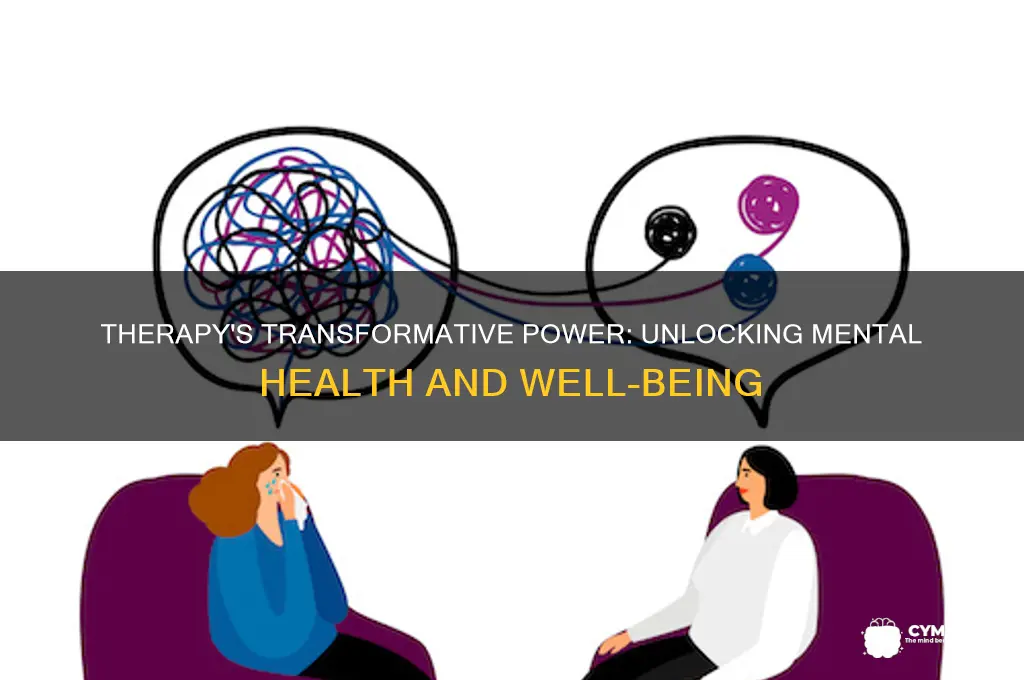
Therapy plays a crucial role in supporting mental health by providing individuals with a safe, non-judgmental space to explore their thoughts, emotions, and behaviors. Through evidence-based techniques such as cognitive-behavioral therapy (CBT), mindfulness, and interpersonal therapy, therapists help clients identify and challenge negative thought patterns, develop coping strategies, and build resilience. Therapy also fosters self-awareness, improves communication skills, and strengthens relationships, addressing underlying issues that contribute to mental health challenges. By offering tailored guidance and emotional support, therapy empowers individuals to manage symptoms, achieve personal growth, and enhance their overall well-being, making it an invaluable tool in the journey toward mental health recovery and stability.
Explore related products
$9.59 $16.99



What You'll Learn
- Stress Reduction: Therapy teaches coping strategies to manage stress effectively, improving overall mental well-being
- Emotional Regulation: Helps individuals understand and control emotions, reducing anxiety and mood swings
- Trauma Healing: Provides tools to process and overcome past traumas, fostering resilience and recovery
- Improved Relationships: Enhances communication skills, fostering healthier connections with others and reducing conflicts
- Self-Awareness: Encourages introspection, helping individuals recognize patterns and make positive life changes

Stress Reduction: Therapy teaches coping strategies to manage stress effectively, improving overall mental well-being
Stress is an inevitable part of life, but its impact on mental health can be mitigated through effective coping strategies learned in therapy. Unlike generic advice to "take a deep breath," therapeutic interventions offer personalized tools tailored to individual needs. For instance, cognitive-behavioral therapy (CBT) identifies and reframes negative thought patterns that exacerbate stress, while mindfulness-based stress reduction (MBSR) teaches techniques like body scans and meditation to anchor individuals in the present moment. These methods are not one-size-fits-all; a therapist might recommend 20 minutes of daily mindfulness practice for a busy professional or progressive muscle relaxation for someone with physical tension. The key is consistency—integrating these strategies into daily routines to build resilience over time.
Consider the case of a 35-year-old teacher overwhelmed by work demands and family responsibilities. Through therapy, she learned to prioritize tasks using the "Eisenhower Matrix," distinguishing between urgent and important activities. Her therapist also introduced diaphragmatic breathing exercises, practiced for 5 minutes twice daily, to reduce cortisol levels. Within weeks, she reported feeling more in control and less reactive to stressors. This example underscores therapy’s role in transforming abstract concepts like "stress management" into actionable steps, making it a practical tool for real-life challenges.
While coping strategies are powerful, their effectiveness depends on application and adaptation. A common pitfall is abandoning techniques during high-stress periods, precisely when they’re most needed. Therapists often caution against this, encouraging clients to view setbacks as opportunities to refine their approach rather than failures. For instance, if journaling feels tedious, switching to voice notes might be more sustainable. Additionally, combining strategies—such as pairing physical activity with cognitive reframing—can enhance their impact. Research shows that individuals who use multiple coping methods experience greater stress reduction than those relying on a single approach.
The long-term benefits of stress reduction through therapy extend beyond immediate relief. Chronic stress is linked to conditions like anxiety, depression, and cardiovascular disease, but consistent use of coping strategies can disrupt this cycle. A study published in *Psychosomatic Medicine* found that participants who completed an 8-week MBSR program showed reduced activity in the amygdala, the brain’s stress response center, even months after the intervention. This highlights therapy’s potential not just to manage stress but to rewire the brain for greater emotional regulation.
Ultimately, therapy’s value in stress reduction lies in its ability to empower individuals with skills they can use independently. Unlike temporary fixes, these strategies become part of one’s mental toolkit, fostering self-efficacy and long-term well-being. Whether through structured exercises, lifestyle adjustments, or mindset shifts, therapy offers a pathway to navigate life’s pressures with confidence and clarity. For anyone feeling overwhelmed, it’s not just about surviving stress—it’s about learning to thrive despite it.
Reading for Resilience: How Books Boost Mental Health and Well-Being
You may want to see also
Explore related products
$10.99 $18.99


$9.79 $17.99



Emotional Regulation: Helps individuals understand and control emotions, reducing anxiety and mood swings
Emotions, when left unchecked, can spiral into overwhelming anxiety or erratic mood swings, hijacking daily life. Emotional regulation, a core focus of therapy, teaches individuals to recognize, understand, and manage these emotional currents. Through techniques like mindfulness, cognitive reframing, and grounding exercises, therapy equips people with tools to respond to emotions rather than react impulsively. For instance, a person experiencing panic might learn to identify the physical sensations of anxiety (rapid heartbeat, shallow breathing) and apply a 4-7-8 breathing technique (inhale for 4 seconds, hold for 7, exhale for 8) to regain control.
Consider the case of a 28-year-old professional whose work stress triggers frequent irritability and outbursts. In therapy, they learn to label their emotions ("I’m feeling frustrated because this deadline is unrealistic") and challenge catastrophic thinking ("One mistake won’t ruin my career"). Over time, this practice reduces their emotional volatility, improving relationships and job satisfaction. Research supports this: Dialectical Behavior Therapy (DBT), a modality emphasizing emotional regulation, has been shown to decrease anxiety symptoms by 50% in adults with borderline personality disorder within 12 months of consistent treatment.
However, emotional regulation isn’t about suppressing feelings but channeling them constructively. Therapists often caution against over-relying on distraction (e.g., scrolling social media) as a coping mechanism, as it avoids addressing the root cause. Instead, they encourage practices like journaling or progressive muscle relaxation, which foster self-awareness and long-term resilience. For adolescents, age-appropriate strategies such as emotion thermometers (visual tools to gauge intensity) can make abstract concepts tangible and actionable.
The takeaway? Emotional regulation is a skill, not an innate trait, and like any skill, it requires practice. Therapists act as coaches, guiding individuals through personalized strategies tailored to their emotional triggers and lifestyle. Whether through individual sessions, group therapy, or digital apps (e.g., Calm or Headspace), consistent engagement with these tools can transform emotional chaos into clarity, reducing anxiety and mood swings while fostering a sense of agency over one’s mental health.
Building Stronger Minds: The Power of Community Resilience on Mental Health
You may want to see also
Explore related products


Trauma Healing: Provides tools to process and overcome past traumas, fostering resilience and recovery
Trauma casts a long shadow, often silently shaping behaviors, emotions, and relationships long after the event itself. Therapy acts as a beacon, illuminating the path to understanding and healing. Through evidence-based modalities like Cognitive Behavioral Therapy (CBT), Eye Movement Desensitization and Reprocessing (EMDR), and somatic experiencing, therapists provide structured frameworks to process traumatic memories. These tools don’t erase the past but reframe it, allowing individuals to integrate their experiences without being defined by them. For instance, EMDR uses bilateral stimulation (such as eye movements or tapping) to help the brain reprocess traumatic memories, reducing their emotional charge. This isn’t about reliving pain but about rewriting the narrative of survival.
Consider the case of a 32-year-old survivor of childhood abuse who entered therapy with chronic anxiety and flashbacks. Through CBT, they learned to challenge distorted beliefs like “I am unworthy of love” and replace them with evidence-based affirmations. Simultaneously, somatic experiencing helped them reconnect with their body, releasing stored tension through guided breathing and movement exercises. Within six months, their flashbacks decreased by 70%, and they reported feeling more grounded and in control. This example underscores therapy’s dual role: it addresses the cognitive and emotional layers of trauma while honoring the body’s wisdom in healing.
Healing from trauma isn’t linear; it requires patience, consistency, and the right tools. Therapists often recommend a “trauma toolkit” tailored to individual needs. This might include journaling to externalize emotions, mindfulness practices to stay present during triggers, or creative outlets like art or music to express what words cannot. For adolescents, play therapy or narrative techniques can help them process trauma indirectly, bypassing the overwhelm of direct confrontation. Adults might benefit from group therapy, which fosters a sense of community and reduces feelings of isolation. The key is personalization—what works for one person may not work for another, and therapists adapt their approach accordingly.
Critics might argue that revisiting trauma can retraumatize, but when done safely and ethically, therapy minimizes this risk. Therapists create a containment framework, ensuring clients feel secure before exploring painful memories. Grounding techniques, such as the 5-4-3-2-1 method (naming five things you see, four you can touch, etc.), are taught early on to manage distress. Additionally, therapists emphasize pacing, allowing clients to dictate the speed of their healing journey. This collaborative approach builds trust and empowers individuals to reclaim agency over their narrative.
Ultimately, trauma healing in therapy is about transformation, not just recovery. It equips individuals with resilience, a skill set that extends beyond trauma processing. Those who heal often report improved relationships, heightened emotional regulation, and a renewed sense of purpose. For example, a 45-year-old veteran who underwent prolonged exposure therapy not only overcame PTSD symptoms but also became a peer mentor, using his experience to inspire others. Therapy doesn’t just mend the past; it fortifies the future, turning survivors into thrivers. In a world where trauma is inevitable, this is not just a service—it’s a lifeline.
Can Specific Frequencies Boost Your Mood and Mental Well-being?
You may want to see also
Explore related products


Improved Relationships: Enhances communication skills, fostering healthier connections with others and reducing conflicts
Therapy often begins with the individual, but its ripple effects can transform how we connect with others. One of the most tangible benefits is the enhancement of communication skills, a cornerstone of healthier relationships. Consider this: effective communication isn’t just about speaking clearly; it’s about listening actively, understanding nonverbal cues, and expressing emotions without blame. Therapy provides a structured environment to practice these skills, often through role-playing, feedback sessions, or homework assignments like journaling conversations. For instance, a therapist might guide a client to reframe a confrontational statement ("You never listen!") into a reflective one ("I feel unheard when we talk about this"). This shift alone can reduce defensiveness and open the door to resolution.
The impact of improved communication extends beyond conflict resolution—it fosters deeper emotional connections. Research shows that couples who engage in therapy report higher levels of empathy and intimacy, even when addressing long-standing issues. For example, a study published in the *Journal of Marital and Family Therapy* found that couples who practiced "speaker-listener" techniques during sessions experienced a 30% reduction in relationship distress over six months. These techniques involve one partner expressing their feelings while the other paraphrases and validates, ensuring both feel heard. Such practices aren’t limited to romantic relationships; they apply equally to friendships, family dynamics, and workplace interactions.
However, mastering these skills requires patience and consistency. Therapists often recommend "micro-practices," such as dedicating 10 minutes daily to active listening or using "I" statements instead of "you" accusations. For adolescents and young adults, who are still developing emotional regulation, these practices can be particularly transformative. A 2020 study in *Developmental Psychology* highlighted that teens who participated in communication-focused therapy sessions reported fewer peer conflicts and higher social satisfaction within three months. The key is to integrate these skills into everyday life, not just during therapy sessions.
A common caution is the tendency to revert to old patterns under stress. Therapy equips individuals with tools to recognize this backsliding and course-correct. For instance, a therapist might teach a client the "pause and reflect" technique: when tensions rise, take a 2-minute break to breathe deeply and identify the underlying emotion before responding. This simple act can prevent escalation and create space for calmer dialogue. Over time, these habits become second nature, reducing the frequency and intensity of conflicts.
Ultimately, therapy’s role in improving relationships isn’t about eliminating disagreements—it’s about changing how we navigate them. By honing communication skills, individuals learn to approach interactions with curiosity rather than criticism, empathy rather than ego. The result? Relationships that are not only less contentious but also more authentic and fulfilling. Whether you’re repairing a strained bond or strengthening an existing one, the principles learned in therapy provide a blueprint for connection that lasts.
Boost Your Brain: The Surprising Benefits of Mental Math Mastery
You may want to see also
Explore related products



Self-Awareness: Encourages introspection, helping individuals recognize patterns and make positive life changes
Therapy fosters self-awareness by creating a structured space for introspection, a process often neglected in the chaos of daily life. Through guided conversations, individuals learn to examine their thoughts, emotions, and behaviors without judgment. This practice is akin to holding a mirror to one’s inner world, revealing patterns that might otherwise remain hidden. For instance, a person might notice they consistently avoid conflict, a behavior rooted in childhood experiences. By identifying such patterns, therapy empowers individuals to question their automatic responses and understand the underlying causes, laying the groundwork for intentional change.
Consider the analogy of untangling a knot: self-awareness is the careful examination of each twist and turn before gently pulling the threads apart. Therapists often use techniques like journaling, mindfulness exercises, or cognitive reframing to deepen this process. For example, a therapist might ask a client to track their emotional reactions to specific situations for a week. This simple act of observation can highlight recurring triggers, such as stress at work leading to emotional eating. Armed with this insight, individuals can begin to experiment with healthier coping mechanisms, turning self-awareness into a tool for transformation.
The power of self-awareness extends beyond personal insight; it catalyzes actionable change. Once patterns are recognized, therapy provides a framework for setting realistic goals and measuring progress. For a teenager struggling with social anxiety, self-awareness might reveal a fear of rejection tied to past experiences. With this understanding, they can work with their therapist to practice assertiveness in low-stakes situations, gradually building confidence. Similarly, an adult dealing with chronic stress might identify a tendency to overcommit, prompting them to set boundaries and prioritize self-care. These small, deliberate steps accumulate into significant life shifts.
However, cultivating self-awareness is not without challenges. It requires vulnerability and a willingness to confront uncomfortable truths. Some individuals may resist this process, fearing what they might discover about themselves. Therapists address this by fostering a nonjudgmental environment and emphasizing that self-awareness is not about self-criticism but self-compassion. Practical tips, such as starting with small, focused reflections rather than overwhelming self-analysis, can make the process more accessible. For instance, dedicating five minutes daily to reflect on a single interaction can be more manageable than attempting a comprehensive self-evaluation.
Ultimately, self-awareness is the cornerstone of therapeutic progress, transforming passive existence into active engagement with one’s life. It shifts the narrative from “Why does this keep happening to me?” to “What can I do differently?” This shift in perspective is not just empowering; it is liberating. By recognizing patterns and understanding their origins, individuals can rewrite their stories, making choices that align with their values and aspirations. Therapy, in this sense, is not just about healing past wounds but about building a future shaped by self-awareness and intentionality.
Supporting Mental Health: Practical Ways to Aid Recovery and Resilience
You may want to see also
Frequently asked questions
Therapy helps improve mental health by providing a safe space to explore thoughts, emotions, and behaviors. It equips individuals with coping strategies, helps identify unhealthy patterns, and fosters self-awareness and personal growth.
Yes, therapy is highly effective for conditions like anxiety and depression. Evidence-based approaches such as cognitive-behavioral therapy (CBT) and mindfulness-based therapies can reduce symptoms, improve mood, and enhance overall functioning.
The timeline varies depending on the individual and the nature of their concerns. Some people notice improvements within a few sessions, while others may take several weeks or months. Consistency and active participation in therapy are key to achieving lasting results.
The therapist-client relationship is crucial for mental health improvement. A trusting, non-judgmental, and supportive relationship allows individuals to feel safe, understood, and motivated to work through challenges, fostering healing and growth.