Harper Lewis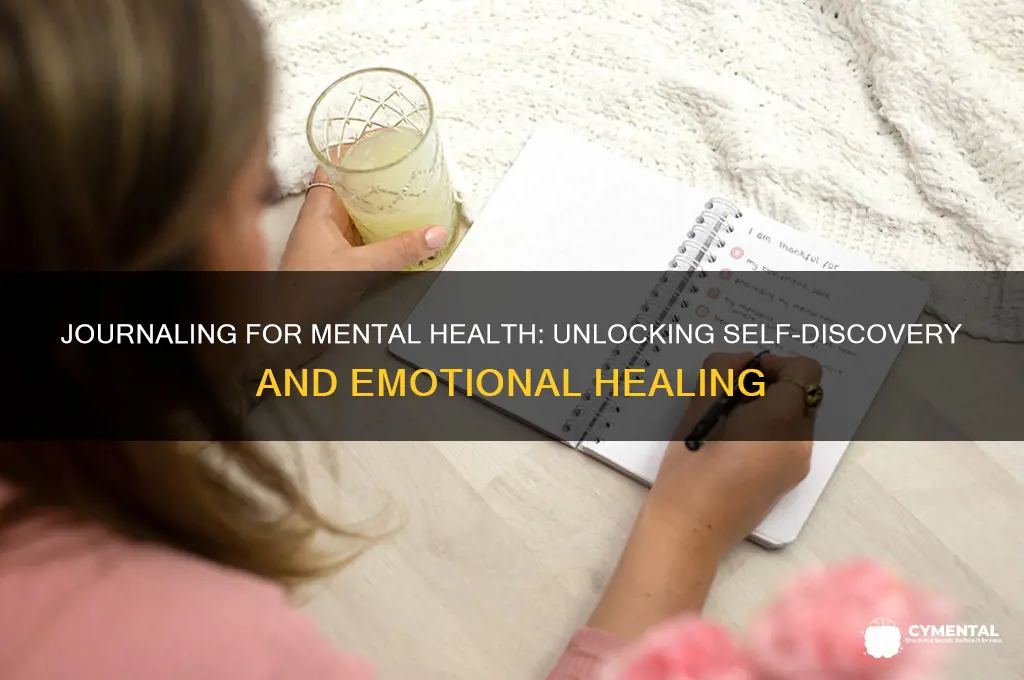
Journaling is a powerful tool for enhancing mental health, offering a safe and private space for individuals to express their thoughts, emotions, and experiences. By putting pen to paper, people can gain clarity, process complex feelings, and track patterns in their moods or behaviors, which can lead to greater self-awareness and emotional regulation. Regular journaling has been shown to reduce stress, anxiety, and symptoms of depression, as it allows for the release of pent-up emotions and fosters a sense of control over one's inner world. Additionally, it encourages mindfulness and reflection, helping individuals identify triggers, set personal goals, and celebrate progress, ultimately promoting a more balanced and resilient mental state. Whether through structured prompts or free-flowing entries, journaling serves as a therapeutic practice that supports overall well-being.
Explore related products


What You'll Learn
- Stress Reduction: Writing down thoughts helps lower stress levels by clearing the mind effectively
- Emotional Clarity: Journaling organizes emotions, making it easier to understand and manage feelings
- Goal Tracking: It aids in setting, monitoring, and achieving personal mental health goals
- Self-Reflection: Promotes introspection, fostering self-awareness and personal growth over time
- Anxiety Relief: Helps reduce anxiety by externalizing worries and creating actionable solutions

Stress Reduction: Writing down thoughts helps lower stress levels by clearing the mind effectively
Stress accumulates in the mind like static on a radio, distorting clarity and draining energy. Writing down thoughts acts as a reset button, tuning out the noise and restoring mental bandwidth. Studies show that expressive writing for as little as 15–20 minutes a day can significantly reduce cortisol levels, the body’s primary stress hormone. This isn’t about crafting perfect prose—it’s about dumping the mental clutter onto paper, no filter required.
Consider journaling as a form of cognitive decluttering. When worries swirl in the mind, they gain power through repetition. Transferring them to paper externalizes the chaos, making it tangible and, paradoxically, more manageable. For instance, a 2018 study in *Advances in Psychiatric Treatment* found that participants who journaled about stressors reported feeling more in control and less overwhelmed. The act of writing forces the brain to slow down, analyze, and reframe, breaking the cycle of rumination.
To maximize stress reduction, adopt a structured approach. Start by setting a timer for 10–15 minutes to avoid overthinking. Write freely, focusing on the source of stress without censoring. Use prompts like, *“What’s weighing on me right now?”* or *“What’s one small step I can take to address this?”* For chronic stressors, try a “worry journal” where you dedicate 10 minutes nightly to offload anxieties, then close the notebook—symbolically leaving the worries behind.
However, journaling isn’t a one-size-fits-all solution. For some, revisiting traumatic thoughts on paper can amplify distress. If writing about a stressor feels re-traumatizing, shift focus to gratitude or future planning instead. Pair journaling with grounding techniques, like deep breathing or a brief walk, to enhance its calming effects. Consistency is key—aim for daily practice, even if brief, to train the brain to default to this stress-relief tool.
The beauty of journaling lies in its simplicity and accessibility. It requires nothing more than a pen and paper, yet its impact on stress reduction is profound. By clearing mental space, it creates room for problem-solving, creativity, and emotional balance. Think of it as a daily tune-up for the mind, preventing stress from becoming a chronic condition. Start small, stay consistent, and let the pages become your sanctuary from life’s static.
Volleyball's Impact: Boosting Mental Health Through Teamwork and Active Play
You may want to see also
Explore related products


Emotional Clarity: Journaling organizes emotions, making it easier to understand and manage feelings
Emotions, when left unprocessed, can feel like a tangled web, making it difficult to discern one feeling from another. Journaling acts as a comb, gently untangling these threads and laying them out for examination. By putting emotions into words, you create distance between yourself and the feeling, allowing for a more objective analysis. This process, often referred to as "emotional distancing," is a cornerstone of cognitive behavioral therapy and can be achieved through the simple act of writing.
Consider this scenario: You've had a frustrating day at work, and upon arriving home, you feel a surge of anger. Instead of reacting impulsively, you sit down with your journal and begin to write. As you describe the events of the day, the anger starts to unravel. You realize it's not just anger; there's also a sense of disappointment and a feeling of being undervalued. This breakdown of emotions is the first step towards understanding and, ultimately, managing them.
The practice of journaling for emotional clarity is not about suppressing feelings but about creating a safe space to explore and accept them. Research suggests that expressive writing, where individuals write about their thoughts and feelings, can lead to improved mental health outcomes. A study published in the *Journal of Experimental Psychology* found that participants who engaged in expressive writing for 15-20 minutes a day over three consecutive days experienced reduced stress and improved mood. This 'dosage' of journaling can be particularly effective for young adults and adolescents, who often struggle with emotional regulation.
Here's a practical approach: Start by setting aside a dedicated time each day for journaling, preferably when you're undisturbed. Begin with a simple prompt like, "Today, I feel..." and let the words flow without censoring. Encourage yourself to be as detailed as possible, describing not only the emotion but also the physical sensations and thoughts associated with it. For instance, instead of just writing "I'm sad," try "I feel a heaviness in my chest, and my mind keeps replaying the argument, making me feel helpless." This level of specificity is key to unlocking emotional clarity.
A comparative analysis of journaling techniques reveals that structured journaling, where prompts guide the writing process, can be more effective for emotional organization than free-form writing. Structured prompts might include questions like, "What triggered this emotion?" or "How does this feeling manifest physically?" These directed inquiries help to systematically dissect emotions, making them more manageable. For instance, a study comparing structured vs. unstructured journaling found that participants using structured prompts reported greater emotional insight and reduced anxiety levels.
In conclusion, journaling serves as a powerful tool for emotional clarity, offering a means to organize and understand the complex landscape of feelings. By regularly engaging in this practice, individuals can develop a healthier relationship with their emotions, leading to improved mental well-being. The key lies in consistency and specificity, allowing the written word to become a mirror reflecting the intricacies of one's emotional world.
Mental Mapping: Boosting Learning, Memory, and Academic Success in School
You may want to see also
Explore related products


$7.84 $14.99


Goal Tracking: It aids in setting, monitoring, and achieving personal mental health goals
Journaling serves as a tangible roadmap for mental health improvement, and goal tracking is its most actionable feature. By translating abstract aspirations like "reduce anxiety" into specific, measurable targets—such as "practice deep breathing for 5 minutes daily"—journaling transforms vague intentions into structured plans. This clarity not only demystifies the path to progress but also anchors the mind in actionable steps, reducing overwhelm and fostering a sense of control.
Consider the process as a three-phase system: setting, monitoring, and achieving. In the setting phase, journaling prompts you to define goals with precision—SMART criteria (Specific, Measurable, Achievable, Relevant, Time-bound) are particularly effective. For instance, instead of "improve sleep," write "go to bed by 10 PM and wake at 6 AM, five days a week, for the next month." This specificity ensures goals are grounded in reality, not wishful thinking. Monitoring involves regular check-ins, where you record progress, setbacks, and reflections. A simple habit tracker or weekly review can highlight patterns—such as noticing that journaling before bed correlates with deeper sleep—allowing for informed adjustments.
The act of tracking itself becomes a tool for accountability and motivation. Studies suggest that individuals who write down their goals are 42% more likely to achieve them, as the physical act of recording reinforces commitment. For mental health, this could mean noting daily mood ratings on a scale of 1–10, alongside triggers and coping strategies. Over time, this data becomes a personal case study, revealing what works (e.g., 30 minutes of morning meditation reduces afternoon anxiety) and what doesn’t (e.g., excessive screen time before bed disrupts sleep).
However, goal tracking in journaling is not without pitfalls. Overloading your journal with too many goals can lead to burnout, while overly rigid targets may trigger self-criticism. Balance is key: pair ambitious goals with self-compassion, and celebrate small wins. For example, if your goal is to journal daily but you miss a day, note the reason without judgment and refocus on the next entry. Additionally, integrate flexibility by revisiting goals monthly to ensure they align with your evolving needs.
In practice, combine goal tracking with other journaling techniques for maximum impact. Pair progress logs with gratitude entries to maintain perspective, or use bullet journaling to visually track habits alongside emotional reflections. For teens and young adults, digital journaling apps with built-in goal-tracking features can enhance consistency, while older adults may prefer the tactile experience of a physical notebook. Regardless of format, the synergy of setting, monitoring, and achieving goals through journaling cultivates a proactive stance toward mental health—one that turns passive struggles into active triumphs.
School Psychologists: Essential Mental Health Support in Education
You may want to see also
Explore related products




Self-Reflection: Promotes introspection, fostering self-awareness and personal growth over time
Journaling serves as a mirror to the mind, capturing thoughts, emotions, and experiences in a way that forces the writer to confront their inner world. This act of self-reflection is not merely about recording events but about dissecting them, understanding their impact, and identifying patterns that shape behavior and mindset. For instance, a person who journals about recurring conflicts at work might notice a tendency to avoid confrontation, a realization that can spark targeted efforts to improve communication skills. By consistently engaging in this process, individuals can move beyond surface-level observations to deeper insights about their motivations, fears, and values.
To maximize the introspective benefits of journaling, structure your entries with intentionality. Start by describing a situation objectively, then analyze your emotional and behavioral responses, and finally, explore the underlying beliefs or triggers that influenced those reactions. For example, instead of writing, "I felt angry during the meeting," delve into why: "I felt angry because my idea was dismissed, which made me question my competence. This reaction stems from a fear of failure that I’ve carried since childhood." Such detailed examination transforms journaling from a passive activity into an active tool for self-discovery.
A cautionary note: self-reflection through journaling can sometimes unearth uncomfortable truths or unresolved emotions. If this happens, approach the process with compassion rather than judgment. Acknowledge the difficulty of confronting these aspects of yourself and consider seeking support from a therapist or trusted friend. The goal is not to criticize but to understand, using that understanding as a foundation for growth. For instance, recognizing a pattern of self-sabotage in relationships can be painful, but it also opens the door to addressing the root causes and adopting healthier behaviors.
Over time, regular journaling cultivates self-awareness, a critical component of personal growth. It allows individuals to track changes in their perspectives, priorities, and emotional responses, providing tangible evidence of progress. For example, someone who journals about anxiety might notice a shift from entries dominated by fear to those reflecting resilience and coping strategies. This documented evolution reinforces the belief in one’s ability to change, fostering a sense of agency and optimism. To enhance this effect, periodically review past entries to identify themes and measure growth, celebrating milestones along the way.
Practical tips can further amplify the self-reflective power of journaling. Dedicate a specific time each day to write, even if it’s just 10 minutes, to establish consistency. Use prompts like "What did I learn about myself today?" or "What am I avoiding and why?" to guide deeper reflection. Experiment with different formats—bullet points, letters to yourself, or dialogue between conflicting parts of your identity—to keep the practice engaging. Finally, treat your journal as a judgment-free zone, allowing yourself to be honest and vulnerable. By doing so, you transform journaling into a dynamic dialogue with yourself, one that nurtures self-awareness and fuels continuous personal growth.
Can Faith and Divine Intervention Aid Mental Health Struggles?
You may want to see also
Explore related products


Anxiety Relief: Helps reduce anxiety by externalizing worries and creating actionable solutions
Anxiety often thrives in the abstract, where worries swirl unchecked in the mind. Journaling acts as a grounding force, pulling these intangible fears into the tangible realm of paper and ink. By externalizing anxieties, you disrupt their cyclical nature, transforming amorphous dread into identifiable concerns. This simple act of transcription can immediately reduce the emotional charge of a worry, making it feel less overwhelming and more manageable.
Consider this a form of cognitive decluttering. When you journal, you’re not just writing down worries; you’re creating space in your mind. Research suggests that expressive writing for as little as 15–20 minutes a day can significantly lower anxiety levels, particularly in individuals prone to rumination. The key lies in specificity: instead of jotting down vague statements like “I’m anxious about work,” dissect the worry. Is it a looming deadline? A difficult conversation? The more detailed your entry, the easier it becomes to pinpoint actionable steps.
Once worries are on paper, the next step is to engage with them proactively. Journaling isn’t merely a dumping ground for fears; it’s a tool for problem-solving. After listing concerns, dedicate a section of your journal to brainstorming solutions. For instance, if you’re anxious about a presentation, break it down: research the topic, practice aloud, seek feedback. Even if solutions seem small, the act of planning shifts your mindset from passive worry to active resolution. This process, known as “solution-focused journaling,” has been shown to reduce anxiety by fostering a sense of control and agency.
For maximum effectiveness, pair journaling with mindfulness techniques. Before writing, take a few deep breaths to center yourself. After journaling, review your entries periodically to track progress. Over time, you’ll notice patterns—triggers, coping mechanisms, and recurring themes—that can inform long-term strategies for managing anxiety. Remember, the goal isn’t to eliminate anxiety entirely but to cultivate a healthier relationship with it, one journal entry at a time.
Christian Psychology: A Faith-Based Approach to Mental Health Healing?
You may want to see also
Frequently asked questions
Journaling helps improve mental health by providing a safe space to express emotions, clarify thoughts, and process experiences. It reduces stress, increases self-awareness, and promotes emotional release.
Yes, journaling can reduce anxiety by allowing you to externalize worries, identify triggers, and gain perspective on anxious thoughts, helping to calm the mind.
Journaling can be effective for managing depression by tracking moods, identifying negative thought patterns, and fostering gratitude or positive reflections, which can improve overall outlook.
Consistency is key; journaling daily or a few times a week can yield the most mental health benefits, but even occasional entries can provide relief and clarity.
Write about your feelings, daily experiences, goals, or challenges. Techniques like gratitude lists, stream-of-consciousness writing, or reflective prompts can also be helpful.