Harper Lewis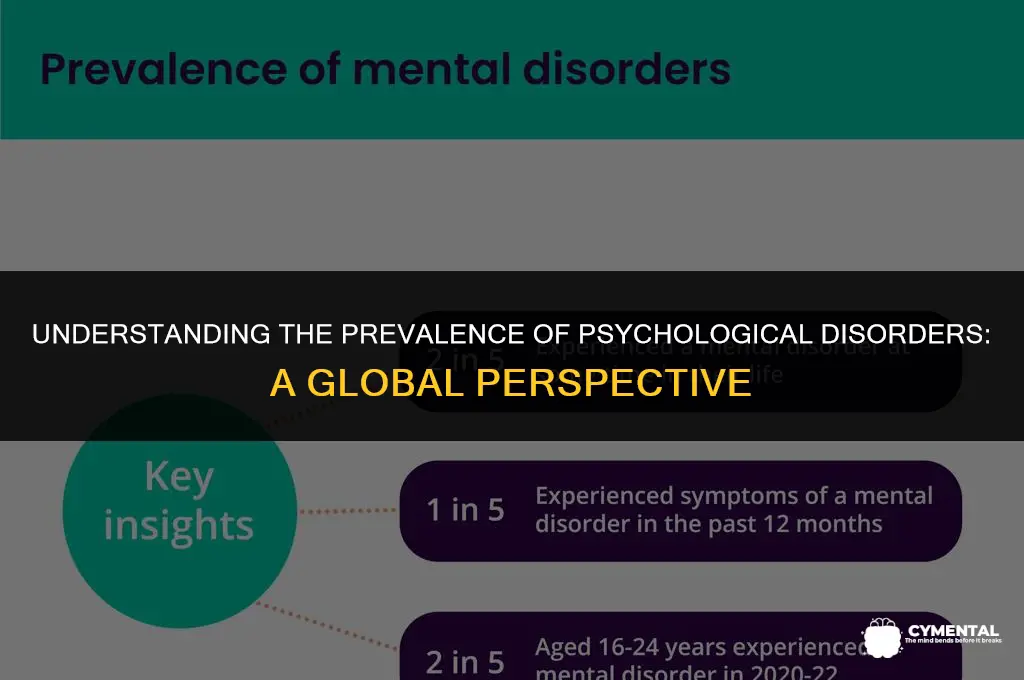
Psychological disorders, also known as mental health conditions, affect a significant portion of the global population. According to recent studies, approximately one in four individuals will experience a mental health issue at some point in their lives. This statistic underscores the widespread nature of psychological disorders and highlights the importance of addressing mental health concerns. The impact of these conditions can vary greatly, ranging from mild symptoms that cause minimal disruption to severe cases that significantly impair daily functioning and overall well-being. Understanding the prevalence and effects of psychological disorders is crucial for promoting awareness, reducing stigma, and ensuring access to appropriate treatment and support services.
Explore related products


What You'll Learn
- Prevalence of Anxiety Disorders: Statistics on the number of individuals affected by anxiety disorders globally
- Depression Statistics: Data on the prevalence of depressive disorders across different demographics
- Bipolar Disorder Rates: Information on the incidence of bipolar disorder in various populations
- Schizophrenia Prevalence: Overview of schizophrenia's occurrence and its impact on society
- Eating Disorders Data: Insights into the number of people suffering from eating disorders worldwide

Prevalence of Anxiety Disorders: Statistics on the number of individuals affected by anxiety disorders globally
Anxiety disorders are among the most prevalent psychological conditions worldwide, affecting millions of individuals across various demographics. According to the World Health Organization (WHO), approximately 260 million people globally suffer from anxiety disorders, making it one of the most common mental health issues. This prevalence is not limited to any specific age group, as anxiety can manifest in children, adolescents, and adults alike. However, it is often observed that the onset of anxiety disorders typically occurs during adolescence or early adulthood.
The impact of anxiety disorders extends beyond individual suffering, affecting societal and economic spheres as well. Anxiety-related conditions contribute significantly to the global burden of disease, measured in Disability-Adjusted Life Years (DALYs). DALYs account for both the years of life lost due to premature death and the years lived with disability, providing a comprehensive measure of the disease's impact. In 2015, anxiety disorders were estimated to account for over 32 million DALYs globally, highlighting the substantial toll these conditions take on public health.
Furthermore, anxiety disorders often co-occur with other mental health conditions, such as depression, substance use disorders, and other anxiety-related disorders. This comorbidity can complicate treatment and exacerbate the overall impact on an individual's quality of life. For instance, individuals with generalized anxiety disorder (GAD) are at a higher risk of developing major depressive disorder, and those with panic disorder are more likely to experience agoraphobia.
Despite the high prevalence and significant impact of anxiety disorders, there remains a considerable treatment gap. Many individuals with anxiety disorders do not receive adequate treatment, often due to barriers such as stigma, lack of access to mental health services, and financial constraints. This underscores the need for increased awareness, improved access to care, and more effective treatment strategies to address the global burden of anxiety disorders.
In conclusion, anxiety disorders are a pervasive and impactful mental health issue, affecting a substantial portion of the global population. The prevalence of these disorders, their significant contribution to the global burden of disease, and the high rates of comorbidity with other mental health conditions highlight the critical need for enhanced mental health services and interventions. Addressing the treatment gap and improving access to care are essential steps in mitigating the widespread impact of anxiety disorders on individuals and society as a whole.
Mental Health Conditions That May Disqualify You from Military Service
You may want to see also
Explore related products


Depression Statistics: Data on the prevalence of depressive disorders across different demographics
Depression is a pervasive mental health condition that affects millions of people worldwide. According to the World Health Organization (WHO), approximately 264 million individuals suffer from depression globally. This condition does not discriminate by age, gender, or socioeconomic status, but certain demographics are more vulnerable than others.
In the United States, the prevalence of depression varies significantly across different age groups. The National Institute of Mental Health (NIMH) reports that in 2020, 8.3% of adults aged 18-25 experienced a major depressive episode, compared to 4.7% of those aged 65 and older. This suggests that younger adults are more susceptible to depression, potentially due to factors such as increased stress, social media use, and economic pressures.
Gender also plays a role in the prevalence of depression. Women are more likely to experience depression than men, with the WHO estimating that 5.1% of women and 3.1% of men suffer from the condition. This gender disparity may be attributed to hormonal differences, social expectations, and the higher likelihood of women experiencing trauma and abuse.
Socioeconomic factors also contribute to the prevalence of depression. Individuals living in poverty or with limited access to healthcare are more likely to experience depression due to the chronic stress of financial insecurity and lack of support. Furthermore, certain racial and ethnic groups may be more vulnerable to depression due to systemic inequalities and cultural factors.
Understanding the demographics of depression is crucial for developing targeted interventions and improving mental health outcomes. By recognizing the specific populations at risk, healthcare providers and policymakers can allocate resources more effectively and implement strategies to reduce the burden of depression on individuals and communities.
Exploring Procrastination: Is It a Mental Disorder?
You may want to see also
Explore related products


Bipolar Disorder Rates: Information on the incidence of bipolar disorder in various populations
Bipolar disorder, characterized by its dramatic mood swings from manic highs to depressive lows, affects a significant portion of the global population. Epidemiological studies suggest that approximately 2.8% of adults worldwide experience bipolar disorder at some point in their lives. However, the prevalence can vary widely across different regions and demographic groups. For instance, a 2019 study published in the *Journal of Affective Disorders* found that the lifetime prevalence of bipolar disorder was highest in North America (4.4%) and lowest in Africa (1.1%).
Several factors contribute to these regional disparities, including genetic predisposition, environmental stressors, and access to mental health care. In developed countries, the disorder is often more readily diagnosed and treated, which may influence reported rates. Conversely, in developing nations, stigma and limited mental health resources can lead to underreporting and misdiagnosis.
Age is another critical factor in the incidence of bipolar disorder. Typically, the disorder first manifests in late adolescence or early adulthood, with the median age of onset being around 25 years. However, it can also occur in children and older adults, albeit less frequently. Early detection and intervention are crucial, as the disorder tends to worsen over time if left untreated.
Gender also plays a role in the prevalence of bipolar disorder. Women are more likely to experience the disorder than men, with a lifetime prevalence of 3.3% compared to 2.4% for men. This gender disparity may be linked to hormonal fluctuations, social factors, and differences in coping mechanisms.
Understanding the incidence of bipolar disorder in various populations is essential for developing targeted interventions and improving mental health outcomes. By recognizing the factors that influence prevalence, health professionals can better allocate resources and design effective treatment strategies.
Overcoming Stigmas: Strategies to Mitigate Bias Against Mental Health Disorders
You may want to see also
Explore related products


Schizophrenia Prevalence: Overview of schizophrenia's occurrence and its impact on society
Schizophrenia is a chronic brain disorder characterized by symptoms such as delusions, hallucinations, trouble with thinking, and concentration. According to the World Health Organization (WHO), schizophrenia affects approximately 24 million people worldwide, which is about 1% of the global population. The disorder typically begins in late adolescence or early adulthood and can have a significant impact on a person's quality of life, relationships, and ability to function in society.
The prevalence of schizophrenia varies across different regions and countries. In the United States, for example, the National Institute of Mental Health (NIMH) estimates that about 1.5% of the adult population, or approximately 3.5 million people, suffer from schizophrenia. In contrast, some studies suggest that the prevalence of schizophrenia may be lower in certain Asian countries, such as Japan and China, where the reported rates are around 0.5% of the population.
Schizophrenia can have a profound impact on society, both in terms of the individuals affected and their families, as well as the broader community. People with schizophrenia may experience difficulties in maintaining employment, housing, and relationships, which can lead to social isolation and marginalization. Additionally, the disorder can place a significant burden on healthcare systems, as individuals with schizophrenia may require ongoing treatment and support.
Research has shown that early intervention and treatment can improve outcomes for people with schizophrenia. Antipsychotic medications, psychotherapy, and social support can help manage symptoms and improve a person's ability to function in daily life. However, access to effective treatment and support can be limited in many parts of the world, particularly in low- and middle-income countries.
In conclusion, schizophrenia is a prevalent and impactful psychological disorder that affects millions of people worldwide. While treatment and support can improve outcomes, there is a need for greater awareness, resources, and access to care to address the needs of individuals with schizophrenia and their communities.
Understanding Stockholm Syndrome: A Complex Psychological Phenomenon
You may want to see also
Explore related products


Eating Disorders Data: Insights into the number of people suffering from eating disorders worldwide
Recent studies indicate that approximately 9% of the global population will experience an eating disorder in their lifetime. This statistic underscores the widespread nature of these conditions, which are often misunderstood as being rare or limited to specific demographics. Eating disorders do not discriminate; they affect individuals of all ages, genders, and socioeconomic backgrounds. The most common types include anorexia nervosa, bulimia nervosa, and binge eating disorder, each with its own set of diagnostic criteria and treatment approaches.
The prevalence of eating disorders varies across different regions and countries. For instance, research suggests that anorexia nervosa is more common in Western countries, while binge eating disorder is more prevalent in Eastern nations. These variations may be attributed to cultural differences, societal pressures, and access to healthcare services. It is crucial to recognize these disparities to develop targeted interventions and improve global mental health outcomes.
Eating disorders are complex conditions that often co-occur with other psychological disorders, such as depression, anxiety, and substance abuse. This comorbidity can complicate diagnosis and treatment, highlighting the need for integrated care approaches. Furthermore, the stigma associated with eating disorders can prevent individuals from seeking help, leading to underreporting and inadequate support systems.
To address the growing concern of eating disorders, it is essential to increase awareness and education among the general public, healthcare professionals, and policymakers. This includes promoting healthy body image standards, providing accessible treatment options, and supporting research initiatives to better understand these conditions. By working together, we can strive towards reducing the prevalence and impact of eating disorders worldwide.
Understanding Borderline Personality Disorder: A Mental Health Perspective
You may want to see also
Frequently asked questions
According to the World Health Organization (WHO), approximately 1 billion people worldwide suffer from a mental disorder.
Anxiety disorders are the most common psychological disorders globally, affecting around 260 million people.
In the United States, about 1 in 5 adults experience a mental illness each year, which translates to around 52 million people.
The WHO estimates that about 10-20% of adolescents worldwide experience a mental health disorder.