Lucas Bennett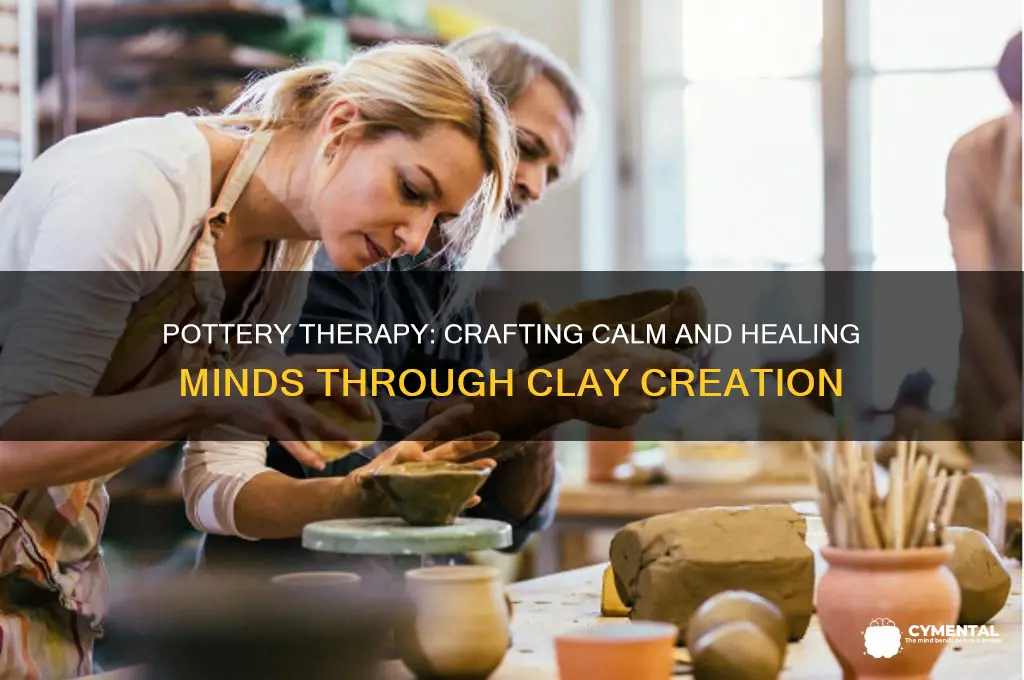
Pottery has emerged as a therapeutic and deeply beneficial activity for mental health, offering a unique blend of mindfulness, creativity, and tactile engagement. The process of shaping clay with one’s hands encourages a focus on the present moment, helping to quiet racing thoughts and reduce anxiety. The repetitive motions involved, such as centering clay on a wheel or smoothing surfaces, can induce a meditative state, promoting relaxation and stress relief. Additionally, the act of creating something tangible fosters a sense of accomplishment and self-expression, boosting self-esteem and providing an outlet for emotions. For many, pottery becomes a form of art therapy, allowing individuals to process complex feelings and experiences in a non-verbal, intuitive way. Its calming nature and the satisfaction of crafting something beautiful make pottery a powerful tool for improving mental well-being.
| Characteristics | Values |
|---|---|
| Stress Reduction | Engaging in pottery activates the parasympathetic nervous system, reducing cortisol levels and promoting relaxation. |
| Mindfulness | The tactile and repetitive nature of pottery encourages present-moment awareness, reducing anxiety and improving focus. |
| Creative Expression | Pottery provides an outlet for self-expression, helping individuals process emotions and enhance self-esteem. |
| Sensory Stimulation | Working with clay engages multiple senses, which can be grounding and therapeutic for individuals with sensory processing needs. |
| Achievement & Pride | Completing a pottery piece fosters a sense of accomplishment, boosting confidence and motivation. |
| Social Connection | Group pottery classes or workshops encourage social interaction, reducing feelings of isolation and fostering community. |
| Cognitive Benefits | Pottery improves hand-eye coordination, fine motor skills, and problem-solving abilities, supporting cognitive health. |
| Emotional Regulation | The rhythmic and meditative process of pottery helps regulate emotions and manage symptoms of depression or PTSD. |
| Therapeutic Focus | Pottery therapy is often used in clinical settings to address trauma, anxiety, and other mental health challenges. |
| Accessible Activity | Pottery is inclusive and can be adapted for individuals of all ages and skill levels, making it widely accessible. |
Explore related products


What You'll Learn
- Stress Relief: Clay molding reduces anxiety, promotes mindfulness, and provides a calming, therapeutic sensory experience
- Creative Expression: Crafting pottery fosters self-expression, boosts mood, and enhances emotional well-being through artistic freedom
- Focus & Mindfulness: Shaping clay demands concentration, grounding thoughts, and encouraging present-moment awareness for mental clarity
- Sense of Achievement: Completing pieces builds confidence, pride, and a tangible sense of accomplishment, uplifting self-esteem
- Social Connection: Group pottery classes reduce isolation, foster community, and provide supportive, shared creative experiences

Stress Relief: Clay molding reduces anxiety, promotes mindfulness, and provides a calming, therapeutic sensory experience
The simple act of molding clay between your fingers can be a powerful antidote to stress. This tactile experience engages the senses, drawing your focus away from anxious thoughts and grounding you in the present moment. Imagine the cool, pliable clay yielding to your touch, its texture a soothing contrast to the intangible worries cluttering your mind. This sensory immersion is a cornerstone of mindfulness, a practice proven to reduce anxiety and promote emotional well-being.
Studies suggest that engaging in activities like pottery can lower cortisol levels, the hormone associated with stress. A 2016 study published in the *Journal of Art Therapy* found that participants who engaged in clay work experienced significant reductions in anxiety and improvements in mood.
To harness the stress-relieving benefits of clay molding, start with a small amount of air-dry clay, roughly the size of your fist. Begin by simply kneading it, feeling its resistance and then its surrender to your touch. Gradually shape it, allowing your intuition to guide you. Don't worry about creating a masterpiece; focus on the process, the sensation of the clay, the rhythm of your movements. Aim for 20-30 minutes of uninterrupted clay time, ideally daily or several times a week, to experience the cumulative benefits.
For a deeper sensory experience, incorporate essential oils known for their calming properties, like lavender or chamomile, into your clay. The aroma will enhance the therapeutic effect, creating a multi-sensory haven of relaxation. Remember, the goal is not perfection but presence. Allow yourself to get lost in the tactile dance with the clay, letting go of worries and embracing the calming rhythm of creation.
Accessing Free Mental Health Support: Options and Resources Available
You may want to see also
Explore related products


Creative Expression: Crafting pottery fosters self-expression, boosts mood, and enhances emotional well-being through artistic freedom
Pottery, an ancient craft, offers a unique avenue for creative expression that goes beyond the mere act of shaping clay. It provides a therapeutic outlet, allowing individuals to communicate their emotions, thoughts, and experiences through a tactile and visual medium. This process of self-expression is inherently liberating, as it encourages the exploration of personal narratives and the manifestation of inner feelings into tangible forms.
The Art of Self-Discovery: Engaging in pottery can be a journey of self-discovery. As one's hands mold the clay, the mind often wanders into a meditative state, uncovering hidden emotions and thoughts. For instance, the simple act of centering clay on a potter's wheel demands focus and presence, quieting the mental noise and allowing for a deeper connection with one's inner self. This process can be particularly beneficial for those struggling with anxiety or stress, offering a momentary escape from overwhelming thoughts. A study published in the *Journal of Art Therapy* suggests that such creative activities can reduce cortisol levels, providing a physiological basis for the calming effect many potters experience.
Emotional Release and Mood Enhancement: The tactile nature of pottery provides a sensory experience that can be incredibly soothing. The feel of cool, wet clay between fingers, the resistance it offers, and the gradual transformation under one's touch can be a powerful emotional release. This sensory engagement stimulates the brain's reward system, releasing dopamine, often resulting in an improved mood. For individuals dealing with depression or emotional trauma, this can be a gentle yet effective way to encourage positive feelings. A weekly pottery session, for instance, could serve as a consistent mood booster, offering a sense of accomplishment and a tangible reminder of one's creativity.
Unleashing Creativity, Unlocking Freedom: Pottery as an art form is remarkably forgiving, allowing for experimentation and embracing imperfections. Unlike some other art forms, pottery encourages a playful approach, where mistakes can be reshaped, and each piece is uniquely individual. This freedom to create without the pressure of perfection is therapeutic, fostering a sense of artistic liberty. For beginners, starting with hand-building techniques like coil or slab building can be less intimidating than the potter's wheel, offering immediate gratification and a sense of achievement. As skills progress, the wheel can become a tool for more complex self-expression, where the challenge of mastering a new technique adds to the sense of accomplishment.
Incorporating pottery into one's routine as a form of creative expression can be a powerful tool for mental health. It provides a means to communicate, heal, and grow, all while engaging in a centuries-old craft. Whether it's a dedicated pottery class or a DIY home project, the benefits of this art form are accessible to all ages and skill levels, offering a unique and fulfilling way to enhance emotional well-being. The key lies in embracing the process, allowing the clay to become a medium for personal storytelling and emotional release.
Massage Therapy: Unlocking Mental Wellness and Stress Relief Naturally
You may want to see also
Explore related products



$14.65 $19.95


Focus & Mindfulness: Shaping clay demands concentration, grounding thoughts, and encouraging present-moment awareness for mental clarity
The act of shaping clay is a tactile meditation, a process that demands your full attention. Unlike activities that allow the mind to wander, pottery requires a deep focus on the here and now. The clay resists, yields, and responds to your touch, forcing you to be present in the moment. This immediate feedback loop between your hands and the material grounds your thoughts, pulling you away from the mental noise of daily life. For those struggling with anxiety or a racing mind, this forced concentration can be a powerful tool for mental clarity.
Consider the steps involved: centering the clay on the wheel, applying even pressure, and shaping it without letting it collapse. Each stage requires precision and mindfulness. Beginners often find themselves frustrated by the clay’s unpredictability, but this very challenge teaches patience and the importance of staying focused. Studies suggest that engaging in such focused activities for as little as 20 minutes a day can reduce stress levels by up to 30%. The repetitive motions of kneading, smoothing, and molding clay can induce a state similar to mindfulness meditation, calming the nervous system and promoting a sense of calm.
For those new to pottery, start with small, manageable projects. Hand-building techniques like coil pots or pinch pots are excellent entry points, as they require less technical skill but still demand attention to detail. Gradually move to the wheel, where the challenge of centering the clay becomes a metaphor for finding balance in life. Remember, the goal isn’t perfection but presence. Even if your piece doesn’t turn out as planned, the process itself is therapeutic. Keep a journal to reflect on how your focus shifts during each session—you may notice patterns that reveal how pottery is reshaping your mental habits.
Comparing pottery to other mindfulness practices, such as yoga or breathing exercises, highlights its unique benefits. While yoga focuses on the body and breath, pottery engages both the hands and the mind in a creative process. This dual engagement can be particularly beneficial for individuals who find traditional meditation too abstract or passive. The tangible result of your efforts—a bowl, a vase, or even a misshapen lump—provides a sense of accomplishment that reinforces the value of staying present. Unlike digital hobbies, pottery disconnects you from screens, offering a sensory experience that fully immerses you in the moment.
Finally, incorporate pottery into a routine for maximum benefit. Dedicate a specific time each week to this practice, treating it as a non-negotiable appointment with yourself. Create a workspace free from distractions, with soft lighting and perhaps calming music to enhance focus. For those with busy schedules, even 15 minutes of hand-building or sculpting can provide a mental reset. Over time, you’ll find that the skills of concentration and mindfulness cultivated through pottery begin to permeate other areas of life, improving focus at work, reducing reactivity in relationships, and fostering a deeper appreciation for the present moment.
Family Support: A Powerful Ally for Mental Health and Well-Being
You may want to see also
Explore related products


Sense of Achievement: Completing pieces builds confidence, pride, and a tangible sense of accomplishment, uplifting self-esteem
The act of shaping clay into a finished piece is a powerful metaphor for personal growth. Each stage of the process—wedging, centering, forming, glazing, and firing—mirrors the steps we take to refine ourselves. When a potter finally holds a completed mug, bowl, or vase, it’s more than an object; it’s a physical manifestation of patience, skill, and perseverance. This tangible result serves as a reminder that effort yields progress, a lesson that translates directly to mental health. In a world where many struggles feel abstract and unresolvable, pottery offers a concrete way to measure success, one piece at a time.
Consider the process of glazing, a step that often feels like a gamble. Will the colors blend as envisioned? Will the piece survive the kiln? When it emerges intact and beautiful, the sense of triumph is immediate. This micro-achievement triggers a release of dopamine, the brain’s reward chemical, reinforcing the connection between effort and positive outcomes. For individuals battling anxiety or depression, this cycle can be transformative. A study published in *Art Therapy: Journal of the American Art Therapy Association* found that participants who engaged in pottery reported higher levels of self-efficacy after just six weeks of consistent practice. The key? Regularity. Aim for at least two sessions per week to build momentum and maintain the psychological benefits.
Contrast pottery with digital hobbies, where progress is often measured in likes, shares, or levels cleared. These metrics are fleeting and subjective, whereas a finished ceramic piece is undeniably real. It can be held, gifted, or displayed—a constant reminder of capability. For teenagers and young adults, who often grapple with self-doubt, this can be particularly impactful. A high school ceramics class in Portland, Oregon, reported a 30% increase in student confidence levels over a semester, as measured by self-assessment surveys. Teachers noted that even students who initially struggled with the medium found pride in their final creations, no matter how imperfect.
To maximize this benefit, set realistic goals. Beginners might start with simple forms like pinch pots or coil bowls, gradually advancing to more complex projects. Keep a "progress journal" with photos of each piece, noting challenges overcome and skills learned. This visual record amplifies the sense of achievement, especially on days when motivation wanes. For those with busy schedules, even 30 minutes of daily hand-building can yield noticeable results over time. The goal isn’t perfection—it’s proof of progress.
Finally, share your work. Displaying a piece at home or gifting it to a loved one externalizes the accomplishment, making it socially validating. A community pottery studio in Austin, Texas, hosts monthly "brag nights," where members showcase their work and discuss their journeys. Participants report feeling not just pride in their creations, but also a deepened sense of belonging. This combination of personal and communal recognition amplifies the mental health benefits, turning pottery from a solitary craft into a shared celebration of resilience.
Skateboarding: A Powerful Tool for Boosting Mental Health and Wellness
You may want to see also
Explore related products


Social Connection: Group pottery classes reduce isolation, foster community, and provide supportive, shared creative experiences
Human beings are inherently social creatures, yet modern life often leaves us feeling disconnected. Group pottery classes offer a unique antidote to this isolation by creating a space where individuals can connect through shared creative experiences. Unlike solitary hobbies, pottery in a group setting encourages interaction, whether through collaborative projects, casual conversations, or mutual encouragement. This dynamic fosters a sense of belonging, as participants bond over the challenges and triumphs of shaping clay into art. For those struggling with loneliness or social anxiety, these classes provide a low-pressure environment to engage with others, gradually building confidence and relationships.
Consider the structure of a typical group pottery class: participants gather around communal tables, each working on their own piece but within arm’s reach of others. Instructors often facilitate icebreakers or group critiques, prompting dialogue and feedback. This setup naturally encourages interaction, as questions like “How did you achieve that texture?” or “What inspired your design?” become common. Over time, these exchanges evolve into deeper conversations, transforming a room of strangers into a supportive community. Research suggests that such social engagement can reduce symptoms of depression and anxiety, as the act of creating alongside others releases oxytocin, the “bonding hormone,” which promotes feelings of trust and connection.
For maximum benefit, aim to attend group pottery classes at least once a week for a minimum of six weeks. This frequency allows enough time to build familiarity with both the craft and the people around you. If you’re new to pottery, start with beginner-friendly classes that focus on hand-building techniques, as these are less intimidating than wheel-throwing. Bring a notebook to jot down ideas or reflections, and don’t hesitate to share your progress with the group—vulnerability often sparks deeper connections. For older adults or individuals with limited mobility, look for classes tailored to specific age groups or physical needs, ensuring accessibility and comfort.
One compelling example of pottery’s social impact is its use in community centers for marginalized populations, such as refugees or individuals recovering from addiction. In these settings, pottery becomes more than a hobby; it’s a tool for rebuilding social networks and restoring a sense of purpose. Participants often report feeling “seen” and “heard” for the first time in years, as the act of creating together transcends language and cultural barriers. This transformative potential highlights why group pottery classes are not just about making art—they’re about making connections that heal.
Incorporating group pottery into your routine requires minimal investment but yields significant returns. Most studios offer affordable class packages or drop-in rates, and many provide all necessary materials. To enhance the experience, consider joining or forming a “pottery buddy” system, where you and a classmate commit to attending sessions together. This accountability not only ensures consistency but also deepens your bond. Ultimately, group pottery classes remind us that creativity thrives in community, and in that shared space, isolation loses its grip.
Plastic Surgery's Impact: Boosting Mental Health and Self-Confidence
You may want to see also
Frequently asked questions
Pottery engages the mind and body in a calming, repetitive process, such as centering clay on the wheel or hand-building. This mindfulness-like activity reduces stress by focusing attention on the present moment, lowering cortisol levels, and promoting relaxation.
Yes, the creative process of pottery stimulates the release of dopamine, a neurotransmitter associated with pleasure and reward. Completing a piece also boosts self-esteem and provides a sense of accomplishment, enhancing overall mood and emotional satisfaction.
Pottery is often used as a complementary therapy for conditions like depression and PTSD. Its tactile nature provides a grounding sensory experience, while the act of creating can help process emotions and trauma. Many find it a safe, non-verbal way to express themselves and foster healing.