Noah Parker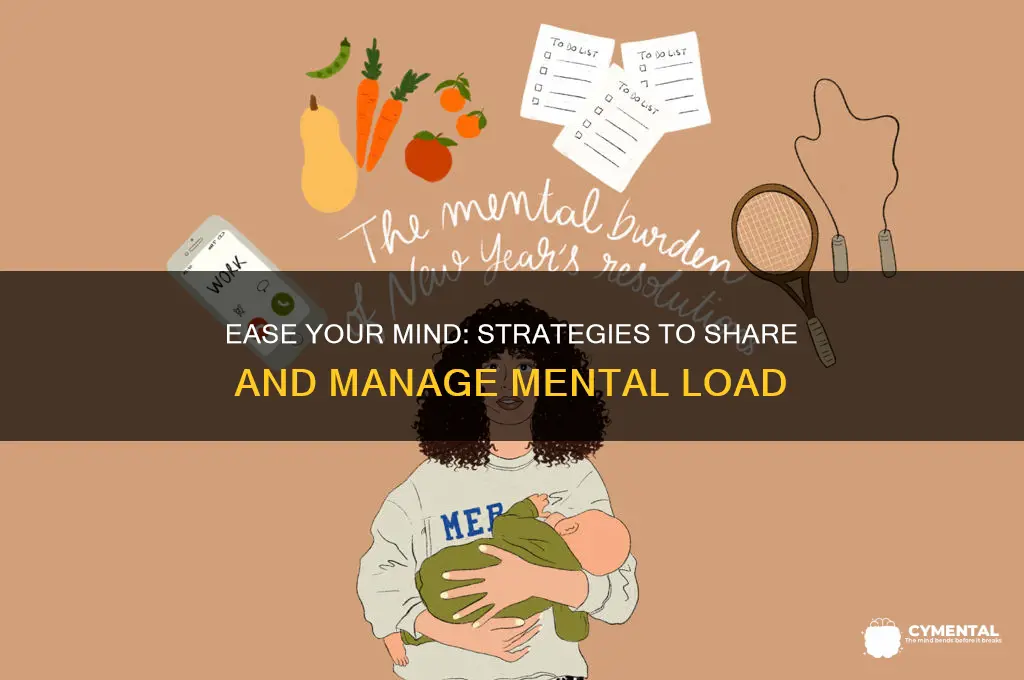
Managing the mental load—the invisible work of planning, organizing, and remembering daily tasks—can feel overwhelming, especially when it’s unevenly distributed in relationships or households. Whether it’s juggling work, family responsibilities, or personal commitments, the constant mental strain can lead to burnout and stress. Recognizing the need for support is the first step toward alleviating this burden. Strategies such as open communication, shared responsibility, and leveraging tools like calendars or task-sharing apps can help distribute the load more equitably. Additionally, seeking external resources, such as therapy, support groups, or time management workshops, can provide valuable insights and coping mechanisms. By addressing the mental load proactively and collaboratively, individuals can reclaim mental space, reduce stress, and foster healthier, more balanced lives.
Explore related products


What You'll Learn
- Delegate Tasks Effectively: Share responsibilities with partners, family, or colleagues to lighten your mental burden
- Prioritize Self-Care: Schedule time for rest, hobbies, and relaxation to maintain mental and emotional balance
- Use Tools & Systems: Leverage apps, calendars, and lists to organize tasks and reduce mental tracking
- Communicate Needs Clearly: Express your feelings and boundaries to ensure others understand and support you
- Seek Professional Support: Consult therapists or coaches for strategies to manage and reduce mental load

Delegate Tasks Effectively: Share responsibilities with partners, family, or colleagues to lighten your mental burden
Delegation is not a sign of weakness but a strategic move to reclaim mental space. By sharing responsibilities, you acknowledge that no one person can—or should—carry the entire load. Start by identifying tasks that others can handle, even if they don’t do them exactly as you would. Perfectionism often fuels the mental load; letting go of control is the first step to relief. For instance, if your partner can manage grocery shopping but doesn’t organize the pantry the way you prefer, focus on the outcome (stocked shelves) rather than the process. This shift in mindset frees up cognitive energy for tasks that truly require your attention.
Effective delegation requires clear communication and realistic expectations. Break tasks into actionable steps and explain their importance to ensure accountability. For example, instead of saying, “Can you help with the kids?” specify, “Can you handle bedtime routines on Tuesdays and Thursdays so I can focus on meal prep?” Similarly, in a workplace setting, assign tasks based on strengths and interests. If a colleague excels at data analysis, delegate that aspect of a project and trust them to deliver. Ambiguity breeds mental clutter, so be precise about what, when, and how tasks should be completed.
One common pitfall in delegation is the tendency to micromanage or mentally track progress. To avoid this, establish check-in points rather than constant oversight. For instance, with family members, set a weekly family meeting to review responsibilities and address any issues. In professional settings, use project management tools like Trello or Asana to track progress without hovering. This not only reduces your mental burden but also fosters independence and ownership in those you’re delegating to.
Finally, delegation is a skill that improves with practice and feedback. After tasks are completed, reflect on what worked and what didn’t. Did the task get done efficiently? Were there misunderstandings? Use these insights to refine your approach. For example, if a delegated task consistently falls through the cracks, consider whether the person is overburdened or if the task needs to be reassigned. Over time, this iterative process builds a system where responsibilities are shared equitably, and the mental load becomes a collective effort rather than a solitary struggle.
Designing Spaces: Architecture's Role in Enhancing Mental Well-being
You may want to see also
Explore related products


Prioritize Self-Care: Schedule time for rest, hobbies, and relaxation to maintain mental and emotional balance
The mental load often feels invisible, yet its weight is undeniable. It’s the constant hum of to-do lists, the mental juggling of responsibilities, and the emotional labor that drains energy reserves. Amid this, self-care isn’t a luxury—it’s a necessity. Scheduling time for rest, hobbies, and relaxation isn’t selfish; it’s strategic. Without it, the mental load becomes unmanageable, leading to burnout, irritability, and diminished productivity. Think of it as refueling a car: you wouldn’t drive on an empty tank, so why run your mind and body into the ground?
Step 1: Audit Your Time, Then Carve Out Space
Start by tracking how you spend your days. Use a journal or app to log activities for a week. Identify pockets of time that can be repurposed for self-care—even 15–30 minutes daily can make a difference. For instance, wake up 30 minutes earlier for meditation or reading, or use your lunch break for a walk instead of scrolling through emails. The key is intentionality: block this time in your calendar as non-negotiable. Treat it like a work meeting or doctor’s appointment—because your mental health deserves the same priority.
Caution: Avoid the Trap of “Productive” Self-Care
Self-care isn’t about optimizing or achieving. It’s not a yoga session to improve flexibility or journaling to boost creativity—though those are fine goals. True self-care is about disengaging from the mental load entirely. For example, instead of a structured hobby, try something mindless like doodling, listening to music, or staring at the sky. The goal is to let your brain rest, not add another task to your list. If your self-care feels like work, it’s not serving its purpose.
Comparative Insight: The “5-Minute Rule” vs. “Deep Rest”
For those who claim they have no time, start with the “5-Minute Rule”: dedicate just 5 minutes daily to something purely enjoyable, like sipping tea or stretching. This micro-dose of self-care can reset your mindset. Conversely, aim for “deep rest” weekly—a 1–2 hour block where you disconnect completely. Turn off notifications, delegate tasks, and immerse yourself in a hobby or relaxation activity. Studies show that even short breaks improve focus and reduce stress, while longer periods of rest enhance emotional resilience.
Practical Tip: Create a Self-Care Menu
Variety keeps self-care sustainable. Make a list of activities you enjoy, categorized by time commitment (5 minutes, 30 minutes, 1 hour+). Examples: deep breathing exercises, painting, dancing, or taking a bath. When you feel overwhelmed, refer to your menu and choose an activity that fits your schedule. This prevents decision fatigue and ensures self-care becomes a habit, not a chore. Remember, the goal isn’t to tick a box—it’s to recharge and reclaim mental space.
Prioritizing self-care isn’t about indulging; it’s about equipping yourself to handle the mental load effectively. Think of it as sharpening a knife—regular maintenance ensures it cuts through tasks with ease. By scheduling rest, hobbies, and relaxation, you’re not escaping responsibility; you’re preparing to face it with clarity and energy. Start small, stay consistent, and watch how this practice transforms not just your mental load, but your overall quality of life.
Supporting Mental Challenges: Compassionate Guidance for Effective Assistance
You may want to see also
Explore related products


Use Tools & Systems: Leverage apps, calendars, and lists to organize tasks and reduce mental tracking
The human brain is not a hard drive with infinite storage. Every unwritten task, every looming deadline, and every "I need to remember that" clutters our mental space, leaving less room for creativity, presence, and peace. This is where external tools become your allies in the battle against mental overload.
Think of apps, calendars, and lists as extensions of your mind, offloading the burden of remembering and organizing. A well-structured to-do list app like Todoist or Trello becomes your external brain, capturing tasks before they slip through the cracks. Shared family calendars, synced across devices, ensure everyone's schedules are visible, eliminating the constant mental juggling of "who needs to be where when?"
The key lies in finding tools that fit your lifestyle and preferences. For the visually inclined, Kanban-style apps like Trello offer a satisfying drag-and-drop interface, while minimalist lovers might prefer the simplicity of Google Keep. The goal is to create a system that feels intuitive, not another source of stress. Remember, the best tool is the one you'll actually use.
Start small. Don't try to overhaul your entire life in one go. Begin by offloading one recurring mental burden, like grocery shopping. Create a shared list with your partner, accessible on both phones. Watch the relief as the mental "milk, eggs, bread" loop fades away. Gradually expand your system, tackling one area at a time – work projects, household chores, personal goals.
While tools are powerful, they're not magic wands. Avoid the trap of over-complicating your system. Too many apps, color-coded categories, and intricate workflows can become a burden in themselves. Keep it simple, focusing on functionality over aesthetics. Regularly review and declutter your lists and calendars, ensuring they remain helpful tools, not digital graveyards of forgotten tasks.
By embracing these external systems, you free up precious mental real estate. You'll be amazed at the clarity and focus that emerges when your mind is no longer a cluttered desk drawer. Remember, delegating to tools isn't a sign of weakness; it's a strategic move towards a calmer, more organized, and ultimately more productive life.
Positive Reinforcement: A Powerful Tool to Combat Mental Illness?
You may want to see also
Explore related products


Communicate Needs Clearly: Express your feelings and boundaries to ensure others understand and support you
Effective communication is the cornerstone of sharing the mental load, yet it’s often where breakdowns occur. People aren’t mind readers, and assumptions breed resentment. Start by identifying specific tasks or responsibilities that overwhelm you, then articulate them clearly. Instead of vague statements like “I’m stressed,” say, “I’m handling all the household scheduling, and it’s taking up too much mental space. Can we split this?” Specificity leaves no room for misinterpretation and invites collaboration.
Consider the medium of communication. A face-to-face conversation may work for partners, but a shared family calendar with delegated tasks could be more effective for households. For example, a weekly check-in meeting where everyone reviews their responsibilities and discusses pain points can prevent mental overload. Pair this with visual aids, like a whiteboard or digital tool, to make expectations tangible. The goal is to create a system where needs are communicated proactively, not reactively.
Boundaries are equally critical. Without them, the mental load can creep back in. For instance, if you’ve agreed that your partner will handle school pickups, resist the urge to remind them or double-check their plans. Trusting others to take ownership is part of the process. If they falter, address it directly but constructively: “I noticed you forgot to pick up the kids yesterday. How can we ensure this doesn’t happen again?” This approach reinforces accountability without undermining their role.
Finally, emotional honesty is non-negotiable. Expressing feelings like frustration or exhaustion isn’t complaining—it’s data. For example, saying, “I feel drained because I’m managing both work deadlines and meal planning,” provides insight into your experience. Pair this with a solution-focused ask: “Could you take over meal planning this week?” This balances vulnerability with action, fostering empathy and shared responsibility. Clear communication isn’t just about words; it’s about creating a culture of mutual support.
Psychiatrists: Expert Mental Health Support for Healing and Recovery
You may want to see also
Explore related products


Seek Professional Support: Consult therapists or coaches for strategies to manage and reduce mental load
Professional support can be a game-changer for those overwhelmed by the mental load, offering tailored strategies that go beyond generic self-help advice. Therapists and coaches specialize in unpacking the psychological and emotional weight individuals carry, often identifying underlying patterns that contribute to the burden. For instance, cognitive-behavioral therapy (CBT) is a proven method for reshaping thought processes, helping clients distinguish between urgent tasks and mental clutter. A therapist might guide a client through exercises like cognitive reframing, where overwhelming responsibilities are broken into manageable steps, reducing the sense of being constantly on edge.
While therapy addresses the root causes, coaching provides actionable tools for immediate relief. A mental load coach, for example, might introduce time-blocking techniques or delegation frameworks tailored to a client’s lifestyle. Imagine a working parent who feels responsible for every household detail; a coach could help them implement a shared family calendar or teach them to communicate expectations clearly, lightening the invisible labor. Unlike DIY approaches, coaches offer accountability, ensuring strategies are not just adopted but sustained over time.
One common misconception is that seeking professional help is a last resort or a sign of failure. In reality, it’s a proactive step toward reclaiming mental space. Consider this: just as physical trainers optimize physical health, mental health professionals optimize cognitive and emotional resilience. For instance, a therapist might recommend mindfulness practices, such as 10-minute daily meditations, to reduce mental noise, while a coach could suggest a “brain dump” exercise—writing down all pending tasks to externalize them and regain focus.
However, not all professionals are created equal. When choosing a therapist or coach, look for specialization in stress management, burnout, or cognitive overload. Credentials matter—licensed therapists (e.g., LPC, LCSW) and certified coaches (e.g., ICF accreditation) ensure evidence-based practices. Cost and accessibility are practical considerations; many professionals offer sliding scales or virtual sessions, making support more attainable. Think of it as an investment in long-term well-being, not a temporary fix.
Ultimately, professional support provides a structured path to managing mental load, combining insight with action. It’s not about eliminating responsibilities but redefining how they’re carried. By working with an expert, individuals can uncover personalized solutions, from boundary-setting techniques to emotional regulation tools. The takeaway? You don’t have to navigate the mental load alone—professional guidance can transform it from a crushing weight into a manageable, even balanced, part of life.
Early Intervention: Transforming Mental Health Outcomes and Building Resilience
You may want to see also
Frequently asked questions
The mental load refers to the invisible work of managing, planning, and organizing daily life, often disproportionately carried by one person in a household or relationship. It’s important to address it because it can lead to burnout, stress, and inequality if left unbalanced.
Use clear, non-accusatory language to explain how the mental load affects you. Share specific examples of tasks you manage and suggest ways to distribute responsibilities more evenly. Tools like shared calendars or task lists can also help visualize the workload.
Start by listing all tasks and responsibilities, then divide them fairly among household members. Automate or simplify tasks where possible (e.g., meal planning apps, recurring grocery deliveries). Regularly check in to ensure the distribution remains equitable.
Prioritize self-care and set boundaries to avoid overloading yourself. Delegate tasks when possible, even if it means letting go of perfection. Seek support from friends, family, or professionals, and consider therapy to address stress and overwhelm.