Madison Cole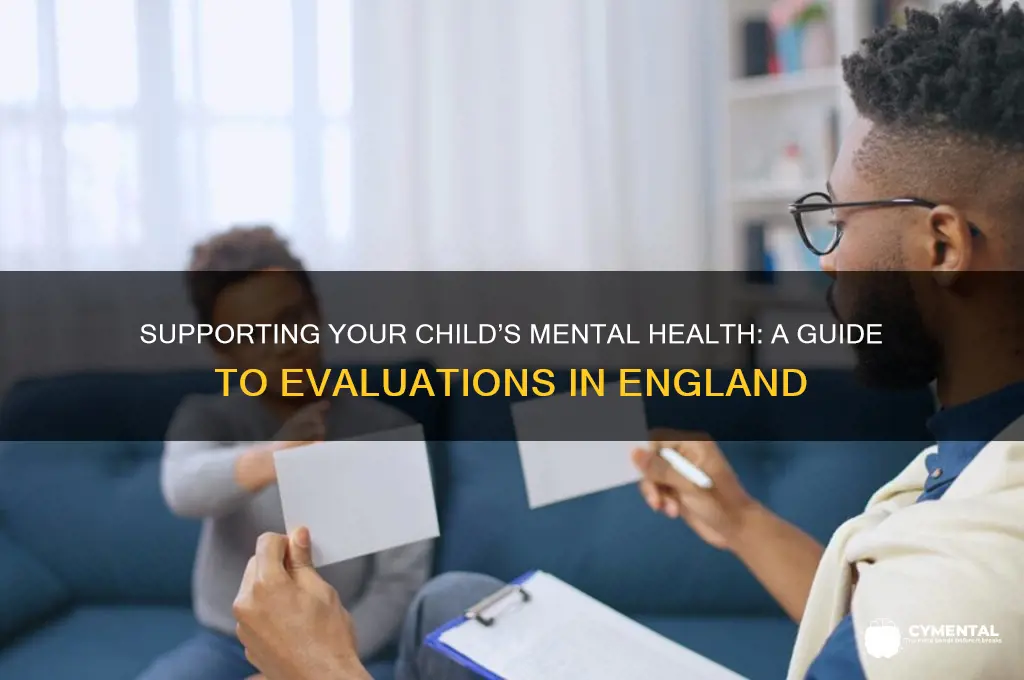
In England, supporting a child through a mental health evaluation is a crucial step in ensuring they receive the appropriate care and support. The process begins with recognizing signs of mental health issues, such as persistent changes in behavior, mood, or academic performance. Parents or guardians can start by consulting the child’s school or a trusted healthcare professional, such as a GP, who can provide guidance and referrals. The NHS offers Child and Adolescent Mental Health Services (CAMHS), which specialize in assessing and treating young people’s mental health needs. To access these services, a referral is typically required, often initiated by a GP, school nurse, or other healthcare provider. Early intervention is key, so it’s important to act promptly and maintain open communication with the child throughout the process, ensuring they feel supported and understood.
Explore related products


$68.61 $109.99


What You'll Learn
- Finding a Qualified Professional: Locate NHS CAMHS or private psychologists/psychiatrists for child mental health assessments
- Referral Process: Obtain referrals from GPs, schools, or self-refer to CAMHS services
- Assessment Types: Understand different evaluations: cognitive, emotional, behavioral, or developmental assessments
- Preparing Your Child: Explain the process simply, reassure, and encourage honesty during evaluation
- Post-Assessment Support: Access therapy, school support, or medication based on evaluation outcomes

Finding a Qualified Professional: Locate NHS CAMHS or private psychologists/psychiatrists for child mental health assessments
In England, accessing mental health services for children often begins with identifying the right professional. The NHS’s Child and Adolescent Mental Health Services (CAMHS) is the primary gateway, offering assessments and treatments for children up to 18 years old. However, long waiting times—sometimes exceeding 12 weeks—can delay critical support. For urgent cases, private psychologists or psychiatrists provide faster access, though costs typically range from £150 to £300 per session. Understanding these options ensures you can choose the best pathway for your child’s needs.
To locate NHS CAMHS, start by consulting your child’s GP or school nurse, who can refer you directly. Alternatively, self-referral is possible in some areas via local CAMHS websites or helplines. Be prepared to provide details about your child’s symptoms, age, and any previous interventions. While CAMHS is free, its multidisciplinary teams—including psychologists, psychiatrists, and therapists—may offer limited session numbers due to high demand. Persistence is key; follow up regularly to ensure your referral progresses.
Private practitioners offer flexibility and shorter wait times but require careful vetting. Use the British Psychological Society (BPS) or Royal College of Psychiatrists directories to find accredited professionals specializing in child mental health. During initial consultations, ask about their experience with your child’s age group (e.g., early years, teens) and specific concerns (anxiety, ADHD, etc.). Some private providers also offer diagnostic assessments, such as ADOS for autism, which can cost £1,000–£2,000 but provide comprehensive insights.
When deciding between NHS and private routes, consider your child’s urgency of need, your financial situation, and the severity of their symptoms. For mild to moderate issues, CAMHS may suffice, while private care is ideal for complex or immediate cases. Combining both—using CAMHS for long-term support and private services for quick assessments—can also be effective. Whichever route you choose, early intervention remains crucial for positive outcomes.
Finally, remember that finding the right professional is just the first step. Building a trusting relationship with the practitioner is essential for effective treatment. Involve your child in the process where appropriate, ensuring they feel heard and supported. With the right guidance, whether through CAMHS or private care, you can help your child navigate their mental health journey with confidence.
Neuroscience Unveils the Brain's Role in Mental Health Insights
You may want to see also
Explore related products

$12.86 $15.95

$130 $136


Referral Process: Obtain referrals from GPs, schools, or self-refer to CAMHS services
In England, the first step to accessing mental health support for a child often involves obtaining a referral to Child and Adolescent Mental Health Services (CAMHS). This process can be initiated through three primary routes: via a General Practitioner (GP), a school, or self-referral. Each pathway has its own nuances, and understanding these can streamline the journey toward evaluation and support.
GP Referral: The Clinical Gateway
GPs serve as the first point of contact within the NHS for mental health concerns. When approaching a GP, provide specific examples of the child’s behavior, emotions, or challenges, as this helps the GP assess the severity and urgency of the case. GPs may conduct an initial assessment, offer advice, or refer directly to CAMHS if they deem it necessary. For children under 16, a parent or guardian typically attends the appointment, though older teenagers may be seen alone if they prefer. GPs can also signpost to other services, such as counseling or support groups, while the CAMHS referral is processed. Practical tip: Write down key concerns beforehand to ensure nothing is overlooked during the appointment.
School Referral: The Educational Perspective
Schools play a vital role in identifying mental health issues, particularly for children aged 5–16 who spend a significant portion of their time in educational settings. Teachers, special educational needs coordinators (SENCOs), or school counselors may notice signs of distress, such as withdrawal, aggression, or declining academic performance. If a school initiates a referral, they will typically liaise with parents or guardians to gather additional information and obtain consent. Schools often use standardized tools, like the Strengths and Difficulties Questionnaire (SDQ), to assess a child’s emotional and behavioral needs before making a referral. Caution: Schools cannot refer without parental consent, so collaboration is essential.
Self-Referral: Taking Control of the Process
Not all families rely on GPs or schools to access CAMHS. Self-referral is an option in some areas, allowing parents, guardians, or young people aged 16+ to contact CAMHS directly. This route can be particularly useful if a GP or school referral feels too slow or if the child’s needs are not being recognized. To self-refer, locate the local CAMHS service (often via the NHS website or local clinical commissioning group) and follow their specific instructions, which may include completing an online form or calling a dedicated helpline. Be prepared to provide detailed information about the child’s symptoms, history, and current support systems. Takeaway: Self-referral empowers families to act proactively, but it requires persistence and clarity in communication.
Comparing the Routes: Which is Best?
The choice of referral route depends on the child’s needs, the urgency of the situation, and the family’s relationship with existing support systems. GP referrals are ideal for cases with clear medical or clinical components, while school referrals are valuable when behavioral or academic issues are prominent. Self-referral suits families who feel equipped to navigate the system independently or when other routes have been unsuccessful. Regardless of the pathway, early action is key. CAMHS services often have waiting lists, so initiating the referral process promptly can reduce delays in accessing support. Practical tip: Keep a record of all communications and referrals to track progress and ensure nothing falls through the cracks.
By understanding and utilizing these referral pathways, families and caregivers can effectively navigate the system to secure the mental health evaluation and support their child needs.
Meditation's Impact: Enhancing Mental Health and Emotional Well-being
You may want to see also
Explore related products


Assessment Types: Understand different evaluations: cognitive, emotional, behavioral, or developmental assessments
Children exhibit a wide range of behaviors and abilities, making it crucial to identify the right type of mental health assessment for their needs. Understanding the distinctions between cognitive, emotional, behavioral, and developmental evaluations is the first step in ensuring your child receives appropriate support. Each assessment type focuses on specific aspects of a child's functioning, providing valuable insights for tailored interventions.
Cognitive Assessments: Unlocking Intellectual Potential
Cognitive assessments measure a child’s thinking, reasoning, and problem-solving abilities. Typically administered by educational psychologists or clinical psychologists, these evaluations use tools like the Wechsler Intelligence Scale for Children (WISC-V), suitable for ages 6 to 16. The WISC-V assesses verbal comprehension, visual spatial skills, fluid reasoning, working memory, and processing speed. For younger children (ages 2.5 to 7), the Wechsler Preschool and Primary Scale of Intelligence (WPPSI-IV) is often used. These assessments help identify learning difficulties, intellectual giftedness, or developmental delays, guiding educational planning and interventions.
Emotional Assessments: Mapping the Inner World
Emotional assessments focus on a child’s feelings, mood, and psychological well-being. Tools like the Strengths and Difficulties Questionnaire (SDQ) for ages 4 to 17 or the Child Depression Inventory (CDI) for ages 7 to 17 are commonly used. These evaluations often involve interviews, questionnaires, and observational data from parents, teachers, and the child. Emotional assessments are critical for diagnosing conditions like anxiety, depression, or trauma, enabling targeted therapeutic interventions such as cognitive-behavioral therapy (CBT) or play therapy.
Behavioral Assessments: Observing Actions and Patterns
Behavioral assessments examine a child’s observable actions and reactions in various settings. Functional Behavior Assessments (FBA) are frequently used to identify triggers for challenging behaviors, such as aggression or withdrawal. This process involves direct observation, interviews, and data collection over time. For example, a child with autism may undergo an FBA to understand the root cause of repetitive behaviors. Behavioral assessments often lead to behavior management plans, which may include positive reinforcement strategies or environmental modifications.
Developmental Assessments: Tracking Growth Milestones
Developmental assessments evaluate a child’s progress in areas like speech, motor skills, social interaction, and self-care. The Ages and Stages Questionnaires (ASQ) for ages 1 month to 5 years and the Denver Developmental Screening Test (DDST) are widely used tools. These assessments are particularly important for identifying delays early, allowing for timely interventions such as speech therapy or occupational therapy. For instance, a child struggling with fine motor skills might benefit from targeted exercises to improve handwriting.
Practical Tips for Parents
When seeking an assessment, consult your child’s school SENCO (Special Educational Needs Coordinator) or GP for referrals to NHS services or private practitioners. Keep a journal of observed behaviors, academic struggles, or emotional changes to provide detailed information during evaluations. Remember, the goal is not to label your child but to uncover their strengths and challenges, paving the way for effective support. Each assessment type offers a unique lens, ensuring a comprehensive understanding of your child’s mental health needs.
Shipping the Mentally Ill to California: Nevada's Controversial Solution
You may want to see also
Explore related products

$61.79

$350.72 $375


Preparing Your Child: Explain the process simply, reassure, and encourage honesty during evaluation
Children often mirror their parents’ anxieties, so your calm approach to a mental health evaluation sets the tone. Explain the process in age-appropriate terms: for younger children (under 8), liken it to a "check-up for feelings," while older children (8–12) might understand it as a "chat about thoughts and emotions." Avoid jargon like "assessment" or "diagnosis," which can sound intimidating. Instead, say, "Someone wants to hear about how you feel at school and at home." Use analogies they relate to—for instance, "It’s like telling a coach how you play in a game so they can help you improve."
Reassurance is key, but avoid empty promises like "Everything will be fine." Instead, validate their feelings: "It’s okay to feel nervous, but this is a good step to help us understand how to support you better." Emphasize that the evaluator is there to help, not judge. For children aged 10 and above, who may fear being labeled, clarify that this is about finding solutions, not assigning blame. Share a relatable example: "Remember when we adjusted your bedtime to help you feel more rested? This is similar—finding ways to make things easier for you."
Encouraging honesty requires creating a safe space. Let your child know that all their thoughts and feelings are important, even if they seem "silly" or "bad." Use phrases like, "The more you share, the better they can help us figure things out." For younger children, practice role-playing at home: "Let’s pretend I’m the evaluator, and you can tell me how you feel about going to school." For teenagers, acknowledge their desire for privacy but stress that honesty helps tailor the right support. Remind them, "This is about getting the help you need, not about anyone being in trouble."
Finally, prepare them for what to expect during the evaluation. Mention that there might be questions, drawings, or games, depending on their age. For children under 12, bring a comfort item like a toy or blanket to the session. For older children, suggest writing down thoughts beforehand if they fear forgetting. End with a positive note: "This is a brave step, and I’m proud of you for doing it." Your tone and confidence will reassure them that this process is manageable and beneficial.
Capturing Moments: How Photography Boosts Mental Well-Being and Healing
You may want to see also
Explore related products



Post-Assessment Support: Access therapy, school support, or medication based on evaluation outcomes
Following a mental health evaluation, the journey towards supporting a child’s well-being is just beginning. The post-assessment phase is critical, as it determines the tailored interventions needed to address the identified challenges. Depending on the evaluation outcomes, options may include therapy, school-based support, or medication, each serving distinct purposes and requiring careful consideration.
Therapy stands as a cornerstone of post-assessment support, offering children a safe space to explore their emotions, develop coping strategies, and build resilience. Cognitive Behavioral Therapy (CBT) is particularly effective for ages 5–18, focusing on identifying and changing negative thought patterns. For younger children, play therapy can be transformative, using toys and games to communicate feelings they may not yet articulate. Parents should inquire about the therapist’s experience with the child’s specific age group and condition, ensuring a good fit. Sessions typically last 45–60 minutes, with frequency ranging from weekly to monthly, depending on severity.
School support is another vital component, often overlooked but essential for academic and social success. Following an evaluation, parents can request an Education, Health and Care (EHC) plan, which outlines the child’s needs and the school’s responsibilities. This may include one-on-one support, adjusted testing conditions, or access to a school counselor. Collaboration between parents, teachers, and mental health professionals ensures consistency in strategies, such as using visual aids for children with ADHD or creating a "calm corner" for those prone to anxiety.
Medication is sometimes recommended, particularly for conditions like severe anxiety, depression, or ADHD, when therapy and environmental adjustments alone are insufficient. For ADHD, methylphenidate (e.g., Ritalin) is commonly prescribed for children over 6, starting at low doses (5–10 mg) and adjusted based on response. Antidepressants like fluoxetine may be considered for adolescents, but close monitoring is essential due to potential side effects. Parents should weigh the benefits against risks, consult a child psychiatrist, and ensure regular follow-ups to assess efficacy and adjust dosages as needed.
Practical tips for navigating post-assessment support include maintaining open communication with all stakeholders, from therapists to teachers, to ensure a unified approach. Keep a journal to track the child’s progress and any side effects from medication. Advocate for your child by staying informed about their rights under the UK’s mental health and education frameworks. Finally, remember that flexibility is key—what works initially may need adjustment over time as the child grows and their needs evolve.
Daily Exercise: A Powerful Tool to Prevent Mental Illness?
You may want to see also
Frequently asked questions
Look for persistent changes in behavior, mood, or performance, such as withdrawal, aggression, difficulty concentrating, or signs of anxiety or depression. If you’re concerned, consult your GP or school for advice.
Your child’s GP, school nurse, teacher, or a health visitor can refer them to Child and Adolescent Mental Health Services (CAMHS). You can also self-refer in some areas.
The process typically includes an initial assessment by CAMHS, which may involve discussions with your child, you, and sometimes school staff. Assessments may include questionnaires, observations, and referrals for further specialist evaluations if needed.
Waiting times vary by area and urgency. Routine referrals may take several weeks to months, while urgent cases are prioritized. Contact your local CAMHS or NHS trust for specific timelines.