Ava Ramirez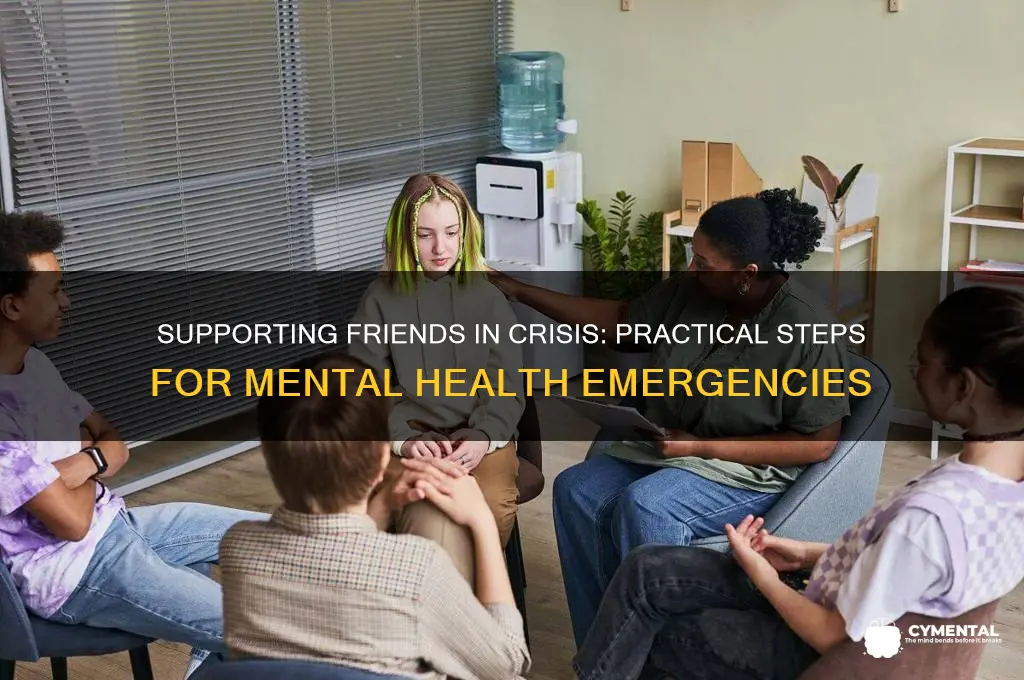
Helping a friend in a mental health crisis requires empathy, patience, and proactive support. Start by creating a safe, non-judgmental space for them to express their feelings, actively listening without interrupting or offering quick fixes. Encourage them to seek professional help, such as contacting a therapist or crisis hotline, and offer to accompany them if they feel overwhelmed. Be mindful of their boundaries while gently reminding them of coping strategies or self-care practices they’ve found helpful in the past. Avoid minimizing their struggles or pressuring them to “snap out of it,” and instead, validate their emotions and reassure them that they are not alone. Stay connected, check in regularly, and prioritize your own well-being to avoid burnout while supporting them through this challenging time.
Explore related products


What You'll Learn
- Listen Actively, Non-Judgmentally: Create a safe space for your friend to express their feelings openly
- Encourage Professional Help: Gently suggest therapy, hotlines, or mental health resources tailored to their needs
- Stay Present and Calm: Maintain composure to provide stability and reassurance during their distress
- Remove Immediate Dangers: Ensure their physical safety by addressing any risks or harmful situations
- Follow Up Consistently: Check in regularly to show ongoing support and care after the crisis

Listen Actively, Non-Judgmentally: Create a safe space for your friend to express their feelings openly
One of the most powerful ways to support a friend in a mental health crisis is to simply listen. Not the distracted, half-attentive listening we often default to, but active, non-judgmental listening that creates a safe space for them to unravel their thoughts and emotions. This means putting aside your phone, making eye contact (if culturally appropriate), and giving your undivided attention. It’s about being fully present, not just physically, but emotionally, signaling to your friend that their feelings matter and that they’re not alone.
Active listening involves more than silence; it requires engagement. Reflect back what you hear to show understanding: “It sounds like you’re feeling overwhelmed by everything right now.” Avoid interrupting or jumping to solutions. Instead, use open-ended questions like, “How has this been affecting you?” or “What’s been the hardest part for you?” These questions invite your friend to explore their feelings further, rather than shutting down the conversation. Remember, your role isn’t to fix their crisis but to provide a safe, non-judgmental space where they can express themselves without fear of criticism or dismissal.
Creating this safe space also means being mindful of your language and reactions. Phrases like “You’ll get over it” or “It could be worse” can minimize their experience and shut down communication. Instead, validate their emotions with statements like, “It makes sense that you’re feeling this way” or “I can see how difficult this is for you.” Be cautious with humor or personal anecdotes; while well-intentioned, they can unintentionally shift the focus away from your friend’s experience. The goal is to keep the conversation centered on them, not on your perspective or advice.
Practical tips can enhance your ability to listen actively. For instance, practice patience—allow pauses in the conversation without feeling the need to fill the silence. Sometimes, just sitting quietly with your friend can be more comforting than words. Additionally, be aware of your body language. Leaning in slightly, nodding, and maintaining an open posture can reinforce that you’re engaged and supportive. If the conversation becomes emotionally intense, take a deep breath and remain calm; your composure can help stabilize the situation.
Ultimately, active, non-judgmental listening is a form of emotional first aid. It doesn’t require expertise, just empathy and presence. By creating a safe space for your friend to express their feelings openly, you’re helping them feel seen, heard, and understood—a critical step in navigating a mental health crisis. This simple yet profound act can provide the foundation they need to seek further help or begin their journey toward healing.
Supporting Mental Health: Effective Ways to Help Someone in Need
You may want to see also
Explore related products




Encourage Professional Help: Gently suggest therapy, hotlines, or mental health resources tailored to their needs
Professional help can be a lifeline for someone in a mental health crisis, yet suggesting it requires sensitivity and tact. Start by acknowledging their struggle without judgment—phrases like “It sounds like you’re going through a lot, and I’m here for you” create a safe space for openness. Avoid pushing therapy or hotlines as a quick fix; instead, frame these resources as tools for support, emphasizing their effectiveness in similar situations. For instance, mention how therapy helped a mutual friend or how hotlines provided immediate relief during moments of overwhelm. This approach normalizes seeking help while respecting their autonomy.
Tailoring your suggestion to their needs is crucial. Research local or online resources beforehand, such as therapists specializing in their specific concerns (e.g., anxiety, trauma, or LGBTQ+ issues) or hotlines like the Crisis Text Line (text HOME to 741741) for real-time support. If they’re hesitant, offer to help them find a provider or even accompany them to the first appointment. Practical barriers like cost or accessibility often deter people, so suggest sliding-scale clinics, telehealth options, or apps like BetterHelp or Talkspace for affordable, flexible care. Specificity shows you’ve put thought into their situation, making the suggestion feel less generic and more actionable.
A comparative approach can also be persuasive. Contrast the temporary relief of self-soothing methods (e.g., binge-watching, sleeping) with the long-term benefits of professional guidance. For example, “While taking a break can help in the moment, therapy might give you tools to handle this in the future.” This highlights the value of sustained support without diminishing their current coping mechanisms. Similarly, compare the anonymity of a hotline to the judgment-free zone of a therapist’s office, helping them see the unique advantages of each resource.
Finally, be prepared for resistance. Some may fear stigma, doubt the effectiveness of therapy, or feel unworthy of help. Address these concerns empathetically, not argumentatively. Share statistics, like how 75% of people who try therapy report improvement, or personal anecdotes that humanize the process. If they remain hesitant, suggest starting small—a single session, a brief hotline call, or a mental health app trial. The goal isn’t to convince them instantly but to plant the seed of possibility, letting them know professional help is available when they’re ready.
Capturing Moments: How Photography Boosts Mental Well-Being and Healing
You may want to see also
Explore related products


Stay Present and Calm: Maintain composure to provide stability and reassurance during their distress
In the midst of a mental health crisis, your friend’s world may feel like it’s unraveling. Their emotions could be chaotic, their thoughts racing, and their sense of safety shattered. Amid this storm, your ability to stay present and calm becomes a lifeline. It’s not about suppressing their distress but about grounding yourself to provide a steady presence. Think of it as anchoring a boat in rough waters—your composure prevents the situation from escalating further. Panic or agitation from you can inadvertently amplify their anxiety, while calmness communicates safety and control.
To maintain this composure, start by regulating your own breathing. Inhale deeply for a count of four, hold for four, exhale for six. This activates your parasympathetic nervous system, reducing your stress response. Speak in a slow, even tone, using simple, reassuring phrases like, “I’m here with you,” or “We’ll figure this out together.” Avoid rushing to “fix” the situation or offering platitudes like “It’ll be okay.” Instead, acknowledge their pain with statements like, “This must feel overwhelming right now.” Validation, not solutions, is often what they need most in the moment.
Contrast this with the common mistake of mirroring their distress. If your friend is hyperventilating, for instance, resist the urge to show urgency. Instead, model calmness by saying, “Let’s take a slow breath together,” and demonstrate the technique. This not only helps them physiologically but also shifts the dynamic from chaos to cooperation. Similarly, maintain open but relaxed body language—no crossed arms or fidgeting. Sit at their level, not above them, to avoid appearing authoritative or distant.
A practical tip is to limit distractions. Turn off loud music, close unnecessary tabs on your phone, and focus solely on them. This signals that they have your undivided attention, which can be profoundly reassuring. If they’re dissociating or spiraling, gently guide them back to the present with sensory cues: “Feel the chair supporting you,” or “Notice the sound of my voice.” These grounding techniques, paired with your calm demeanor, can help stabilize their nervous system.
Ultimately, staying present and calm isn’t about being stoic or unemotional—it’s about being a consistent, non-judgmental presence. Your friend may not remember every word you say, but they’ll remember how you made them feel. By holding space with patience and composure, you offer them a temporary refuge from their turmoil. This act of quiet solidarity can be one of the most powerful ways to support someone in crisis.
Seeking Support: A Guide to Accessing Mental Health Assistance
You may want to see also
Explore related products

$6.99 $6.99


Remove Immediate Dangers: Ensure their physical safety by addressing any risks or harmful situations
In a mental health crisis, the environment can be as critical as the emotional state. A cluttered room with sharp objects, an unlocked medicine cabinet, or even a nearby balcony can pose immediate threats. Your first step is to scan the surroundings for potential hazards. Remove any weapons, medications, or tools that could be used for self-harm. If they’re in a precarious physical location, like a high ledge or busy street, gently guide them to a safer space. This isn’t about control—it’s about creating a buffer between their distress and potential harm.
Consider the scenario of a friend who’s expressed suicidal thoughts while sitting in a room with a visible bottle of prescription pills. Here, the immediate danger is clear. Calmly ask if you can secure the medication for their safety, and place it out of reach or take it to another room. If they resist, explain that it’s a temporary measure to help them think clearly. Similarly, if they’re holding a sharp object, suggest an activity that requires them to set it down, like drawing or writing, and discreetly move the item away. These actions must be done with empathy, not force, to avoid escalating their distress.
Physical safety also extends to their immediate needs. If they’re under the influence of substances, monitor for signs of overdose or severe impairment. For example, alcohol poisoning can be life-threatening if blood alcohol levels exceed 0.30%, so watch for symptoms like vomiting, seizures, or slowed breathing. In such cases, call emergency services immediately. Similarly, if they’ve taken an unknown substance, have the container or a description ready for medical professionals. Your role is to observe, act, and advocate for their well-being without judgment.
Finally, remember that removing immediate dangers isn’t a one-time task—it’s an ongoing assessment. As their emotional state shifts, so might the risks. For instance, a friend who initially seemed calm might suddenly become agitated and attempt to leave a safe space. Stay alert but non-confrontational; suggest a walk together instead of blocking their path. By prioritizing their physical safety, you create a foundation for addressing the deeper issues at hand, ensuring they have the chance to heal.
The Power of Friendship: Supporting Mental Health and Well-Being
You may want to see also
Explore related products

$8.81 $17.99

$27.32 $29.95


Follow Up Consistently: Check in regularly to show ongoing support and care after the crisis
A single conversation, no matter how supportive, is rarely enough to resolve a mental health crisis. The aftermath of such an event can leave your friend feeling vulnerable, isolated, and unsure of how to move forward. This is where consistent follow-up becomes crucial. It's a tangible demonstration of your commitment to their well-being, a safety net woven from regular check-ins and genuine concern.
Think of it as tending to a fragile plant. You wouldn't water it once and expect it to thrive. Consistent care, tailored to its needs, is what allows it to grow stronger. Similarly, your friend needs ongoing support to navigate the challenges that arise after a crisis.
The Art of the Check-In:
Don't fall into the trap of generic "How are you?" texts. Aim for specificity and sincerity. Reference something you discussed during the crisis, a shared interest, or a recent event in their life. For example, "I was thinking about what you said about feeling overwhelmed at work. How's that project going?" or "Remember that book you were excited about? Did you finish it?" This shows you've been listening and genuinely care about their individual experience.
Vary the frequency and method of your check-ins. A daily text might feel overwhelming, while a monthly phone call could seem distant. Aim for a balance – perhaps a weekly message, a bi-weekly video call, and occasional in-person meetings if possible. Consider their preferences and comfort level. Some people prefer the immediacy of texting, while others appreciate the intimacy of a voice call.
Beyond Words: Actions Speak Louder
Remember, support isn't just about words. Small gestures can speak volumes. Offer to accompany them to a therapy appointment, cook a meal together, or simply watch a movie. If they're comfortable, suggest activities that promote well-being, like going for a walk, practicing mindfulness, or engaging in a shared hobby. These actions demonstrate your willingness to be present and actively contribute to their healing process.
Navigating the Long Haul:
Be prepared for setbacks. Recovery isn't linear. There will be good days and bad days. Avoid judgment or frustration if they seem to be regressing. Instead, acknowledge their struggles and reaffirm your support. Remind them of their progress and encourage them to celebrate small victories.
Consistency is key. By showing up regularly, listening attentively, and offering practical support, you become a vital part of your friend's support network. Remember, you're not alone in this journey. Encourage them to seek professional help if needed, and take care of yourself as well. Supporting someone through a mental health crisis can be emotionally demanding, so ensure you have your own support system in place.
Literature's Healing Power: Enhancing Mental Health Through Reading and Reflection
You may want to see also
Frequently asked questions
Look for sudden or severe changes in behavior, mood, or functioning, such as extreme sadness, anxiety, withdrawal, or talk of self-harm. Trust your instincts—if something feels wrong, it’s worth addressing.
Be calm, empathetic, and non-judgmental. Let them know you care and are there to support them. Use phrases like, “I’m here for you,” or “How can I help?” Avoid minimizing their feelings or offering quick fixes.
Take their statements seriously and stay with them if possible. Encourage them to seek professional help, such as calling a crisis hotline or contacting a mental health professional. Do not leave them alone if they are at immediate risk.
Respect their boundaries but let them know you’re available when they’re ready. Continue to check in gently and encourage professional support. If they’re in danger, seek help from a trusted authority or crisis service.