Lucas Bennett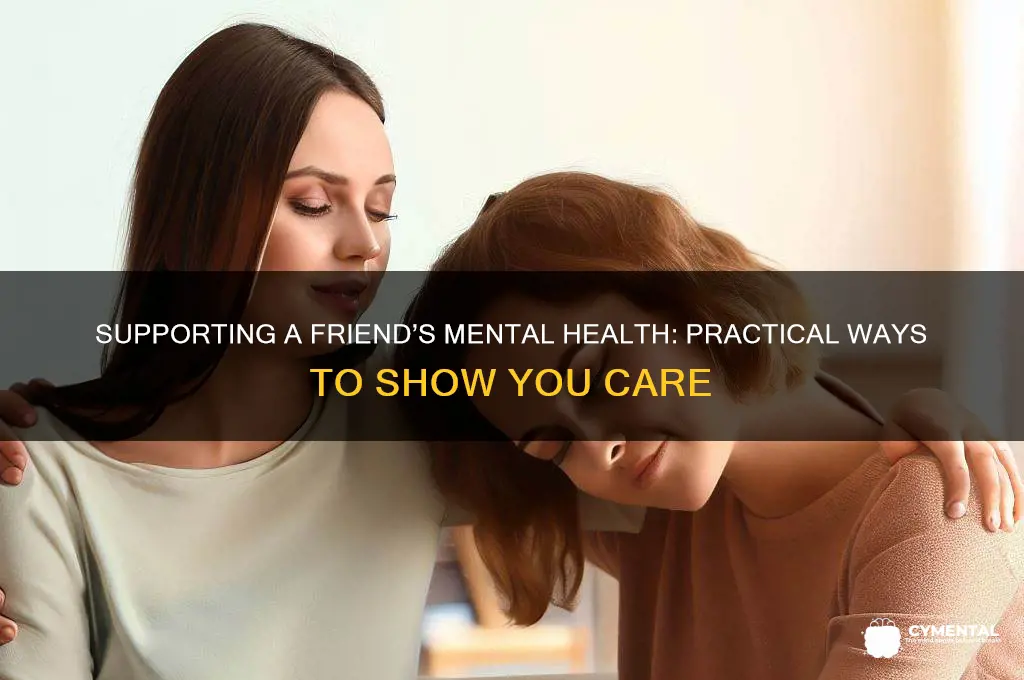
Supporting a friend’s mental health begins with active listening and empathy, creating a safe, non-judgmental space for them to express their feelings. Encourage open communication by asking how they’re doing and validating their emotions without trying to fix their problems. Educate yourself about their specific struggles, whether it’s anxiety, depression, or another condition, to better understand their experience. Offer practical help, such as accompanying them to appointments or simply spending time together, and remind them of available resources like therapy or helplines. Above all, be patient and consistent, as mental health challenges often require time and understanding. Your presence and support can make a significant difference in their journey toward healing.
Explore related products


What You'll Learn
- Listen Actively: Give undivided attention, avoid judgment, and validate their feelings without interrupting or offering solutions
- Encourage Professional Help: Gently suggest therapy or counseling, offering to help find resources or accompany them
- Check-In Regularly: Send messages, call, or visit consistently to show ongoing support and care
- Be Patient: Understand recovery takes time; avoid pressuring them to feel better quickly
- Promote Self-Care: Encourage healthy habits like exercise, sleep, and hobbies to boost their well-being

Listen Actively: Give undivided attention, avoid judgment, and validate their feelings without interrupting or offering solutions
Active listening is a cornerstone of supporting a friend’s mental health, yet it’s often misunderstood as mere silence. It’s not about waiting for your turn to speak but fully immersing yourself in their experience. When your friend shares their struggles, put away distractions—no phone, no mental to-do list. Maintain eye contact if you’re in person, or if it’s a call, avoid multitasking. Research shows that undivided attention releases oxytocin, the bonding hormone, which fosters trust and safety. This isn’t about being a therapist; it’s about being human. Your presence alone can communicate, “You’re not alone.”
Validation is the antidote to invalidation, a silent killer of self-worth. When your friend expresses feelings—whether it’s anxiety, sadness, or anger—resist the urge to minimize or rationalize. Phrases like “It could be worse” or “Just think positively” dismiss their reality. Instead, use reflective statements: “It sounds like you’re feeling overwhelmed,” or “That must be really hard for you.” Validation doesn’t mean agreeing; it means acknowledging their truth. Studies indicate that feeling heard reduces cortisol levels, easing emotional distress. It’s not about fixing; it’s about holding space.
Judgment, even subtle, can shut down a conversation faster than silence. Your friend might fear being labeled as “dramatic” or “weak,” so they’ll test the waters before fully opening up. Avoid reactions like raised eyebrows, sighs, or unsolicited advice. For example, if they confess to skipping work due to anxiety, don’t say, “You should just push through it.” Instead, ask open-ended questions: “What made that day particularly difficult?” Neutrality isn’t apathy; it’s respect. Your role isn’t to evaluate but to witness.
Interrupting—whether to offer solutions or share a similar story—derails the flow of trust. While your intentions might be good, it shifts the focus from their experience to yours. For instance, if they’re talking about a panic attack, resist saying, “I had something like that once…” Their story isn’t a cue for yours; it’s a plea for understanding. If you feel compelled to speak, pause and ask yourself, “Is this about them or me?” Let their narrative unfold without inserting your script. Patience isn’t passive; it’s powerful.
Active listening is a skill, not an instinct, and it requires practice. Start small: set aside 10 minutes daily to listen without interrupting. Notice your impulses—to fix, advise, or relate—and gently redirect your focus back to them. Over time, this practice becomes less about effort and more about empathy. Remember, you’re not their therapist, but you can be their anchor. In a world that rushes to solve, your willingness to simply listen can be revolutionary.
Mental Maps: Unlocking Cognitive Navigation and Spatial Understanding Benefits
You may want to see also
Explore related products


Encourage Professional Help: Gently suggest therapy or counseling, offering to help find resources or accompany them
Recognizing when a friend might benefit from professional mental health support is a delicate but crucial step in being a supportive ally. While you can offer a listening ear and emotional backing, there are times when the expertise of a trained therapist or counselor is necessary. These professionals provide structured, evidence-based interventions that can address underlying issues more effectively than casual conversations. However, suggesting therapy can feel intrusive if not approached thoughtfully. The key is to frame it as a collaborative, supportive gesture rather than a judgment or criticism.
Begin by normalizing the conversation around mental health and professional help. Share anecdotes or statistics that highlight the prevalence and effectiveness of therapy. For instance, studies show that 75% of individuals who engage in therapy experience significant improvement in their mental health. You might say, "I’ve heard from a lot of people that talking to a therapist can really help when things feel overwhelming. It’s not just about big problems—it’s about having a space to work through anything." This approach reduces stigma and positions therapy as a common, accessible resource.
When suggesting therapy, be specific and practical. Offer to help research therapists, check insurance coverage, or even accompany them to the first appointment. For example, "If you’re open to it, I can help you find someone who specializes in what you’re going through. I know it can feel daunting to start, so I’d be happy to go with you if that helps." Providing concrete steps removes barriers and shows your commitment to their well-being. Avoid pressuring them; instead, emphasize that the decision is theirs, and you’re there to support them regardless.
It’s also important to address potential concerns they might have. Some people fear therapy will label them as "broken" or worry about the cost. Acknowledge these valid worries and provide reassurance. For instance, "I know therapy can feel intimidating, but it’s really just a tool to help you feel better. And there are options for every budget—some therapists offer sliding scales, and many insurance plans cover sessions." By preemptively addressing hesitations, you make the idea of seeking help feel more approachable.
Finally, remember that your role is to encourage, not to force. If your friend isn’t ready, respect their pace while continuing to offer support in other ways. Sometimes, simply planting the seed is enough—they may return to the idea when they feel more prepared. Encouraging professional help is an act of care that requires sensitivity, patience, and a willingness to meet your friend where they are. It’s not about fixing them but about empowering them to take steps toward healing.
Do Mentally Ill Individuals Seek Support? Breaking Barriers and Stigma
You may want to see also
Explore related products





Check-In Regularly: Send messages, call, or visit consistently to show ongoing support and care
Regular, consistent contact is a cornerstone of supporting a friend’s mental health. Think of it as emotional maintenance—just as you’d check in on a car’s oil levels to prevent breakdowns, periodic check-ins can catch small issues before they escalate. A 2021 study published in the *Journal of Social and Personal Relationships* found that individuals who received consistent social support reported lower levels of anxiety and depression. The key here is consistency: a single grand gesture pales in comparison to the cumulative effect of small, regular acts of care.
To implement this effectively, aim for a cadence that feels natural but intentional. For close friends, a weekly text or call can suffice; for those at higher risk or in acute distress, daily check-ins may be necessary. Use open-ended questions like, *“How’s your week been so far?”* or *“What’s been on your mind lately?”* to invite honest conversation. Avoid overloading them with advice unless asked—sometimes, simply being heard is the most powerful form of support. Pro tip: Set a recurring reminder on your phone to ensure these check-ins don’t slip through the cracks of a busy schedule.
Contrast this with sporadic, high-intensity interactions, which can feel overwhelming or insincere. For instance, bombarding a friend with messages after weeks of silence may inadvertently signal that their well-being is an afterthought. Consistency builds trust and reinforces the message, *“I’m here for you, not just when it’s convenient.”* This is especially critical for friends dealing with chronic mental health conditions, where the reassurance of a stable support system can be as vital as professional treatment.
Finally, tailor your approach to their preferences and circumstances. Some may prefer quick voice notes over lengthy texts, while others might appreciate a surprise visit (if they’re comfortable with it). For long-distance friendships, virtual coffee dates or shared activities like watching a movie simultaneously can bridge the gap. The goal isn’t to impose your idea of support but to meet them where they are, consistently and authentically. In doing so, you’re not just checking in—you’re weaving a safety net, one interaction at a time.
Are Mental Health Hotlines Free? Costs and Accessibility Explained
You may want to see also
Explore related products


$4.56 $16.99


$8.81 $16.99


Be Patient: Understand recovery takes time; avoid pressuring them to feel better quickly
Recovery from mental health challenges is a marathon, not a sprint. It’s a process marked by setbacks, plateaus, and small victories, often invisible to outsiders. Pressuring a friend to "snap out of it" or "feel better already" can deepen their sense of failure or inadequacy, reinforcing the very self-criticism many mental health struggles thrive on. Instead, acknowledge the complexity of their journey. Phrases like, "I know this is hard, and I’m here for however long it takes," validate their experience without imposing timelines.
Consider the analogy of healing a broken bone. A doctor wouldn’t rush a patient to remove their cast after a week, nor would they criticize them for limping. Mental health recovery operates similarly: it requires time, rest, and often professional intervention. For instance, research shows that cognitive-behavioral therapy (CBT) typically spans 12–20 sessions over several months, while medication adjustments for conditions like depression can take 4–6 weeks to show effects. Impatience undermines this reality, turning support into stress.
Patience also means resisting the urge to "fix" your friend’s problems. Unsolicited advice, like "Have you tried yoga?" or "Maybe you just need a vacation," can feel dismissive, as if their struggle could be solved with a simple lifestyle tweak. Instead, focus on active listening and presence. Ask open-ended questions like, "What does a good day look like for you right now?" or "How can I best support you this week?" This shifts the conversation from solutions to understanding, fostering trust and connection.
Finally, model patience by managing your own expectations. Supporting a friend through mental health struggles can be emotionally taxing, and it’s natural to feel frustrated or helpless at times. Set boundaries to protect your well-being, such as scheduling self-care activities or seeking support from other friends or a therapist. Remember, your role isn’t to accelerate their recovery but to provide steady, nonjudgmental companionship. In doing so, you become a reliable anchor in their unpredictable sea, offering stability without urgency.
Occupational Therapy: Unlocking Mental Wellness Through Purposeful Activities
You may want to see also
Explore related products

$10.7 $15.99

$11.6 $14.99


$12.35 $14.99


Promote Self-Care: Encourage healthy habits like exercise, sleep, and hobbies to boost their well-being
Self-care isn’t just a buzzword—it’s a cornerstone of mental health. When your friend is struggling, encouraging healthy habits like exercise, sleep, and hobbies can provide a tangible way to improve their well-being. These activities aren’t just distractions; they’re scientifically proven to reduce stress, boost mood, and enhance resilience. For instance, just 30 minutes of moderate exercise, like brisk walking or cycling, releases endorphins that act as natural mood lifters. Similarly, prioritizing 7–9 hours of sleep per night can stabilize emotions and improve cognitive function. Hobbies, whether painting, gardening, or playing an instrument, offer a sense of accomplishment and a break from negative thought patterns. By framing these habits as acts of self-compassion rather than chores, you can help your friend see them as essential tools for healing.
Encouraging self-care requires more than just suggesting a jog or early bedtime. Start by modeling these behaviors yourself—invite your friend to join you for a walk, cook a healthy meal together, or share a hobby you both enjoy. This creates a low-pressure environment where they can see the benefits firsthand. If they’re resistant, acknowledge their feelings without judgment. For example, instead of saying, “You’d feel better if you exercised,” try, “I’ve noticed that going for a walk helps me clear my head—would you like to try it with me?” Small, consistent steps are key. Suggest setting a sleep schedule by going to bed 15 minutes earlier each night, or starting with a 10-minute yoga routine to ease into exercise. The goal is to make these habits feel accessible, not overwhelming.
Compare self-care to maintaining a car: just as regular oil changes and tire rotations keep a vehicle running smoothly, healthy habits keep the mind and body functioning optimally. Neglecting these practices can lead to breakdowns, both mechanical and emotional. For example, chronic sleep deprivation can exacerbate anxiety and depression, while a sedentary lifestyle weakens both physical and mental resilience. Conversely, engaging in regular self-care acts as preventive maintenance, reducing the risk of mental health crises. Think of exercise as the engine tune-up, sleep as the battery recharge, and hobbies as the interior detailing—each plays a unique role in keeping the system balanced. By helping your friend adopt these habits, you’re not just addressing symptoms but building long-term resilience.
Finally, remember that self-care isn’t one-size-fits-all. What works for one person may not work for another, so tailor your approach to your friend’s interests and lifestyle. If they’re artistic, suggest journaling or sketching as a way to process emotions. If they’re competitive, propose joining a recreational sports league. For those who thrive on structure, recommend apps like Headspace for guided meditation or Sleep Cycle to track sleep patterns. The key is to make self-care feel personal and enjoyable, not obligatory. Celebrate small victories—like a week of consistent sleep or a new hobby they’re passionate about—to reinforce the habit. Over time, these practices can become second nature, providing a foundation of stability and joy in their life.
Marijuana and Mental Health: Exploring Potential Benefits and Risks
You may want to see also
Frequently asked questions
Approach the topic with empathy and sensitivity. Choose a private, calm setting and use open-ended questions like, "How have you been feeling lately?" or "I’ve noticed you seem a bit down. Is everything okay?" Let them know you’re there to listen without judgment and avoid pressuring them to open up if they’re not ready.
Offer consistent emotional support by checking in regularly, listening actively, and validating their feelings. Encourage them to seek professional help if needed, and assist with finding resources like therapists or support groups. Small gestures, like spending time together or helping with daily tasks, can also make a big difference.
Set boundaries to avoid burnout and prioritize your own well-being. It’s okay to say no if you’re overwhelmed. Seek support from other friends, family, or a therapist, and practice self-care activities like exercise, meditation, or hobbies. Remember, you can’t pour from an empty cup.