Noah Parker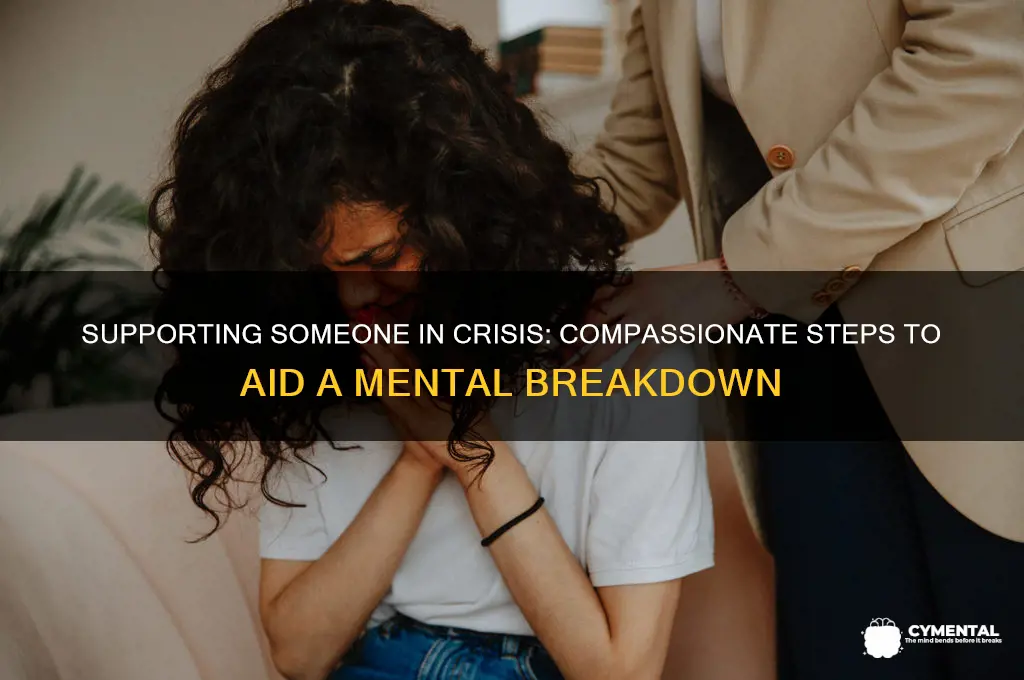
Helping someone experiencing a mental breakdown requires empathy, patience, and a calm, supportive approach. Start by creating a safe and non-judgmental environment, allowing them to express their feelings without interruption. Listen actively and validate their emotions, acknowledging their pain without trying to minimize it. Encourage them to take slow, deep breaths to help ground them, and gently suggest seeking professional help if they haven’t already. Avoid pressuring them or offering quick fixes, and instead, focus on being present and reassuring. If the situation feels unsafe or beyond your ability to manage, don’t hesitate to involve emergency services or a mental health professional to ensure they receive the care they need.
Explore related products


What You'll Learn
- Listen Actively, Non-Judgmentally: Create a safe space, let them express feelings without interruption or criticism
- Encourage Professional Help: Gently suggest therapy or crisis hotlines; offer to assist in finding resources
- Stay Calm and Patient: Avoid panic; maintain a soothing presence to reduce their overwhelming stress
- Remove Immediate Triggers: Identify and minimize stressors in their environment to ease the situation
- Offer Practical Support: Help with daily tasks like meals, hygiene, or reminders to take medication

Listen Actively, Non-Judgmentally: Create a safe space, let them express feelings without interruption or criticism
In the midst of a mental breakdown, the simplest act of listening can be a lifeline. Active, non-judgmental listening creates a sanctuary where fragmented thoughts and overwhelming emotions can spill out without fear of rejection or correction. This isn’t about offering solutions or fixing the problem—it’s about holding space for another human being to feel seen and heard in their rawest state. The power lies in silence, in the absence of interruption, and in the presence of unwavering acceptance.
Consider the mechanics of this approach. Start by eliminating distractions—turn off phones, close laptops, and focus entirely on the person. Use open body language: face them, maintain eye contact (if culturally appropriate), and nod occasionally to signal engagement. Avoid the urge to interject with advice, anecdotes, or reassurances like “It’ll be okay” or “You’re overreacting.” Instead, reflect back what you hear to validate their experience: “It sounds like you’re feeling completely overwhelmed right now.” This technique, borrowed from therapeutic practices, helps the person feel understood and encourages them to explore their emotions further.
Criticism, even when well-intentioned, can shut down communication faster than a slammed door. Phrases like “You shouldn’t feel that way” or “Just think positively” minimize the person’s experience and reinforce feelings of shame or inadequacy. Instead, adopt a stance of radical empathy. Imagine their inner world as a storm—your role isn’t to calm the winds but to stand beside them, offering shelter from the judgmental rain. This doesn’t mean you condone harmful behavior, but rather that you separate the person from their pain, acknowledging that their feelings are real and valid, even if their actions need addressing later.
Practical tips can make this process more accessible. Set a time limit if needed—“I’m here for you for the next hour”—to manage your own emotional capacity while providing structure. Use grounding techniques if the person becomes dissociative or hyperventilates: ask them to name five things they can see, four they can touch, and so on. And remember, this isn’t a one-time intervention but a skill to cultivate. The more consistently you create a safe, non-judgmental space, the more likely the person will feel comfortable returning to it in future moments of crisis.
Ultimately, active, non-judgmental listening is an act of profound respect—a recognition that someone’s pain deserves to be witnessed, not fixed or dismissed. It’s a reminder that in a world that often demands productivity and positivity, simply being present can be revolutionary. By offering this kind of space, you’re not just helping someone through a breakdown; you’re helping them reclaim their humanity, one uninterrupted sentence at a time.
Struggling to Find Adequate Mental Health Support? You're Not Alone
You may want to see also
Explore related products


Encourage Professional Help: Gently suggest therapy or crisis hotlines; offer to assist in finding resources
Recognizing the limits of personal support is crucial when someone is experiencing a mental breakdown. While your presence and empathy are invaluable, professional intervention often becomes necessary to address the underlying issues effectively. Gently suggesting therapy or crisis hotlines can be a turning point, but timing and approach matter. Wait for a moment when the person is relatively calm and receptive, then frame the suggestion as a collaborative step toward healing rather than a critique of their coping abilities. For instance, you might say, “I’ve noticed how hard this has been for you, and I think talking to a professional could offer some new tools to help you feel better.”
Crisis hotlines, such as the National Suicide Prevention Lifeline (988 in the U.S.), provide immediate support and can be a lifeline during acute episodes. However, many people hesitate to reach out due to stigma or fear of judgment. Offering to assist in finding resources can remove barriers and demonstrate your commitment to their well-being. Start by researching local therapists, mental health clinics, or online counseling platforms like BetterHelp or Talkspace. If the person is open to it, you could even help schedule the first appointment or sit with them while they make the call. Practical assistance like this turns a daunting task into a manageable one.
It’s essential to avoid pushing too hard, as this can trigger resistance or deepen feelings of inadequacy. Instead, use open-ended questions to explore their willingness to seek help. For example, “Have you ever considered talking to someone about this?” or “Would it be helpful if I looked up some resources for you?” This approach respects their autonomy while keeping the door open for further conversation. Remember, the goal is to empower, not to control, their decision-making process.
Comparing the benefits of professional help to other forms of support can also be persuasive. While friends and family provide emotional comfort, therapists offer evidence-based strategies tailored to specific mental health challenges. Crisis hotlines, on the other hand, provide immediate de-escalation techniques that can prevent situations from worsening. By highlighting these unique advantages, you can help the person see professional intervention as a complementary, not competing, form of support.
Finally, be prepared for resistance or ambivalence. Many individuals fear the stigma associated with therapy or worry about the cost and time commitment. Address these concerns directly by offering solutions, such as sliding-scale clinics, telehealth options, or employee assistance programs. Reassure them that seeking help is a sign of strength, not weakness, and that taking this step could significantly improve their quality of life. Your persistence, paired with sensitivity, can make all the difference in guiding them toward the support they need.
Mental Health Teams: A Housing Support Solution for Vulnerable Individuals
You may want to see also
Explore related products


Stay Calm and Patient: Avoid panic; maintain a soothing presence to reduce their overwhelming stress
In the midst of a mental breakdown, the person experiencing it is often engulfed in a storm of emotions, their rationality overshadowed by overwhelming stress. Your reaction in these moments can either anchor them or inadvertently escalate their distress. Panic is contagious; if you mirror their turmoil, you risk deepening their sense of helplessness. Instead, embody calmness as a counterbalance. Lower your voice, slow your movements, and maintain a steady presence. This isn’t about minimizing their experience but about creating a safe emotional space where they can begin to regain control.
Consider the physiological impact of your demeanor. When you remain calm, your tone and body language signal safety, which can help regulate their nervous system. For instance, speaking in a measured, gentle voice activates the parasympathetic response, encouraging relaxation. Conversely, hurried or frantic behavior triggers the fight-or-flight response, exacerbating their anxiety. Practical tips include taking deep breaths yourself before approaching them, as this synchronizes your rhythm with a calming pattern they can subconsciously mirror. Even small actions, like offering a glass of water or sitting quietly nearby, communicate support without intrusion.
Patience is equally critical, as mental breakdowns rarely resolve quickly. Avoid rushing the process or pressuring them to "snap out of it." Time feels distorted during such episodes, and what seems like minutes to you might feel like hours to them. Instead, adopt a mindset of accompaniment, letting them know you’re there for as long as they need. Phrases like, "Take your time," or "I’m here with you," reinforce this commitment. Resist the urge to offer solutions or advice prematurely; sometimes, your silent, nonjudgmental presence is the most powerful form of reassurance.
A comparative perspective highlights the difference between enabling and supporting. Staying calm doesn’t mean indulging their distress or avoiding difficult conversations later. It’s about prioritizing immediate emotional safety over long-term problem-solving. Think of it as first aid for the mind: just as you’d stabilize a physical injury before treating it, you must stabilize their emotional state before addressing underlying issues. This approach not only reduces their immediate suffering but also builds trust, making them more receptive to help when they’re ready.
In conclusion, staying calm and patient during someone’s mental breakdown is both an art and a science. It requires self-awareness to manage your own reactions, empathy to meet them where they are, and discipline to resist unhelpful impulses. By maintaining a soothing presence, you become a grounding force in their chaos, offering the first step toward recovery. Remember, your goal isn’t to fix them but to remind them they’re not alone—and that, in itself, can be transformative.
Healing from Toxic Relationships: Finding Mental Health Support and Recovery
You may want to see also
Explore related products


$14.28 $22.95


Remove Immediate Triggers: Identify and minimize stressors in their environment to ease the situation
During a mental breakdown, the environment can act as a silent aggressor, amplifying distress through sensory overload, emotional triggers, or physical clutter. A study by the American Psychological Association highlights that 73% of individuals experiencing acute stress report environmental factors as primary contributors. To intervene effectively, begin by scanning the immediate surroundings for obvious stressors: blaring noises, harsh lighting, or even a cluttered space. For instance, a person overwhelmed by a deadline might be further agitated by a ringing phone or a pile of unpaid bills in plain sight. Removing these triggers isn’t about creating a sterile environment but about curating a space that feels safe and non-threatening.
Start with sensory adjustments. Lower the volume of background noise, dim bright lights, or switch to warmer tones. If the person is in a public space, guide them to a quieter area or offer noise-canceling headphones. For tactile sensitivities, consider swapping tight clothing for something loose or removing restrictive accessories. These changes, though small, can significantly reduce the physiological symptoms of stress, such as elevated heart rate or hyperventilation. Remember, the goal is to create a sensory baseline that doesn’t compete with their internal turmoil.
Next, address emotional triggers tied to physical objects or reminders. A photo, a piece of mail, or even a specific scent can evoke distressing memories or anxieties. For example, a student in the midst of a breakdown might be triggered by a textbook left open on the table. Temporarily removing such items from sight can prevent further escalation. If you’re unsure what qualifies as a trigger, observe their reactions or gently ask, “Is there anything here that feels overwhelming right now?” This approach respects their autonomy while actively reducing environmental pressure.
Finally, streamline the physical space to minimize cognitive load. A cluttered room can mirror a cluttered mind, making it harder for someone to focus or calm down. Clear unnecessary items from their immediate area, but avoid making drastic changes that might feel invasive. For instance, instead of reorganizing an entire desk, simply move distracting objects to a nearby shelf. If they’re in a shared space, ask others to temporarily reduce activity or conversation around them. The takeaway? A calm environment doesn’t require perfection—just thoughtful, immediate adjustments that signal safety and reduce demands on their already taxed mental resources.
Healing Hooves: How Horses Transform Mental Health and Wellness
You may want to see also
Explore related products



Offer Practical Support: Help with daily tasks like meals, hygiene, or reminders to take medication
During a mental breakdown, even the most mundane tasks can feel insurmountable. The weight of depression, anxiety, or overwhelming stress can sap energy and motivation, leaving basic self-care routines neglected. This is where practical support becomes a lifeline. Offering to help with daily tasks like preparing meals, assisting with hygiene, or setting reminders for medication isn't just about physical assistance; it's about restoring a sense of normalcy and dignity.
A simple act like cooking a nutritious meal can provide more than just sustenance. It's a tangible demonstration of care, a reminder that someone is looking out for their well-being. Similarly, helping with hygiene tasks, whether it's reminding them to shower or assisting with laundry, can alleviate the shame and discomfort that often accompany neglect of these routines during a breakdown.
Let's break down the "how-to" of practical support. Start by observing areas where the person is visibly struggling. Is their kitchen empty? Are personal care items untouched? Offer specific, actionable help: "I can pick up groceries for you today," or "Would it be okay if I helped you fold laundry while we chat?" Avoid vague offers like "Let me know if you need anything," which can feel overwhelming. For medication reminders, consider using technology. Set alarms on their phone, or explore apps specifically designed for medication management. If they're comfortable, offer to help organize their medication into daily pill organizers, ensuring they take the correct dosage at the right time.
Remember, the goal isn't to take over completely, but to provide a supportive framework. Encourage independence whenever possible, gradually reducing your assistance as they regain strength. This fosters a sense of accomplishment and empowers them to reclaim control over their daily life.
It's crucial to approach this type of support with sensitivity and respect. Avoid being patronizing or making them feel infantilized. Acknowledge their autonomy and ask for their preferences. Some may prefer you handle tasks discreetly, while others might appreciate your company during these activities. Be mindful of personal boundaries and always ask for consent before assisting with intimate tasks.
Effective Strategies to Support and Empower Individuals in Need
You may want to see also
Frequently asked questions
Signs include extreme anxiety, inability to perform daily tasks, disconnection from reality, severe mood swings, persistent crying, or expressing feelings of hopelessness or worthlessness. Physical symptoms like fatigue, insomnia, or changes in appetite may also be present.
Approach them calmly and empathetically. Use a gentle tone, avoid judgment, and let them know you’re there to support them. Say something like, “I’m here for you” or “How can I help?” Give them space if needed, but ensure they feel safe and not alone.
Avoid minimizing their feelings with phrases like “Just cheer up” or “It’s not that bad.” Don’t argue, criticize, or try to force solutions. Refrain from leaving them alone if they’re at risk of self-harm, and never dismiss their experience as “overreacting.”
Seek professional help if the person is suicidal, self-harming, hallucinating, or unable to care for themselves. Contact a mental health crisis line, therapist, or emergency services if the situation is severe or life-threatening. Encourage them to get professional support even if the crisis passes.