Lucas Bennett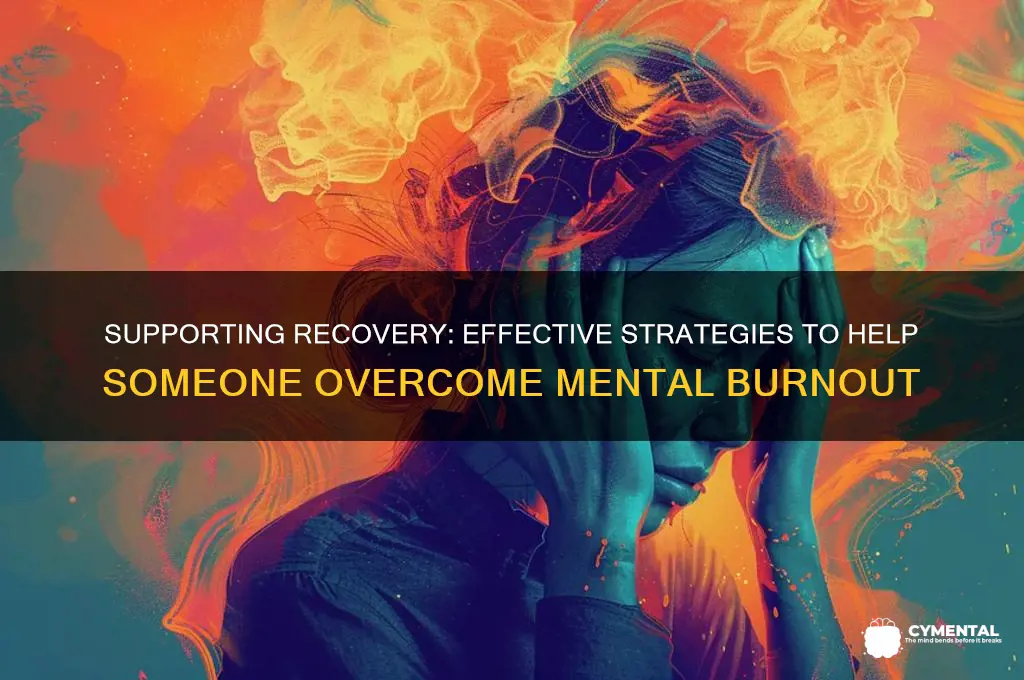
Mental burnout, characterized by emotional exhaustion, reduced productivity, and a sense of detachment, is a growing concern in today’s fast-paced world. It often stems from prolonged stress, overwhelming responsibilities, or a lack of work-life balance. Helping someone experiencing burnout requires empathy, patience, and practical support. Start by actively listening without judgment, validating their feelings, and encouraging them to prioritize self-care. Suggest small, manageable steps like setting boundaries, taking breaks, or seeking professional help. Offer to assist with tasks or simply be present as a source of comfort. Creating a safe, non-pressured environment and fostering open communication can significantly aid their recovery and help them regain a sense of control and well-being.
| Characteristics | Values |
|---|---|
| Listen Actively | Provide a safe, non-judgmental space for the person to express their feelings. Avoid interrupting or offering immediate solutions. |
| Encourage Self-Care | Suggest activities like adequate sleep, healthy eating, hydration, and regular exercise to restore physical and mental energy. |
| Help Prioritize Tasks | Assist in breaking down overwhelming tasks into smaller, manageable steps to reduce stress and increase productivity. |
| Promote Work-Life Balance | Encourage setting boundaries, such as designated work hours and unplugging from work-related communication during personal time. |
| Suggest Professional Help | Recommend therapy, counseling, or mental health professionals for specialized support and coping strategies. |
| Foster Social Connections | Encourage spending time with supportive friends, family, or joining community groups to combat isolation. |
| Mindfulness and Relaxation Techniques | Introduce practices like meditation, deep breathing, yoga, or progressive muscle relaxation to reduce stress. |
| Limit Overcommitment | Help the person say "no" to additional responsibilities and focus on essential tasks to prevent further burnout. |
| Celebrate Small Wins | Acknowledge and celebrate minor achievements to boost morale and motivation. |
| Educate on Burnout | Share information about burnout symptoms, causes, and prevention to increase awareness and reduce stigma. |
| Create a Supportive Environment | Offer practical help, such as assisting with chores or errands, to alleviate daily stressors. |
| Encourage Time Off | Urge the person to take breaks, vacations, or mental health days to recharge and recover. |
| Avoid Enabling Overwork | Discourage behaviors that contribute to burnout, such as excessive overtime or neglecting self-care. |
| Provide Emotional Validation | Acknowledge their struggles and emotions without minimizing their experience. |
| Offer Flexibility | If applicable, suggest flexible work arrangements or adjusted deadlines to reduce pressure. |
| Monitor Progress | Regularly check in to see how they’re doing and adjust support strategies as needed. |
Explore related products


What You'll Learn
- Encourage Rest and Sleep: Promote adequate sleep and relaxation to aid recovery and reduce stress levels
- Provide Emotional Support: Listen actively, validate feelings, and offer empathy without judgment or pressure
- Assist with Task Prioritization: Help identify essential tasks, delegate, or simplify responsibilities to reduce overwhelm
- Encourage Healthy Habits: Support balanced eating, hydration, and exercise to boost energy and mood
- Suggest Professional Help: Recommend therapy, counseling, or mental health resources for expert guidance

Encourage Rest and Sleep: Promote adequate sleep and relaxation to aid recovery and reduce stress levels
Sleep deprivation exacerbates mental burnout by impairing cognitive function, emotional regulation, and physical resilience. Adults require 7-9 hours of sleep per night, yet burnout often disrupts this through racing thoughts, insomnia, or overwork. Prioritize sleep hygiene by establishing a consistent bedtime routine: dim lights 1-2 hours before bed, limit screen exposure, and create a cool, quiet environment. Encourage the use of white noise machines or calming apps like Calm or Headspace to signal the brain it’s time to wind down. Without adequate rest, recovery from burnout remains incomplete, as the brain cannot repair neural pathways or process emotions effectively.
Instruct the individual to treat sleep as a non-negotiable appointment, not a luxury. Start by incrementally adjusting their schedule: go to bed 15 minutes earlier each night until the target time is reached. Introduce relaxation techniques such as progressive muscle relaxation or guided meditation 30 minutes before bed. Avoid caffeine after 2 p.m. and limit vigorous exercise within 2 hours of bedtime. For persistent insomnia, consider melatonin supplements (1-5 mg) under professional guidance, but avoid dependency. Pair these steps with a digital detox: charge devices outside the bedroom to eliminate temptation and blue light interference.
Compare the restorative power of sleep to a computer reboot—essential for clearing mental clutter and resetting systems. While short naps (20-30 minutes) can temporarily alleviate fatigue, they cannot replace nighttime sleep. Encourage weekend recovery sleep only if it doesn’t disrupt the weekly rhythm, as inconsistency undermines circadian health. Highlight the compounding effects of sleep debt: losing 1 hour nightly reduces cognitive performance akin to a 0.10 blood alcohol level. Unlike other burnout interventions, sleep is both preventative and curative, making it a cornerstone of recovery.
Persuade skeptics by framing sleep as a productivity tool, not an indulgence. Research shows well-rested individuals complete tasks 15-30% faster and make fewer errors. Share relatable examples: Arianna Huffington’s advocacy for sleep after collapsing from exhaustion or athletes prioritizing rest for peak performance. Emphasize that burnout recovery isn’t passive; it’s an active process fueled by intentional rest. For caregivers or partners, model this behavior by respecting shared sleep schedules and creating a household culture that values downtime. Sleep isn’t a pause—it’s a pillar of resilience.
Marijuana's Potential: Easing Mental Health Struggles and Improving Lives
You may want to see also
Explore related products


Provide Emotional Support: Listen actively, validate feelings, and offer empathy without judgment or pressure
Emotional support is a cornerstone of helping someone recover from mental burnout, yet it’s often misunderstood as mere sympathy or advice-giving. The key lies in active listening, validation, and empathy—three distinct but interconnected practices that create a safe space for healing. Active listening isn’t about waiting for your turn to speak; it’s about fully engaging with the person’s words, tone, and body language. For instance, repeating back what they’ve said in your own words (“It sounds like you’re feeling overwhelmed by the constant deadlines”) shows you’re not just hearing, but understanding. This simple act can make someone feel seen, a critical step in alleviating the isolation burnout often brings.
Validation is the antidote to the self-doubt and guilt that frequently accompany burnout. Phrases like “It makes sense that you’re exhausted after juggling so much” or “Anyone in your situation would feel the same way” normalize their experience, dismantling the belief that they’re somehow failing. Validation doesn’t mean agreeing with every sentiment but acknowledging the legitimacy of their emotions. For example, if someone says, “I feel like I’m not good enough,” respond with, “It’s completely understandable to feel that way when you’re under so much pressure,” rather than dismissing it with, “You’re being too hard on yourself.” The former honors their reality; the latter minimizes it.
Empathy, when offered without judgment or pressure, becomes a powerful tool for connection. It’s about stepping into their shoes, not fixing their problems. Avoid phrases like “You just need to…” or “Have you tried…?” which can feel dismissive or burdensome. Instead, say, “I can’t imagine how hard this must be for you,” or “I’m here for you, no matter what.” Empathy also means respecting their pace of recovery. Forcing solutions or timelines (“You should take a vacation” or “You’ll feel better soon”) can add guilt or anxiety. Let your presence be the support, not your agenda.
Practical tips can enhance these practices. Set aside dedicated time for conversations, free from distractions like phones or TV. Use open-ended questions (“How has this been affecting you?”) to encourage deeper sharing. If they struggle to express themselves, suggest journaling or drawing as alternative outlets. Remember, emotional support isn’t about solving burnout—it’s about creating a foundation of trust and understanding that allows the person to begin healing on their own terms. Done right, it’s not just a gesture of kindness; it’s a vital part of their recovery process.
Supporting Your Daughter's Mental Health: A Guide for Concerned Parents
You may want to see also
Explore related products


Assist with Task Prioritization: Help identify essential tasks, delegate, or simplify responsibilities to reduce overwhelm
One of the most effective ways to alleviate mental burnout is to streamline the individual's workload. Start by helping them identify essential tasks—those that are critical to their role or well-being. Use the Eisenhower Matrix, a tool that categorizes tasks into four quadrants: urgent and important, important but not urgent, urgent but not important, and neither. Focus on the first quadrant, ensuring these tasks receive immediate attention, while delegating or eliminating those in the other categories. For instance, a manager overwhelmed by meetings might prioritize client presentations (urgent and important) and delegate status updates (urgent but less critical) to a team member.
Delegation is a powerful yet underutilized strategy in combating burnout. Assess the individual’s responsibilities and identify tasks that can be reassigned without compromising quality. For example, a teacher feeling overwhelmed by grading and lesson planning could delegate administrative tasks like photocopying or classroom setup to a teaching assistant or volunteer. Be mindful of the person’s reluctance to let go—often rooted in perfectionism or fear of inadequacy. Encourage them to view delegation as a collaborative effort rather than a sign of weakness. Start small, with low-stakes tasks, to build confidence in the process.
Simplification is another critical aspect of task prioritization. Break complex tasks into smaller, manageable steps to reduce cognitive load. For a freelance designer juggling multiple projects, this might mean dividing a website redesign into phases: research, wireframing, design, and revisions. Use tools like Trello or Asana to visualize progress and maintain clarity. Additionally, eliminate unnecessary steps or redundancies. For instance, a marketer spending hours on detailed reports might simplify by focusing on key metrics and using templates to streamline the process.
Finally, establish boundaries to prevent task creep—the gradual accumulation of responsibilities beyond one’s capacity. Encourage the individual to say no to non-essential tasks or commitments that drain their energy. This requires self-awareness and assertiveness, skills that can be developed through practice. Role-play scenarios where they can politely decline additional tasks, emphasizing their current priorities. For example, a nonprofit employee might respond to a request for extra volunteer hours with, “I’d love to help, but I’m fully committed to [specific task] this week. Can we revisit this next month?”
By assisting with task prioritization—whether through identification, delegation, simplification, or boundary-setting—you provide tangible relief to someone experiencing mental burnout. This approach not only reduces overwhelm but also empowers the individual to regain control over their workload, fostering a sense of competence and resilience. Remember, the goal isn’t to eliminate all tasks but to create a sustainable balance that aligns with their capacity and priorities.
Supporting Mental Health at Work: Practical Strategies for Employers and Colleagues
You may want to see also
Explore related products


Encourage Healthy Habits: Support balanced eating, hydration, and exercise to boost energy and mood
Mental burnout often manifests as a profound lack of energy, yet the solution isn’t always rest. The body’s ability to recover hinges on three pillars: nutrition, hydration, and movement. Each plays a distinct role in replenishing depleted resources, but their synergy is where true rejuvenation lies. For instance, a well-hydrated body processes nutrients more efficiently, while consistent exercise enhances the absorption of mood-regulating vitamins like B12 and D. Ignoring this trifecta can prolong recovery, turning a temporary slump into a chronic condition.
Start with small, actionable changes in diet. Encourage meals rich in complex carbohydrates (e.g., quinoa, sweet potatoes) for sustained energy, paired with lean proteins (chicken, tofu) to stabilize blood sugar. Incorporate omega-3 fatty acids (salmon, flaxseeds) to combat inflammation, a silent contributor to fatigue. Avoid the trap of quick-fix sugary snacks; they spike energy temporarily but crash mood and focus. Instead, suggest snacks like apple slices with almond butter or a handful of nuts. Aim for three balanced meals and two snacks daily, ensuring no more than 4–5 hours between eating to maintain metabolic consistency.
Hydration is deceptively simple yet often overlooked. Dehydration mimics burnout symptoms—fatigue, irritability, and foggy thinking. Recommend carrying a reusable water bottle with markings to track intake, aiming for 2–3 liters daily, adjusted for activity level and climate. For those struggling to drink plain water, infuse it with cucumber, mint, or berries for flavor without added sugar. Limit diuretic beverages like coffee and alcohol, which exacerbate dehydration, and pair water with electrolytes (magnesium, potassium) post-exercise to restore balance.
Exercise doesn’t require marathons. Even 20 minutes of moderate activity—brisk walking, yoga, or cycling—triggers endorphins and reduces cortisol, the stress hormone. For burnout sufferers, consistency trumps intensity. Suggest a daily routine that includes stretching to alleviate tension, strength training twice a week to build resilience, and mindfulness-based movement like tai chi to calm the mind. Caution against over-exertion; pushing too hard can deepen exhaustion. Instead, focus on activities that feel enjoyable and sustainable, fostering a sense of accomplishment rather than obligation.
The key to success lies in integration, not isolation. Pair a hydrating morning smoothie with a 10-minute walk, or follow a protein-rich lunch with a short stretch session. These habits reinforce each other, creating a cycle of energy and positivity. Track progress using a journal or app to celebrate small wins, like increased water intake or consistent meal times. Over time, these habits rebuild the body’s resilience, transforming burnout recovery from a struggle into a structured, empowering process.
Sauna Therapy: Unlocking Mental Health Benefits for Mind and Body
You may want to see also
Explore related products


Suggest Professional Help: Recommend therapy, counseling, or mental health resources for expert guidance
Recognizing the signs of mental burnout in someone you care about can be the first step toward helping them regain balance. However, it’s crucial to understand that burnout often requires more than just rest or lifestyle adjustments. Professional intervention, such as therapy or counseling, can provide the structured support needed to address underlying issues and develop coping strategies. Mental health professionals are trained to diagnose, treat, and manage burnout effectively, offering tools that go beyond what friends or family can provide.
One practical way to suggest professional help is by framing it as a proactive step toward self-care rather than a last resort. For instance, you might say, “I’ve noticed you’ve been feeling overwhelmed, and I think talking to a therapist could give you some new perspectives and strategies to manage this.” Provide concrete resources, such as local mental health clinics, online therapy platforms, or employee assistance programs (EAPs) if their workplace offers them. If they’re hesitant, offer to help them find a provider or even schedule the first appointment. Small actions like these can reduce the barrier to seeking help.
It’s important to acknowledge that not all therapy or counseling approaches are one-size-fits-all. Cognitive-behavioral therapy (CBT), for example, is highly effective for burnout as it focuses on identifying and changing negative thought patterns and behaviors. Mindfulness-based stress reduction (MBSR) is another evidence-based option that teaches individuals to manage stress through mindfulness practices. When suggesting professional help, encourage the person to explore different modalities to find what resonates with them. This personalized approach increases the likelihood of engagement and success.
A common misconception is that therapy is only for severe mental health issues, but this couldn’t be further from the truth. Burnout, while not a clinical diagnosis, can lead to anxiety, depression, and other mental health challenges if left unaddressed. Early intervention through professional help can prevent these complications. Share this insight to normalize seeking support and emphasize that it’s a sign of strength, not weakness. Additionally, remind them that many therapists offer sliding scale fees or work with insurance, making it more accessible than they might think.
Finally, be mindful of the language you use when discussing professional help. Avoid phrases like “you need help” or “something is wrong with you,” as these can feel stigmatizing. Instead, focus on collaboration and empowerment. For example, say, “Let’s look into some resources together—there are professionals who specialize in helping people through exactly what you’re experiencing.” By approaching the conversation with empathy and specificity, you can encourage the person to take the first step toward recovery.
Gardening for Mental Health: Cultivating Peace and Well-Being Naturally
You may want to see also
Frequently asked questions
Signs of mental burnout include chronic fatigue, decreased productivity, irritability, detachment from work or responsibilities, and feelings of helplessness or cynicism. Physical symptoms like headaches or sleep disturbances may also be present.
Listen without judgment, validate their feelings, and encourage them to take breaks or seek professional help. Offer practical assistance, such as helping with tasks, and create a supportive, non-demanding environment.
Prioritize rest, set boundaries, and engage in activities that bring joy or relaxation. Regular exercise, mindfulness practices, and maintaining a healthy diet can also aid recovery.
Professional help should be sought if symptoms persist despite self-care efforts, if there are thoughts of self-harm, or if burnout significantly impacts daily functioning. A therapist or counselor can provide tailored strategies and support.