Ava Ramirez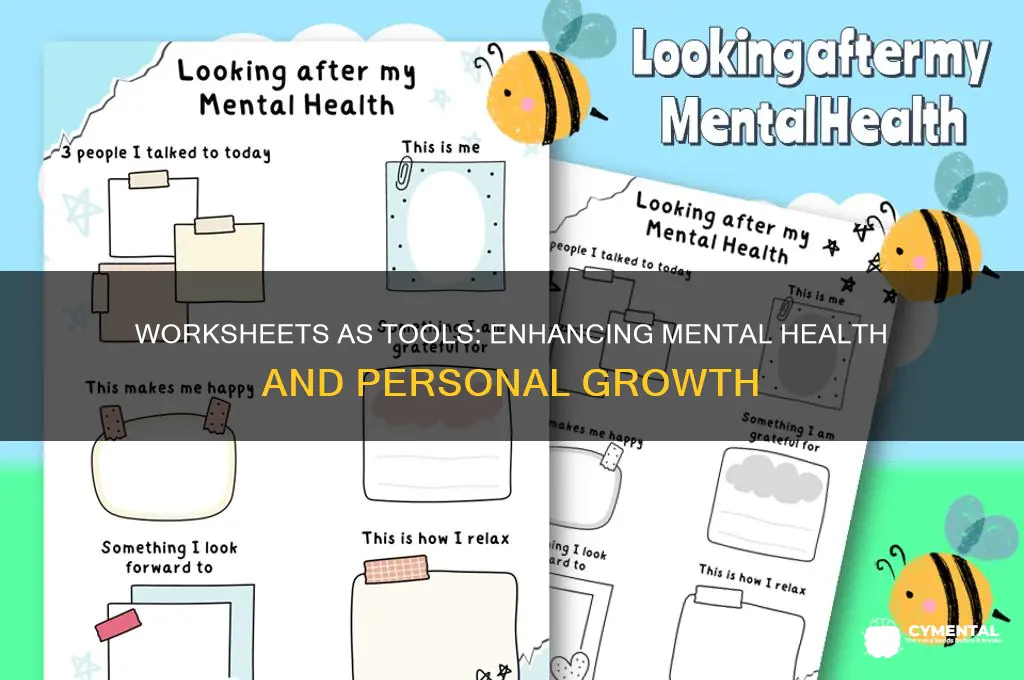
Worksheets can be a valuable tool in supporting mental health by providing structured, actionable strategies to manage challenges such as anxiety, depression, or stress. Designed to encourage self-reflection, mindfulness, and cognitive reframing, these exercises often incorporate evidence-based techniques like cognitive-behavioral therapy (CBT) or positive psychology. By guiding individuals through step-by-step activities, worksheets help identify negative thought patterns, set achievable goals, and practice coping skills, fostering a sense of control and progress. Their accessibility and flexibility make them ideal for use in therapy sessions, self-care routines, or as supplementary resources, empowering individuals to actively engage in their mental health journey.
| Characteristics | Values |
|---|---|
| Structured Self-Reflection | Worksheets provide a structured format for individuals to reflect on thoughts, emotions, and behaviors, promoting self-awareness and insight. |
| Cognitive Restructuring | They help identify and challenge negative thought patterns, replacing them with more balanced and positive perspectives. |
| Skill Building | Worksheets teach practical skills like mindfulness, stress management, and problem-solving, empowering individuals to cope with challenges. |
| Goal Setting | They assist in setting achievable mental health goals, breaking them into manageable steps, and tracking progress. |
| Emotional Regulation | Worksheets offer tools and techniques to recognize, understand, and manage emotions effectively. |
| Behavioral Activation | They encourage engagement in positive activities, combating symptoms of depression and anxiety. |
| Psychoeducation | Worksheets provide information about mental health conditions, reducing stigma and increasing understanding. |
| Consistency and Practice | Regular use reinforces therapeutic techniques, fostering long-term habit formation and improvement. |
| Accessibility | Worksheets are easily accessible, cost-effective, and can be used independently or with professional guidance. |
| Personalization | Many worksheets are customizable, allowing individuals to tailor them to their specific needs and preferences. |
Explore related products


What You'll Learn
- Stress Reduction Techniques: Worksheets guide mindfulness, breathing exercises, and relaxation methods to manage stress effectively
- Emotion Tracking Tools: Help identify patterns, triggers, and coping strategies for emotional regulation
- Cognitive Restructuring: Challenge negative thoughts with structured exercises to improve mental clarity
- Goal Setting Worksheets: Break down overwhelming tasks into manageable steps for reduced anxiety
- Gratitude Practices: Foster positivity and resilience through daily gratitude journaling prompts

Stress Reduction Techniques: Worksheets guide mindfulness, breathing exercises, and relaxation methods to manage stress effectively
Worksheets designed for stress reduction serve as structured tools that transform abstract concepts like mindfulness and relaxation into actionable practices. Unlike generic advice, these sheets often include step-by-step instructions for techniques such as diaphragmatic breathing, where individuals are guided to inhale for a count of four, hold for four, exhale for six, and repeat for five minutes. This specificity ensures users can apply methods immediately, making them particularly effective for adults and teens who thrive on clear, tangible tasks. For instance, a worksheet might pair breathing exercises with a visual diagram of the diaphragm to enhance understanding and engagement.
One of the strengths of worksheets lies in their ability to combine cognitive and behavioral strategies. A mindfulness worksheet, for example, might prompt users to identify three sensory details in their environment (e.g., "What do you hear? Smell? Feel?") followed by a reflection on how this grounding exercise shifts their emotional state. Such activities are backed by research showing that mindfulness practices reduce cortisol levels by up to 14% over eight weeks. Worksheets also often include tracking sections, allowing users to monitor progress and identify patterns, such as which techniques work best during work-related stress versus personal conflicts.
While worksheets are accessible and self-paced, their effectiveness depends on consistent use and proper adaptation. For children or individuals with attention challenges, shorter exercises (e.g., 2-minute breathing sessions) paired with visual aids or gamified elements can improve adherence. Caution should be taken with relaxation techniques like progressive muscle relaxation, as tensing muscles incorrectly can lead to discomfort. Pairing worksheets with professional guidance ensures techniques are performed safely, especially for those with physical limitations or trauma histories.
The comparative advantage of worksheets over apps or videos is their tactile nature, which fosters deeper engagement. Writing down reflections or physically checking off completed exercises activates the brain’s reticular activating system, enhancing memory and commitment to the practice. For instance, a worksheet might ask users to rate their stress level before and after an exercise on a scale of 1 to 10, providing immediate feedback on effectiveness. This tangible interaction makes worksheets a powerful complement to digital tools, particularly for individuals who learn best through hands-on activities.
In conclusion, stress reduction worksheets are not just informational handouts but dynamic guides that bridge the gap between theory and practice. By offering structured, evidence-based techniques and opportunities for self-reflection, they empower individuals to take control of their stress management. Whether used independently or as part of therapy, these tools provide a cost-effective, scalable solution for improving mental well-being across diverse populations.
Organize Your Life: Boost Mental Clarity and Reduce Stress
You may want to see also
Explore related products


Emotion Tracking Tools: Help identify patterns, triggers, and coping strategies for emotional regulation
Emotions, often experienced as fleeting and intangible, can be systematically mapped and understood through emotion tracking tools. These structured worksheets prompt users to record their feelings, associated thoughts, and environmental factors at regular intervals—daily, weekly, or situationally. By logging this data, individuals create a tangible record of their emotional landscape, transforming abstract experiences into analyzable patterns. For instance, a person might notice that feelings of anxiety consistently spike during work meetings, accompanied by self-critical thoughts like, "I’m not prepared enough." This granular documentation serves as the foundation for deeper self-awareness and targeted intervention.
The analytical power of emotion tracking lies in its ability to reveal triggers—specific events, people, or thoughts that precede emotional shifts. For example, a worksheet might include columns for time, location, emotion intensity (on a scale of 1–10), and potential triggers. Over time, a user might identify that arguments with a family member or even minor disruptions like a missed meal correlate with heightened irritability. This insight is not just observational; it’s actionable. Once triggers are pinpointed, individuals can proactively modify their environments or responses, such as scheduling regular breaks during stressful tasks or setting boundaries in challenging relationships.
Beyond identifying triggers, emotion tracking tools foster the development of personalized coping strategies. Worksheets often include sections for recording what actions were taken during an emotional episode and their effectiveness. For instance, deep breathing exercises might reduce anger from a 9 to a 5, while journaling has no impact. By experimenting with and documenting different strategies, users build a toolkit tailored to their needs. This process demystifies emotional regulation, turning it from a reactive process into a deliberate practice. For adolescents, who often struggle with emotional volatility, pairing tracking with simple strategies like the 5-4-3-2-1 grounding technique can provide immediate relief while building long-term skills.
However, the effectiveness of emotion tracking depends on consistency and honesty. Skipping entries or downplaying emotions undermines the tool’s utility. To mitigate this, start small—commit to tracking for just five minutes daily—and use prompts that encourage specificity, such as, "What physical sensations accompanied this emotion?" Additionally, digital tools like mood-tracking apps can complement worksheets by providing reminders and visual trend analyses. For those in therapy, sharing tracked data with a clinician can deepen sessions, as patterns become clearer and progress more measurable.
In conclusion, emotion tracking tools are not just reflective exercises; they are practical instruments for emotional mastery. By systematically logging emotions, triggers, and coping strategies, individuals gain clarity, agency, and resilience. Whether used independently or as part of a broader mental health plan, these worksheets transform the chaotic experience of emotions into a navigable, even predictable, terrain. The key lies in treating them not as passive journals but as active experiments in self-understanding and growth.
Sports and Mental Health: Boosting Well-Being Through Physical Activity
You may want to see also
Explore related products


Cognitive Restructuring: Challenge negative thoughts with structured exercises to improve mental clarity
Negative thoughts can spiral into a cycle of anxiety and depression, clouding judgment and distorting reality. Cognitive restructuring, a core technique in cognitive-behavioral therapy (CBT), offers a structured approach to break this cycle. By identifying, challenging, and replacing negative thought patterns, individuals can gain mental clarity and improve their overall well-being.
Imagine a scenario where someone believes, "I always mess everything up." A cognitive restructuring worksheet would guide them through a series of steps. First, they'd identify the triggering situation (e.g., forgetting a deadline). Next, they'd examine the evidence for and against their negative thought. Did they truly "always" mess up, or were there instances of success? The worksheet would then prompt them to generate more balanced thoughts, such as "I made a mistake, but I've succeeded in similar tasks before." Finally, they'd rate the believability of their original and new thoughts, tracking progress over time.
Consistently practicing these exercises, even for 15-20 minutes daily, can lead to significant improvements in mood and coping mechanisms.
Worksheets provide a tangible tool for this process, offering structure and objectivity. They encourage self-reflection and help individuals distance themselves from their negative thoughts, viewing them as hypotheses to be tested rather than absolute truths. This analytical approach empowers individuals to become active participants in their own mental health journey.
Compared to simply trying to "think positively," cognitive restructuring worksheets provide a systematic method for dismantling negative thought patterns and building more realistic and helpful perspectives.
While worksheets are a valuable tool, they are most effective when used in conjunction with professional guidance, especially for severe or persistent mental health challenges. It's crucial to remember that cognitive restructuring is a skill that takes time and practice to master. Patience, self-compassion, and a commitment to the process are essential for long-term success.
Supporting Reluctant Loved Ones: Accessing Mental Health Care in Australia
You may want to see also
Explore related products


Goal Setting Worksheets: Break down overwhelming tasks into manageable steps for reduced anxiety
Anxiety often stems from feeling overwhelmed by the sheer scale of tasks, whether it’s completing a project, managing finances, or even personal goals like fitness. Goal-setting worksheets act as a cognitive scaffold, breaking these monolithic challenges into smaller, actionable steps. By dissecting a task into components, individuals can focus on one piece at a time, reducing the mental load and fostering a sense of control. For example, instead of fixating on "write a thesis," a worksheet might guide you to outline chapters, research daily for 30 minutes, or draft one section per week. This granular approach transforms abstract goals into tangible progress, mitigating anxiety through clarity and structure.
Consider the mechanics of how these worksheets function. Typically, they prompt users to define a primary goal, then subdivide it into subtasks, assign deadlines, and track completion. This process engages the prefrontal cortex, the brain’s planning center, while calming the amygdala, which drives stress responses. Studies in cognitive behavioral therapy (CBT) show that structured planning reduces anxiety by 30-40% in adults aged 18-45. For instance, a worksheet for "plan a vacation" might include steps like "research destinations (1 hour)," "book flights (by Friday)," and "pack essentials (Sunday evening)." Such specificity eliminates ambiguity, a common anxiety trigger.
However, not all goal-setting worksheets are created equal. Overloading a worksheet with too many steps or rigid timelines can backfire, reintroducing stress. The key is balance: aim for 3-5 subtasks per goal, with flexible deadlines. For instance, a worksheet for "improve mental health" could include "meditate 5 minutes daily," "journal twice a week," and "schedule one social activity monthly." Pairing these steps with self-reflection prompts, such as "What went well today?" or "How can I adjust my approach?" enhances mindfulness and adaptability. For teens or individuals with ADHD, visual aids like progress bars or color-coding can improve engagement.
Practical implementation requires consistency and self-compassion. Start by dedicating 10 minutes daily to review and update your worksheet. If a step feels insurmountable, break it down further—for example, "clean the house" becomes "tidy one room per day." Celebrate small wins to reinforce motivation. Caution against perfectionism: missing a deadline doesn’t mean failure; it’s an opportunity to reassess and recalibrate. Pairing worksheets with digital tools like apps or reminders can enhance adherence, especially for tech-savvy users. Over time, this practice rewires the brain to approach challenges methodically, reducing anxiety not just in task completion but in life’s broader uncertainties.
Dance Therapy: Unlocking Mental Wellness Through Movement and Expression
You may want to see also
Explore related products


Gratitude Practices: Foster positivity and resilience through daily gratitude journaling prompts
Gratitude journaling isn’t just a feel-good trend—it’s a scientifically backed tool for rewiring the brain toward positivity. Studies show that consistently recording moments of gratitude can increase dopamine and serotonin levels, fostering emotional resilience. Unlike generic affirmations, gratitude prompts ground individuals in tangible, daily experiences, making them particularly effective for those grappling with anxiety or depression. For instance, a simple prompt like, “What small act of kindness did someone show you today?” shifts focus from deficits to abundance, retraining the mind to notice the overlooked.
To begin, set aside 5–10 minutes daily, ideally in the morning or before bed. Use a dedicated notebook or a printable worksheet with structured prompts to maintain consistency. Start with three specific entries, avoiding vague statements like “I’m grateful for my health.” Instead, write, “I’m grateful for the warm cup of tea that calmed my nerves this morning.” For children or teens, visual prompts like drawing a picture of something they’re thankful for can make the practice more engaging. Pairing journaling with a sensory cue, such as a specific pen or calming music, reinforces the habit.
While gratitude journaling is accessible to all ages, its impact varies by approach. Adults may benefit from reflective prompts like, “What challenge taught me something valuable this week?” whereas younger individuals respond better to concrete questions, such as, “Who made you smile today?” Caution against over-generalization; specificity amplifies the emotional connection. For those with trauma or severe depression, pairing gratitude practices with professional therapy ensures the exercise doesn’t feel dismissive of their struggles.
The beauty of gratitude journaling lies in its cumulative effect. Over time, it reshapes cognitive patterns, reducing rumination and increasing optimism. A 2015 study found that participants who journaled weekly reported significantly better mental health after just six months. To sustain momentum, vary prompts monthly or incorporate themes like relationships, nature, or personal growth. For skeptics, start with a 21-day challenge—research suggests habits solidify within this timeframe. The goal isn’t to force positivity but to cultivate a balanced perspective, one entry at a time.
Supporting Your Partner’s Mental Health: Compassionate Strategies for Healing Together
You may want to see also
Frequently asked questions
Worksheets can help individuals manage anxiety by providing structured exercises to identify triggers, track symptoms, and practice coping strategies like deep breathing or cognitive reframing.
Yes, worksheets can be effective for improving mood by encouraging self-reflection, gratitude practices, and goal-setting, which are evidence-based techniques for combating depression.
Absolutely, worksheets often include prompts for identifying unhealthy coping habits and replacing them with positive strategies, such as mindfulness or problem-solving exercises.
Worksheets provide a safe and guided way to explore and express emotions related to trauma, often incorporating journaling, grounding techniques, or emotional regulation tools.
Yes, worksheets focused on self-esteem often include affirmations, identifying strengths, and challenging negative self-talk, which can help individuals build confidence over time.