Caleb Wright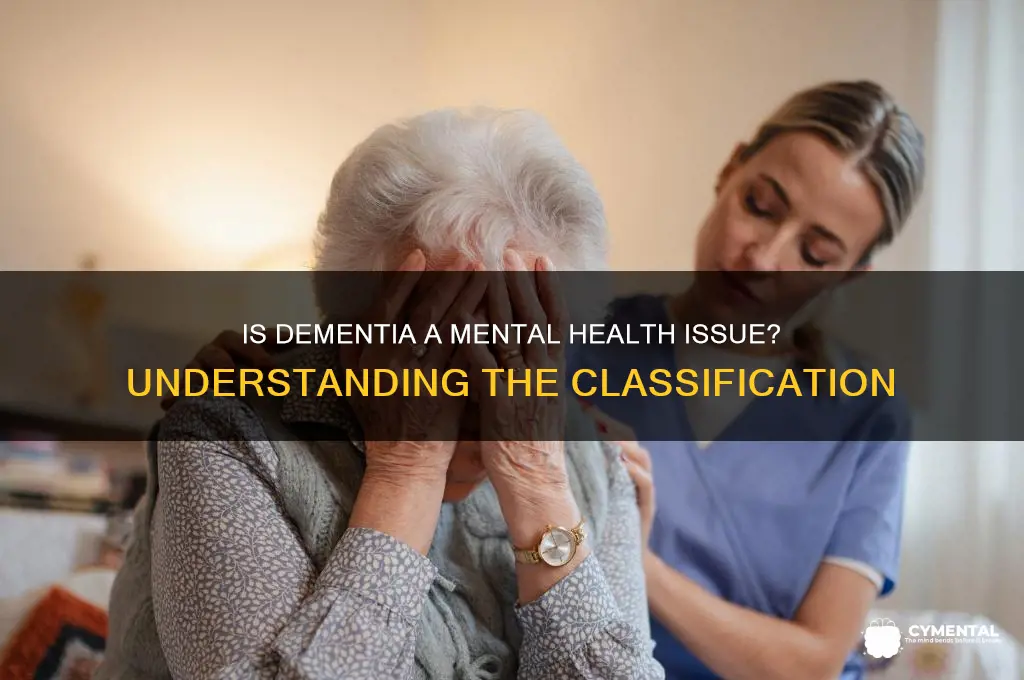
Dementia is a complex and multifaceted condition that primarily affects memory, cognitive function, and daily functioning, often raising questions about its classification within the realm of mental health. While it is not traditionally categorized as a mental health issue in the same way as conditions like depression or anxiety, dementia does share some overlapping symptoms and impacts on emotional and psychological well-being. It is generally considered a neurodegenerative disorder, stemming from physical changes in the brain, yet its effects on mood, behavior, and personality often blur the lines between neurological and mental health concerns. As a result, dementia is increasingly recognized as a condition that intersects both domains, necessitating a holistic approach to care that addresses both cognitive decline and mental health challenges.
| Characteristics | Values |
|---|---|
| Classification | Dementia is not strictly classified as a mental health issue but rather as a neurological disorder. However, it often overlaps with mental health due to its impact on cognitive and psychological functions. |
| Primary Cause | Neurodegenerative diseases (e.g., Alzheimer's), vascular issues, or other brain conditions, not primarily psychological factors. |
| Symptoms | Memory loss, cognitive decline, confusion, personality changes, and behavioral disturbances. |
| Mental Health Overlap | Symptoms like depression, anxiety, and psychosis are common in dementia, linking it to mental health concerns. |
| Treatment | Focuses on managing symptoms, slowing progression, and providing psychological support, often involving both neurological and psychiatric care. |
| Stigma | Often stigmatized similarly to mental health conditions due to misconceptions about its causes and effects. |
| Diagnostic Criteria | Diagnosed through neurological assessments, brain imaging, and cognitive testing, not solely through mental health evaluations. |
| Progression | Progressive and chronic, with worsening symptoms over time, unlike many mental health conditions that may be episodic. |
| Impact on Daily Life | Severely affects daily functioning, independence, and quality of life, similar to severe mental health disorders. |
| Research Focus | Primarily studied as a neurological condition, though mental health aspects are increasingly recognized in research. |
Explore related products


What You'll Learn
- Dementia vs. Mental Illness: Key differences in symptoms, causes, and treatment approaches
- Classification in DSM-5: How dementia is categorized in diagnostic manuals
- Overlap with Mental Health: Shared symptoms like depression, anxiety, and psychosis
- Neurological Basis: Dementia’s root in brain degeneration, not psychological factors
- Stigma and Perception: Public misunderstanding of dementia as solely a mental health issue

Dementia vs. Mental Illness: Key differences in symptoms, causes, and treatment approaches
Dementia and mental illness are often conflated, yet they represent distinct conditions with unique symptoms, causes, and treatment approaches. While both can profoundly impact an individual’s quality of life, understanding their differences is crucial for accurate diagnosis and effective management. Dementia primarily affects memory, cognition, and daily functioning, whereas mental illnesses like depression or schizophrenia predominantly influence mood, perception, and behavior. Recognizing these distinctions ensures tailored interventions and better outcomes for patients.
Symptoms: Memory Loss vs. Mood Disturbances
Dementia is characterized by progressive cognitive decline, often beginning with memory loss and advancing to difficulties in problem-solving, language, and spatial awareness. For instance, a person with Alzheimer’s disease, the most common form of dementia, may forget recent events, struggle to follow conversations, or get lost in familiar places. In contrast, mental illnesses typically manifest as emotional or psychological disturbances. Depression, for example, involves persistent sadness, loss of interest in activities, and fatigue, while schizophrenia may include hallucinations or delusions. These symptoms are not inherently tied to cognitive deterioration but rather to disruptions in emotional regulation or perception.
Causes: Neurodegeneration vs. Multifactorial Origins
The root causes of dementia and mental illness differ significantly. Dementia is primarily driven by neurodegenerative processes, such as the accumulation of amyloid plaques and tau tangles in Alzheimer’s disease or the loss of dopamine-producing neurons in dementia with Lewy bodies. These physical changes in the brain are often irreversible. Mental illnesses, however, arise from a complex interplay of genetic, environmental, and psychological factors. For instance, depression may be triggered by trauma, hormonal imbalances, or a family history of the condition. While both conditions can have genetic components, the biological mechanisms at play are distinct.
Treatment Approaches: Medication Management vs. Psychotherapy
Treatment strategies for dementia and mental illness also diverge. Dementia management focuses on slowing cognitive decline and improving quality of life. Medications like donepezil (Aricept) or memantine (Namenda) are commonly prescribed to temporarily alleviate symptoms, but they do not halt disease progression. Non-pharmacological interventions, such as cognitive stimulation therapy or caregiver support, play a critical role. Mental illnesses, on the other hand, often respond well to a combination of medication and psychotherapy. Antidepressants like selective serotonin reuptake inhibitors (SSRIs) or antipsychotics are frequently used, alongside therapies like cognitive-behavioral therapy (CBT) or dialectical behavior therapy (DBT). These approaches address underlying psychological issues rather than neurodegenerative changes.
Practical Tips for Caregivers and Patients
For caregivers of individuals with dementia, creating a structured daily routine, using memory aids, and fostering a safe environment can significantly reduce confusion and agitation. For those managing mental illness, maintaining a consistent sleep schedule, engaging in regular physical activity, and building a strong support network are essential. Both conditions benefit from early intervention, so recognizing symptoms promptly and seeking professional help is critical. Understanding the unique challenges of each condition allows for more compassionate and effective care.
In summary, while dementia and mental illness share some overlapping features, their symptoms, causes, and treatments are fundamentally different. Dementia is a neurodegenerative condition marked by cognitive decline, whereas mental illness involves emotional and psychological disturbances. Tailoring interventions to these distinctions ensures better outcomes and improved quality of life for those affected.
Supporting Mental Health: Compassionate Responses to Help Someone in Need
You may want to see also
Explore related products


Classification in DSM-5: How dementia is categorized in diagnostic manuals
Dementia's classification in the Diagnostic and Statistical Manual of Mental Disorders, Fifth Edition (DSM-5), is a nuanced and carefully considered categorization. The DSM-5, published by the American Psychiatric Association, is the authoritative guide for mental health professionals in the United States and is widely used internationally. In this manual, dementia is not listed as a single disorder but rather as a group of neurocognitive disorders, reflecting the diverse etiologies and clinical presentations of these conditions.
Categorization and Criteria
The DSM-5 categorizes dementia under the heading of "Neurocognitive Disorders," which are characterized by a decline in cognitive function, including memory, executive function, language, and visuospatial abilities. This classification is based on the understanding that dementia is primarily a neurological condition, resulting from various brain diseases or injuries. The manual provides specific criteria for diagnosing different types of neurocognitive disorders, such as Alzheimer's disease, vascular dementia, and frontotemporal dementia. For instance, Alzheimer's disease is diagnosed when there is evidence of cognitive decline in at least two areas, including memory, and when these symptoms interfere with independence in everyday activities.
Severity and Progression
A key aspect of the DSM-5 classification is the emphasis on the severity and progression of symptoms. Neurocognitive disorders are categorized into mild and major types, depending on the extent of cognitive impairment and its impact on daily functioning. Mild neurocognitive disorder is diagnosed when there is a modest decline in cognitive abilities, but the individual can still perform everyday activities independently. In contrast, major neurocognitive disorder is characterized by significant cognitive impairment that interferes with independence in daily life. This distinction is crucial for treatment planning and prognosis, as it helps clinicians tailor interventions to the specific needs of each patient.
Differential Diagnosis and Comorbidities
The DSM-5 also provides guidance on differential diagnosis, helping clinicians distinguish neurocognitive disorders from other conditions with similar presentations, such as depression or delirium. This is particularly important given the high prevalence of comorbidities in older adults, who are at increased risk for both dementia and other mental health disorders. For example, distinguishing between depressive symptoms and the apathy often seen in frontotemporal dementia can be challenging but is essential for appropriate management. The manual encourages a comprehensive assessment, considering medical, neurological, and psychiatric factors, to ensure an accurate diagnosis.
Implications for Treatment and Research
The classification of dementia in the DSM-5 has significant implications for treatment and research. By categorizing dementia as a neurocognitive disorder, the manual highlights the need for a multidisciplinary approach, involving neurologists, psychiatrists, and other healthcare professionals. This classification also facilitates research into the underlying causes, risk factors, and potential treatments for these conditions. For instance, understanding the distinct clinical features of different neurocognitive disorders can guide the development of targeted therapies and interventions. Furthermore, the DSM-5's emphasis on severity and progression provides a framework for monitoring disease course and evaluating treatment efficacy, ultimately improving patient outcomes and quality of life.
In summary, the DSM-5's classification of dementia as a neurocognitive disorder reflects a sophisticated understanding of these complex conditions. By providing clear diagnostic criteria, emphasizing severity and progression, and guiding differential diagnosis, the manual supports accurate diagnosis, effective treatment planning, and ongoing research. As our understanding of dementia continues to evolve, the DSM-5 serves as a vital tool for clinicians and researchers, fostering a more nuanced and compassionate approach to caring for individuals with these debilitating disorders.
Understanding Asexuality: Debunking Myths and Mental Health Misconceptions
You may want to see also
Explore related products


Overlap with Mental Health: Shared symptoms like depression, anxiety, and psychosis
Dementia and mental health conditions often share symptoms like depression, anxiety, and psychosis, blurring the lines between neurological decline and psychiatric disorders. For instance, a 72-year-old woman with early-stage Alzheimer’s may exhibit persistent sadness, social withdrawal, and irrational fears—symptoms typically associated with major depressive disorder or generalized anxiety disorder. This overlap complicates diagnosis, as clinicians must discern whether these behaviors stem from dementia’s neurodegeneration or co-occurring mental health issues. Recognizing this intersection is crucial for tailored treatment, as misattribution can lead to ineffective interventions, such as prescribing antidepressants without addressing cognitive decline.
Consider the diagnostic process as a layered investigation. Step one: assess for cognitive impairment using tools like the Mini-Mental State Examination (MMSE). Step two: screen for mental health symptoms with validated scales, such as the Geriatric Depression Scale (GDS) or the Generalized Anxiety Disorder-7 (GAD-7). Caution: avoid dismissing symptoms as "just dementia" without thorough evaluation. For example, psychotic features like hallucinations or delusions in dementia patients may require antipsychotic medications, but these should be used judiciously due to increased risks in older adults, including stroke and mortality. Practical tip: maintain a symptom diary to track patterns, aiding both caregivers and healthcare providers in distinguishing between dementia progression and mental health fluctuations.
Persuasively, the shared symptoms argue for an integrated care model. Depression in dementia patients, for instance, is not merely a reaction to cognitive loss but may result from overlapping neurobiological pathways, such as serotonin dysregulation. Studies show that up to 40% of dementia patients experience clinically significant depression, yet fewer than 10% receive adequate treatment. This gap underscores the need for multidisciplinary teams—geriatricians, psychiatrists, and neuropsychologists—to collaborate on treatment plans. For anxiety, cognitive-behavioral therapy (CBT) adapted for cognitive impairment can be effective, though sessions should be shorter and more repetitive to accommodate memory limitations.
Comparatively, while mental health conditions like schizophrenia or bipolar disorder are distinct diagnoses, their symptomatic overlap with dementia highlights the complexity of brain disorders. For example, late-onset psychosis in a 65-year-old might initially resemble schizophrenia but could be a prodromal symptom of Lewy body dementia. This distinction is critical, as antipsychotics may exacerbate cognitive decline in Lewy body dementia, whereas schizophrenia typically responds to standard antipsychotic regimens. The takeaway: accurate diagnosis requires a nuanced understanding of both mental health and neurodegenerative conditions, emphasizing the need for specialized training in geriatric psychiatry.
Descriptively, the lived experience of this overlap is often chaotic for patients and caregivers. Imagine a 78-year-old man with vascular dementia who becomes agitated, accusing his wife of stealing his belongings—a symptom of both dementia-related paranoia and anxiety. His wife, unsure whether this is a mental health crisis or dementia progression, feels helpless. Practical strategies include creating a calm environment, using simple, reassuring language, and avoiding confrontation. Medically, low-dose SSRIs like sertraline (25–50 mg daily) may alleviate anxiety and depression in dementia patients, but close monitoring is essential to avoid side effects like falls or serotonin syndrome. This scenario illustrates the delicate balance required in managing shared symptoms, blending empathy, clinical expertise, and environmental modifications.
Singulair and Mental Health: Frequency of Psychological Side Effects
You may want to see also
Explore related products


Neurological Basis: Dementia’s root in brain degeneration, not psychological factors
Dementia, often misunderstood as a mental health issue, is fundamentally a neurological disorder. Unlike conditions such as depression or anxiety, which primarily stem from psychological or environmental factors, dementia arises from physical degeneration of the brain. This distinction is critical for understanding its causes, progression, and treatment. For instance, Alzheimer’s disease, the most common form of dementia, involves the accumulation of amyloid plaques and tau tangles in the brain, leading to the death of neurons and atrophy of brain regions essential for memory and cognition. This biological process contrasts sharply with mental health disorders, which are typically characterized by imbalances in neurotransmitters or psychological stressors.
To illustrate the neurological basis of dementia, consider the role of brain imaging in diagnosis. Techniques like MRI and PET scans reveal structural changes in the brains of dementia patients, such as shrinkage of the hippocampus, a region vital for memory. These changes are not observed in mental health disorders, which often lack identifiable physical markers. For example, a PET scan of a patient with major depressive disorder might show altered brain activity but not the widespread atrophy seen in dementia. This evidence underscores the tangible, physical nature of dementia, rooted in brain pathology rather than psychological factors.
Understanding dementia as a neurological condition has practical implications for treatment. While mental health issues often respond to psychotherapy, medication, or lifestyle changes, dementia requires interventions targeting brain degeneration. For instance, medications like donepezil and memantine aim to slow cognitive decline by modulating neurotransmitters, but they do not address the underlying cause of neuronal death. Emerging therapies, such as those targeting amyloid plaques, offer hope but highlight the complexity of treating a condition with irreversible brain damage. This contrasts with mental health treatments, which often focus on symptom management and psychological resilience.
A comparative analysis further clarifies the distinction. Schizophrenia, a severe mental health disorder, involves hallucinations and delusions linked to dopamine dysregulation, but it does not cause the progressive brain atrophy seen in dementia. Similarly, post-traumatic stress disorder (PTSD) results from traumatic experiences and affects brain function, but it does not lead to the widespread neuronal loss characteristic of dementia. These comparisons emphasize that while both dementia and mental health disorders affect the brain, their origins, mechanisms, and outcomes differ fundamentally.
In conclusion, dementia’s classification as a neurological disorder, not a mental health issue, is grounded in its biological roots. Recognizing this distinction is essential for accurate diagnosis, appropriate treatment, and public understanding. While mental health disorders are often reversible or manageable, dementia’s progression reflects irreversible brain degeneration. This clarity not only guides medical practice but also reduces stigma, ensuring that individuals with dementia receive the specialized care their condition demands.
Empathetic Strategies for Collaborating with Individuals Facing Mental Health Challenges
You may want to see also
Explore related products


Stigma and Perception: Public misunderstanding of dementia as solely a mental health issue
Dementia is often pigeonholed as a mental health issue, a misconception that perpetuates stigma and oversimplifies its complex nature. While it’s true that dementia affects cognitive functions like memory, reasoning, and behavior, it is primarily a neurological disorder caused by physical changes in the brain. Conditions such as Alzheimer’s disease, vascular dementia, and Lewy body dementia are rooted in brain cell damage or degeneration, not solely in psychological factors. This distinction is critical, as labeling dementia exclusively as a mental health issue can lead to inadequate support, misdirected interventions, and a lack of empathy for its biological underpinnings.
Consider the public’s perception of mental health versus neurological disorders. Mental health issues are often associated with personal struggles, emotional instability, or lifestyle choices, whereas neurological disorders are viewed as medical conditions requiring specialized care. When dementia is misclassified, individuals may face unwarranted judgment or assumptions about their condition. For instance, a person with dementia might be dismissed as “just forgetful” or “losing their mind,” rather than recognized as someone experiencing irreversible brain changes. This misunderstanding not only minimizes their challenges but also discourages early diagnosis and access to appropriate treatments, such as medications (e.g., cholinesterase inhibitors) or cognitive therapies tailored to neurological conditions.
The stigma surrounding dementia as a mental health issue also impacts caregivers and families. Caregivers may feel isolated or blamed for their loved one’s decline, as if they could have prevented it through better emotional support. In reality, dementia care requires a multifaceted approach, including medical management, environmental modifications, and emotional resilience. Public education campaigns could address this by emphasizing the biological basis of dementia, using analogies like “diabetes of the brain” to highlight its physical nature. Practical tips, such as creating structured daily routines or using memory aids, can empower caregivers while dispelling myths about the condition’s origins.
Comparatively, conditions like depression or anxiety are mental health issues with clear psychological and environmental triggers, often treatable with therapy and medication. Dementia, however, lacks a cure and progresses due to irreversible brain damage. Conflating the two undermines the urgency for research funding and innovative treatments for neurological disorders. For example, while antidepressants target neurotransmitter imbalances, dementia medications aim to slow neuronal degeneration—a fundamentally different mechanism. Recognizing this distinction fosters a more accurate public understanding and encourages advocacy for dementia-specific resources.
To combat stigma, it’s essential to reframe the narrative around dementia. Instead of focusing solely on cognitive decline, highlight its impact on physical health, such as increased risk of falls or difficulty swallowing in later stages. Encourage media portrayals that depict dementia as a medical condition, not a character flaw. For instance, films like *The Notebook* or *Still Alice* humanize the experience while emphasizing its biological roots. By shifting perceptions, society can move toward a more compassionate and informed response, ensuring individuals with dementia receive the dignity and care they deserve.
Supporting Children’s Mental Health: Practical Strategies for Parents and Caregivers
You may want to see also
Frequently asked questions
Yes, dementia is generally considered a mental health issue as it primarily affects cognitive functions such as memory, thinking, and behavior.
Dementia is categorized under mental health because it involves significant changes in brain function, leading to impairments in mental processes and emotional regulation.
While dementia shares the mental health classification, it is distinct from conditions like depression or anxiety, as it is primarily a neurodegenerative disorder rather than a mood or anxiety disorder.
Yes, mental health professionals, including psychiatrists and psychologists, often play a role in diagnosing, managing symptoms, and providing support for individuals with dementia and their families.





![Fun and Relaxing Activities for Adults: Puzzles for People with Dementia [Large-Print] (Easy Activities)](https://m.media-amazon.com/images/I/71TZXb-jUEL._AC_UL320_.jpg)