Madison Cole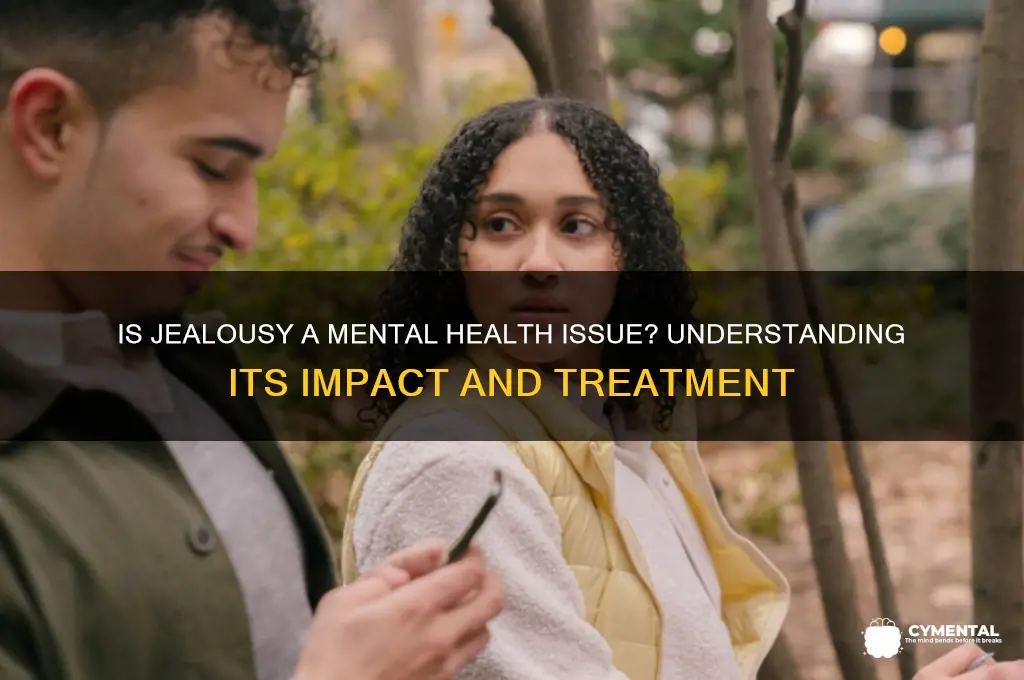
Jealousy, often viewed as a common human emotion, raises questions about its potential classification as a mental health issue when it becomes excessive, persistent, or debilitating. While mild jealousy is a normal reaction to perceived threats in relationships or personal achievements, its extreme forms—such as pathological jealousy or delusional jealousy—can significantly impair one’s functioning and well-being. These severe manifestations often involve irrational suspicions, obsessive thoughts, and behaviors that strain relationships and erode self-esteem. From a psychological perspective, such patterns may be linked to underlying conditions like anxiety disorders, borderline personality disorder, or even psychosis. Understanding whether jealousy crosses the line into a mental health concern requires examining its intensity, duration, and impact on daily life, prompting a closer look at its roots and potential interventions.
| Characteristics | Values |
|---|---|
| Definition | Jealousy is an emotional response to a perceived threat of losing something or someone valued, often involving fear, anger, or sadness. |
| Normal vs. Pathological | Mild jealousy is a common human emotion, but excessive, irrational, or uncontrollable jealousy may indicate an underlying mental health issue. |
| Associated Disorders | - Delusional Jealousy (Othello Syndrome): A subtype of delusional disorder where an individual has persistent, false beliefs of infidelity without evidence. - Obsessive-Compulsive Disorder (OCD): Jealousy can manifest as intrusive thoughts or compulsive behaviors. - Borderline Personality Disorder (BPD): Intense fear of abandonment can lead to extreme jealousy. - Anxiety and Depression: Chronic jealousy often co-occurs with these conditions. |
| Psychological Factors | - Low self-esteem - Insecurity - Past trauma or betrayal - Attachment issues |
| Behavioral Signs | - Excessive monitoring of partner’s activities - Accusations without evidence - Controlling behavior - Emotional outbursts or aggression |
| Impact on Relationships | Strains trust, communication, and intimacy; can lead to relationship breakdown. |
| Treatment Options | - Therapy: Cognitive Behavioral Therapy (CBT), couples therapy, or psychotherapy. - Medication: Antidepressants or antipsychotics for severe cases. - Self-Help: Building self-esteem, improving communication, and addressing underlying issues. |
| Prevention | Promoting healthy relationships, open communication, and addressing insecurities early. |
| Cultural Influence | Perceptions of jealousy vary culturally; some cultures normalize possessiveness, while others view it as unhealthy. |
| Gender Differences | Studies suggest men and women may experience jealousy differently, with men more likely to react to sexual infidelity and women to emotional infidelity. |
Explore related products


What You'll Learn

Jealousy vs. Envy: Key Differences
Jealousy and envy, often used interchangeably, are distinct emotions with unique triggers and manifestations. Jealousy arises when someone perceives a threat to a valued relationship, such as a romantic partner or close friend. For instance, feeling jealous when your partner spends time with an ex-lover involves fear of losing them. Envy, on the other hand, occurs when you desire something someone else possesses—be it a material object, a skill, or a status. Imagine envying a colleague’s promotion; here, the focus is on wanting what they have, not on a relationship threat. Understanding this difference is crucial, as misidentifying these emotions can lead to ineffective coping strategies.
To address jealousy or envy constructively, start by labeling the emotion accurately. If it’s jealousy, focus on strengthening the relationship through open communication and boundary-setting. For example, a 20-minute daily check-in with your partner can reduce insecurities. If it’s envy, channel that energy into self-improvement. Envy can be a motivator if reframed positively—use it to set specific, achievable goals, like dedicating 30 minutes daily to skill-building. However, caution is necessary: unchecked jealousy can escalate into possessiveness, while chronic envy may lead to resentment. Both, when extreme, can signal underlying mental health issues like anxiety or low self-esteem.
From a mental health perspective, jealousy becomes problematic when it turns obsessive or irrational, such as constantly monitoring a partner’s activities without cause. This behavior aligns with symptoms of conditions like Obsessive-Compulsive Disorder (OCD) or delusional jealousy, a symptom of psychosis. Envy, when persistent, can contribute to depression or anxiety, especially if it fosters a sense of inadequacy. Therapists often use Cognitive Behavioral Therapy (CBT) to help individuals challenge distorted thoughts driving these emotions. For instance, a CBT exercise might involve listing evidence against the belief that a partner is unfaithful, reducing jealousy’s grip.
Practically, distinguishing between jealousy and envy can guide healthier responses. If you’re jealous, ask yourself: “Is this fear based on evidence, or am I projecting insecurities?” If envious, reframe it as inspiration: “How can I work toward achieving something similar?” For parents, teaching children this difference fosters emotional intelligence. For example, instead of saying, “Stop being jealous,” help them articulate, “I feel sad because I want that toy too,” encouraging empathy and self-awareness. By addressing these emotions mindfully, individuals can prevent them from becoming detrimental to mental health.
In summary, while jealousy guards relationships and envy covets possessions or qualities, both can spiral into mental health challenges if mismanaged. Recognizing their triggers and employing targeted strategies—communication for jealousy, goal-setting for envy—can transform these emotions from destructive to constructive. Whether through therapy, self-reflection, or practical steps, understanding and navigating these differences is key to emotional well-being.
Gallbladder-Brain Connection: Uncovering Mental Health Links to Gallbladder Issues
You may want to see also
Explore related products


$49.15 $72.99

$10.49 $19.99


Jealousy’s Impact on Relationships
Jealousy, when unchecked, erodes trust—the cornerstone of any healthy relationship. It begins subtly: a lingering question about a partner’s whereabouts, a scrutinizing glance at their phone, or an offhand remark about a colleague. Over time, these behaviors signal insecurity, planting seeds of doubt in both parties. Trust, once compromised, becomes difficult to rebuild. A 2021 study published in the *Journal of Social and Personal Relationships* found that individuals who experienced chronic jealousy reported lower levels of relationship satisfaction and higher rates of conflict. The takeaway is clear: jealousy, if left unaddressed, can create a cycle of suspicion that undermines the very foundation of intimacy.
Consider the mechanics of jealousy in action. It often stems from a perceived threat—real or imagined—to one’s relationship. For instance, a partner might feel jealous when their significant other spends time with a friend, fearing emotional or physical attraction. This triggers a fight-or-flight response, leading to possessive behaviors like constant texting, monitoring social media, or demanding accountability for every minute. Such actions, while driven by fear, communicate a lack of confidence in the relationship. Over time, the targeted partner may feel suffocated, resentful, or even guilty for their independence. This dynamic shifts the relationship from a partnership to a power struggle, where one person seeks control and the other resists it.
To mitigate jealousy’s destructive potential, couples must adopt practical strategies. First, identify the root cause of the jealousy. Is it based on past experiences, low self-esteem, or genuine red flags? Open communication is key—express feelings without accusation, using “I” statements to avoid defensiveness. For example, “I feel anxious when you don’t respond to my texts” is more constructive than “You’re always ignoring me.” Second, establish boundaries that respect both partners’ autonomy. Agree on what constitutes appropriate behavior and what crosses the line. Third, focus on building self-worth. Jealousy often thrives in individuals who doubt their value. Engaging in hobbies, therapy, or self-improvement can reduce dependency on external validation.
Comparatively, healthy relationships view jealousy as a signal rather than a sentence. It’s an opportunity to address insecurities and strengthen the bond. For instance, a couple might use a jealous episode to discuss their commitment, reaffirming their love and priorities. In contrast, toxic relationships weaponize jealousy, using it to manipulate or control. The difference lies in intention: one seeks resolution, the other dominance. By reframing jealousy as a call to action rather than a flaw, couples can transform it from a relationship threat into a catalyst for growth.
Finally, recognize when jealousy becomes a mental health issue. Persistent, irrational jealousy—known as morbid jealousy or Othello syndrome—may indicate underlying conditions like anxiety, depression, or obsessive-compulsive disorder. If jealousy leads to paranoia, aggression, or constant surveillance, professional intervention is necessary. Therapies like cognitive-behavioral therapy (CBT) can help individuals challenge distorted thoughts and develop healthier coping mechanisms. For couples, joint counseling provides a safe space to explore triggers and rebuild trust. Addressing jealousy as both a relational and mental health concern ensures a holistic approach to healing.
Resigning with Compassion: Addressing Mental Health in Your Resignation Letter
You may want to see also
Explore related products


Clinical Signs of Pathological Jealousy
Jealousy, in its mildest form, is a common human emotion, often fleeting and manageable. However, when it becomes intense, irrational, and persistent, it can escalate into pathological jealousy—a condition that significantly disrupts an individual’s life and relationships. Recognizing the clinical signs of this disorder is crucial for early intervention and treatment. Pathological jealousy is not merely a heightened version of normal jealousy; it is a symptom of underlying mental health issues such as delusional disorder, obsessive-compulsive disorder (OCD), or severe anxiety. Below are key indicators that distinguish pathological jealousy from its benign counterpart.
Obsessive Thoughts and Behaviors: One of the most prominent clinical signs is the presence of intrusive, obsessive thoughts about a partner’s perceived infidelity, even in the absence of evidence. These thoughts are not fleeting but persistent, often leading to compulsive behaviors such as checking a partner’s phone, following them, or demanding constant reassurance. For example, a person might spend hours analyzing text messages or social media activity, seeking any hint of betrayal. This pattern resembles OCD, where the individual feels powerless to stop the cycle of doubt and verification. If these behaviors consume more than one hour a day or cause significant distress, professional help is warranted.
Paranoid Delusions: In severe cases, pathological jealousy can manifest as delusional disorder, subtype jealous type. Here, the individual holds an unshakable belief that their partner is unfaithful, despite overwhelming evidence to the contrary. These delusions are not influenced by cultural or religious beliefs but are instead fixed and false. For instance, a person might accuse their partner of having an affair based on a misinterpreted comment or gesture, and no amount of reasoning can alter their conviction. This symptom is particularly dangerous as it can lead to aggressive or violent behavior, necessitating immediate psychiatric evaluation.
Emotional and Physical Symptoms: Pathological jealousy often co-occurs with intense emotional distress, including anxiety, anger, and depression. Physical symptoms such as insomnia, weight loss, and fatigue may also be present. These symptoms are not merely reactions to relationship stress but are part of a broader psychological dysfunction. For example, a person might experience panic attacks when their partner is out of sight or develop somatic complaints like headaches and stomachaches due to chronic stress. If these symptoms persist for more than two weeks and interfere with daily functioning, it’s a red flag for pathological jealousy.
Impact on Relationships and Functioning: The final indicator is the profound impact on personal and social functioning. Pathological jealousy erodes trust, leading to constant conflict and emotional exhaustion for both partners. It can also impair work performance, social interactions, and overall quality of life. For instance, a person might avoid social gatherings out of fear their partner will interact with others or become so preoccupied with jealousy that they neglect responsibilities. If relationships or daily activities are severely compromised, it’s essential to seek therapy, such as cognitive-behavioral therapy (CBT), which has proven effective in managing obsessive thoughts and improving coping strategies.
In summary, pathological jealousy is marked by obsessive thoughts, paranoid delusions, severe emotional and physical symptoms, and significant impairment in functioning. Recognizing these signs early can prevent the condition from worsening and pave the way for effective treatment. If you or someone you know exhibits these symptoms, consult a mental health professional for a thorough assessment and tailored intervention.
Supporting Mental Health: Compassionate Ways to Encourage and Uplift Others
You may want to see also
Explore related products




Jealousy and Anxiety Disorders
Jealousy, when persistent and irrational, often intertwines with anxiety disorders, creating a cycle of distress that can be debilitating. Generalized Anxiety Disorder (GAD) and Obsessive-Compulsive Disorder (OCD) are two conditions where jealousy manifests as intrusive thoughts or compulsive behaviors. For instance, individuals with OCD may experience relentless doubts about a partner’s fidelity, leading to repetitive checking of their phone or social media—a ritual that temporarily alleviates anxiety but reinforces the obsession. Similarly, those with GAD might catastrophize minor interactions, imagining worst-case scenarios that fuel jealousy. Recognizing this link is crucial, as untreated anxiety can amplify jealous feelings, turning them from fleeting emotions into chronic mental health challenges.
To address jealousy rooted in anxiety disorders, cognitive-behavioral therapy (CBT) is a proven intervention. CBT helps individuals identify and challenge distorted thought patterns, such as "My partner will leave me if someone else talks to them." Therapists may use exposure and response prevention (ERP) for OCD-related jealousy, gradually exposing clients to anxiety-provoking situations without engaging in compulsive behaviors. For GAD, mindfulness techniques and relaxation exercises can reduce the hypervigilance that often accompanies jealous thoughts. Medications like selective serotonin reuptake inhibitors (SSRIs) may also be prescribed, particularly for OCD, to manage symptoms at a neurochemical level. Combining therapy and medication can provide a comprehensive approach to breaking the jealousy-anxiety cycle.
A comparative analysis reveals that jealousy in anxiety disorders differs from normative jealousy in intensity, frequency, and impact. While occasional jealousy is a common human emotion, anxiety-driven jealousy is disproportionate and resistant to logic. For example, a person with anxiety might feel threatened by a partner’s friendship with a coworker, even with no evidence of romantic involvement. This contrasts with situational jealousy, which arises from specific, observable behaviors. Understanding this distinction is key to determining when jealousy crosses into pathological territory and requires professional intervention.
Practical tips for managing jealousy-related anxiety include setting boundaries with technology, such as limiting social media use to reduce triggers. Journaling can help individuals reflect on the irrationality of their thoughts, while communication with partners fosters transparency and trust. For severe cases, support groups provide a sense of community and shared experience. Importantly, self-compassion is essential; acknowledging that jealousy is a symptom of anxiety, not a character flaw, can reduce self-blame and encourage proactive treatment. By addressing both the emotional and cognitive aspects of jealousy, individuals can regain control over their mental health.
Reclaim Your Energy: Strategies to Overcome Mental Health Fatigue and Boost Motivation
You may want to see also
Explore related products

$9.99 $13.99


Treatment Options for Excessive Jealousy
Excessive jealousy, when it becomes intrusive and distressing, often warrants targeted intervention. Cognitive Behavioral Therapy (CBT) stands as a frontline treatment, helping individuals identify and reframe irrational thoughts that fuel jealous behaviors. For instance, a therapist might guide a client to challenge the belief, “My partner will leave me if they talk to others,” by examining evidence and developing more balanced perspectives. Sessions typically occur weekly for 12–16 weeks, with homework assignments reinforcing skills like thought recording and behavioral experiments.
Pharmacological interventions may complement therapy, particularly when jealousy coexists with conditions like anxiety or depression. Selective serotonin reuptake inhibitors (SSRIs), such as fluoxetine (20–60 mg/day) or sertraline (50–200 mg/day), can reduce obsessive symptoms and emotional reactivity. However, medication alone rarely addresses the cognitive distortions driving jealousy, making it most effective when paired with psychotherapy. Always consult a psychiatrist to tailor dosages and monitor side effects, especially in adolescents or older adults.
For couples grappling with relational jealousy, conjoint therapy offers a structured approach to improve communication and rebuild trust. Techniques like the “speaker-listener” exercise encourage partners to express concerns without interruption, fostering empathy and reducing defensiveness. Couples typically attend 8–12 sessions, with progress contingent on both parties’ commitment to transparency and change. Practical tips include scheduling “trust-building” activities, such as shared hobbies or open discussions about boundaries, outside of therapy.
Mindfulness-based interventions provide another avenue, teaching individuals to observe jealous feelings without reacting impulsively. Practices like body scans or mindful breathing can be integrated into daily routines, even in 5–10 minute increments. Apps like Headspace or Calm offer guided sessions, though in-person training with a certified instructor ensures proper technique. Over time, mindfulness cultivates emotional regulation, reducing the intensity of jealous episodes and enhancing overall well-being.
Finally, support groups—whether in-person or online—offer a sense of community and accountability. Sharing experiences with others who understand the struggle normalizes feelings of shame and isolation. Groups often follow a structured format, such as the 12-step model adapted for jealousy, emphasizing self-reflection and progressive goals. While not a standalone treatment, they reinforce skills learned in therapy and provide ongoing encouragement for long-term management.
Supporting Teens: Navigating Mental Health Challenges with Compassion and Care
You may want to see also
Frequently asked questions
No, jealousy is a normal human emotion when experienced in moderation. However, excessive or uncontrollable jealousy may indicate underlying mental health issues such as anxiety, low self-esteem, or borderline personality disorder.
Jealousy itself is not a standalone mental disorder, but it can be a symptom of conditions like delusional jealousy (Othello syndrome) or obsessive-compulsive disorder (OCD) when it becomes irrational and persistent.
If jealousy interferes with your daily life, relationships, or causes distress, it may be a mental health concern. Signs include constant suspicion, obsessive thoughts, or controlling behavior despite evidence to the contrary.
Yes, jealousy often coexists with anxiety and depression. It can stem from insecurities, fear of abandonment, or low self-worth, which are common symptoms of these mental health conditions.
Yes, therapy, particularly cognitive-behavioral therapy (CBT), can help address the root causes of unhealthy jealousy, improve self-esteem, and develop healthier coping strategies for managing emotions.



![Envy [Blu-ray]](https://m.media-amazon.com/images/I/81JJI1FTMjL._AC_UL320_.jpg)