Madison Cole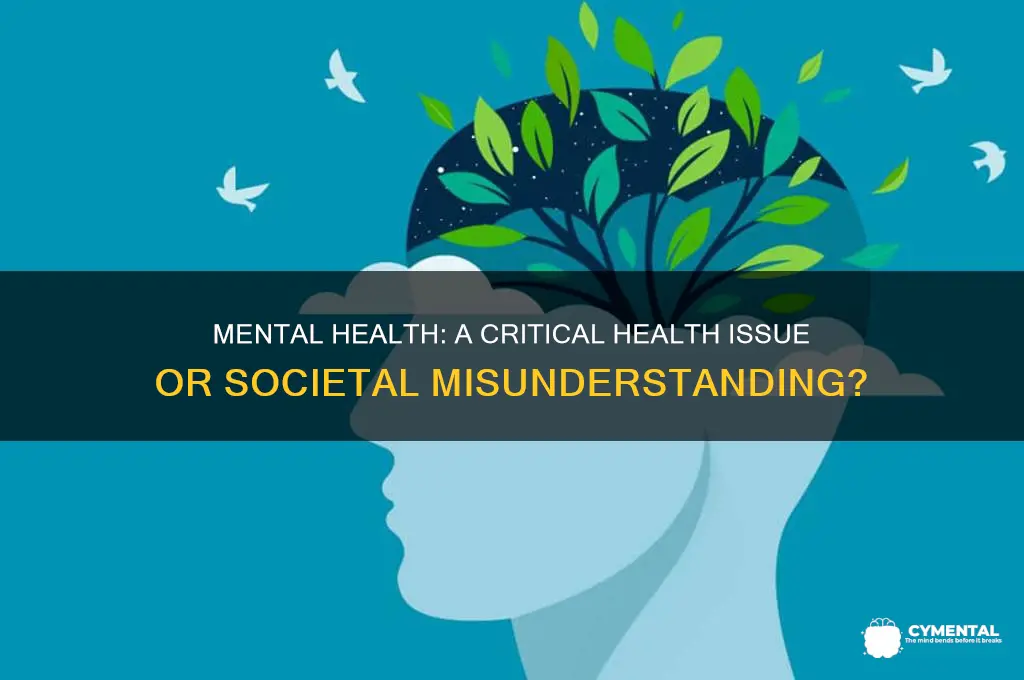
Mental health is undeniably a critical component of overall health, yet its classification as a health issue often sparks debate. While physical ailments are typically more visible and measurable, mental health conditions—such as depression, anxiety, and schizophrenia—affect millions worldwide, impacting their daily functioning, relationships, and quality of life. The World Health Organization (WHO) explicitly recognizes mental health as an integral part of health, emphasizing that there is no health without mental health. However, societal stigma, inadequate resources, and a lack of understanding often marginalize mental health concerns, leading to questions about its prioritization within healthcare systems. Addressing mental health as a legitimate health issue is essential for fostering holistic well-being and ensuring equitable access to care.
Explore related products



What You'll Learn

Stigma Surrounding Mental Health
Mental health is unequivocally a health issue, yet stigma remains its most insidious barrier to treatment and understanding. Despite advancements in medical science and public awareness, the perception of mental illness as a personal failing or weakness persists, deterring millions from seeking help. This stigma manifests in various forms: social exclusion, workplace discrimination, and even self-imposed silence due to fear of judgment. For instance, a 2021 study by the World Health Organization revealed that nearly two-thirds of individuals with mental health conditions avoid treatment due to anticipated stigma. This reluctance exacerbates symptoms, delays recovery, and perpetuates a cycle of suffering.
Consider the language often used to describe mental health struggles. Phrases like "just snap out of it" or "you’re overreacting" trivialize conditions such as depression or anxiety, reducing them to mere mood swings rather than legitimate medical issues. This dismissive tone not only invalidates the experiences of those affected but also reinforces harmful stereotypes. To combat this, individuals and organizations must adopt precise, empathetic language. For example, instead of saying "he’s bipolar," use "he lives with bipolar disorder," emphasizing the condition as a part of the person’s life, not their identity.
Stigma also thrives in systemic gaps, particularly in healthcare and education. Mental health services are often underfunded and inaccessible, particularly in low-income communities. Schools frequently lack curricula that normalize mental health discussions, leaving young people ill-equipped to recognize symptoms in themselves or others. A practical step toward change is integrating mental health education into standard school programs, starting as early as age 10. Teach students to identify signs of distress, practice self-care, and support peers without judgment. Simultaneously, policymakers must allocate resources to ensure affordable, culturally sensitive mental health services for all demographics.
Finally, stigma is not just an external force—it often internalizes, leading to self-stigma. Individuals may believe they are unworthy of help or fear becoming a burden to others. This internalized shame can be as debilitating as the condition itself. To address this, peer support groups and storytelling platforms play a crucial role. Sharing personal narratives of recovery humanizes mental health struggles and fosters a sense of community. For example, campaigns like "Time to Change" in the UK have successfully reduced stigma by amplifying lived experiences. By normalizing these conversations, society can dismantle the silence that perpetuates stigma and encourage proactive care.
Unveiling Stigma: How Society Treats Mental Health Struggles
You may want to see also
Explore related products


Physical vs. Mental Health Prioritization
Mental health is undeniably a health issue, yet its prioritization often lags behind physical health in both societal awareness and healthcare systems. While physical ailments like broken bones or chronic diseases are immediately visible and quantifiable, mental health struggles—anxiety, depression, PTSD—are frequently dismissed as intangible or less urgent. This disparity is evident in healthcare spending: globally, only 2% of health budgets are allocated to mental health, despite it accounting for 13% of the global burden of disease. Such underinvestment perpetuates a cycle where mental health issues are undertreated, leading to worsening physical health outcomes, as the two are inextricably linked.
Consider the practical implications of this prioritization gap. A 45-year-old with hypertension is likely to receive regular check-ups, medication adjustments, and lifestyle advice. In contrast, someone of the same age suffering from chronic depression may face barriers to accessing therapy, long wait times for psychiatric appointments, and limited insurance coverage for mental health services. This imbalance is not just unfair—it’s counterproductive. Untreated depression, for instance, increases the risk of cardiovascular disease by 64%, highlighting how neglecting mental health directly impacts physical well-being. Prioritizing one over the other is not just a matter of focus; it’s a matter of holistic health.
To bridge this gap, individuals and institutions must adopt a dual-pronged approach. First, integrate mental health screenings into routine physical check-ups. For example, a 30-year-old visiting their primary care physician for a yearly physical should also be assessed for signs of anxiety or burnout using validated tools like the GAD-7 or PHQ-9. Second, employers can play a pivotal role by offering mental health days alongside sick days, normalizing the idea that mental health deserves the same attention as physical health. Practical steps like these not only destigmatize mental health but also create a framework for early intervention.
However, prioritization isn’t just about systems—it’s about mindset. Society often equates productivity with physical health, overlooking the fact that mental health is equally critical to functioning. A software engineer with carpal tunnel syndrome would receive ergonomic adjustments, but the same engineer struggling with burnout might be told to “tough it out.” This double standard must change. By reframing mental health as a non-negotiable component of overall health, we can foster a culture where seeking help for emotional pain is as accepted as seeking help for physical pain.
Ultimately, the physical vs. mental health prioritization debate is a false dichotomy. Both are essential, and neglecting one undermines the other. Take, for instance, a 60-year-old with diabetes: managing their blood sugar requires not just medication but also stress reduction, as cortisol levels directly impact glucose regulation. This example underscores the need for a unified approach—one that treats the mind and body as interconnected, not isolated entities. Prioritizing mental health isn’t just about fairness; it’s about effectiveness. After all, a healthy mind is the foundation of a healthy life.
Racism and Mental Health: Unraveling the Psychological Roots of Prejudice
You may want to see also
Explore related products




Access to Mental Health Care
Mental health is unequivocally a health issue, yet access to care remains fragmented and inequitable. Globally, nearly one billion people live with a mental health disorder, yet 75% in low-income countries receive no treatment. Even in high-income nations, barriers persist: in the U.S., 56% of adults with mental illness received no care in 2022. This disparity underscores a systemic failure to treat mental health with the same urgency as physical health, despite its profound impact on overall well-being and societal functioning.
Consider the logistical hurdles: in rural areas, 85% of counties in the U.S. lack a practicing psychiatrist, forcing individuals to travel hours for care. Urban centers fare little better, with long wait times—often 2–3 months—for therapy appointments. Telehealth emerged as a solution during the pandemic, but only 40% of mental health providers offer virtual services, and digital access remains limited for older adults and low-income populations. These gaps highlight the need for infrastructure that prioritizes geographic and technological accessibility.
Cost is another prohibitive factor. In the U.S., out-of-pocket expenses for therapy sessions average $65–$250 per hour, and medication costs can exceed $1,000 annually without insurance. Even with coverage, high deductibles and limited provider networks restrict options. Contrast this with physical health care, where emergency services are mandated by law. Mental health care lacks such protections, leaving many to forgo treatment due to financial strain. Policy reforms, such as parity laws and subsidized care, are essential to bridge this gap.
Stigma compounds these barriers, deterring individuals from seeking help. In a 2021 WHO survey, 40% of respondents cited fear of judgment as a reason for avoiding mental health services. Cultural misconceptions, particularly in collectivist societies, often equate mental illness with personal weakness or spiritual failure. Public awareness campaigns, like the UK’s "Time to Change," have reduced stigma by 5% annually since 2009, demonstrating the power of education and normalization. Integrating mental health screenings into primary care could further destigmatize access, treating it as routine rather than exceptional.
Finally, workforce shortages cripple the system. The global shortage of mental health professionals is projected to reach 4.3 million by 2030. Task-sharing models, where non-specialists deliver evidence-based interventions under supervision, have shown promise in low-resource settings. For instance, Zimbabwe’s Friendship Bench program trained lay health workers to provide problem-solving therapy, reducing depression symptoms in 70% of participants. Scaling such initiatives could democratize access while addressing workforce gaps.
In conclusion, access to mental health care is a multifaceted crisis demanding targeted solutions. From expanding telehealth to reforming insurance policies, dismantling stigma, and innovating workforce strategies, each step must be deliberate and inclusive. Mental health is a health issue—treating it as such requires not just acknowledgment, but action.
Rising Mental Health Challenges: Analyzing the Surge Since 2000
You may want to see also
Explore related products


$10.79 $19.99


Mental Health as a Public Issue
Mental health is unequivocally a health issue, but its classification as a public issue demands a shift in perspective—from individual responsibility to collective accountability. Public health issues are those that transcend personal boundaries, impacting communities, economies, and societal structures. Mental health fits this criterion because untreated conditions like depression, anxiety, or schizophrenia ripple outward, affecting productivity, healthcare costs, and social cohesion. For instance, the World Health Organization estimates that depression and anxiety disorders cost the global economy $1 trillion annually in lost productivity. This is not merely a private struggle; it is a societal burden that requires systemic intervention.
Consider the analogy of infectious diseases: just as vaccinations protect communities through herd immunity, addressing mental health at a public level creates a resilient societal fabric. Schools, workplaces, and healthcare systems must integrate mental health screenings and support services as standard practice. For example, in Finland, schools implement the "KiVa" anti-bullying program, which includes mental health education, reducing anxiety and depression in adolescents by 25%. Such initiatives demonstrate that prevention and early intervention are not only feasible but cost-effective, saving an estimated $10 for every $1 invested, according to the National Institute of Mental Health.
However, treating mental health as a public issue also requires dismantling stigma, a barrier as insidious as any pathogen. Stigma isolates individuals, delays treatment, and perpetuates misconceptions. Public campaigns like Australia’s "RUOK?" encourage open conversations about mental health, normalizing vulnerability and seeking help. Pairing awareness with actionable steps—such as training gatekeepers (teachers, managers, clergy) in Mental Health First Aid—transforms passive concern into active support. These measures are not optional; they are essential components of a public health strategy.
A critical aspect of this public approach is equity. Mental health disparities disproportionately affect marginalized groups—low-income communities, racial minorities, and LGBTQ+ individuals—due to systemic barriers like limited access to care and higher stress burdens. Addressing mental health as a public issue necessitates targeted policies, such as subsidizing therapy for underserved populations or integrating culturally competent care models. For instance, the UK’s "Improving Access to Psychological Therapies" program prioritizes accessibility, reducing wait times to under 6 weeks for 90% of patients. Such initiatives underscore that equity is not an afterthought but a cornerstone of public mental health.
Finally, the public nature of mental health demands cross-sector collaboration. Governments, employers, educators, and healthcare providers must align efforts to create supportive environments. For example, companies like Unilever and Google have implemented workplace wellness programs, including free counseling and stress management workshops, yielding a 20% increase in employee satisfaction and a 15% reduction in absenteeism. Similarly, integrating mental health into primary care—as seen in India’s "Manodarpan" initiative, which offers tele-counseling for students—bridges gaps in access. These examples illustrate that mental health is not a siloed issue but a shared responsibility, requiring coordinated action to foster healthier, more resilient societies.
Supporting Your Spouse: Navigating Mental Health Challenges Together with Compassion
You may want to see also
Explore related products


$14.2 $24.95


Integration with Physical Healthcare Systems
Mental health is undeniably a health issue, yet its integration with physical healthcare systems remains fragmented. This disconnect perpetuates stigma, delays treatment, and worsens outcomes for patients with co-occurring physical and mental health conditions. Consider this: a patient with diabetes is twice as likely to experience depression, yet only a fraction receive adequate mental health care within their primary care setting. This example underscores the urgent need for seamless integration.
Step 1: Embed Mental Health Screening in Routine Care
Primary care visits are often the first point of contact for patients. Incorporate standardized mental health screenings, such as the PHQ-9 for depression or GAD-7 for anxiety, into annual physicals or chronic disease management appointments. For instance, a 50-year-old patient with hypertension should also be screened for depressive symptoms, as untreated mental health issues can exacerbate blood pressure control.
Caution: Avoid Overburdening Providers
While screening is critical, primary care providers (PCPs) often lack the time or expertise to address complex mental health needs. Implement a tiered care model: PCPs handle mild cases with brief interventions (e.g., 5–10 minutes of motivational interviewing), while moderate to severe cases are referred to embedded mental health professionals within the same clinic.
Step 2: Leverage Collaborative Care Models
Collaborative care, a team-based approach involving PCPs, care managers, and psychiatrists, has proven effective in treating conditions like depression and anxiety. For example, a care manager might follow up weekly with a patient prescribed an SSRI (e.g., 20 mg of fluoxetine daily) to monitor side effects and adherence, while a consulting psychiatrist adjusts the treatment plan remotely.
Analysis: Cost vs. Benefit
While initial setup costs for integrated care models can be high, studies show a return on investment through reduced hospitalizations and improved productivity. For instance, a 2018 study found that collaborative care reduced depression-related healthcare costs by 25% over two years.
Step 3: Train Physical Healthcare Staff in Mental Health Basics
PCPs and nurses should receive training in mental health first aid and evidence-based interventions. For example, a nurse managing a patient with chronic pain could incorporate cognitive-behavioral techniques to address associated anxiety, reducing the need for opioid prescriptions.
Practical Tip: Use Technology to Bridge Gaps
Telehealth platforms and integrated electronic health records (EHRs) can facilitate communication between physical and mental health providers. A PCP could instantly consult a psychiatrist via EHR messaging to discuss a patient’s medication regimen, ensuring coordinated care.
Treating mental health as separate from physical health is outdated and harmful. By embedding mental health care into physical healthcare systems, we can address the whole person, improve outcomes, and reduce the economic burden of untreated mental illness. Start small—with screening tools and staff training—and scale up to collaborative care models. The goal is clear: make integrated care the norm, not the exception.
Cannibalism and Mental Health: Unraveling the Complex Psychological Factors
You may want to see also
Frequently asked questions
Yes, mental health is a critical component of overall health, recognized by organizations like the World Health Organization (WHO) as essential to well-being.
Absolutely. Mental health issues can significantly impact daily functioning, relationships, and physical health, often requiring professional treatment and support.
Yes, mental health problems are treatable through therapy, medication, lifestyle changes, and other evidence-based interventions, similar to physical health conditions.
Yes, mental health is a core part of healthcare, and healthcare systems are increasingly integrating mental health services into primary care and specialized treatment programs.