Ava Ramirez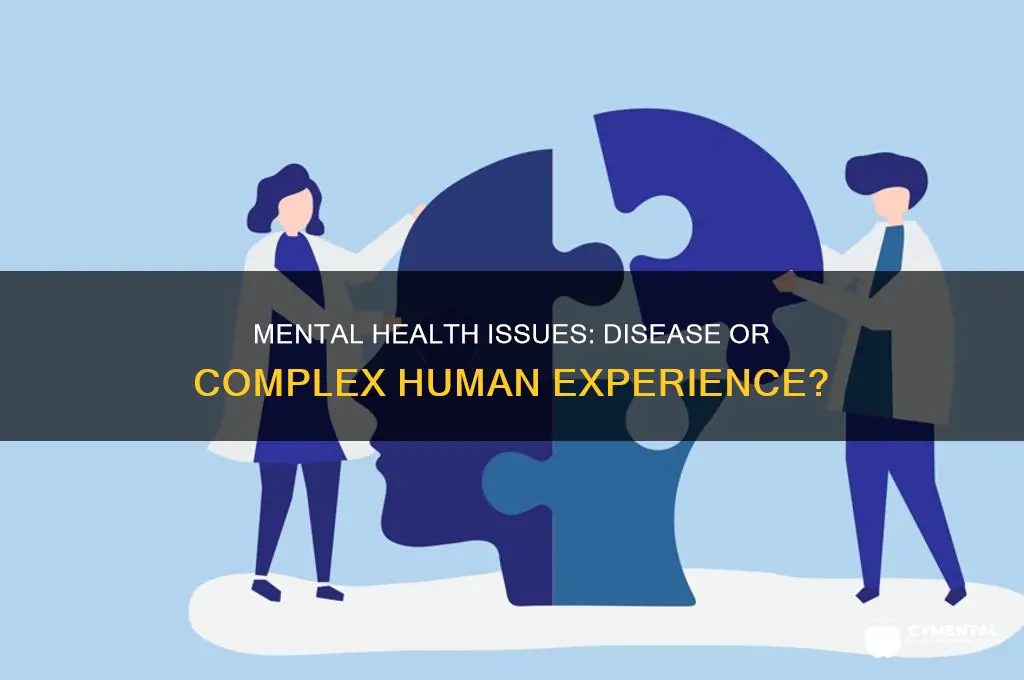
Mental health issues have long been a subject of debate, with questions arising about whether they should be classified as diseases. This discussion is rooted in the complex interplay between biological, psychological, and social factors that contribute to conditions like depression, anxiety, and schizophrenia. While some argue that mental health disorders are diseases due to their genetic and neurological underpinnings, others emphasize the role of environmental stressors and personal experiences, suggesting they are better understood as responses to life circumstances rather than purely medical conditions. This debate has significant implications for treatment approaches, stigma reduction, and the allocation of healthcare resources, highlighting the need for a nuanced understanding of mental health in both scientific and societal contexts.
Explore related products



What You'll Learn
- Biological Factors: Genetic predisposition, brain chemistry, and neurological differences contributing to mental health conditions
- Environmental Triggers: Stress, trauma, and societal pressures as catalysts for mental health issues
- Medical Classification: DSM-5 and ICD-11 criteria defining mental disorders as diagnosable conditions
- Stigma and Perception: Societal views on mental health as illness versus personal weakness
- Treatment Approaches: Medication, therapy, and lifestyle changes as disease management strategies

Biological Factors: Genetic predisposition, brain chemistry, and neurological differences contributing to mental health conditions
Mental health conditions are not solely the result of personal weakness or environmental stressors; biological factors play a significant role in their development. Among these, genetic predisposition stands out as a critical determinant. Research shows that certain mental health disorders, such as schizophrenia, bipolar disorder, and major depressive disorder, have a heritability rate of 60-80%. This means that if a close family member has one of these conditions, your risk of developing it increases significantly. For instance, having a parent with schizophrenia elevates your risk from the general population’s 1% to about 10%. Understanding this genetic link is crucial for early intervention and personalized treatment strategies.
Brain chemistry imbalances are another biological factor that contributes to mental health conditions. Neurotransmitters like serotonin, dopamine, and norepinephrine regulate mood, emotion, and cognition. When these chemicals are out of balance, it can lead to disorders such as depression or anxiety. For example, low serotonin levels are often associated with depression, which is why selective serotonin reuptake inhibitors (SSRIs) like fluoxetine (Prozac) are commonly prescribed. These medications work by increasing serotonin availability in the brain, often at dosages ranging from 20 to 60 mg daily for adults. However, it’s essential to note that medication effectiveness varies, and a trial-and-error approach under professional guidance is often necessary.
Neurological differences also play a pivotal role in mental health conditions. Structural and functional abnormalities in the brain, such as reduced volume in the hippocampus (linked to depression) or hyperactivity in the amygdala (associated with anxiety), are observed in neuroimaging studies. For instance, individuals with post-traumatic stress disorder (PTSD) often show heightened amygdala activity during emotional processing tasks. These findings underscore the importance of neuroplasticity-focused interventions, such as cognitive-behavioral therapy (CBT) or mindfulness practices, which can help rewire neural pathways over time. Practical tips include engaging in regular physical activity, which promotes brain-derived neurotrophic factor (BDNF) production, a protein essential for neuronal growth and repair.
While biological factors are significant, they do not act in isolation. The interplay between genetics, brain chemistry, and neurological differences often requires a multifaceted treatment approach. For children and adolescents, early screening for genetic markers or neurological anomalies can be beneficial, especially if there’s a family history of mental health conditions. Adults can benefit from lifestyle modifications, such as maintaining a balanced diet rich in omega-3 fatty acids, which support brain health, and avoiding excessive alcohol or caffeine, which can exacerbate chemical imbalances. Ultimately, recognizing the biological underpinnings of mental health conditions empowers individuals to seek targeted, evidence-based treatments and fosters a more compassionate understanding of these disorders.
Supporting Your Adult Son: Navigating Mental Health Challenges Together
You may want to see also
Explore related products


Environmental Triggers: Stress, trauma, and societal pressures as catalysts for mental health issues
Stress, trauma, and societal pressures are not mere background noise in the lives of individuals; they are active agents that can ignite or exacerbate mental health issues. Consider the workplace, where chronic stress from long hours, job insecurity, or toxic environments has been linked to a 50% increased risk of developing depression or anxiety disorders. The American Psychological Association reports that one in three workers experiences chronic work stress, a statistic that underscores the pervasive nature of this environmental trigger. Unlike genetic predispositions, which are immutable, these external factors are often within the realm of influence, making them critical targets for prevention and intervention.
Trauma, another potent environmental trigger, operates on a spectrum—from acute incidents like accidents or assaults to prolonged exposure to adverse childhood experiences (ACEs). Studies show that individuals with four or more ACEs are 12 times more likely to attempt suicide, four times more likely to become depressed, and twice as likely to develop heart disease. The brain’s response to trauma, particularly in early developmental stages, can rewire neural pathways, creating a heightened sensitivity to stress and a predisposition to mental health disorders. This is not a sign of weakness but a biological adaptation to survival, one that demands understanding and targeted therapeutic approaches like trauma-focused cognitive behavioral therapy (TF-CBT).
Societal pressures, often subtle yet relentless, contribute uniquely to mental health issues by imposing unattainable standards and fostering a culture of comparison. For instance, the rise of social media has been correlated with increased rates of anxiety and depression, particularly among adolescents. A 2021 study found that teens who spent more than three hours a day on social media were at a 60% higher risk of reporting symptoms of depression. These platforms amplify societal expectations around appearance, success, and happiness, creating a breeding ground for self-doubt and inadequacy. Unlike stress or trauma, which can often be localized and addressed, societal pressures are systemic, requiring both individual resilience-building and broader cultural shifts.
Addressing these environmental triggers requires a multi-faceted approach. For stress, practical strategies include setting boundaries at work, practicing mindfulness, and engaging in regular physical activity—even 30 minutes of moderate exercise daily can reduce symptoms of anxiety by 25%. Trauma survivors benefit from evidence-based therapies like Eye Movement Desensitization and Reprocessing (EMDR), which has shown a 77% success rate in resolving PTSD symptoms. To combat societal pressures, individuals can curate their social media feeds to include positive, diverse content and engage in community activities that foster a sense of belonging. Policymakers, meanwhile, must address systemic issues like workplace protections and media literacy education to create a more supportive environment.
The takeaway is clear: mental health issues are not solely diseases of the mind but are deeply intertwined with the environments in which we live. By recognizing stress, trauma, and societal pressures as catalysts, we shift the narrative from individual pathology to collective responsibility. This perspective not only empowers individuals to take actionable steps but also calls for societal changes that prioritize mental well-being. After all, prevention is not just about treating symptoms—it’s about transforming the conditions that allow those symptoms to emerge in the first place.
Navigating Fame and Mental Health: Strategies for Ethical Visibility
You may want to see also
Explore related products


Medical Classification: DSM-5 and ICD-11 criteria defining mental disorders as diagnosable conditions
Mental health issues are increasingly recognized as diagnosable conditions, thanks to standardized medical classification systems like the DSM-5 (Diagnostic and Statistical Manual of Mental Disorders, 5th edition) and ICD-11 (International Classification of Diseases, 11th revision). These frameworks provide clinicians with criteria to identify, diagnose, and treat mental disorders, positioning them within the broader medical landscape. By defining symptoms, duration, and functional impact, these systems bridge the gap between subjective experiences and objective medical assessment.
The DSM-5, published by the American Psychiatric Association, categorizes mental disorders based on symptom clusters and clinical thresholds. For example, Major Depressive Disorder requires at least five symptoms (e.g., persistent sadness, loss of interest) present for two weeks, with one being either depressed mood or anhedonia. Similarly, Generalized Anxiety Disorder is diagnosed when excessive worry occurs more days than not for at least six months, accompanied by symptoms like restlessness or sleep disturbance. These criteria ensure consistency across diagnoses, enabling targeted treatment plans, such as selective serotonin reuptake inhibitors (SSRIs) at dosages like 20–40 mg/day for depression.
In contrast, the ICD-11, developed by the World Health Organization, emphasizes a global perspective, integrating cultural and contextual factors. It introduces dimensional assessments, such as the severity of depressive symptoms (mild, moderate, severe), and includes new diagnoses like Complex PTSD and Gaming Disorder. For instance, Gaming Disorder is diagnosed when gaming behavior takes precedence over other activities, continues despite negative consequences, and persists for at least 12 months. This approach aligns with international healthcare systems, facilitating cross-cultural research and treatment.
A key distinction between the two systems lies in their structure and application. While the DSM-5 is widely used in clinical practice and research in the United States, the ICD-11 serves as the global standard for health statistics and insurance coding. For example, a clinician in the U.S. might diagnose a patient with "Bipolar I Disorder" using DSM-5 criteria, while a colleague in Europe would code the same condition as "Bipolar Disorder, current episode manic" under ICD-11. Despite differences, both systems aim to reduce diagnostic ambiguity and improve patient outcomes.
Practical tips for clinicians include cross-referencing DSM-5 and ICD-11 criteria to ensure comprehensive assessment, especially in multicultural settings. For patients, understanding these classifications can demystify diagnoses and foster collaboration in treatment planning. For example, a patient diagnosed with Social Anxiety Disorder (DSM-5) or "Anxiety or Fear-Related Disorders" (ICD-11) might explore cognitive-behavioral therapy or medications like SSRIs, tailored to their symptom severity and functional impairment.
In conclusion, the DSM-5 and ICD-11 criteria are indispensable tools for defining mental disorders as diagnosable conditions. By standardizing diagnosis, they enable evidence-based treatment, research, and policy-making. While debates about the "disease" label persist, these systems underscore the medical legitimacy of mental health issues, paving the way for improved care and societal understanding.
Imagining Non-Existent People: Mental Health Concern or Creative Expression?
You may want to see also
Explore related products


Stigma and Perception: Societal views on mental health as illness versus personal weakness
Mental health issues are often framed as either a medical condition or a personal failing, a dichotomy that shapes societal attitudes and individual behaviors. This binary perspective—illness versus weakness—perpetuates stigma, influencing how people seek help, how they are treated, and how they perceive themselves. Understanding this divide is crucial for dismantling barriers to care and fostering empathy.
Consider the language used in everyday conversations. Phrases like "just snap out of it" or "they’re being dramatic" reflect a perception of mental health struggles as a matter of willpower rather than a legitimate health concern. This narrative is reinforced by cultural norms that equate emotional resilience with strength, leaving little room for vulnerability. For instance, in many workplaces, taking a mental health day is still viewed with skepticism, while physical ailments are readily accepted as valid reasons for absence. Such attitudes discourage individuals from acknowledging their struggles, fearing judgment or professional repercussions.
Contrast this with the medical model, which categorizes mental health issues as diagnosable conditions with biological, psychological, and environmental roots. Disorders like depression, anxiety, and schizophrenia are recognized in diagnostic manuals such as the DSM-5, often treated with therapies, medications, and lifestyle adjustments. For example, selective serotonin reuptake inhibitors (SSRIs) are prescribed to manage depression, with dosages typically starting at 10–20 mg daily for adults, adjusted based on response and tolerance. This approach validates the experiences of those suffering, offering a framework for treatment and recovery. Yet, even within this model, stigma persists, as some view medication or therapy as a crutch rather than a necessary intervention.
The tension between these perspectives highlights a deeper societal issue: the reluctance to treat mental health with the same urgency and compassion as physical health. A broken leg is visible, its treatment straightforward, and its recovery measurable. Mental health, however, is often invisible, its symptoms subjective, and its healing nonlinear. This disparity fuels misconceptions, such as the belief that mental illness is a choice or a sign of moral weakness. For adolescents, this stigma can be particularly damaging, as 50% of mental health conditions emerge by age 14, yet only 20% receive the care they need, often due to fear of being labeled "weak" or "different."
To bridge this gap, education and advocacy are essential. Campaigns like the World Health Organization’s "Mental Health Action Plan" emphasize destigmatization through awareness and community engagement. Practical steps include incorporating mental health literacy into school curricula, training employers to recognize signs of distress, and promoting open dialogue in media and public discourse. For individuals, small actions like using neutral language ("they’re managing anxiety" instead of "they’re anxious") can shift perceptions. Ultimately, reframing mental health as a universal aspect of human experience, rather than a binary of illness or weakness, is key to fostering a more compassionate and informed society.
Navigating Mental Health Conversations with Your Boss: Tips for Success
You may want to see also
Explore related products


Treatment Approaches: Medication, therapy, and lifestyle changes as disease management strategies
Mental health issues are increasingly recognized as conditions that can be managed effectively through a combination of medication, therapy, and lifestyle changes. While the debate over whether they qualify as diseases continues, the focus has shifted toward practical strategies that alleviate symptoms and improve quality of life. Each approach targets different aspects of mental health, and their integration often yields the most comprehensive results.
Medication serves as a cornerstone for many individuals, particularly those with severe or persistent symptoms. For example, selective serotonin reuptake inhibitors (SSRIs) like fluoxetine (Prozac) or sertraline (Zoloft) are commonly prescribed for depression and anxiety disorders. Dosages typically start low—10–20 mg daily for adults—and are adjusted based on response and side effects. Antipsychotics such as quetiapine (Seroquel) or aripiprazole (Abilify) may be used for conditions like bipolar disorder or schizophrenia, often at doses ranging from 50 to 300 mg daily. It’s crucial to monitor for side effects, such as weight gain or drowsiness, and to follow a psychiatrist’s guidance for tapering or discontinuation to avoid withdrawal symptoms. Medication is not a one-size-fits-all solution but a tailored intervention that requires patience and collaboration with a healthcare provider.
Therapy complements medication by addressing underlying thought patterns and behaviors. Cognitive-behavioral therapy (CBT) is widely used for conditions like depression, anxiety, and PTSD, focusing on identifying and changing negative thought cycles. For instance, a therapist might help a client reframe catastrophic thinking ("I’ll never succeed") into more balanced perspectives ("I can take steps to improve"). Dialectical behavior therapy (DBT) is particularly effective for borderline personality disorder, teaching skills like emotional regulation and mindfulness. Therapy sessions typically last 45–60 minutes and may occur weekly or biweekly. While progress can be gradual, consistent engagement often leads to lasting changes in coping mechanisms and emotional resilience.
Lifestyle changes form the third pillar of mental health management, emphasizing the role of daily habits in symptom reduction. Regular physical activity, such as 30 minutes of moderate exercise five times a week, has been shown to reduce symptoms of depression and anxiety by boosting endorphins and improving sleep. Dietary adjustments, like increasing omega-3 fatty acids (found in fish, flaxseeds, and walnuts) and reducing processed sugars, can also support brain health. Sleep hygiene—maintaining a consistent sleep schedule, limiting screen time before bed, and creating a restful environment—is critical, as poor sleep exacerbates mental health issues. Mindfulness practices, such as meditation or yoga, can further enhance emotional stability. These changes require commitment but offer the added benefit of improving overall physical health.
Integrating these approaches requires a personalized strategy. For a 35-year-old with generalized anxiety disorder, for instance, a treatment plan might include 20 mg of escitalopram daily, weekly CBT sessions, and a routine of morning jogging and evening meditation. Regular check-ins with a psychiatrist and therapist ensure adjustments are made as needed. While medication provides biochemical support, therapy equips individuals with tools to navigate challenges, and lifestyle changes create a foundation for sustained well-being. Together, they transform mental health management from a reactive process into a proactive, holistic practice.
Bullying and Mental Health: Unraveling the Complex Connection and Impact
You may want to see also
Frequently asked questions
Mental health issues are often classified as disorders or illnesses rather than diseases in the traditional sense. They are recognized as medical conditions that affect thoughts, emotions, and behaviors, and are typically diagnosed and treated by mental health professionals.
While some mental health issues can be effectively managed or resolved with treatment, others may require ongoing care. Unlike many physical diseases, mental health conditions often involve complex interactions between genetics, environment, and personal experiences, making a "cure" less straightforward.
No, mental health issues are not contagious. They cannot be transmitted from person to person. However, environmental factors, such as stress or trauma, can influence the development of mental health conditions in individuals.