Harper Lewis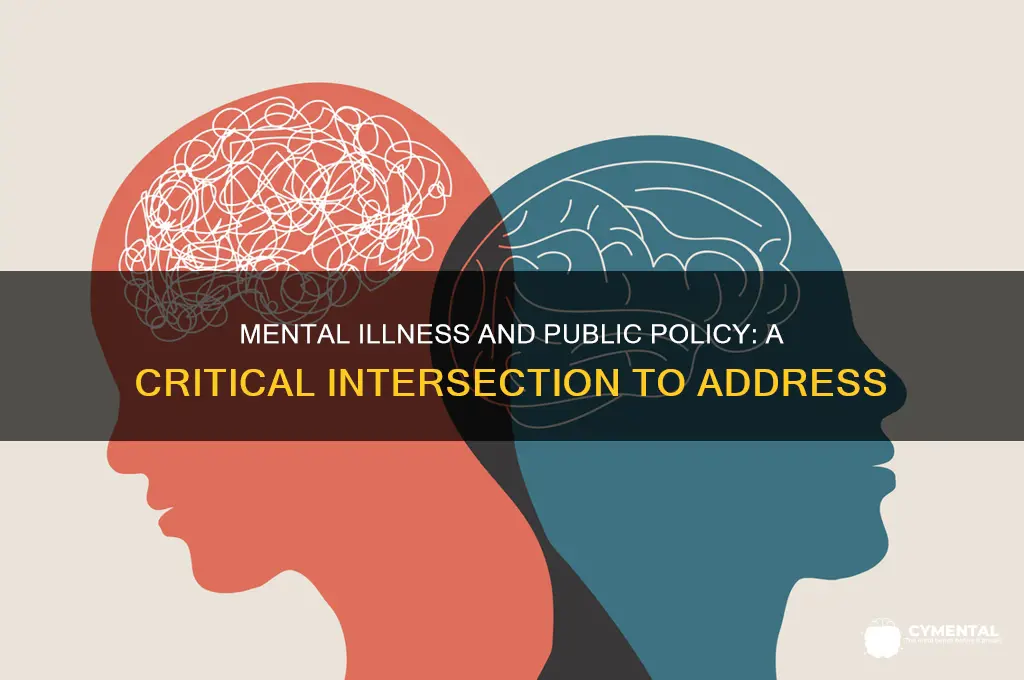
Mental illness has increasingly become a pressing public policy issue due to its widespread impact on individuals, families, and communities, as well as its significant economic and social costs. With millions of people globally affected by conditions such as depression, anxiety, and schizophrenia, mental health challenges strain healthcare systems, reduce workforce productivity, and contribute to societal issues like homelessness and incarceration. Policymakers face the critical task of addressing gaps in access to care, funding for research and treatment, and stigma reduction, while also ensuring equitable support across diverse populations. As mental health intersects with education, employment, criminal justice, and social welfare, it demands a comprehensive, interdisciplinary policy approach to mitigate its far-reaching consequences and promote overall well-being.
Explore related products


What You'll Learn

Access to Mental Health Care
Mental health care remains inaccessible for millions due to systemic barriers like cost, provider shortages, and stigma. In the U.S., nearly 60% of counties have no practicing psychiatrists, leaving rural and low-income communities particularly vulnerable. Even in urban areas, long wait times—often exceeding 30 days for an initial appointment—delay critical treatment. For those with severe conditions like schizophrenia or bipolar disorder, this gap can lead to hospitalization or crisis. Policy interventions, such as Medicaid expansion and telehealth funding, have begun to address these disparities, but significant gaps persist, highlighting the need for sustained, targeted reforms.
Consider the case of telehealth, which emerged as a lifeline during the COVID-19 pandemic. By 2021, telehealth visits for mental health services accounted for 36% of all outpatient care, compared to just 1% pre-pandemic. This shift democratized access for individuals in remote areas or with mobility challenges. However, disparities remain: only 24% of rural households have adequate broadband access, limiting telehealth’s reach. Policymakers must pair telehealth expansion with infrastructure investments, such as subsidizing internet access or deploying mobile clinics, to ensure equitable benefits. Without such measures, telehealth risks becoming another tool that widens, rather than closes, the access gap.
Stigma remains a silent barrier, deterring individuals from seeking care even when services are available. In a 2022 survey, 40% of respondents reported feeling ashamed to discuss mental health concerns with a provider. This reluctance delays diagnosis and treatment, exacerbating conditions like depression or anxiety. Public campaigns, such as the UK’s *Time to Change* initiative, have demonstrated success in reducing stigma through community engagement and media representation. Policymakers should allocate funding for similar programs, integrating mental health education into school curricula and workplace training. Normalizing conversations about mental health is not just a social goal—it’s a policy imperative for increasing care utilization.
Finally, workforce shortages demand innovative solutions. By 2025, the U.S. will face a projected shortage of 15,600 psychiatrists, particularly in child and adolescent care. Task-sharing models, where non-specialists like nurses or social workers deliver evidence-based interventions under supervision, offer a scalable solution. For instance, the World Health Organization’s *Mental Health Gap Action Programme* has trained primary care workers in over 100 countries to manage conditions like depression using structured protocols. U.S. policymakers could incentivize such programs through loan forgiveness or grant funding, ensuring that underserved areas have access to trained providers. Without addressing the workforce crisis, even the most well-funded policies will fall short.
Healing and Recovery: Overcoming Mental Health Challenges with Practical Strategies
You may want to see also
Explore related products


Stigma Reduction Strategies
Stigma surrounding mental illness persists as a formidable barrier to effective public policy, often deterring individuals from seeking help and limiting resource allocation. Addressing this requires targeted strategies that dismantle misconceptions and foster empathy. One proven approach is contact-based education, which involves facilitated interactions between individuals with lived experience of mental illness and the general public. Research shows that structured conversations lasting as little as 45 minutes can significantly reduce stigmatizing attitudes by humanizing mental health struggles and challenging stereotypes. For instance, programs like Time to Change in the UK have demonstrated that repeated exposure to personal narratives can shift societal perceptions over time, making this a scalable and evidence-based intervention.
Another critical strategy is policy-driven language reform, which emphasizes the use of person-first language and avoids pathologizing terms. For example, replacing "schizophrenic" with "person with schizophrenia" reinforces the individual’s identity beyond their diagnosis. Governments and media outlets play a pivotal role here by adopting guidelines that promote respectful communication. A study published in *The Journal of Mental Health* found that media portrayals of mental illness improved by 30% when outlets implemented such frameworks, leading to reduced public fear and increased sympathy. Practical steps include training journalists, updating official documents, and incentivizing compliance through public recognition or funding priorities.
Workplace initiatives also serve as a powerful arena for stigma reduction, given that adults spend a significant portion of their lives at work. Implementing mental health first aid training, for instance, equips employees to recognize signs of distress and offer support. Companies like Unilever have reported a 20% increase in help-seeking behavior after integrating such programs. Additionally, normalizing discussions about mental health through regular wellness campaigns or peer support groups can create a culture of openness. Employers should pair these efforts with tangible policies, such as flexible leave for mental health appointments, to ensure actions align with rhetoric.
Finally, youth-focused interventions are essential for preventing stigma from taking root in future generations. School-based programs like the Mental Health Foundation’s "Make It Count" initiative integrate mental health education into curricula, teaching students aged 11–16 how to challenge stigma and support peers. These programs often include role-playing scenarios, art projects, and peer-led discussions, making the content engaging and relatable. Evaluations show that participants are 40% more likely to intervene when they witness stigmatizing behavior. Policymakers can amplify these efforts by mandating mental health literacy training in teacher education programs and allocating funds for evidence-based school resources.
In conclusion, stigma reduction is not a singular intervention but a multifaceted endeavor requiring collaboration across sectors. By combining contact-based education, language reform, workplace initiatives, and youth-focused programs, societies can create an environment where mental illness is understood, not feared. Each strategy must be tailored to local contexts and continuously evaluated for impact, ensuring that progress is sustained and scalable. The ultimate goal is not just to change minds but to transform systems, making mental health care as accessible and accepted as physical health care.
Enhance Your Well-Being: Practical Strategies to Improve Mental Health Issues
You may want to see also
Explore related products


Funding for Mental Health Services
Mental health services in the United States are chronically underfunded, with only 11% of the healthcare budget allocated to mental health, despite mental illness accounting for 23% of the nation’s disease burden. This disparity highlights a systemic failure to prioritize mental health as a critical public policy issue. For context, countries like Australia and Canada allocate closer to 15-18% of their healthcare budgets to mental health, demonstrating a more equitable distribution of resources. Such underfunding in the U.S. results in limited access to care, long wait times, and inadequate treatment options, particularly for low-income and marginalized communities.
Consider the practical implications of this funding gap. In 2021, over 50% of U.S. adults with mental illness received no treatment, often due to cost barriers or lack of available providers. For children and adolescents, the situation is equally dire: only 20% of those with diagnosable mental health conditions receive adequate care. To address this, policymakers could implement targeted funding models, such as the 1115 Medicaid waiver programs, which allow states to reinvest savings into mental health services. For instance, California’s Whole Person Care pilot allocated $3 billion to integrate physical and mental healthcare, reducing emergency room visits by 25% among participants.
A persuasive argument for increased funding lies in its economic benefits. Untreated mental illness costs the U.S. economy $193 billion annually in lost earnings, reduced productivity, and increased healthcare expenditures. By contrast, every dollar invested in evidence-based mental health treatment yields a $4 return in improved health outcomes and economic productivity. For example, the National Institute of Mental Health estimates that expanding access to cognitive-behavioral therapy (CBT) for depression could save $2,500 per patient annually in healthcare costs. Policymakers must recognize that funding mental health services is not just a moral imperative but a fiscally responsible decision.
Comparatively, the opioid crisis offers a cautionary tale about the consequences of inadequate funding. Between 1999 and 2019, over 500,000 Americans died from opioid overdoses, a crisis fueled in part by insufficient access to mental health and substance use treatment. In response, Congress allocated $1.5 billion annually through the 21st Century Cures Act, but this funding remains fragmented and insufficient. A more comprehensive approach, such as integrating mental health services into primary care settings, could prevent similar crises. For instance, the Collaborative Care model, which embeds mental health professionals in primary care clinics, has been shown to reduce depression symptoms by 50% within 6 months.
To improve funding for mental health services, policymakers should take three concrete steps. First, increase federal and state allocations to meet the World Health Organization’s recommendation of 15% of healthcare budgets for mental health. Second, mandate insurance parity by enforcing the Mental Health Parity and Addiction Equity Act, ensuring mental health coverage is equal to physical health coverage. Third, invest in workforce development by expanding scholarships and loan forgiveness programs for mental health professionals, particularly in underserved areas. Without these measures, the gap between need and access will continue to widen, perpetuating a public health crisis that affects millions.
Mental Health and Probate Court: Understanding the Legal Intersection
You may want to see also
Explore related products


Workplace Mental Health Policies
Mental health in the workplace is no longer a peripheral concern but a central pillar of organizational success. According to the World Health Organization, depression and anxiety disorders cost the global economy $1 trillion annually in lost productivity. This stark statistic underscores the urgency for robust workplace mental health policies, not as a luxury but as a strategic imperative. Companies that prioritize mental well-being see reduced absenteeism, higher employee engagement, and improved overall performance. Yet, despite growing awareness, many organizations still lack comprehensive frameworks to address this issue effectively.
Crafting effective workplace mental health policies requires a multi-faceted approach. First, organizations must destigmatize mental health conversations through awareness campaigns and training programs. For instance, implementing mandatory mental health first-aid training for managers can equip them to recognize signs of distress and provide appropriate support. Second, policies should include flexible work arrangements, such as remote work options or reduced hours, to accommodate employees dealing with mental health challenges. Third, access to professional resources, like Employee Assistance Programs (EAPs) or subsidized therapy sessions, should be clearly outlined and promoted. A study by the American Psychological Association found that employees with access to mental health resources report 40% higher job satisfaction.
However, even the most well-designed policies can fall short without a culture of trust and accountability. Leaders must model vulnerability by openly discussing their own mental health experiences, fostering an environment where employees feel safe seeking help. Additionally, regular feedback mechanisms, such as anonymous surveys or focus groups, can help organizations gauge the effectiveness of their policies and identify areas for improvement. For example, a tech company in Silicon Valley introduced bi-annual mental health check-ins, resulting in a 25% increase in employees seeking support within the first year.
Critics argue that implementing such policies can be resource-intensive, particularly for small businesses. While this is a valid concern, the long-term benefits far outweigh the initial investment. Even modest initiatives, like offering mental health days or creating quiet spaces for relaxation, can make a significant difference. Governments can play a role by offering tax incentives or grants to businesses that prioritize mental health, making it feasible for organizations of all sizes to take action. Ultimately, workplace mental health policies are not just about compliance—they are about creating a humane, productive, and resilient workforce.
Low Self-Esteem: A Hidden Mental Health Struggle Explored
You may want to see also
Explore related products


Mental Health in Criminal Justice
The intersection of mental health and criminal justice reveals a stark reality: U.S. jails and prisons house ten times more individuals with serious mental illness than state psychiatric hospitals. This statistic underscores a systemic failure to address mental health as a public policy issue, instead criminalizing conditions that require treatment, not incarceration.
Consider the case of a 28-year-old man with schizophrenia arrested for trespassing after sleeping in a public park. Without access to community mental health services, his untreated psychosis led to behaviors misinterpreted as criminal intent. This scenario is not anomalous. Approximately 20% of jail inmates and 15% of prisoners have a serious mental illness, often entering the system for low-level, nonviolent offenses. The criminal justice system, ill-equipped to provide therapeutic interventions, exacerbates their conditions through isolation, trauma, and lack of access to medication.
To disrupt this cycle, policymakers must implement evidence-based diversion programs. Crisis Intervention Teams (CIT), for instance, train law enforcement to de-escalate encounters with mentally ill individuals, redirecting them to treatment instead of arrest. In Memphis, where CIT originated, such interventions reduced officer injuries by 40% and increased connections to mental health services. Similarly, Mental Health Courts offer supervised treatment plans as alternatives to incarceration, with recidivism rates dropping by 30-50% among participants.
However, diversion alone is insufficient. Community-based resources must be robust enough to absorb those diverted. This includes expanding access to affordable housing, outpatient treatment, and peer support programs. For example, the Housing First model, which provides stable housing without preconditions of sobriety or treatment, has reduced hospitalizations and arrests among chronically homeless individuals with mental illness by up to 60%.
Ultimately, treating mental illness as a criminal justice issue is not only inhumane but fiscally irresponsible. The annual cost of incarcerating a person is $30,000, compared to $10,000 for community-based treatment. By prioritizing prevention, diversion, and support, policymakers can transform a system that punishes vulnerability into one that fosters recovery. The question is not whether mental health is a public policy issue, but how boldly we will act to address it.
Understanding Hoarding: A Complex Mental Health Challenge Explained
You may want to see also
Frequently asked questions
Yes, mental illness is a significant public policy issue because it affects a large portion of the population, impacts public health, and has economic and social consequences that require government intervention and resources.
Mental illness is a concern for public policy makers because it influences workforce productivity, healthcare costs, crime rates, and overall societal well-being, necessitating policies to address prevention, treatment, and support systems.
Governments play a critical role in addressing mental illness by funding research, improving access to mental health services, implementing anti-stigma campaigns, and creating policies that protect the rights and well-being of individuals with mental health conditions.