Madison Cole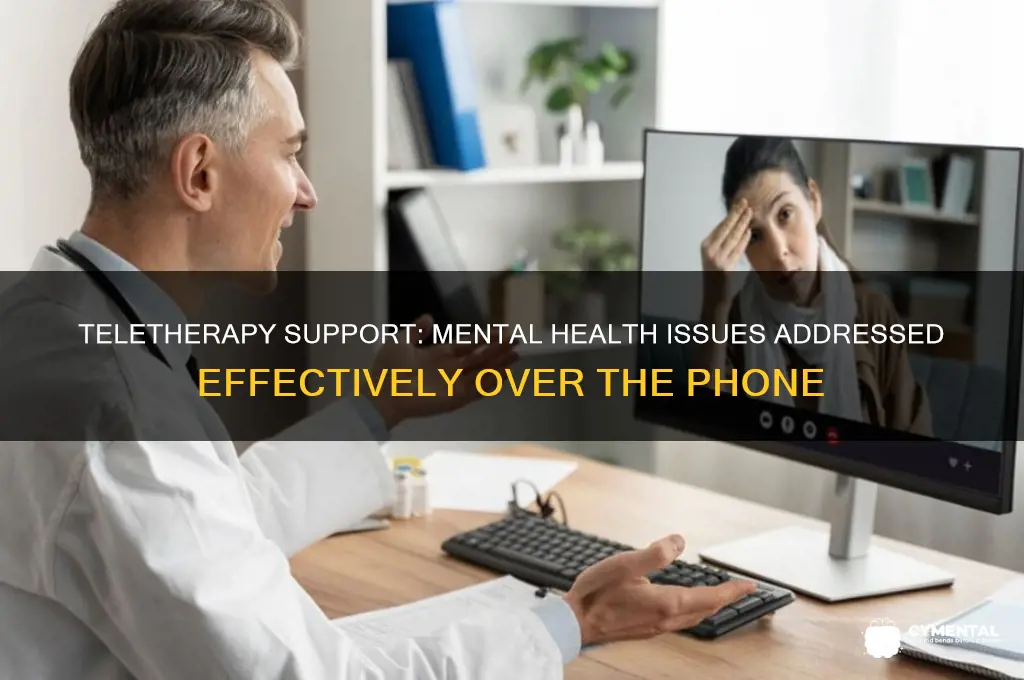
Mental health concerns can often be effectively addressed through phone-based support, offering a convenient and accessible way for individuals to receive help. Conditions such as mild to moderate anxiety, depression, stress, and loneliness can benefit from telephonic interventions, including counseling, therapy, and crisis hotlines. Phone support allows for real-time guidance, coping strategies, and emotional reassurance, particularly for those who may face barriers to in-person care, such as geographical isolation, mobility issues, or stigma. Additionally, phone-based services can assist with sleep disturbances, grief, and relationship issues, providing a lifeline for individuals seeking immediate assistance or ongoing support in managing their mental well-being.
Explore related products


What You'll Learn

Anxiety and stress management techniques
Anxiety and stress, though often intertwined, respond uniquely to targeted interventions, many of which can be effectively delivered over the phone. Consider the immediacy of a phone call: it bridges the gap between isolation and connection, offering real-time support without the barriers of physical distance or scheduling conflicts. For instance, cognitive reframing—a technique where individuals learn to challenge and reshape negative thought patterns—can be guided through structured conversations. A counselor might prompt, *"When you feel overwhelmed, ask yourself: Is this thought based on fact, or is it exaggerated by my anxiety?"* This simple question, delivered over a call, empowers individuals to pause and reassess their mental spirals.
One evidence-based technique particularly suited for phone sessions is diaphragmatic breathing, often referred to as "belly breathing." Instructing someone to inhale deeply through their nose for a count of four, hold for four, and exhale through their mouth for six can activate the parasympathetic nervous system, reducing heart rate and cortisol levels. For maximum effectiveness, this exercise should be practiced for 5–10 minutes daily, but even a single session during a phone call can provide immediate relief. Pairing this with progressive muscle relaxation—tensing and releasing muscle groups in sequence—amplifies its calming effects. These techniques require no equipment, making them accessible to anyone with a phone connection.
While phone-based interventions are powerful, they’re not one-size-fits-all. For example, younger adults (ages 18–30) often respond well to app-integrated phone sessions that include mindfulness prompts or guided imagery, whereas older adults (ages 50+) may prefer structured, conversational approaches focused on problem-solving. Cultural considerations also matter: in collectivist cultures, incorporating family or community support into phone sessions can enhance efficacy. A cautionary note: severe anxiety disorders, such as panic disorder or PTSD, may require in-person therapy or medication, but mild to moderate cases can often be managed with consistent phone-based strategies.
The persuasive power of a phone call lies in its ability to normalize struggles and provide actionable tools in the moment. For instance, a counselor might teach the "5-4-3-2-1 grounding technique," where the individual names five things they see, four they can touch, three they hear, two they can smell, and one they can taste. This sensory refocusing disrupts anxiety loops and can be practiced independently after the call. Pairing such techniques with accountability—such as scheduling weekly check-ins—ensures progress. The takeaway? Phone-based anxiety and stress management isn’t just a stopgap; it’s a viable, scalable solution for building resilience in real time.
Boost Your Mental Health: Simple Strategies for Well-Being and Resilience
You may want to see also
Explore related products


$9.59 $16.99


$4.99


Depression symptom monitoring and coping strategies
Depression often manifests in subtle, gradual changes that can be difficult to track without a structured approach. Monitoring symptoms over the phone can provide a consistent, accessible way to identify patterns and triggers. For instance, a daily or weekly check-in call can help individuals record mood fluctuations, sleep disturbances, or changes in appetite. Apps paired with phone consultations can streamline this process, offering reminders and standardized questionnaires like the PHQ-9 to quantify depressive symptoms. This data not only aids self-awareness but also equips mental health professionals with actionable insights to tailor interventions.
Effective coping strategies for depression can be taught and reinforced through phone-based support. Cognitive-behavioral techniques, such as reframing negative thoughts or scheduling pleasurable activities, are particularly well-suited for remote delivery. For example, a therapist might guide a client through a thought record during a call, helping them challenge distorted beliefs in real-time. Additionally, mindfulness exercises or progressive muscle relaxation can be instructed over the phone, with recordings sent afterward for continued practice. These strategies empower individuals to manage symptoms independently, fostering resilience between sessions.
While phone-based monitoring and coping strategies are valuable, they require careful implementation to avoid pitfalls. Over-reliance on self-reporting can lead to underestimation of symptoms, especially in cases of severe depression where motivation is low. To mitigate this, providers should establish clear protocols for escalating care if symptoms worsen, such as connecting individuals to crisis hotlines or in-person services. Furthermore, ensuring privacy and confidentiality during calls is critical, particularly when discussing sensitive topics. Secure platforms and encrypted communication tools can address these concerns while maintaining trust.
The accessibility of phone-based interventions makes them particularly beneficial for underserved populations, including those in rural areas or with limited mobility. For older adults, who may face barriers to technology use, simple strategies like scheduled check-ins or guided journaling can be adapted to their comfort level. Similarly, for adolescents, incorporating text-based reminders or brief video calls can enhance engagement. By tailoring approaches to specific demographics, phone-based depression support becomes a versatile tool that bridges gaps in mental health care.
Ultimately, depression symptom monitoring and coping strategies delivered over the phone offer a scalable, cost-effective solution for early intervention and ongoing management. They complement traditional therapy by providing continuous support outside clinical settings, fostering a sense of accountability and progress. While not a replacement for face-to-face care in severe cases, these methods democratize access to mental health tools, enabling individuals to take proactive steps toward recovery from anywhere. With thoughtful design and execution, phone-based approaches can be a transformative resource in the fight against depression.
Empower Yourself, Lift Others: Balancing Self-Preservation and Compassion
You may want to see also
Explore related products


Crisis intervention and immediate emotional support
In moments of acute distress, a phone call can be a lifeline. Crisis intervention over the phone provides immediate emotional support, helping individuals navigate overwhelming situations like suicidal thoughts, panic attacks, or traumatic events. Trained professionals use active listening, grounding techniques, and safety planning to stabilize callers, often de-escalating crises within minutes. For instance, the National Suicide Prevention Lifeline (988 in the U.S.) connects individuals to counselors who assess risk, offer coping strategies, and link them to local resources. This real-time support can prevent self-harm and provide a sense of hope when it’s needed most.
Consider the mechanics of such calls: counselors often employ a structured approach, starting with empathy and validation to build trust. They then assess the immediacy of danger, guiding callers through breathing exercises or distraction techniques to reduce emotional intensity. For example, during a panic attack, a counselor might instruct the caller to focus on five things they can see, four they can touch, and so on—a grounding technique that shifts focus away from distress. These methods are simple yet effective, demonstrating how phone-based support can deliver tangible relief in high-stress moments.
While crisis hotlines are invaluable, they’re not a substitute for long-term therapy. However, they serve as a critical bridge, offering immediate help while connecting individuals to ongoing care. For instance, a caller experiencing a psychotic episode might receive short-term stabilization over the phone, followed by a referral to a psychiatrist or emergency services if necessary. This dual role—providing instant support and facilitating access to further treatment—highlights the unique value of phone-based crisis intervention in the mental health landscape.
Practical tips for utilizing these services include keeping hotline numbers saved in your phone or written down for easy access. If you’re calling on behalf of someone else, stay calm and relay accurate information about their condition. Remember, these services are confidential and judgment-free, designed to meet you where you are. Whether you’re in crisis yourself or supporting someone who is, knowing how to leverage phone-based emotional support can make a profound difference in moments of vulnerability.
Supporting Your Spouse: Encouraging Mental Health Treatment with Compassion
You may want to see also
Explore related products


Grief and loss counseling sessions
Grief is a universal experience, yet it remains deeply personal, often leaving individuals feeling isolated and misunderstood. Phone-based counseling sessions offer a unique avenue for support, providing accessibility and flexibility for those navigating the tumultuous journey of loss. Unlike traditional face-to-face therapy, phone sessions eliminate geographical barriers, allowing individuals to connect with specialized grief counselors from the comfort of their own space. This modality is particularly beneficial for those who may be physically unable to travel, live in remote areas, or prefer the anonymity that a phone call affords.
The structure of grief counseling over the phone often begins with establishing a safe and empathetic environment. Counselors use active listening techniques, such as reflective questioning and summarization, to help clients articulate their emotions and experiences. For instance, a counselor might ask, *"What does a typical day look like for you since the loss?"* or *"How have your relationships been affected?"* These questions encourage clients to explore their grief in a structured yet compassionate manner. Sessions typically last 45 to 60 minutes, with a focus on setting achievable goals, such as identifying coping mechanisms or processing unresolved emotions.
One of the strengths of phone counseling for grief is its ability to adapt to the client’s pace. Grief is nonlinear, and phone sessions allow for spontaneous check-ins during moments of acute distress. For example, a client might call during a particularly difficult anniversary or holiday, receiving immediate support without the need for scheduling weeks in advance. Additionally, phone counseling can incorporate practical strategies, such as guided breathing exercises or journaling prompts, which clients can implement in real-time during the call.
However, phone-based grief counseling is not without its limitations. Nonverbal cues, such as body language and facial expressions, are absent, which can sometimes hinder the depth of connection. Counselors must rely on tone of voice, pauses, and verbal responses to gauge emotional states. To mitigate this, counselors often use more explicit language to confirm understanding, such as *"It sounds like you’re feeling overwhelmed—is that right?"* Clients can also play an active role by being as descriptive as possible about their feelings and experiences.
In conclusion, grief and loss counseling sessions over the phone are a valuable resource for those seeking support in their bereavement journey. They offer convenience, immediacy, and a tailored approach to navigating the complexities of loss. While they may lack the visual component of in-person therapy, the benefits of accessibility and flexibility often outweigh this drawback. For anyone struggling with grief, phone counseling can be a lifeline, providing professional guidance and emotional support during one of life’s most challenging experiences.
Move to Thrive: Physical Activity's Impact on Mental Well-Being
You may want to see also
Explore related products


Sleep improvement and relaxation guidance
Sleep deprivation isn’t just a personal nuisance—it’s a public health crisis. Over 50 million Americans report sleep disturbances, and chronic insomnia is linked to anxiety, depression, and cognitive decline. Yet, many overlook the phone as a tool for addressing this. Sleep improvement and relaxation guidance delivered via phone calls or apps can be surprisingly effective, offering structured support without the barriers of in-person therapy.
Consider cognitive behavioral therapy for insomnia (CBT-I), a gold-standard treatment. Over-the-phone CBT-I programs, like those offered by Sleepio, use automated or live coaching to teach sleep hygiene, stimulus control, and cognitive reframing. Users track sleep patterns via apps, receiving personalized feedback during weekly calls. Research shows 70% of participants experience significant improvement within 6–8 weeks. For example, a 45-year-old with insomnia might learn to limit bedtime phone use, establish a wind-down routine, and replace anxious thoughts like "I’ll never fall asleep" with "Rest is enough."
Guided relaxation techniques are another phone-friendly solution. Progressive muscle relaxation (PMR) and diaphragmatic breathing can be taught in 10–15-minute sessions. For PMR, instruct clients to tense and release muscle groups systematically, starting with the feet and ending at the face. Pair this with paced breathing: inhale for 4 seconds, hold for 4, exhale for 6. Apps like Calm or Headspace offer audio guides, but live calls allow for real-time adjustments. For instance, a caller struggling with tension headaches might focus on neck and shoulder releases, reducing pain and improving sleep onset.
However, phone-based interventions aren’t one-size-fits-all. Older adults may prefer human interaction over apps, while younger users might engage more with gamified tracking. Caution is needed for those with severe sleep disorders or comorbid conditions like PTSD, who may require in-person care. Additionally, reliance on technology can backfire if notifications disrupt sleep—a paradoxical pitfall.
The takeaway? Phone-based sleep improvement isn’t just convenient; it’s evidence-based. By combining structured programs, real-time coaching, and tailored techniques, individuals can reclaim their nights. Start small: track sleep for a week, then address one habit at a time. With consistency, even the most restless minds can find peace—one call at a time.
Natural Ways to Support Mental Health and Well-being Effectively
You may want to see also
Frequently asked questions
Yes, anxiety disorders can often be helped over the phone through cognitive-behavioral therapy (CBT), mindfulness techniques, and stress management strategies. Phone sessions provide accessible support for symptom management and coping skill development.
Absolutely. Phone-based therapy can address depression by offering emotional support, goal-setting, and behavioral activation techniques. Regular check-ins can also monitor progress and provide accountability.
Yes, phone consultations can provide immediate guidance during panic attacks, teaching grounding techniques, breathing exercises, and coping strategies. Ongoing support can also help identify triggers and prevent future episodes.