Lucas Bennett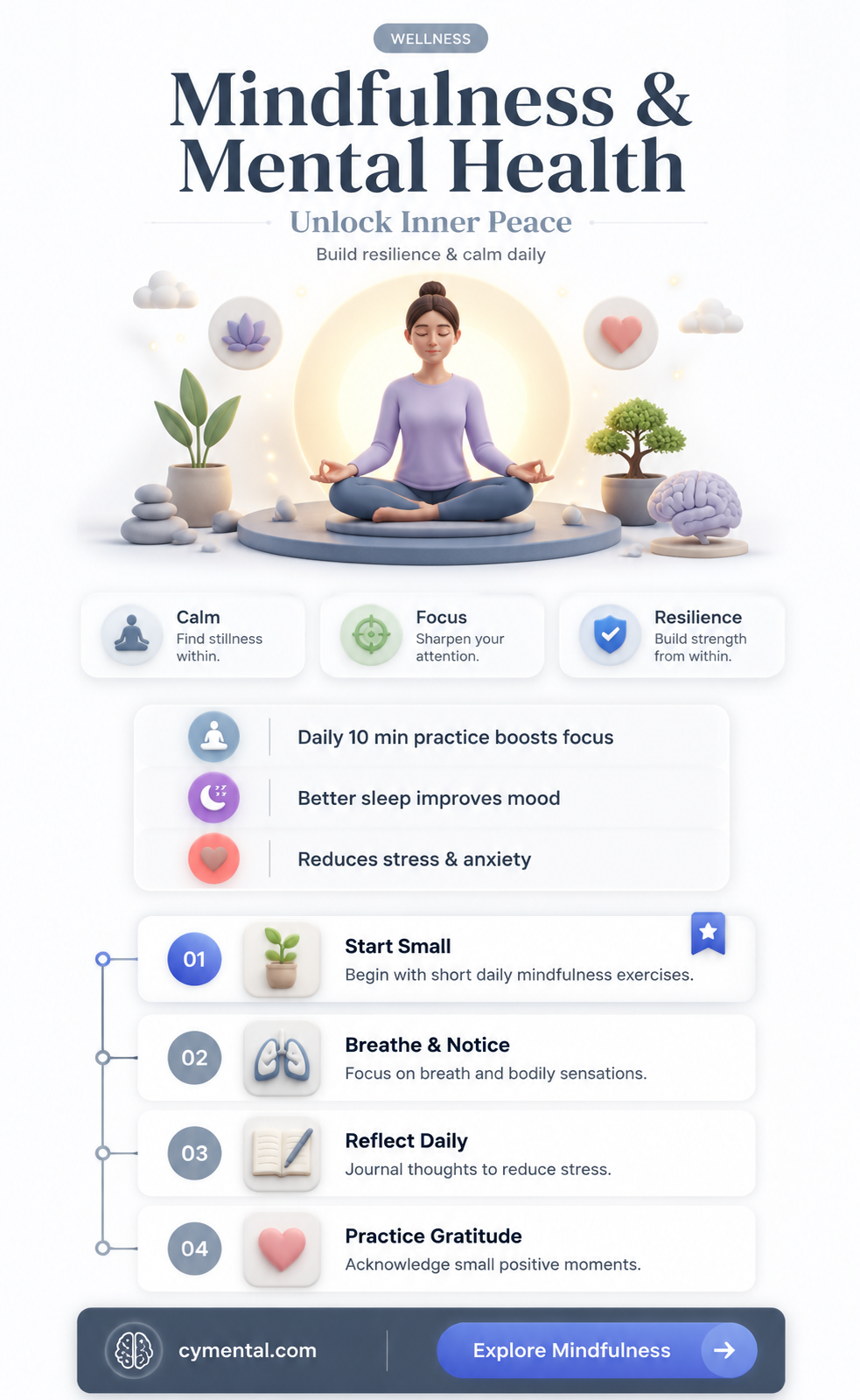
Mindfulness, the practice of being fully present and engaged in the current moment without judgment, has gained significant attention in recent years as a potential tool for improving mental health. Rooted in ancient traditions like Buddhism, mindfulness has been adapted into modern therapeutic techniques, such as Mindfulness-Based Stress Reduction (MBSR) and Mindfulness-Based Cognitive Therapy (MBCT). Research suggests that mindfulness can help reduce symptoms of anxiety, depression, and stress by fostering greater self-awareness, emotional regulation, and a non-reactive mindset. By encouraging individuals to observe their thoughts and feelings without attachment, mindfulness may disrupt negative thought patterns and promote a sense of calm and clarity. While not a cure-all, its growing body of evidence highlights mindfulness as a valuable complement to traditional mental health treatments, offering a holistic approach to well-being.
| Characteristics | Values |
|---|---|
| Reduces Stress | Mindfulness practices, such as meditation, have been shown to decrease cortisol levels, a key stress hormone, and promote relaxation. |
| Improves Anxiety | Studies indicate mindfulness-based interventions can significantly reduce symptoms of anxiety disorders, including generalized anxiety and social anxiety. |
| Enhances Depression Management | Mindfulness-based cognitive therapy (MBCT) is effective in preventing relapse in individuals with recurrent depression and improving overall mood. |
| Increases Emotional Regulation | Regular mindfulness practice helps individuals become more aware of their emotions, leading to better emotional control and reduced reactivity. |
| Boosts Attention and Focus | Mindfulness training improves sustained attention, working memory, and cognitive flexibility, enhancing overall concentration. |
| Promotes Resilience | Mindfulness fosters psychological resilience by encouraging acceptance and non-judgmental awareness of thoughts and feelings. |
| Reduces Symptoms of PTSD | Mindfulness-based therapies have shown promise in alleviating symptoms of post-traumatic stress disorder (PTSD) by helping individuals process traumatic memories. |
| Improves Sleep Quality | Mindfulness practices, such as body scans and mindful breathing, can enhance sleep quality and reduce insomnia symptoms. |
| Enhances Self-Awareness | Mindfulness increases introspection and self-awareness, helping individuals understand their thoughts, behaviors, and emotional patterns. |
| Supports Addiction Recovery | Mindfulness-based relapse prevention programs have been effective in reducing substance use and cravings by promoting awareness and self-control. |
| Improves Overall Well-being | Consistent mindfulness practice is associated with higher levels of life satisfaction, happiness, and overall mental well-being. |
Explore related products


$11.49 $14.99


What You'll Learn
- Mindfulness reduces stress and anxiety through focused breathing and present-moment awareness techniques
- Enhances emotional regulation by increasing self-awareness and acceptance of feelings
- Improves depression symptoms by fostering non-judgmental observation of negative thoughts
- Boosts resilience by teaching adaptive coping strategies for challenging situations
- Supports PTSD recovery by grounding individuals in the present, reducing flashbacks

Mindfulness reduces stress and anxiety through focused breathing and present-moment awareness techniques
Stress and anxiety often stem from the mind’s tendency to dwell on past regrets or future worries. Mindfulness interrupts this cycle by anchoring attention to the present moment, a technique supported by decades of research. Studies show that even brief daily practice—as little as 10 minutes of focused breathing—can reduce cortisol levels, the body’s primary stress hormone. For instance, a 2019 study published in *Psychoneuroendocrinology* found that participants who engaged in mindful breathing exercises experienced a 15% decrease in cortisol after just one week. This physiological shift underscores why mindfulness is increasingly recommended as a first-line intervention for stress and anxiety.
To harness mindfulness effectively, start with a simple breathing exercise. Sit comfortably, close your eyes, and inhale deeply through your nose for a count of four, hold for four, exhale through your mouth for six, and pause for two. Repeat this cycle for five minutes, gently bringing your focus back to your breath whenever your mind wanders. This technique, known as box breathing, activates the parasympathetic nervous system, promoting relaxation. Pairing this with present-moment awareness—noticing sensations like the rise and fall of your chest—amplifies its calming effects. Consistency is key; aim to practice twice daily, especially during peak stress times like mornings or evenings.
While mindfulness is accessible to all ages, its application varies. For children, guided visualizations or mindful movement (e.g., yoga) can make the practice engaging. Teens, often overwhelmed by academic and social pressures, benefit from short, structured sessions integrated into routines, like mindful breathing before exams. Adults, particularly those with high-stress jobs, may find apps like Headspace or Calm helpful for maintaining consistency. However, caution is advised for individuals with trauma or severe anxiety, as intense focus on the present can sometimes trigger distress. In such cases, working with a trained therapist to tailor the practice is essential.
Comparing mindfulness to traditional stress-relief methods highlights its unique advantages. Unlike medication, which often treats symptoms temporarily, mindfulness addresses the root cause by rewiring neural pathways associated with stress. Unlike exercise, which requires physical exertion, mindfulness can be practiced anywhere, making it ideal for those with physical limitations. Its effectiveness lies in its simplicity and adaptability, offering a sustainable tool for long-term mental health management. By prioritizing focused breathing and present-moment awareness, individuals can cultivate resilience against life’s inevitable stressors.
Helping Reluctant Loved Ones Access Mental Health Care in Texas
You may want to see also
Explore related products


Enhances emotional regulation by increasing self-awareness and acceptance of feelings
Mindfulness practices, such as meditation and mindful breathing, directly target the brain’s ability to observe and manage emotions without being overwhelmed by them. By fostering self-awareness, individuals learn to recognize emotional triggers and patterns, creating a mental pause between feeling and reacting. For instance, a study published in *Frontiers in Psychology* found that just 10 minutes of daily mindfulness practice over 8 weeks significantly improved emotional regulation in adults aged 18–45. This heightened awareness allows people to step back from impulsive responses, reducing the intensity of negative emotions like anger or anxiety.
Consider this practical approach: Begin by setting aside 5–10 minutes daily to focus on your breath. When an emotion arises, label it without judgment—for example, “I notice I’m feeling frustrated.” This simple act of acknowledgment shifts the brain from reactive mode to observational mode, a key step in emotional regulation. Over time, this practice builds neural pathways that strengthen self-awareness, making it easier to catch emotions before they escalate. For teens and young adults, incorporating mindfulness into routines like brushing teeth or walking to class can make it more accessible and habitual.
One of the most transformative aspects of mindfulness is its emphasis on acceptance. Unlike suppression or avoidance, mindfulness encourages individuals to embrace their feelings as temporary experiences rather than permanent states. This shift in perspective reduces the fear and resistance often associated with difficult emotions, fostering a sense of calm and resilience. For example, a person experiencing sadness might remind themselves, “This feeling is here now, but it will pass,” instead of spiraling into self-criticism. Research in *Clinical Psychology Review* highlights that acceptance-based practices are particularly effective in reducing symptoms of depression and anxiety.
However, it’s crucial to approach mindfulness with realistic expectations. While its benefits are well-documented, it’s not a quick fix. Consistency is key—skipping days or rushing through practices diminishes its effectiveness. Additionally, mindfulness may feel uncomfortable initially, especially for those unaccustomed to confronting their emotions. For individuals with severe trauma or PTSD, guided sessions with a trained professional are recommended to ensure safety and support. Pairing mindfulness with other therapeutic techniques, such as cognitive-behavioral therapy, can enhance its impact, particularly for complex mental health challenges.
Incorporating mindfulness into daily life doesn’t require drastic changes. Start small: take three deep breaths before responding to a stressful email, or practice mindful walking by focusing on the sensation of your feet touching the ground. For parents, modeling these behaviors can help children develop emotional regulation skills early. Apps like Headspace or Calm offer structured programs tailored to different age groups and needs, making mindfulness more accessible. By weaving these practices into everyday moments, individuals can cultivate a more balanced and compassionate relationship with their emotions, ultimately improving their mental health.
Mental Health Awareness: Impact on Well-Being and Societal Support
You may want to see also
Explore related products


Improves depression symptoms by fostering non-judgmental observation of negative thoughts
Depression often traps individuals in a cycle of negative self-talk, where intrusive thoughts are not just observed but internalized as truths. Mindfulness disrupts this cycle by teaching the practice of non-judgmental observation. Instead of reacting to thoughts like "I am worthless" with emotional escalation, mindfulness encourages acknowledging them as passing mental events, no more permanent or defining than clouds in the sky. This cognitive shift reduces the emotional charge tied to negative thoughts, a mechanism supported by studies showing that mindfulness-based interventions decrease rumination, a core symptom of depression.
Consider a practical example: a 35-year-old professional experiencing depressive episodes might spend hours fixating on a perceived workplace failure. Through mindfulness training, they learn to label such thoughts as "thinking" rather than facts, observing them without self-criticism. Over time, this practice weakens the link between negative thoughts and emotional distress. Research from *JAMA Psychiatry* (2016) found that mindfulness-based cognitive therapy (MBCT) reduced relapse rates in depression by 31% over 60 weeks, with non-judgmental awareness being a key therapeutic component.
Implementing this approach requires consistency. Start with 10-minute daily mindfulness sessions, focusing on breath awareness while noting thoughts without judgment. Apps like Headspace or Calm offer guided exercises tailored to depression management. For adolescents, shorter 5-minute sessions paired with journaling can help externalize negative thoughts. Caution: mindfulness is not a replacement for medication or therapy but a complementary tool. Individuals with severe depression should consult a mental health professional before relying solely on mindfulness practices.
The neuroscience behind this technique is compelling. Functional MRI studies reveal that mindfulness practice reduces activity in the default mode network (DMN), the brain’s "self-referential" system often hyperactive in depression. Simultaneously, it strengthens the prefrontal cortex’s ability to regulate emotional responses. This biological rewiring explains why non-judgmental observation doesn’t merely suppress symptoms but fosters resilience against depressive relapse.
Incorporating mindfulness into daily routines doesn’t require monastic dedication. Simple acts like mindful eating—focusing on the texture, taste, and aroma of food—can cultivate present-moment awareness. For caregivers supporting loved ones with depression, modeling non-judgmental language ("I notice you’re feeling overwhelmed" vs. "You’re overreacting") reinforces the practice. While not a panacea, mindfulness offers a scalable, evidence-based strategy to dismantle the thought patterns fueling depression, one observation at a time.
Social Media Bans: A Mental Health Solution for Teens?
You may want to see also
Explore related products


Boosts resilience by teaching adaptive coping strategies for challenging situations
Mindfulness isn't just about sitting cross-legged and breathing deeply. It's a mental training practice that rewires how we respond to stress, anxiety, and adversity. At its core, mindfulness teaches us to observe our thoughts and emotions without judgment, creating a crucial buffer between stimulus and reaction. This mental pause is where resilience is forged.
When faced with a challenging situation, our instinct often leans towards fight, flight, or freeze. Mindfulness interrupts this primal response, offering a fourth option: observe. By cultivating present-moment awareness, we learn to recognize the physical sensations, thoughts, and emotions that arise during stress. This awareness is the first step in choosing a more adaptive coping strategy.
Imagine a teenager facing exam anxiety. Instead of succumbing to panic and procrastination, mindfulness training might equip them with the ability to acknowledge the racing heart and negative self-talk without getting swept away. They could then consciously choose to take deep breaths, reframe the anxiety as excitement, and focus on a manageable study plan. This is resilience in action – not the absence of difficulty, but the ability to navigate it with greater flexibility and control.
Studies suggest that regular mindfulness practice, even as little as 10 minutes daily, can significantly enhance emotional regulation and stress response. Techniques like body scans, mindful walking, or focused breathing exercises can be easily integrated into daily routines, making this a practical tool for all ages.
It's important to note that mindfulness isn't a magic bullet. It doesn't erase challenges, but it provides a toolkit for facing them head-on. Think of it as building mental muscle – the more we practice observing our thoughts and emotions without judgment, the stronger our resilience becomes. This doesn't mean suppressing difficult emotions, but rather learning to relate to them in a way that allows for healthier coping mechanisms.
For those struggling with chronic stress or mental health conditions, mindfulness should be seen as a complementary practice, not a replacement for professional help. However, its accessibility and proven benefits make it a valuable tool for anyone seeking to boost their resilience and navigate life's inevitable challenges with greater ease.
Social Services and Mental Health: A Path to Healing and Support
You may want to see also
Explore related products


Supports PTSD recovery by grounding individuals in the present, reducing flashbacks
Mindfulness techniques, such as focused breathing and body scans, anchor individuals with PTSD in the present moment, disrupting the cycle of intrusive memories. When a flashback begins, the person is taught to notice physical sensations—the feel of their feet on the ground, the rhythm of their breath—rather than being swept away by past trauma. This grounding practice, often integrated into therapies like Trauma-Focused Cognitive Behavioral Therapy (TF-CBT), has been shown to reduce the frequency and intensity of flashbacks over time. For instance, a 2016 study in the *Journal of Traumatic Stress* found that veterans practicing mindfulness reported a 30% decrease in flashback occurrences after eight weeks of consistent practice.
To implement this technique, start with a simple exercise: sit quietly and focus on your breath for five minutes daily. When a flashback arises, shift your attention to tangible objects in your environment—name five things you can see, four you can touch, three you can hear, and so on. This "5-4-3-2-1" method, recommended by PTSD therapists, helps reorient the mind to the present. Pairing this with progressive muscle relaxation—tensening and releasing each muscle group—can further enhance grounding. Consistency is key; aim for twice-daily practice, especially during moments of calm, to build resilience against sudden triggers.
While mindfulness is not a standalone cure for PTSD, it complements traditional treatments like medication and psychotherapy by addressing the hyperarousal that fuels flashbacks. For example, mindfulness-based stress reduction (MBSR) programs, typically eight weeks long, teach individuals to observe their thoughts without judgment, reducing the emotional charge of traumatic memories. However, caution is advised for those with severe PTSD, as unsupervised practice may initially intensify distress. Always begin under the guidance of a trained therapist, particularly if you’re under 18 or have comorbid conditions like depression.
Comparing mindfulness to other grounding techniques, such as journaling or art therapy, highlights its efficiency in acute moments of distress. Unlike writing, which requires cognitive engagement, mindfulness relies on sensory awareness, making it accessible even when thoughts feel chaotic. A 2020 meta-analysis in *Clinical Psychology Review* noted that mindfulness outperformed traditional grounding methods in reducing PTSD symptoms among adults aged 25–50, particularly when combined with exposure therapy. For adolescents, however, shorter, gamified mindfulness exercises—like mindful walking or breathing apps—may be more engaging and effective.
Incorporating mindfulness into daily routines maximizes its benefits for PTSD recovery. For instance, use red lights as reminders to take three deep breaths, or keep a small object (like a smooth stone) in your pocket to touch during moments of anxiety. Over time, these micro-practices build a reflex to ground oneself automatically. While results vary, studies suggest that individuals practicing mindfulness for at least 20 minutes daily experience significant symptom reduction within three months. Remember, mindfulness is a tool, not a quick fix—its power lies in steady, intentional use.
Seeking Mental Health Help: A Divine Frown or Sacred Support?
You may want to see also
Frequently asked questions
Yes, mindfulness has been shown to reduce symptoms of anxiety and depression by promoting present-moment awareness and reducing rumination on negative thoughts.
Mindfulness improves mental health by enhancing emotional regulation, increasing self-awareness, and fostering a non-judgmental attitude toward thoughts and feelings.
Yes, mindfulness is accessible to everyone and can benefit individuals with or without mental health challenges, though it should complement, not replace, professional treatment when needed.
Consistent practice, even as little as 10 minutes daily, can show positive effects on mental health within a few weeks, though long-term benefits are seen with sustained practice.