Caleb Wright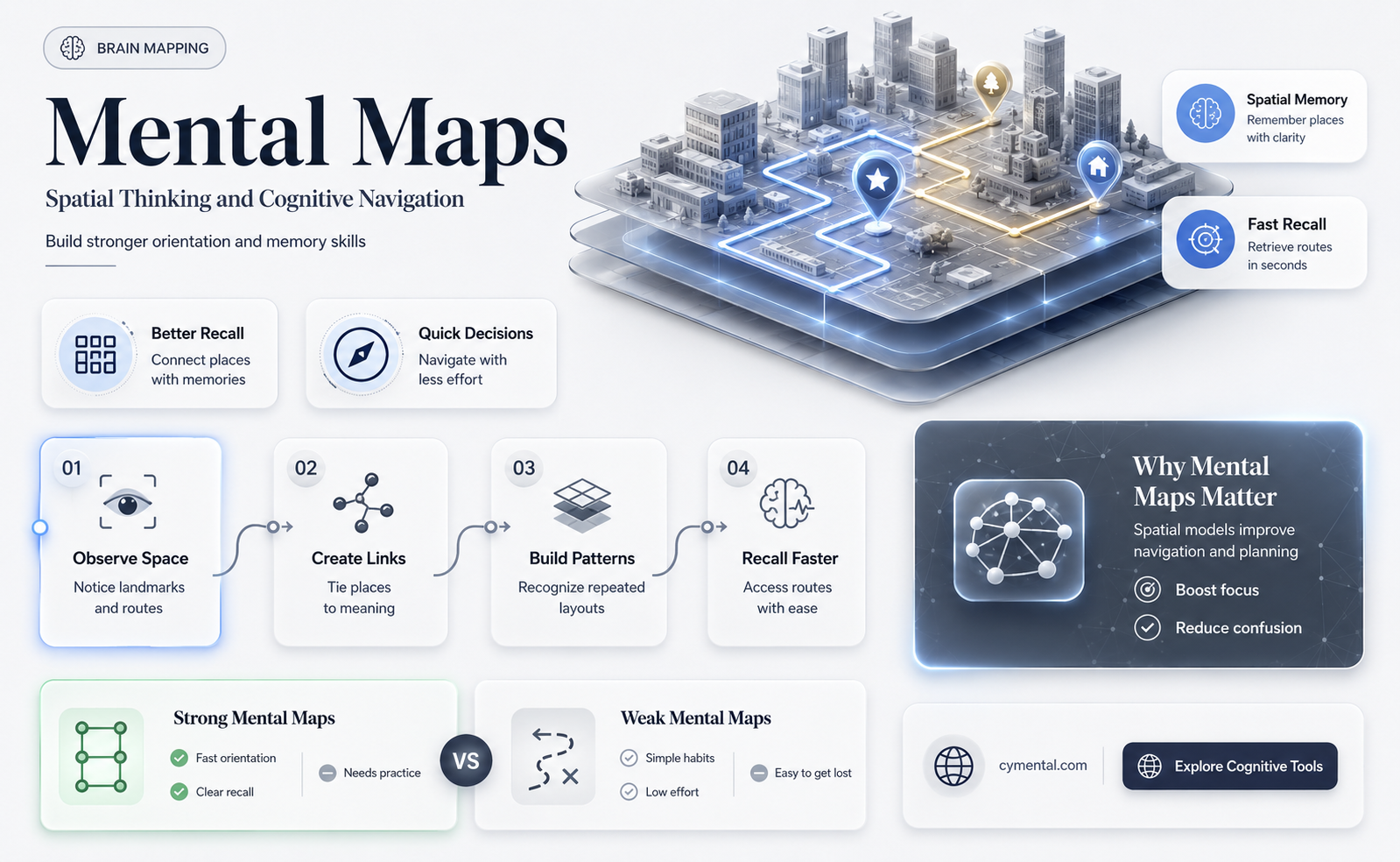
Mental maps, also known as cognitive maps, are internal representations of our environment that help us navigate and understand the world around us. They are incredibly helpful because they allow individuals to organize spatial information, plan routes, and make decisions based on their understanding of locations, distances, and relationships between places. By relying on mental maps, people can efficiently move through familiar and unfamiliar areas, recall important landmarks, and adapt to changes in their surroundings. Moreover, mental maps enhance problem-solving skills, foster a sense of direction, and contribute to a deeper connection with one's environment, making them an essential tool for daily life and spatial cognition.
| Characteristics | Values |
|---|---|
| Spatial Understanding | Mental maps help individuals understand and navigate physical spaces by organizing spatial information in their minds. |
| Decision Making | They aid in making informed decisions by providing a visual representation of locations, distances, and relationships between places. |
| Memory Enhancement | Mental maps improve memory by associating spatial information with personal experiences, landmarks, and routes. |
| Problem Solving | They assist in solving spatial problems, such as finding the shortest route or planning trips efficiently. |
| Orientation | Mental maps help individuals orient themselves in unfamiliar environments by providing a cognitive framework of the area. |
| Planning | They facilitate planning by allowing individuals to mentally simulate routes, estimate travel times, and anticipate obstacles. |
| Cultural and Social Awareness | Mental maps can reflect cultural and social knowledge, helping individuals understand community layouts and local significance. |
| Adaptability | They enable individuals to adapt to changes in their environment by updating their mental representations of spaces. |
| Reduced Anxiety | Familiarity with mental maps can reduce anxiety in navigation, especially in new or complex environments. |
| Educational Tool | Mental maps are used in education to teach geography, urban planning, and spatial reasoning skills. |
| Personal Identity | They contribute to personal identity by shaping how individuals perceive and interact with their surroundings. |
| Efficiency in Navigation | Mental maps improve navigation efficiency by reducing reliance on external aids like maps or GPS. |
Explore related products

![Mind Mapping for Students With Adult ADHD in College: Brain Strategies to Sharpen Focus, Beat Procrastination & Calm Stressful Thoughts for an Anxiety-Free Academic Life [BONUS: LIVE STRATEGY CALL]](https://m.media-amazon.com/images/I/61akOquuzFL._AC_UL320_.jpg)


What You'll Learn
- Navigation and Orientation: Mental maps aid in understanding spatial relationships, enhancing navigation skills in familiar and new environments
- Decision-Making: They simplify complex choices by visualizing options, risks, and outcomes in a structured way
- Memory Retention: Mental maps improve recall by organizing information spatially, linking concepts for better memory storage
- Problem-Solving: They help break down problems into manageable parts, fostering creative and logical solutions
- Planning and Strategy: Mental maps assist in organizing tasks, setting goals, and visualizing long-term plans effectively

Navigation and Orientation: Mental maps aid in understanding spatial relationships, enhancing navigation skills in familiar and new environments
Mental maps are the brain’s internal GPS, silently shaping how we move through the world. By encoding spatial relationships—distances, directions, and landmarks—these cognitive frameworks allow us to navigate both familiar neighborhoods and uncharted territories with confidence. For instance, recalling the location of a favorite café relative to a subway station relies on a mental map, as does plotting a route through a new city using a combination of street signs and visual cues. This ability isn’t just convenient; it’s fundamental to independence and safety in daily life.
To build and refine mental maps, start by actively observing your surroundings. When walking or driving, note key landmarks, intersections, and spatial patterns. For example, if a park is always three blocks east of your office, anchor that relationship in your mind. In unfamiliar environments, use a physical map or digital tool as a starting point, but periodically look up to connect the abstract representation to the real world. Studies show that combining visual and spatial learning—such as tracing routes with your finger while studying a map—improves retention by up to 40%. Practice this habit consistently, and your mental maps will become more detailed and reliable.
One of the most compelling benefits of mental maps is their adaptability. Unlike static GPS systems, which can fail in areas with poor signal or unexpected detours, mental maps allow for improvisation. For instance, if a road is closed, someone with a strong mental map can quickly reroute by recalling alternative paths or nearby landmarks. This flexibility is particularly valuable for children and older adults, who may face cognitive or technological barriers. Encouraging kids to draw maps of their school or neighborhood, or helping seniors visualize routes to medical appointments, can enhance their spatial awareness and confidence.
However, mental maps aren’t infallible. They can be distorted by memory biases, such as overestimating distances in unfamiliar areas or misremembering the orientation of landmarks. To mitigate this, cross-reference your mental map with external sources periodically. For example, if you’re unsure whether a store is north or south of a train station, verify its location using a digital map or by asking for directions. Additionally, avoid over-reliance on technology; studies show that excessive GPS use can atrophy spatial memory, making mental maps less accurate over time. Balance convenience with active engagement to keep your cognitive navigation skills sharp.
Ultimately, mental maps are a testament to the brain’s remarkable ability to organize and interpret space. By understanding and nurturing this skill, we not only improve our navigation efficiency but also deepen our connection to the environments we inhabit. Whether you’re guiding a child through a crowded park or planning a cross-country road trip, mental maps offer a powerful tool for orientation and independence. Invest time in building and maintaining them, and you’ll find that every journey—big or small—becomes more intuitive and rewarding.
AI's Role in Mental Health: Support, Challenges, and Future Potential
You may want to see also
Explore related products



Decision-Making: They simplify complex choices by visualizing options, risks, and outcomes in a structured way
Mental maps act as cognitive blueprints, transforming abstract decisions into tangible, navigable landscapes. When faced with a complex choice—whether selecting a career path, planning a project, or making a significant purchase—the human brain struggles to weigh options, risks, and outcomes simultaneously. Mental maps address this challenge by spatially organizing information, allowing decision-makers to visualize relationships and hierarchies. For instance, a decision tree can branch out to show possible outcomes of investing in stocks versus bonds, with each path annotated with potential risks and rewards. This visual structure reduces cognitive load, making it easier to compare alternatives and predict consequences.
Consider a scenario where a small business owner must decide whether to expand operations. A mental map could plot key factors like market demand, financial resources, and operational capacity as interconnected nodes. By drawing lines to represent dependencies—such as how market demand influences revenue projections—the owner can see how changes in one area ripple through the system. This approach not only clarifies the decision-making process but also highlights blind spots, such as overlooked risks or untapped opportunities. Practical tools like mind maps or flowcharts can be created digitally or on paper, with color-coding and symbols to emphasize critical elements.
The power of mental maps lies in their ability to make implicit trade-offs explicit. For example, a student deciding between two universities might map out factors like tuition costs, program reputation, and location. By assigning weights to each factor based on personal priorities, the student can visually compare the total "value" of each option. This methodical approach minimizes the influence of emotional biases, ensuring decisions are grounded in rational analysis. A tip for beginners: start with a central idea, then use branches to categorize pros, cons, and uncertainties, refining the map as new information emerges.
However, mental maps are not without limitations. Overloading a map with too much detail can defeat its purpose, making it as confusing as the original problem. To avoid this, prioritize information by focusing on high-impact factors and using sub-maps for secondary details. For instance, a map for a career change might have a primary layer for job satisfaction, salary, and work-life balance, with a secondary layer for specific roles or industries. Regularly updating the map as new data becomes available ensures its relevance and accuracy.
In conclusion, mental maps serve as decision-making accelerators, turning complexity into clarity. By visualizing options, risks, and outcomes in a structured format, they enable individuals to navigate choices with confidence and precision. Whether used for personal or professional decisions, the key is to balance detail with simplicity, ensuring the map remains a tool for insight rather than a source of overwhelm. Start small, iterate often, and let the map guide your thinking—not dictate it.
Mental Health Conditions: A Pathway to Medicaid Eligibility in Michigan?
You may want to see also
Explore related products


Memory Retention: Mental maps improve recall by organizing information spatially, linking concepts for better memory storage
The human brain is a spatial thinker, naturally inclined to organize information based on its relationship to other elements in a given environment. This innate ability forms the foundation of mental maps, a powerful tool for enhancing memory retention. By leveraging our brain's spatial processing strengths, mental maps transform abstract concepts into tangible, interconnected networks, making information easier to recall.
Imagine trying to memorize a list of historical events in chronological order. A linear approach, while logical, can be cumbersome. However, by creating a mental map, you could visualize a timeline as a winding river, with each event represented by a landmark along its banks. The Battle of Hastings, for instance, could be a towering castle, while the signing of the Magna Carta becomes a grand bridge. This spatial organization not only makes the information more engaging but also creates multiple pathways for retrieval, significantly improving recall.
This technique is particularly effective because it taps into the brain's hippocampus, a region crucial for spatial memory and navigation. Studies have shown that individuals who utilize spatial learning strategies, like mental mapping, exhibit increased hippocampal activity and demonstrate superior memory performance. For example, a study published in the journal *Cognitive Psychology* found that participants who used spatial organization techniques recalled 20% more information than those relying solely on rote memorization.
This advantage extends beyond academic settings. Mental maps can be invaluable for professionals in various fields. A lawyer preparing for a case could map out legal arguments as a courtroom, with each point represented by a different piece of evidence. A marketer could visualize customer journey stages as a cityscape, with each touchpoint represented by a distinct building. By spatially organizing complex information, mental maps facilitate quicker comprehension, better retention, and more effective communication.
Creating effective mental maps requires some practice and creativity. Start by identifying the core concept you want to remember. Then, choose a familiar spatial framework – a room, a city, a landscape – that can serve as your "map." Next, assign key elements of the information to specific locations within this framework, using vivid and memorable imagery. The more unusual and interconnected these associations, the stronger the memory trace will be. Finally, revisit your mental map regularly, reinforcing the spatial connections and ensuring long-term retention.
Music's Impact: Enhancing Mental Agility and Emotional Well-being
You may want to see also
Explore related products

$15.84 $19.99


Problem-Solving: They help break down problems into manageable parts, fostering creative and logical solutions
Mental maps, often referred to as mind maps, serve as powerful tools for dissecting complex problems into smaller, more digestible components. By visually organizing thoughts and ideas, they allow individuals to identify the core elements of a challenge, making it easier to tackle each part systematically. For instance, when faced with a project deadline, a mental map can break down tasks into categories like research, drafting, and editing, each with subtasks and timelines. This structured approach not only clarifies priorities but also reduces overwhelm, enabling focused action.
Consider the analytical process involved in using mental maps for problem-solving. They encourage users to ask probing questions, such as "What are the root causes?" or "What are the potential obstacles?" By mapping out these inquiries and their answers, individuals can uncover hidden patterns or connections that might not be apparent in linear thinking. For example, a business analyzing declining sales might map out factors like market trends, customer feedback, and internal processes, revealing a previously overlooked issue in supply chain management. This methodical breakdown fosters a deeper understanding of the problem, paving the way for targeted solutions.
To maximize the problem-solving potential of mental maps, follow these practical steps: start by defining the central problem in a single, clear statement. Next, branch out with major categories or themes related to the issue. Use color-coding, symbols, or keywords to differentiate between ideas and maintain clarity. Regularly review and update the map as new information emerges, ensuring it remains a dynamic tool rather than a static document. For team collaborations, digital platforms like MindMeister or Miro allow real-time editing and sharing, enhancing collective problem-solving efforts.
A cautionary note: while mental maps excel at breaking down problems, they can become counterproductive if overcomplicated. Avoid the temptation to include every minor detail, as this can clutter the map and obscure the main issues. Instead, focus on the most critical aspects and use secondary maps for deeper exploration if needed. Additionally, ensure the map remains visually balanced, with no single branch dominating the structure. This maintains a holistic perspective, preventing tunnel vision on one aspect of the problem.
In conclusion, mental maps are invaluable for transforming daunting problems into manageable parts, fostering both creativity and logic in the solution-finding process. By providing a visual framework, they encourage thorough analysis, prioritize actionable steps, and facilitate collaboration. Whether used individually or in a group setting, their adaptability and simplicity make them a versatile tool for tackling challenges across various domains, from personal projects to complex organizational issues.
Tax Dollars and Mental Health: Funding Institutions for Better Care?
You may want to see also
Explore related products


Planning and Strategy: Mental maps assist in organizing tasks, setting goals, and visualizing long-term plans effectively
Mental maps serve as a cognitive blueprint, transforming abstract ideas into structured, actionable plans. By visually organizing tasks, they reduce cognitive load, allowing individuals to focus on execution rather than recall. For instance, a project manager might use a mental map to break down a complex initiative into phases, subtasks, and deadlines, ensuring nothing is overlooked. This methodical approach not only clarifies priorities but also fosters a sense of control, reducing anxiety associated with large-scale endeavors.
Consider the process of setting goals. Mental maps excel in bridging the gap between ambition and action by providing a spatial representation of objectives and the steps required to achieve them. For example, a student aiming to complete a thesis could map out research milestones, writing schedules, and submission deadlines. This visual framework not only motivates by making progress tangible but also highlights dependencies, such as how data collection must precede analysis. The result is a clearer, more adaptable strategy that evolves with changing circumstances.
Long-term planning benefits significantly from mental maps’ ability to balance detail and overview. A startup founder, for instance, might map a five-year growth strategy, starting with broad goals like "expand market share" and drilling down to quarterly targets, resource allocation, and contingency plans. This hierarchical visualization ensures alignment across teams and stakeholders while maintaining flexibility for unforeseen challenges. Unlike linear lists, mental maps accommodate complexity, enabling users to see how individual actions contribute to overarching visions.
However, the effectiveness of mental maps in planning hinges on their design and maintenance. Overloading a map with excessive detail can defeat its purpose, while neglecting updates renders it obsolete. Practical tips include limiting each node to a single concept, using color-coding for categories (e.g., red for urgent tasks, green for completed), and revisiting the map weekly to reflect progress. Digital tools like MindMeister or Miro offer the advantage of real-time collaboration and scalability, though analog methods like whiteboards retain tactile appeal for brainstorming sessions.
In essence, mental maps are not just tools for visualization but catalysts for strategic thinking. They compel users to articulate goals, anticipate challenges, and devise pathways to success. By translating complexity into clarity, they empower individuals and teams to navigate uncertainty with confidence, turning abstract aspirations into concrete achievements. Whether for personal development or organizational strategy, the mental map’s true value lies in its ability to make the intangible tangible and the overwhelming manageable.
Steroids and Mental Health: Exploring Potential Benefits and Risks
You may want to see also
Frequently asked questions
Mental maps, or cognitive maps, are internal representations of external environments stored in the human brain. They help individuals navigate by providing a spatial understanding of their surroundings, allowing them to plan routes, recognize landmarks, and make decisions based on spatial relationships.
Mental maps aid decision-making by organizing and structuring information about a particular area. They enable individuals to weigh options, consider distances, and evaluate potential outcomes by visualizing the spatial context, thus facilitating more informed choices.
Yes, mental maps enhance memory by creating a structured framework for information storage. By associating new knowledge with spatial locations, individuals can improve recall, especially for tasks involving directions, locations, or spatial relationships.
Mental maps encourage problem-solving by providing a visual and spatial perspective on complex issues. They allow individuals to break down problems into manageable parts, identify patterns, and explore alternative solutions by manipulating the mental representation of the environment.
Mental maps assist in learning new environments by providing a framework to organize and integrate new information. They help individuals make sense of unfamiliar spaces, establish connections between different locations, and develop a comprehensive understanding of the area's layout and features.