Ava Ramirez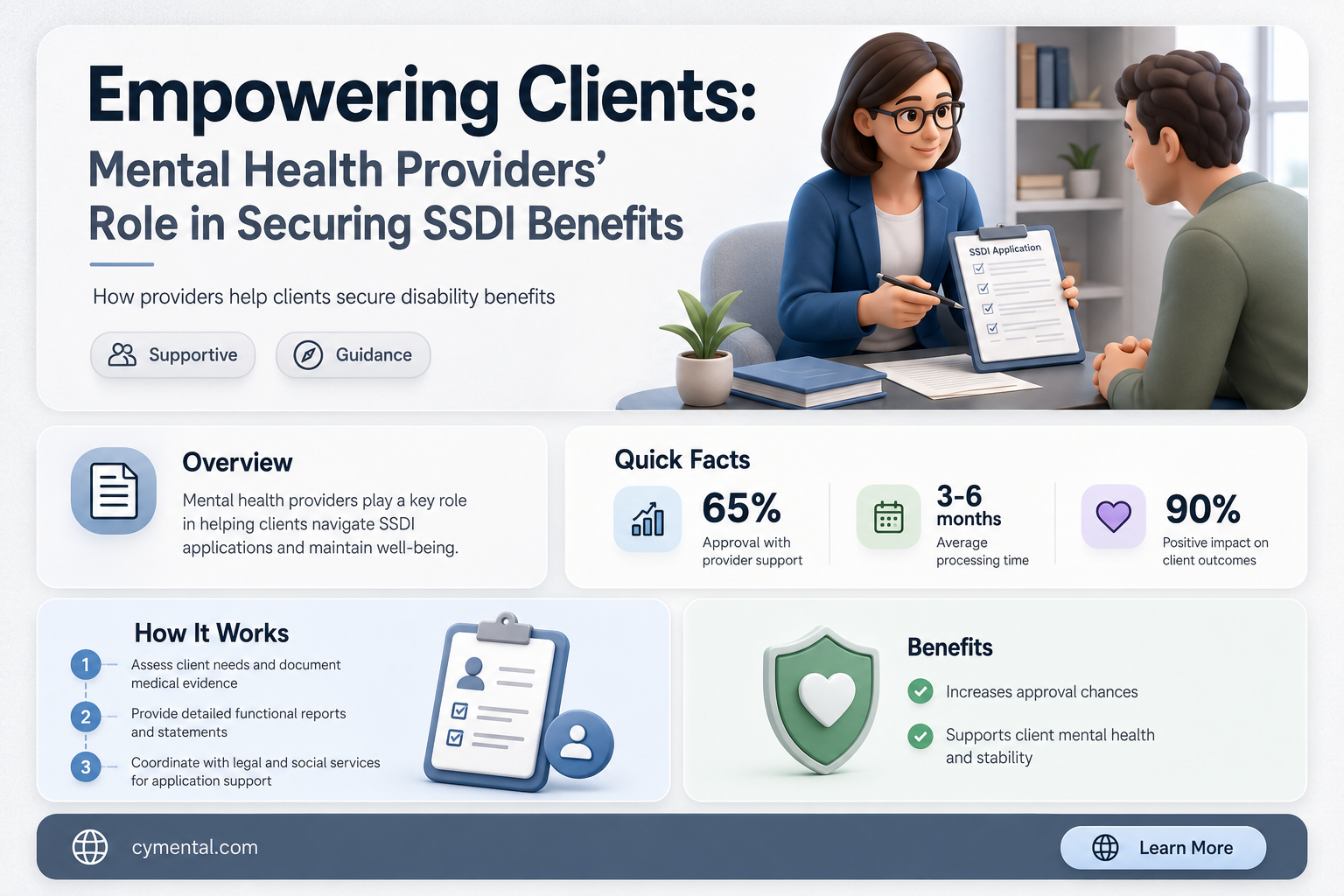
Mental health providers play a crucial role in assisting clients with obtaining Social Security Disability Insurance (SSDI) by providing comprehensive documentation and support that highlights the functional limitations caused by their mental health conditions. Through detailed assessments, treatment records, and personalized statements, providers can effectively demonstrate how a client’s symptoms impair their ability to perform daily activities and maintain employment. Additionally, providers can educate clients about the SSDI application process, advocate on their behalf, and collaborate with legal professionals to ensure a strong, evidence-based case. By addressing both the clinical and administrative aspects, mental health providers empower clients to navigate the complex SSDI system and secure the financial support they need.
Explore related products


What You'll Learn
- Assessing SSDI Eligibility: Help clients understand SSDI criteria and determine if their mental health qualifies
- Documenting Symptoms: Teach clients to track and document symptoms consistently for SSDI applications
- Writing Supportive Letters: Provide detailed, professional letters to support SSDI claims with clinical evidence
- Navigating Appeals: Guide clients through SSDI denials and assist with the appeals process
- Connecting to Resources: Refer clients to SSDI advocates or legal aid for additional support

Assessing SSDI Eligibility: Help clients understand SSDI criteria and determine if their mental health qualifies
Mental health providers play a pivotal role in helping clients navigate the complexities of Social Security Disability Insurance (SSDI) eligibility, particularly when mental health conditions are the primary impairment. The first step in this process is demystifying the SSDI criteria, which are often misunderstood or overwhelming for clients. SSDI requires that an individual’s condition be severe enough to prevent them from engaging in substantial gainful activity (SGA) and is expected to last at least 12 months or result in death. For mental health conditions, this means demonstrating that symptoms significantly impair daily functioning, social interactions, or concentration—key areas evaluated by the Social Security Administration (SSA). Providers must educate clients on these benchmarks, emphasizing that eligibility hinges on the functional impact of their condition, not just the diagnosis itself.
To assess whether a client’s mental health qualifies, providers should conduct a thorough evaluation of their functional limitations. This involves documenting how symptoms like severe depression, anxiety, or psychosis interfere with tasks such as maintaining a schedule, communicating effectively, or adapting to changes. For example, a client with major depressive disorder might struggle with persistent fatigue, making it impossible to work a full-time job. Providers should use standardized tools like the Global Assessment of Functioning (GAF) scale or the World Health Organization Disability Assessment Schedule (WHODAS) to quantify these impairments. Such documentation not only strengthens the SSDI application but also helps clients understand the connection between their symptoms and their inability to work.
A critical yet often overlooked aspect is aligning the client’s condition with the SSA’s Blue Book listings for mental disorders. These listings outline specific criteria for conditions like schizophrenia, bipolar disorder, or PTSD. For instance, Listing 12.04 for depressive disorders requires medical documentation of at least five symptoms (e.g., appetite disturbance, psychomotor agitation) and extreme limitation in one, or marked limitation in two, areas of mental functioning. Providers should review these listings with clients, explaining how their symptoms match or fall short of the criteria. If a client’s condition doesn’t meet a listing, providers can still argue for eligibility through a medical-vocational allowance, which considers age, education, work history, and residual functional capacity.
Practical tips can make this process less daunting. Encourage clients to keep a symptom journal, noting daily challenges and how they affect work-related tasks. This provides concrete evidence for the application and appeals process. Additionally, providers should collaborate with clients to gather all necessary medical records, including therapy notes, medication histories, and hospitalization records. For clients with limited literacy or language barriers, providers can offer simplified explanations of SSDI forms or assist in completing them. Finally, managing expectations is crucial; SSDI approval can take months, and denials are common. Providers should prepare clients for this reality while reinforcing the importance of persistence and accurate documentation.
In conclusion, assessing SSDI eligibility for mental health conditions requires a blend of clinical expertise, advocacy, and education. By helping clients understand the criteria, documenting functional impairments, and navigating the SSA’s requirements, mental health providers can significantly improve their chances of securing this vital support. This process not only aids in financial stability but also validates the client’s struggles, fostering a sense of empowerment in their journey toward recovery.
Unlocking Potential: How Mental Health Enhances Your Life and Success
You may want to see also
Explore related products


Documenting Symptoms: Teach clients to track and document symptoms consistently for SSDI applications
Effective documentation of symptoms is a cornerstone of a successful SSDI application for clients with mental health conditions. Without clear, consistent records, claimants often struggle to demonstrate the severity and longevity of their impairments. Mental health providers play a pivotal role in teaching clients how to track symptoms systematically, transforming subjective experiences into objective evidence that aligns with SSA criteria.
Begin by educating clients on the *why* behind symptom tracking. Emphasize that SSDI evaluators seek patterns of dysfunction, not isolated incidents. For example, a client with major depressive disorder might note daily fluctuations in energy levels, sleep disturbances, or difficulty concentrating. A bipolar disorder claimant could track mood episodes, including duration, triggers, and impact on daily activities. Use analogies to simplify: “Think of this as a medical log, like tracking blood sugar for diabetes—it shows trends over time.”
Provide practical tools tailored to the client’s literacy and tech comfort. For younger or tech-savvy clients, recommend apps like Daylio or Bearable, which allow for quick, timestamped entries. For older adults or those with limited digital access, suggest a paper journal with a simple template: date, time, symptom description, and severity on a 1-10 scale. Encourage specificity—instead of “felt anxious,” prompt for details like “heart racing, avoided social event, lasted 3 hours.” Pair this with a weekly review to identify recurring themes.
Caution clients against backfilling entries, as inconsistencies can raise red flags. Instead, stress the importance of real-time recording, even if brief. For example, a client with PTSD might jot down “flashback at 2 p.m., lasted 20 minutes, unable to work afterward.” If memory is a barrier, suggest setting daily reminders or keeping a small notebook within reach. Providers can model this by documenting session observations in the client’s presence, reinforcing the behavior.
Finally, integrate symptom tracking into treatment goals. For instance, a client with schizophrenia could track auditory hallucinations alongside medication adherence, highlighting side effects or treatment resistance—key factors in SSDI evaluations. Review these logs periodically to identify gaps in documentation and ensure alignment with SSA’s functional criteria, such as difficulty maintaining concentration or interacting with others. By framing tracking as both therapeutic and strategic, providers empower clients to build a compelling case for disability benefits.
AI's Role in Mental Health: Support, Challenges, and Future Possibilities
You may want to see also
Explore related products

$17.97 $17.97


Writing Supportive Letters: Provide detailed, professional letters to support SSDI claims with clinical evidence
Mental health providers play a pivotal role in helping clients secure Social Security Disability Insurance (SSDI) benefits by crafting detailed, professional letters that substantiate claims with clinical evidence. These letters must go beyond general statements of support, offering a clear, objective, and comprehensive account of the client’s mental health condition and its functional impact. A well-structured letter can bridge the gap between clinical observations and the legal criteria for disability, significantly strengthening the client’s case.
To begin, providers should focus on specificity. Instead of vague descriptions like “the client struggles with anxiety,” detail the frequency, severity, and duration of symptoms. For example, “Client experiences panic attacks three to four times weekly, lasting 20–30 minutes each, accompanied by hyperventilation and derealization.” Include diagnostic criteria, such as DSM-5 codes, and reference objective measures like symptom rating scales (e.g., PHQ-9 for depression, GAD-7 for anxiety). Quantifiable data adds credibility and aligns with SSDI’s requirement for medical evidence.
Next, connect symptoms to functional limitations. SSDI evaluates disability based on how impairments affect daily activities, work, and social functioning. For instance, describe how a client’s severe depression limits their ability to concentrate, persist at tasks, or interact with others. Use concrete examples: “Client is unable to complete household chores without frequent breaks due to fatigue and anhedonia, and has missed 50% of scheduled appointments due to lack of motivation.” Avoid assumptions; instead, base observations on clinical notes, therapy sessions, or collateral reports from family members.
A persuasive element to include is the treatment history and prognosis. Document all interventions attempted, such as medication trials (e.g., 20 mg/day of fluoxetine for six weeks with minimal improvement) or therapy modalities (e.g., 12 sessions of CBT with no significant symptom reduction). Highlight the chronic or recurrent nature of the condition, emphasizing why it meets SSDI’s duration requirement of at least 12 months. If the client’s condition is expected to worsen or persist despite treatment, state this explicitly, supported by clinical reasoning.
Finally, adopt a professional yet empathetic tone. While objectivity is crucial, conveying the human impact of the client’s condition can resonate with reviewers. Close the letter by summarizing key points and explicitly stating your opinion on the client’s inability to engage in substantial gainful activity. For example, “Based on the severity and persistence of symptoms, as well as the documented functional limitations, it is my professional opinion that this client is unable to perform full-time work on a sustained basis.” This direct conclusion leaves no ambiguity about your stance.
In summary, writing supportive letters for SSDI claims requires a blend of clinical precision, functional analysis, and persuasive advocacy. By providing detailed, evidence-based narratives, mental health providers can significantly enhance their clients’ chances of approval, ensuring that the complexities of mental illness are accurately represented in the disability determination process.
Physical Education's Impact: Boosting Mental Health and Well-Being
You may want to see also
Explore related products


Navigating Appeals: Guide clients through SSDI denials and assist with the appeals process
A denial of Social Security Disability Insurance (SSDI) benefits can be devastating for clients already struggling with mental health challenges. As a mental health provider, your role in the appeals process is crucial. You can provide emotional support, help clients understand the reasons for denial, and assist in gathering the necessary evidence to strengthen their case.
Understanding Denial Reasons:
The first step is deciphering the denial letter. SSDI denials often cite insufficient medical evidence, lack of treatment compliance, or the belief that the client can perform other work. Analyze the letter with your client, explaining the specific reasons for denial in clear, understandable language. This transparency empowers them to actively participate in the appeals process.
For example, if the denial cites insufficient evidence of functional limitations, discuss with your client how their symptoms impact daily activities like concentration, social interaction, or self-care.
Gathering Crucial Evidence:
The appeals process demands robust documentation. Collaborate with your client to compile a comprehensive file. This includes:
- Detailed Treatment Records: Ensure your own notes meticulously document symptom severity, treatment response, and functional limitations. Encourage clients to request records from all treating providers, including therapists, psychiatrists, and primary care physicians.
- Functional Assessments: Administer standardized assessments or create detailed narratives outlining how the client's mental health condition restricts their ability to perform work-related tasks.
- Collateral Information: Statements from family members, friends, or employers can provide valuable insights into the client's daily functioning and the impact of their mental health condition.
Navigating the Appeals Stages:
The SSDI appeals process typically involves four stages: Reconsideration, Hearing by an Administrative Law Judge (ALJ), Appeals Council Review, and Federal Court Review. Each stage has specific requirements and deadlines. Guide your client through each step, explaining the process, assisting with paperwork, and preparing them for hearings.
Encourage realistic expectations, as appeals can be lengthy. Offer emotional support throughout, acknowledging the stress and frustration of the process.
Advocating for Your Client:
Your role extends beyond paperwork. Advocate for your client's needs during hearings. Clearly articulate the severity of their mental health condition and its impact on their ability to work. Highlight inconsistencies in the denial decision and present evidence that supports their claim. Remember, you are a vital voice for your client, ensuring their story is heard and understood.
Ftm Testosterone Therapy: Mental Health Benefits and Emotional Well-being
You may want to see also
Explore related products


Connecting to Resources: Refer clients to SSDI advocates or legal aid for additional support
Mental health providers often encounter clients whose conditions significantly impair their ability to work, making them potential candidates for Social Security Disability Insurance (SSDI). However, the application process can be daunting, complex, and emotionally taxing. One of the most effective ways providers can support their clients is by connecting them to specialized resources, such as SSDI advocates or legal aid organizations. These professionals are trained to navigate the intricacies of the SSDI system, increasing the likelihood of a successful application while alleviating the client’s stress.
Consider the role of SSDI advocates, who act as intermediaries between the applicant and the Social Security Administration (SSA). Advocates are well-versed in the medical and legal criteria required for approval, ensuring that applications are thorough, accurate, and supported by the necessary documentation. For instance, they can help gather medical records, draft detailed statements about the client’s functional limitations, and prepare clients for SSA interviews or hearings. Referring a client to an advocate can streamline the process, particularly for those with severe mental health conditions who may struggle to manage paperwork or communicate their needs effectively.
Legal aid organizations offer another critical resource, especially for clients facing denials or appeals. These organizations often provide pro bono or low-cost legal representation, which can be invaluable during the appeals process. For example, attorneys specializing in disability law can challenge unfavorable decisions, present additional evidence, and argue on behalf of the client in administrative hearings. Mental health providers should maintain a list of reputable legal aid organizations in their area to facilitate quick referrals when needed. This proactive approach not only supports the client’s financial stability but also reinforces the therapeutic alliance by demonstrating a commitment to their overall well-being.
However, it’s essential to recognize potential barriers to accessing these resources. Some clients may hesitate to seek external help due to stigma, financial concerns, or a lack of awareness about available services. Providers can address these issues by normalizing the referral process, explaining the benefits of professional assistance, and offering to make the initial contact on the client’s behalf. Additionally, providers should verify that the advocate or legal aid organization has experience with mental health cases, as these claims often require a nuanced understanding of psychiatric conditions and their impact on daily functioning.
In conclusion, referring clients to SSDI advocates or legal aid is a practical and compassionate strategy for mental health providers. By leveraging these specialized resources, providers can empower their clients to navigate the SSDI process with greater confidence and success. This collaborative approach not only enhances the likelihood of a positive outcome but also underscores the provider’s role as a holistic supporter of the client’s recovery and financial stability.
Government Support for Mental Health: Effective Solutions or Missed Opportunities?
You may want to see also
Frequently asked questions
Mental health providers can assist clients by documenting their mental health conditions, providing detailed medical evidence, and completing forms like the Medical Source Statement (MSS) to support the SSDI application.
Providers should include thorough records of diagnoses, treatment history, functional limitations, and how the client’s mental health affects their ability to work. Consistency and specificity in documentation are key.
Yes, providers can educate clients about the evaluation process, help them gather necessary evidence, and write letters or testify about the client’s mental health limitations if needed.
Providers can review the denial reasons, update medical records with additional evidence, and support the client through the appeals process by providing further documentation or testimony.
While not legally required, providers are ethically encouraged to support clients by providing accurate and comprehensive medical evidence to help them access necessary benefits like SSDI.