Noah Parker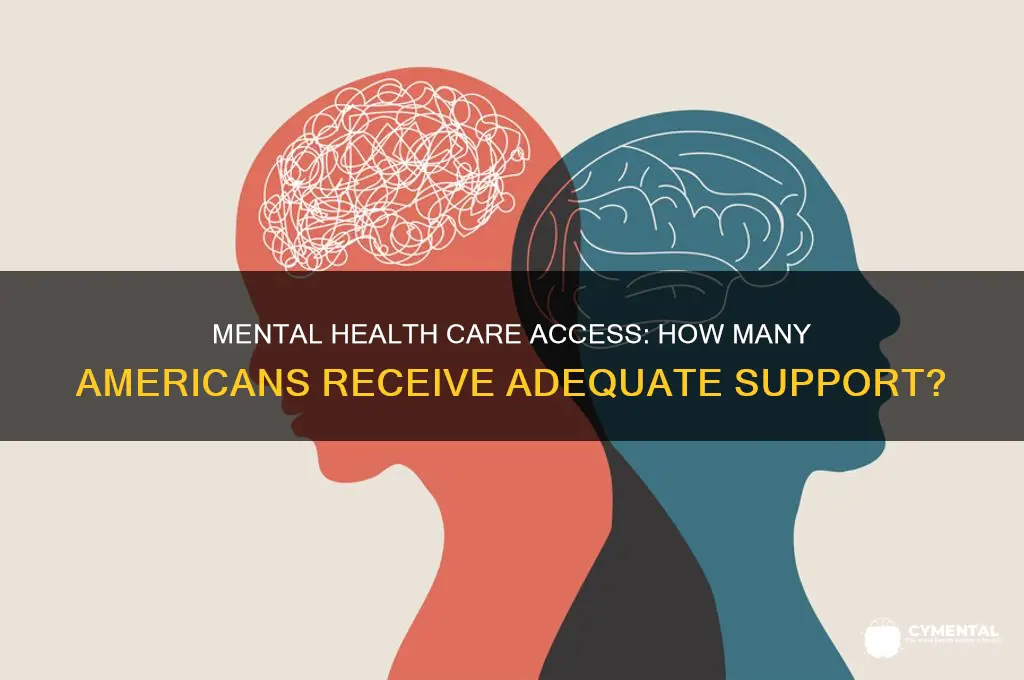
Access to mental health care remains a critical issue in the United States, with significant disparities in who receives the help they need. Despite growing awareness and efforts to destigmatize mental health issues, many Americans still face barriers such as cost, lack of insurance coverage, and limited availability of providers. Studies indicate that only about half of individuals with diagnosable mental health conditions receive treatment, with even lower rates among marginalized communities, including racial and ethnic minorities, low-income populations, and those in rural areas. These disparities highlight the urgent need for systemic reforms to improve accessibility, affordability, and equity in mental health care across the nation.
Explore related products


What You'll Learn
- Access Barriers: Financial constraints, lack of insurance, and stigma prevent many from seeking mental health care
- Treatment Gaps: Only 40% of Americans with mental illness receive adequate treatment annually
- Rural Challenges: Limited providers and resources in rural areas reduce access to mental health services
- Minority Disparities: Racial and ethnic minorities face greater barriers to mental health care
- Youth Needs: Over 60% of youth with mental health issues do not receive necessary treatment

Access Barriers: Financial constraints, lack of insurance, and stigma prevent many from seeking mental health care
Financial constraints are a silent gatekeeper to mental health care, turning a basic need into a luxury for many Americans. Consider this: the average cost of a therapy session without insurance ranges from $100 to $200, and psychiatric evaluations can soar past $500. For a family living paycheck to paycheck, these expenses are insurmountable. Even with insurance, high deductibles and copays often force individuals to choose between mental health care and other essentials like groceries or rent. This economic barrier disproportionately affects low-income households, where nearly 40% of adults with mental illness receive no treatment, compared to 13% of those in higher income brackets. The system, designed to support, instead excludes those who need it most.
Lack of insurance compounds this crisis, leaving millions without a safety net. In states that have not expanded Medicaid, the gap is stark: nearly 2.3 million adults with mental illness fall into the "coverage gap," earning too much for Medicaid but too little for Affordable Care Act subsidies. For these individuals, mental health care is not just expensive—it’s inaccessible. Even insured Americans face limitations, as many plans offer inadequate mental health coverage, with restrictive provider networks or caps on therapy sessions. Without comprehensive insurance, the path to care is riddled with obstacles, turning a systemic issue into a personal one.
Stigma, though intangible, is perhaps the most insidious barrier. Fear of judgment or discrimination keeps countless individuals from seeking help, even when resources are available. In a survey by the American Psychological Association, 50% of respondents cited stigma as a reason for avoiding mental health treatment. This stigma is particularly pervasive in communities of color, where historical mistrust of healthcare systems and cultural taboos around mental illness persist. For example, Black Americans are 20% more likely to experience serious mental health problems but are less likely to seek treatment due to stigma and lack of culturally competent care. Until society normalizes mental health care, stigma will continue to silence those in need.
Breaking these barriers requires a multi-faceted approach. Policymakers must expand Medicaid, enforce parity laws to ensure equal insurance coverage for mental health, and subsidize care for low-income individuals. Employers can play a role by offering robust mental health benefits and fostering workplace cultures that encourage seeking help. At the community level, public awareness campaigns can combat stigma, while training more diverse mental health professionals can improve access for marginalized groups. For individuals, small steps like researching sliding-scale clinics or telehealth options can make care more affordable. The goal is clear: transform mental health care from a privilege into a right, accessible to all.
LSD's Potential: Unlocking Mental Health Benefits and Therapeutic Insights
You may want to see also
Explore related products


$54.19 $114


Treatment Gaps: Only 40% of Americans with mental illness receive adequate treatment annually
Despite the growing awareness of mental health issues, a staggering 60% of Americans with mental illness do not receive the treatment they need each year. This treatment gap is not merely a statistic; it represents millions of individuals struggling without adequate support. The reasons behind this disparity are multifaceted, encompassing financial barriers, stigma, and a shortage of mental health professionals. For instance, in rural areas, where 20% of the U.S. population resides, there is one psychiatrist per 30,000 people, compared to one per 5,000 in urban areas. This geographic imbalance exacerbates the problem, leaving many without access to essential care.
Consider the financial strain: even with insurance, high copays and limited coverage for therapy sessions deter many from seeking help. A single therapy session can cost between $100 and $250 out-of-pocket, a prohibitive expense for low-income individuals. Additionally, the stigma surrounding mental health persists, with 40% of Americans reporting they would feel ashamed or embarrassed if they sought mental health treatment. This stigma is particularly pronounced among men and older adults, who are less likely to acknowledge their struggles or seek help. Addressing these barriers requires systemic change, including policy reforms to improve insurance coverage and public campaigns to destigmatize mental health care.
Another critical factor is the mismatch between demand and supply in mental health services. The U.S. faces a severe shortage of mental health providers, with an estimated need for 6,000 additional psychiatrists by 2025. This shortage is especially acute for specialized care, such as child and adolescent psychiatry, where only 8,300 providers serve the entire nation. Telehealth has emerged as a partial solution, increasing access for those in remote areas, but it is not a panacea. Many individuals lack the technology or digital literacy to utilize these services effectively. Bridging this gap requires investment in training more providers and expanding telehealth infrastructure.
Practical steps can be taken to mitigate this crisis. Employers can play a pivotal role by offering comprehensive mental health benefits, including access to Employee Assistance Programs (EAPs) and flexible work arrangements to reduce stress. Schools and universities can integrate mental health education into curricula, fostering early intervention and reducing stigma among younger generations. Individuals can also take proactive measures, such as researching low-cost clinics, utilizing online therapy platforms, and joining support groups. For example, organizations like the National Alliance on Mental Illness (NAMI) offer free resources and peer support, providing a lifeline for those who cannot afford traditional treatment.
Ultimately, closing the treatment gap requires a collective effort from policymakers, healthcare providers, and communities. By addressing financial barriers, combating stigma, and expanding access to care, we can ensure that more Americans receive the mental health support they desperately need. The 40% treatment rate is not just a number—it’s a call to action to build a more compassionate and equitable mental health system.
Shipping the Mentally Ill to California: Nevada's Controversial Solution
You may want to see also
Explore related products


Rural Challenges: Limited providers and resources in rural areas reduce access to mental health services
In rural America, the stark reality is that over 110 million people live in areas designated as mental health professional shortage areas, according to the Health Resources and Services Administration. This means that for every 30,000 residents, there is often only one psychiatrist available, compared to urban areas where the ratio can be as favorable as 1:5,000. Such disparities highlight a critical gap in access to care, leaving many rural Americans without the mental health support they desperately need.
Consider the logistical hurdles: in some rural counties, the nearest mental health provider can be over 50 miles away, requiring individuals to travel long distances, often without reliable public transportation. For those with severe mental health conditions, such as major depressive disorder or schizophrenia, this barrier can be insurmountable. Even when providers are available, they are frequently overburdened, with caseloads that limit the frequency and duration of sessions. For instance, a therapist in a rural area might see 30+ patients per week, compared to urban counterparts who average 20–25, leading to rushed appointments and inadequate care.
Compounding these challenges is the lack of specialized resources. Rural areas often lack access to evidence-based treatments like cognitive-behavioral therapy (CBT) or dialectical behavior therapy (DBT), which are proven to reduce symptoms of anxiety and depression by up to 50%. Instead, residents may rely on primary care physicians, who, while well-intentioned, often lack the training to manage complex mental health cases. For example, a 2021 study found that only 20% of rural primary care providers felt "very prepared" to treat patients with severe mental illness, compared to 45% of urban providers.
To address these gaps, innovative solutions are emerging. Telehealth has shown promise, with platforms like BetterHelp and Talkspace offering virtual therapy sessions that can reach remote areas. However, this approach is not without challenges: nearly 19 million rural Americans lack access to reliable broadband internet, a prerequisite for effective telehealth. Additionally, older adults, who make up a significant portion of the rural population, may struggle with the technology, limiting its effectiveness. Community-based programs, such as peer support groups and mobile crisis units, are also being piloted, but funding remains a persistent issue, with rural mental health initiatives receiving only a fraction of the resources allocated to urban programs.
Ultimately, the rural mental health crisis demands a multifaceted response. Policymakers must prioritize funding for rural mental health infrastructure, including incentives for providers to practice in underserved areas and investments in broadband expansion. Simultaneously, integrating mental health services into primary care settings and training non-specialists to deliver basic interventions could bridge the gap temporarily. Without such concerted efforts, millions of rural Americans will continue to face barriers to care, perpetuating a cycle of untreated mental illness and its devastating consequences.
Marijuana and Mental Health: Exploring Potential Benefits and Risks
You may want to see also
Explore related products


Minority Disparities: Racial and ethnic minorities face greater barriers to mental health care
Racial and ethnic minorities in the United States are significantly less likely to receive adequate mental health care compared to their white counterparts. Data from the Substance Abuse and Mental Health Services Administration (SAMHSA) reveals that while 47.2% of non-Hispanic whites with mental illness receive treatment, only 33.9% of Black Americans and 32.9% of Hispanic Americans do the same. This disparity persists across age groups, with young adults of color facing particularly steep barriers. For instance, only 7.6% of Black adolescents aged 12–17 receive mental health services, compared to 13.3% of white adolescents.
These disparities stem from a complex interplay of systemic and individual factors. Structural barriers, such as lack of insurance coverage and limited access to providers in underserved communities, disproportionately affect minorities. For example, 11.7% of Hispanic Americans and 9.8% of Black Americans are uninsured, compared to 5.4% of non-Hispanic whites. Even when insured, minorities often encounter providers who lack cultural competency, leading to misdiagnosis or inadequate care. A study in *JAMA Psychiatry* found that Black patients are 20% less likely than white patients to receive evidence-based psychotherapy for depression.
Language and cultural stigma further compound these challenges. In Hispanic communities, for instance, mental health issues are often viewed as a sign of personal weakness or family shame, deterring individuals from seeking help. Similarly, in Asian American communities, the emphasis on collective well-being over individual struggles can discourage open discussions about mental health. These cultural norms, combined with language barriers, mean that many minorities either delay care or avoid it altogether.
Addressing these disparities requires targeted, multifaceted solutions. Policymakers must expand Medicaid coverage and fund community health centers in underserved areas to improve access. Providers should undergo mandatory cultural competency training to better serve diverse populations. Telehealth services, which saw a 60% increase in usage during the COVID-19 pandemic, offer a promising avenue for reaching minorities in remote or stigmatized communities. Additionally, public health campaigns tailored to specific cultural contexts can reduce stigma and encourage early intervention.
Ultimately, closing the mental health care gap for racial and ethnic minorities is not just a matter of equity—it’s a public health imperative. Without targeted interventions, millions will continue to suffer in silence, perpetuating cycles of untreated illness and societal inequity. By dismantling systemic barriers and fostering culturally sensitive care, we can ensure that mental health services are accessible to all Americans, regardless of race or ethnicity.
Anime's Impact: Exploring Mental Health Benefits and Emotional Healing
You may want to see also
Explore related products


Youth Needs: Over 60% of youth with mental health issues do not receive necessary treatment
Over 60% of youth with mental health issues do not receive the treatment they need, a statistic that underscores a systemic failure in addressing adolescent well-being. This gap persists despite evidence that early intervention can prevent lifelong struggles. For instance, untreated anxiety in teens often escalates into chronic disorders by adulthood, while untreated depression increases the risk of self-harm and academic failure. The question isn’t whether these issues are urgent—it’s why so many young people slip through the cracks.
One major barrier is the stigma surrounding mental health, which discourages youth from seeking help. Surveys show that 40% of teens fear being judged if they admit to struggling. Schools, often the first line of defense, frequently lack resources to identify or support students in crisis. Only 20% of high schools have counselors trained in mental health, leaving many students without a trusted adult to turn to. Parents, too, may misinterpret symptoms as typical teenage behavior, delaying intervention. For example, irritability in a 14-year-old might be dismissed as puberty-related when it could signal underlying depression.
Another critical issue is access to care. In rural areas, where 20% of U.S. youth live, there’s often a shortage of mental health providers. Urban areas fare little better, with long waitlists and high costs creating additional hurdles. Telehealth emerged as a solution during the pandemic, but only 30% of low-income families have consistent internet access, limiting its reach. Insurance coverage is equally problematic: 15% of children lack mental health coverage, and even insured families face high copays or limited provider networks. Without affordable, accessible options, many families simply go without care.
To address this crisis, a multi-pronged approach is essential. Schools should integrate mental health education into curricula, teaching students to recognize symptoms in themselves and peers. Training teachers and counselors to spot red flags—like sudden changes in behavior or declining grades—could prompt early referrals. Policymakers must expand Medicaid coverage for mental health services and incentivize providers to work in underserved areas. Parents can play a role by normalizing conversations about emotions and modeling help-seeking behavior. For example, a parent might say, “I’m feeling overwhelmed, so I’m going to talk to my therapist,” reducing stigma by example.
The takeaway is clear: closing the treatment gap requires collective action. Youth mental health isn’t a niche issue—it’s a public health imperative. Every untreated child is a future adult carrying unresolved pain. By investing in prevention, accessibility, and education, we can ensure that the next generation grows up supported, not suffering in silence. The tools exist; what’s missing is the will to use them.
Melodies of Healing: Music’s Role in Mental Health Conversations
You may want to see also
Frequently asked questions
According to the Substance Abuse and Mental Health Services Administration (SAMHSA), only about 43% of adults with mental illness in the U.S. receive treatment.
Common barriers include lack of insurance coverage, high out-of-pocket costs, stigma surrounding mental health, and limited availability of mental health providers, especially in rural areas.
Yes, disparities exist. Minorities, low-income individuals, and those in rural areas are less likely to receive mental health care due to systemic inequalities, cultural barriers, and limited resources.
The pandemic increased demand for mental health services but also highlighted gaps in access. Telehealth expanded access for some, but many still faced challenges due to lack of technology, insurance limitations, or worsening mental health crises.


![Help![Blu-ray]](https://m.media-amazon.com/images/I/6155cLsT0HL._AC_UY218_.jpg)


![Help! [LP]](https://m.media-amazon.com/images/I/71Lo3XMoSlL._AC_UY218_.jpg)