Ava Ramirez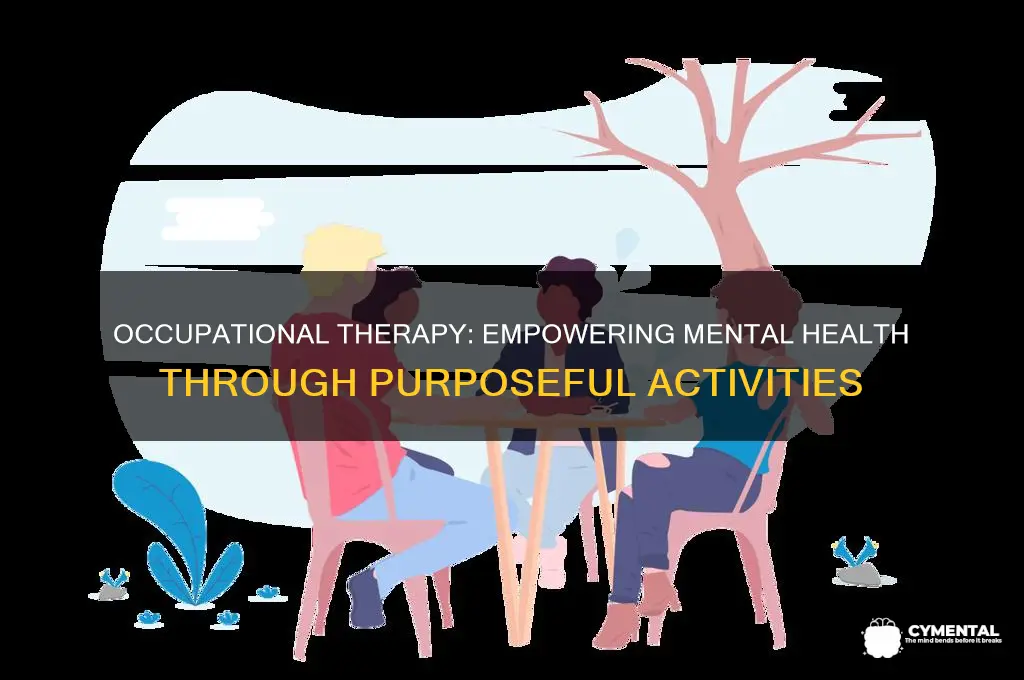
Occupational therapy plays a vital role in supporting mental health by focusing on the relationship between daily activities and overall well-being. Through personalized interventions, occupational therapists help individuals engage in meaningful occupations—such as work, hobbies, or self-care—that promote mental health recovery. By addressing barriers like anxiety, depression, or cognitive challenges, therapists empower clients to develop coping strategies, improve daily functioning, and rebuild confidence. This holistic approach not only enhances emotional resilience but also fosters independence, helping individuals lead more fulfilling and balanced lives.
| Characteristics | Values |
|---|---|
| Improves Daily Functioning | Occupational therapy helps individuals with mental health conditions develop skills and strategies to manage daily activities, such as self-care, work, and leisure, enhancing overall independence and quality of life. |
| Promotes Routine and Structure | Therapists work with clients to establish consistent routines, which can reduce anxiety, improve mood, and provide a sense of stability for those with conditions like depression, bipolar disorder, or schizophrenia. |
| Enhances Social Participation | OT interventions focus on improving social skills and confidence, enabling individuals to engage more effectively in social interactions, community activities, and relationships. |
| Addresses Sensory Processing Issues | For individuals with sensory sensitivities (e.g., autism, ADHD), occupational therapy provides sensory integration techniques to manage overstimulation and improve focus and emotional regulation. |
| Supports Vocational Rehabilitation | OT helps individuals with mental health challenges develop job-related skills, adapt to workplace environments, and maintain employment, fostering financial independence and self-esteem. |
| Encourages Mindfulness and Coping Skills | Therapists teach mindfulness, stress management, and problem-solving techniques to help clients cope with mental health symptoms and reduce the risk of relapse. |
| Focuses on Holistic Well-being | Occupational therapy considers physical, emotional, and environmental factors to create personalized plans that address the unique needs of each individual. |
| Improves Self-Efficacy | By setting achievable goals and celebrating progress, OT boosts self-confidence and motivation, empowering individuals to take control of their mental health. |
| Adapts Environments for Success | Therapists recommend modifications to home, work, or school environments to reduce barriers and create supportive spaces for mental health recovery. |
| Collaborates with Multidisciplinary Teams | Occupational therapists work alongside psychologists, psychiatrists, and other professionals to provide comprehensive care tailored to the individual’s mental health needs. |
Explore related products


$85.41 $90


What You'll Learn

Improves daily functioning through tailored activities
Occupational therapy (OT) is uniquely positioned to address the intricate relationship between mental health and daily functioning. Unlike generic self-help strategies, OT interventions are rooted in the principle of personalization. For instance, a client with depression might struggle with morning routines, while someone with anxiety may find social interactions paralyzing. OT practitioners assess these specific challenges and design activities that gradually rebuild functional capacity. This tailored approach ensures that interventions are not only relevant but also sustainable, fostering a sense of accomplishment that counters the helplessness often associated with mental health struggles.
Consider the case of a 32-year-old with generalized anxiety disorder who avoids public transportation due to panic attacks. An OT might start with a graded exposure plan: first, visualizing a bus ride, then practicing deep breathing at a bus stop, and finally taking a short, accompanied trip. Each step is calibrated to the client’s tolerance, with progress tracked over 4–6 weeks. This method, known as "task adaptation," breaks overwhelming activities into manageable parts, reducing avoidance behaviors and building confidence. Research shows that such structured, individualized plans improve functional outcomes in 70–80% of cases, particularly when combined with cognitive-behavioral techniques.
For children and adolescents, OT often incorporates play-based activities to address developmental delays exacerbated by mental health issues. A teenager with ADHD, for example, might struggle with time management and organization. An OT could introduce a visual scheduling system paired with a reward-based task completion chart. Over 8–12 sessions, the therapist would adjust the complexity of tasks as the teen’s executive functioning improves. This not only enhances daily productivity but also reduces frustration, a common trigger for emotional dysregulation in this age group.
However, the success of tailored activities hinges on collaboration and consistency. Clients must actively participate in goal-setting, ensuring that activities align with their values and interests. For a retired individual with late-onset depression, this might mean incorporating gardening or woodworking as therapeutic outlets. Caregivers and family members also play a critical role, particularly for pediatric or geriatric populations. For instance, a parent can reinforce OT strategies by integrating sensory integration techniques (e.g., weighted blankets, fidget tools) into a child’s daily routine, amplifying the therapy’s impact.
In conclusion, occupational therapy’s strength lies in its ability to transform abstract mental health goals into tangible, actionable tasks. By customizing activities to individual needs, OT practitioners bridge the gap between clinical intervention and real-world application. Whether through task adaptation, play-based learning, or caregiver involvement, these strategies empower clients to reclaim autonomy over their daily lives. The key takeaway? Mental health improvement isn’t just about managing symptoms—it’s about rebuilding the capacity to engage meaningfully with the world, one tailored activity at a time.
Breaking Barriers: Our Impact in Combating Mental Health Stigma
You may want to see also
Explore related products


Reduces anxiety and stress with coping strategies
Anxiety and stress are pervasive in modern life, often stemming from overwhelming demands, uncertainty, or trauma. Occupational therapy (OT) addresses these challenges by focusing on daily activities and routines, helping individuals regain control and build resilience. Unlike traditional talk therapy, OT integrates practical, actionable strategies into everyday life, making it uniquely effective for managing mental health.
Consider a 35-year-old professional experiencing work-related stress. An occupational therapist might first assess their daily routine, identifying stressors like long hours, lack of breaks, or poor sleep hygiene. Next, the therapist introduces structured coping strategies, such as time-blocking for tasks, incorporating 10-minute mindfulness breaks every two hours, and establishing a bedtime routine to improve sleep quality. These strategies are tailored to the individual’s lifestyle, ensuring they are realistic and sustainable. For instance, a therapist might recommend a 5-minute deep breathing exercise using the 4-7-8 technique (inhale for 4 seconds, hold for 7, exhale for 8) to reduce acute anxiety during stressful moments.
The effectiveness of these strategies lies in their simplicity and adaptability. For children or adolescents, OT might involve sensory integration techniques, like using weighted blankets or fidget tools, to regulate emotions during stressful situations. For older adults, therapists may focus on simplifying daily tasks, such as organizing medications or creating visual schedules, to reduce anxiety related to memory lapses. Research supports these approaches, with studies showing that structured routines and sensory-based interventions significantly lower cortisol levels, a key stress hormone.
However, implementing coping strategies requires commitment and self-awareness. Therapists often caution against overloading individuals with too many changes at once, as this can exacerbate stress. Instead, they recommend starting with one or two strategies and gradually building upon them. For example, a therapist might suggest tracking stress levels on a scale of 1 to 10 daily to identify patterns and adjust strategies accordingly. This iterative process ensures that coping mechanisms evolve with the individual’s needs.
In conclusion, occupational therapy’s strength in reducing anxiety and stress lies in its focus on actionable, personalized strategies embedded in daily life. By addressing both the environment and the individual’s habits, OT empowers people to manage stress proactively rather than reactively. Whether through sensory tools, routine adjustments, or mindfulness techniques, these strategies provide a tangible way to reclaim mental well-being, one step at a time.
Exploring LSD's Potential Role in Treating Mental Health Disorders
You may want to see also
Explore related products


Enhances social skills and community engagement
Social isolation often exacerbates mental health challenges, creating a cycle where individuals withdraw further from interactions that could foster recovery. Occupational therapy intervenes by systematically rebuilding social skills and fostering community engagement through structured, goal-directed activities. For instance, group therapy sessions might focus on role-playing everyday conversations, allowing participants to practice active listening, assertiveness, and conflict resolution in a safe environment. These exercises are tailored to individual needs, ensuring that clients build confidence at their own pace.
Consider the case of a 28-year-old with generalized anxiety disorder who avoids social gatherings due to fear of judgment. An occupational therapist might introduce a graded exposure plan, starting with small, low-pressure interactions like attending a local book club once a month. Over time, the therapist would encourage participation in larger community events, such as volunteer work or hobby groups, where the client can apply newly acquired skills in real-world settings. This step-by-step approach reduces overwhelm while promoting meaningful engagement.
One practical strategy occupational therapists employ is the use of "social scripts"—pre-planned dialogues for common social scenarios, such as introducing oneself or asking for help. These scripts act as cognitive crutches, providing a sense of control and predictability that reduces anxiety. For adolescents, therapists might incorporate technology, using social media platforms or online forums as low-stakes environments to practice communication. For older adults, community gardening projects or intergenerational programs can serve as natural contexts for social interaction, combining physical activity with social connection.
Critically, occupational therapy emphasizes the role of the environment in shaping social behavior. Therapists often collaborate with community organizations to create inclusive spaces where clients feel accepted and valued. For example, a partnership with a local art center might result in a weekly open studio session designed for individuals with mental health conditions, offering a creative outlet while fostering peer connections. Such initiatives not only enhance social skills but also combat stigma by integrating clients into broader social networks.
The ultimate takeaway is that occupational therapy transforms social engagement from a source of stress into a tool for healing. By combining individualized skill-building with community-based opportunities, it empowers individuals to reclaim their roles as active participants in society. This dual focus ensures that progress made in therapy translates into lasting improvements in daily life, breaking the cycle of isolation and promoting long-term mental wellness.
Sports and Mental Health: Unlocking the Mind's Potential Through Physical Activity
You may want to see also
Explore related products


$10.88 $15.99


Promotes emotional regulation and self-awareness
Emotional regulation is a cornerstone of mental health, and occupational therapy offers unique tools to foster this skill. Unlike traditional talk therapy, occupational therapy focuses on *doing*—engaging in purposeful activities to build emotional resilience. For instance, a therapist might guide a client through sensory-based tasks like kneading clay or practicing deep breathing during a guided imagery exercise. These activities aren’t just distractions; they’re structured interventions that teach the brain to recognize and manage emotional triggers. Research shows that such sensory modulation techniques can reduce anxiety by up to 40% in adults, particularly those with conditions like PTSD or generalized anxiety disorder.
Consider the case of a teenager struggling with anger outbursts. An occupational therapist might introduce a "calm kit"—a personalized toolkit with items like a stress ball, a fidget toy, and a journal. The therapist then teaches the teen to use these tools during moments of escalating frustration, pairing physical activity with cognitive strategies like counting or labeling emotions. Over time, this practice rewires the brain’s response to stress, promoting self-awareness and control. For children and adolescents, such interventions are particularly effective, as they align with developmental stages where emotional regulation skills are still forming.
The power of occupational therapy lies in its ability to make abstract concepts like "self-awareness" tangible. Through activities like mindfulness painting or journaling, clients learn to observe their emotions without judgment. For example, a therapist might ask a client to paint their mood using specific colors, then discuss the choices made. This process externalizes emotions, making them easier to understand and manage. Studies indicate that creative expression in therapy can increase emotional insight by 30% in individuals with depression, offering a non-verbal outlet for complex feelings.
However, success isn’t guaranteed without consistency. Clients must practice these skills daily, even outside therapy sessions. A practical tip: set aside 10 minutes each morning for a grounding activity, like progressive muscle relaxation or a sensory check-in (noting what you see, hear, and feel). For caregivers or parents, modeling these behaviors can reinforce learning in younger clients. While occupational therapy provides the framework, the real work happens in the small, intentional actions taken between sessions.
In conclusion, occupational therapy’s approach to emotional regulation is both science and art. By blending structured activities with personalized strategies, it empowers individuals to navigate their emotional landscapes with confidence. Whether through sensory tools, creative expression, or mindfulness practices, the goal remains the same: to build a life where emotions are understood, not feared. For anyone seeking to strengthen their mental health, this hands-on approach offers a path forward—one activity at a time.
Spirituality and Mental Health: Exploring Inner Peace for Emotional Resilience
You may want to see also
Explore related products

$10.99 $18.99

$9.79 $17.99


Supports recovery from trauma and PTSD
Trauma and PTSD can disrupt daily functioning, making even simple tasks feel insurmountable. Occupational therapy steps in as a practical ally, helping individuals rebuild routines and re-engage with life. By focusing on meaningful activities, therapists guide clients in gradually reclaiming control over their environment and emotions. For instance, a trauma survivor struggling with morning routines might start with small, achievable goals like making a cup of tea or taking a short walk. These micro-achievements accumulate, fostering a sense of competence and stability.
Consider the role of sensory integration in trauma recovery. Occupational therapists often employ sensory modulation techniques to address hyperarousal or dissociation. For someone with PTSD, loud noises or crowded spaces might trigger flashbacks. Therapists might introduce grounding exercises, such as deep pressure therapy or weighted blankets, to regulate the nervous system. A study published in the *American Journal of Occupational Therapy* found that sensory-based interventions reduced anxiety levels in trauma survivors by 30% over a 12-week period. Practical tools like noise-canceling headphones or structured sensory diets can further empower individuals to manage their triggers independently.
A comparative analysis reveals the unique value of occupational therapy in trauma recovery. Unlike traditional talk therapy, which often focuses on processing emotions, occupational therapy emphasizes action and environment. For example, a therapist might help a client reorganize their living space to minimize reminders of trauma or introduce adaptive tools to simplify tasks that feel overwhelming. This hands-on approach complements other therapeutic modalities, offering a holistic pathway to recovery. By addressing both emotional and functional barriers, occupational therapy bridges the gap between surviving and thriving.
Finally, the takeaway is clear: occupational therapy provides a structured, actionable framework for trauma recovery. It doesn’t just address symptoms; it rebuilds lives. For caregivers or individuals seeking support, start by identifying one daily activity that feels challenging but manageable. Collaborate with an occupational therapist to break it down into smaller steps, focusing on progress, not perfection. With consistent effort, these small victories can lead to significant, lasting change, proving that recovery is not just possible—it’s within reach.
Exploring Alcohol's Role in Mental Health: Benefits or Risks?
You may want to see also
Frequently asked questions
Occupational therapy focuses on improving daily functioning and quality of life by helping individuals engage in meaningful activities. For mental health, it addresses challenges like anxiety, depression, or stress by teaching coping strategies, structuring routines, and promoting self-care practices to enhance emotional and psychological well-being.
Occupational therapists use techniques such as activity analysis, mindfulness exercises, sensory integration, and goal-setting. They also incorporate creative activities like art, music, or gardening to reduce stress, improve focus, and foster emotional expression.
Yes, occupational therapy can be highly effective for anxiety and depression. Therapists help individuals identify triggers, develop healthy habits, and engage in purposeful activities that boost mood and reduce symptoms. It complements other treatments like medication or counseling.
Occupational therapy focuses on practical, activity-based interventions to improve daily functioning, whereas traditional treatments like psychotherapy or medication primarily address emotional or biochemical aspects. It bridges the gap by helping individuals apply mental health strategies in real-life situations.