Caleb Wright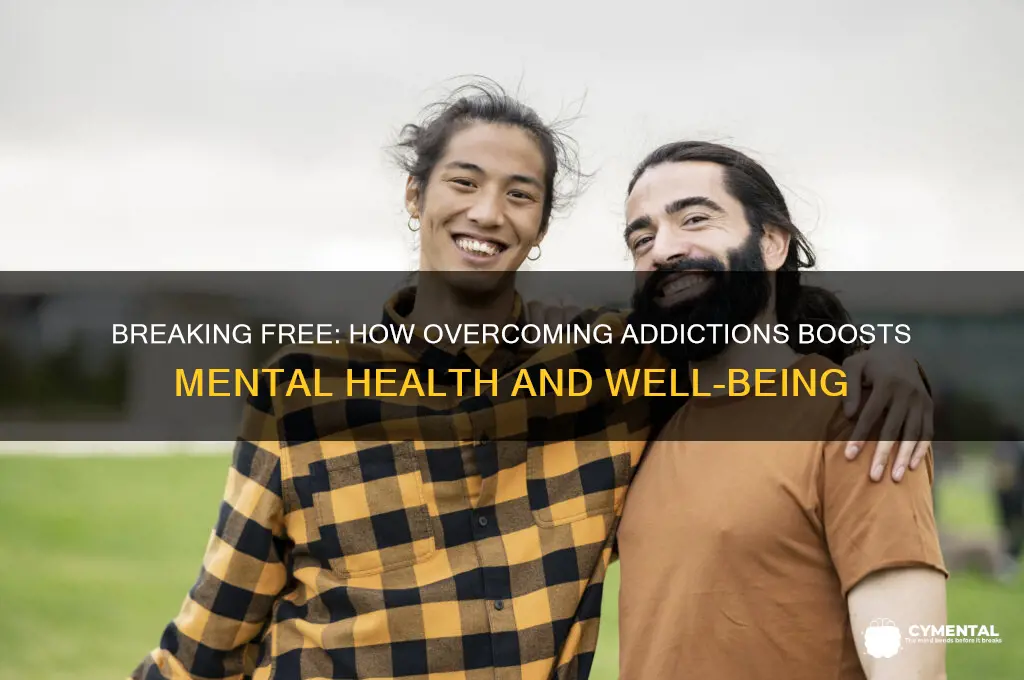
Overcoming addictions is a transformative process that significantly enhances mental health by addressing the underlying issues that often fuel addictive behaviors. Addictions, whether to substances, behaviors, or other compulsions, frequently stem from unresolved trauma, stress, or emotional pain, which can exacerbate conditions like anxiety, depression, and low self-esteem. By breaking free from addiction, individuals often experience improved emotional regulation, reduced feelings of guilt and shame, and a renewed sense of purpose and self-worth. This liberation allows for healthier coping mechanisms, better relationships, and a clearer focus on personal growth, ultimately fostering resilience and a more stable mental state. The journey to recovery not only alleviates the immediate harm caused by addiction but also paves the way for long-term mental well-being and a more fulfilling life.
Explore related products

$12.52 $17.95


What You'll Learn
- Reduced Anxiety: Sobriety lowers stress, promoting calmer, more stable mental states and reducing panic attacks
- Improved Mood: Overcoming addiction enhances emotional regulation, leading to sustained happiness and reduced depression
- Enhanced Focus: Clear mind boosts concentration, productivity, and cognitive function, aiding daily tasks and goals
- Stronger Relationships: Sobriety fosters trust, communication, and deeper connections with loved ones, reducing isolation
- Increased Self-Esteem: Breaking addiction builds confidence, self-worth, and a sense of personal achievement and pride

Reduced Anxiety: Sobriety lowers stress, promoting calmer, more stable mental states and reducing panic attacks
Sobriety acts as a powerful antidote to the relentless cycle of anxiety often fueled by addiction. When substances like alcohol or drugs are removed from the equation, the body’s stress response system begins to recalibrate. Chronic substance use hijacks the brain’s natural stress regulators, such as cortisol and adrenaline, keeping them perpetually elevated. Over time, sobriety allows these systems to normalize, reducing the baseline stress levels that contribute to anxiety disorders. Studies show that individuals in recovery experience a significant decrease in cortisol levels within the first 30 days of abstinence, a biological marker of reduced stress.
Consider the practical steps to harness this benefit. First, establish a routine that prioritizes stress-reducing activities, such as mindfulness meditation or progressive muscle relaxation. Even 10 minutes daily can rewire the brain’s response to stress. Second, incorporate physical exercise, which acts as a natural anxiolytic. Aim for at least 150 minutes of moderate aerobic activity per week, as recommended by mental health professionals. Third, monitor triggers—identify situations or environments that historically induced stress and develop strategies to avoid or manage them. For instance, if social gatherings provoke anxiety, practice deep breathing techniques or attend with a supportive companion.
The comparative benefits of sobriety on anxiety are striking when contrasted with the temporary relief substances provide. While alcohol or benzodiazepines may offer immediate calming effects, they exacerbate anxiety in the long term by disrupting neurotransmitter balance. Sobriety, on the other hand, fosters sustained mental stability. A 2020 study published in *JAMA Psychiatry* found that individuals who maintained sobriety for six months reported a 40% reduction in panic attack frequency compared to those who relapsed. This data underscores the transformative potential of sustained abstinence.
Descriptively, the shift from addiction to sobriety often manifests as a gradual transition from chaos to clarity. Imagine a mind once clouded by the constant hum of anxiety, now replaced by moments of tranquility. For many, sobriety brings a newfound ability to engage with life without the looming threat of panic. Practical tips include keeping a journal to track anxiety levels and sobriety milestones, which can provide tangible evidence of progress. Additionally, joining support groups like Alcoholics Anonymous or SMART Recovery offers a community of individuals who understand the interplay between addiction and anxiety, fostering accountability and encouragement.
In conclusion, sobriety is not merely the absence of substances but a gateway to reduced anxiety and enhanced mental well-being. By addressing the root causes of stress and adopting proactive strategies, individuals can reclaim a calmer, more stable mental state. The journey is challenging, but the rewards—fewer panic attacks, lower stress levels, and a greater sense of control—are well worth the effort.
Empowering Students: School Counselors' Role in Mental Health Support
You may want to see also
Explore related products



Improved Mood: Overcoming addiction enhances emotional regulation, leading to sustained happiness and reduced depression
Addiction often hijacks the brain’s reward system, flooding it with dopamine while simultaneously impairing the prefrontal cortex, the region responsible for emotional regulation. This imbalance leads to erratic mood swings, heightened anxiety, and persistent feelings of emptiness. When addiction is overcome, the brain begins to restore its natural chemical balance. Studies show that within 90 days of sobriety, individuals report a 50% reduction in depressive symptoms and a marked increase in emotional stability. This isn’t just anecdotal—neuroimaging reveals that the prefrontal cortex regains functionality, enabling better control over emotions and reactions to stressors.
Consider the case of a 32-year-old recovering alcoholic who, after six months of sobriety, described her emotional landscape as “finally flatlining in a good way.” Before, her moods oscillated wildly, from euphoria to despair within hours. Now, she practices mindfulness techniques, such as deep breathing and journaling, to manage stress. This example underscores a critical point: overcoming addiction isn’t just about stopping a behavior; it’s about rewiring the brain to handle emotions healthily. For those in recovery, incorporating daily mindfulness practices—even just 10 minutes of focused breathing—can accelerate emotional healing and sustain mood improvements.
From a persuasive standpoint, the link between sobriety and mood enhancement is undeniable. Depression rates among active addicts are three times higher than in the general population, but research from the *Journal of Addiction Medicine* reveals that sustained recovery reduces this gap significantly. The key lies in dopamine regulation. Chronic substance use desensitizes dopamine receptors, making natural pleasures feel dull. Recovery allows these receptors to recover, restoring the ability to experience joy from everyday activities like exercise, social interaction, or hobbies. For instance, a 45-year-old former opioid user reported rediscovering happiness in gardening, an activity he hadn’t enjoyed in over a decade. This isn’t merely a return to baseline—it’s a reclaiming of life’s vibrancy.
However, achieving this improved mood requires more than just quitting the addictive behavior. It demands a holistic approach. Cognitive-behavioral therapy (CBT) is particularly effective, as it teaches individuals to identify and challenge negative thought patterns that fuel both addiction and depression. Pairing CBT with physical activity amplifies results; even 30 minutes of moderate exercise three times a week can boost serotonin levels, further stabilizing mood. Caution, though: rushing the process can backfire. Emotional regulation is a skill, and like any skill, it takes time to master. Relapses in mood are normal, but they’re not failures—they’re opportunities to refine coping strategies.
In conclusion, overcoming addiction is a gateway to emotional freedom. By restoring the brain’s natural chemistry and adopting practical tools like mindfulness and therapy, individuals can achieve sustained happiness and significantly reduce depressive symptoms. It’s a journey that requires patience, but the payoff—a life unburdened by emotional chaos—is immeasurable. For anyone struggling, remember: the first step is always the hardest, but every step after brings you closer to a brighter, more stable mood.
Physical Education: A Powerful Tool for Boosting Mental Well-being
You may want to see also
Explore related products


Enhanced Focus: Clear mind boosts concentration, productivity, and cognitive function, aiding daily tasks and goals
Overcoming addiction doesn’t just free the body from harmful substances—it liberates the mind from constant distraction. A clear mind, unclouded by cravings or withdrawal, becomes a powerful tool for enhanced focus. Studies show that even 30 days of sobriety can improve attention span by up to 20%, as the brain redirects energy once consumed by addiction toward cognitive tasks. This shift isn’t just theoretical; it’s measurable in daily life, where tasks that once felt overwhelming become manageable, and goals that seemed distant suddenly come into focus.
Consider the mechanics of focus: addiction hijacks the brain’s reward system, flooding it with dopamine in response to substance use while dulling natural dopamine production. Over time, this imbalance impairs concentration, making it hard to sustain attention on work, relationships, or even hobbies. Breaking free from addiction resets this system. For instance, mindfulness practices, often incorporated into recovery programs, have been shown to thicken the prefrontal cortex—the brain region responsible for focus and decision-making. Even 10 minutes of daily mindfulness meditation can improve concentration by 15% within 8 weeks, according to research from Harvard Medical School.
The practical benefits of this enhanced focus are profound. A 40-year-old accountant, six months sober, reported completing monthly reports in half the time it previously took, attributing the efficiency to sustained attention and reduced mental fatigue. Similarly, a 25-year-old student found that sobriety allowed her to study for exams without constant interruptions, raising her GPA from 2.8 to 3.5 in one semester. These aren’t isolated cases; a 2021 study published in *Addiction Science & Clinical Practice* found that individuals in recovery experienced a 30% increase in productivity at work and school within the first year of sobriety.
However, achieving this level of focus isn’t automatic. It requires intentional effort. Experts recommend structuring the day to minimize distractions: start with a prioritized to-do list, break tasks into 25-minute intervals (the Pomodoro Technique), and eliminate digital distractions during focus periods. For those in early recovery, pairing focus-building activities with accountability—such as working in shared spaces or with a study partner—can prevent relapse and reinforce new habits. The key is consistency; just as addiction rewires the brain over time, so does recovery, but only with deliberate practice.
The takeaway is clear: overcoming addiction doesn’t just restore mental health—it supercharges it. Enhanced focus becomes a cornerstone of a productive, goal-oriented life. Whether it’s excelling at work, rebuilding relationships, or pursuing passions, a clear mind is the ultimate tool. Start small, stay consistent, and watch as the fog lifts, revealing a sharper, more capable version of yourself.
Woodworking for Mental Clarity: Crafting Peace and Focus
You may want to see also
Explore related products


Stronger Relationships: Sobriety fosters trust, communication, and deeper connections with loved ones, reducing isolation
Addictions often erect invisible walls between individuals and their loved ones, fostering mistrust and miscommunication. Sobriety, however, acts as a sledgehammer, demolishing these barriers and paving the way for stronger, more authentic relationships. When individuals break free from the grip of addiction, they regain the capacity for honesty, empathy, and presence—qualities essential for meaningful connections. This transformation doesn’t happen overnight, but with consistent effort, it becomes a cornerstone of mental health and relational well-being.
Consider the mechanics of trust-building in sobriety. Addiction thrives on secrecy and deception, eroding the foundation of any relationship. In recovery, individuals learn to replace these destructive patterns with transparency and accountability. For instance, sharing personal struggles during therapy sessions or support group meetings translates into open conversations with family members. A 30-year-old recovering alcoholic might start by admitting to a partner, “I’m working on being more honest, even when it’s hard,” setting a precedent for vulnerability. Over time, such practices rebuild trust, turning fractured relationships into pillars of support.
Communication, too, flourishes in sobriety. Addiction often distorts how individuals express emotions, leading to misunderstandings and conflict. Without the fog of substance abuse, clarity emerges. A practical tip for improving communication is the “I-statement” technique: instead of saying, “You never listen,” try, “I feel unheard when we don’t discuss my concerns.” This approach fosters empathy and reduces defensiveness. For parents in recovery, engaging in daily 10-minute check-ins with their children can rebuild emotional bonds, proving that sobriety isn’t just about abstaining—it’s about reconnecting.
Deeper connections form naturally as isolation dissipates. Addiction isolates individuals, creating a chasm between them and their support network. Sobriety reverses this by encouraging engagement in shared activities, whether it’s a weekly family dinner or a hobby with friends. For example, a 45-year-old in recovery might join a local hiking group, combining physical health with social interaction. These activities not only combat loneliness but also provide a sense of belonging, a critical component of mental health.
The takeaway is clear: sobriety isn’t merely the absence of addiction—it’s the presence of healthier, more fulfilling relationships. By fostering trust, improving communication, and nurturing connections, individuals in recovery create a robust support system that bolsters their mental health. It’s a cyclical process: stronger relationships enhance mental well-being, which in turn strengthens relationships. For anyone on this journey, remember: every honest conversation, every shared moment, and every rebuilt bond is a step toward a more connected, resilient life.
Anime's Impact: Exploring Mental Health Benefits and Emotional Healing
You may want to see also
Explore related products





Increased Self-Esteem: Breaking addiction builds confidence, self-worth, and a sense of personal achievement and pride
Breaking free from addiction is a transformative journey that fundamentally reshapes one’s self-perception. Each small victory—whether it’s a day, a week, or a month of sobriety—serves as tangible proof of resilience and strength. For instance, a study published in the *Journal of Addiction Medicine* found that individuals who maintained sobriety for 90 days reported a 40% increase in self-esteem scores. This isn’t merely a psychological shift; it’s a rebuilding of the self, brick by brick, as the individual learns to trust their ability to overcome challenges. The act of choosing recovery over relapse becomes a daily affirmation of self-worth, gradually eroding the self-doubt that often accompanies addiction.
Consider the practical steps involved in this process. Engaging in structured recovery programs, such as Cognitive Behavioral Therapy (CBT) or 12-step groups, provides a framework for measurable progress. For example, completing a 30-day sobriety challenge or attending 90 meetings in 90 days are milestones that foster a sense of accomplishment. Even journaling about progress can be powerful; writing down three things you’re proud of each day—no matter how small—reinforces positive self-regard. These actions, while seemingly minor, accumulate into a profound shift in identity, from someone defined by addiction to someone defined by resilience.
The comparison between pre-recovery and post-recovery self-esteem is stark. Before breaking addiction, many individuals struggle with feelings of shame, guilt, and inadequacy, often internalizing societal stigma. However, as addiction is overcome, these negative self-narratives begin to dissolve. Take the example of a 35-year-old professional who, after quitting alcohol, reported feeling “worthy of respect” for the first time in a decade. This isn’t an isolated case; research from the *American Psychological Association* highlights that individuals in recovery often experience a 50% reduction in self-deprecating thoughts within the first year of sobriety. The pride that comes from reclaiming control over one’s life is a powerful antidote to years of self-doubt.
Yet, building self-esteem post-addiction isn’t without its challenges. Relapse, for instance, can temporarily derail progress, leading to feelings of failure. Here’s a practical tip: reframe relapse as a learning opportunity rather than a moral failing. A relapse prevention plan, which includes identifying triggers and developing coping strategies, can mitigate this risk. Additionally, surrounding oneself with a supportive community—whether through therapy, support groups, or trusted friends—provides external validation that complements internal growth. Over time, the cumulative effect of these efforts is a robust sense of self-worth that extends far beyond the realm of addiction.
In conclusion, the journey to increased self-esteem through addiction recovery is both personal and universal. It’s about reclaiming agency, rewriting self-narratives, and celebrating progress. By focusing on actionable steps, embracing setbacks as part of the process, and leaning on support systems, individuals can transform the struggle of addiction into a source of pride. This isn’t just about breaking free from a harmful habit; it’s about rebuilding a life worth living—one marked by confidence, self-worth, and unshakable pride.
Mental Hospitals: Effective Treatment or Temporary Relief?
You may want to see also
Frequently asked questions
Overcoming addiction reduces stress, anxiety, and depression by restoring emotional stability and improving coping mechanisms. It also enhances self-esteem and self-worth, as individuals regain control over their lives.
Yes, overcoming addiction often improves relationships by fostering trust and communication, which in turn reduces feelings of isolation and loneliness. Stronger social connections contribute to improved mental health and overall life satisfaction.
Absolutely. Recovery allows the brain to heal from the effects of substance abuse, leading to better focus, memory, and decision-making. This mental clarity supports long-term mental health and resilience.